


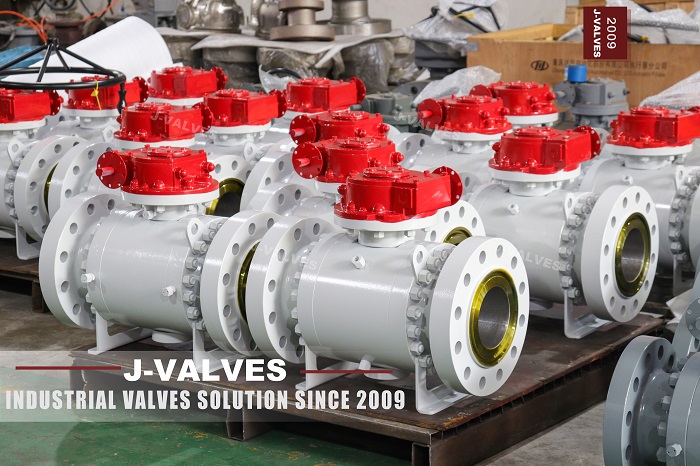
In the oil and gas pipeline transportation and process industries, selecting the right large-diameter, high-pressure ball valve is critical to operational safety and cost efficiency. This article provides a comprehensive technical analysis of the 9-inch (NPS 9) Class 900 ASTM A105 forged carbon steel trunnion-mounted ball valve—a non-standard size product that delivers significant engineering advantages when properly specified and applied.
1. Understanding Trunnion-Mounted Ball Valve Design
Ball valves are broadly classified into two categories based on ball support mechanisms: floating ball and trunnion-mounted ball designs. For a 9-inch (DN225) valve operating at Class 900 pressure, a floating ball design would be impractical—the media pressure acting directly on the ball would generate excessive operating torque, cause uneven seat wear, and potentially deform the ball itself under high-pressure conditions.
The trunnion-mounted design, as specified in API 6D, supports the ball at both ends using fixed trunnion shafts. This means the line pressure is absorbed by the trunnion shafts rather than the seats and stem. The key advantages of this design include:
Reduced Operating Torque: Trunnion-mounted valves typically require only one-third to one-half the torque of equivalent floating ball valves, simplifying manual operation and reducing actuator sizing requirements.
Uniform Sealing: Because the ball does not shift under media pressure, seat sealing forces remain evenly distributed, extending seat life and improving long-term reliability.
Large-Diameter Suitability: API 6D recommends trunnion-mounted construction for pipeline ball valves NPS 6 and above, ensuring both performance and cost-effectiveness at larger sizes.
Double Block & Bleed (DBB): The trunnion design enables dual independent seat seals with a body cavity that can be independently vented, fulfilling the DBB functional requirements defined in API 6D.
2. ASTM A105 Forged Carbon Steel: Material Properties and Limitations
The valve body of the 9-inch Class 900 trunnion ball valve is manufactured from ASTM A105 forged carbon steel. ASTM A105, established by ASTM International, is the standard specification for carbon steel forgings used in piping applications, including flanges, fittings, and valve pressure-containing parts.
The chemical composition of A105 is carbon-based, with carbon content limited to 0.35%, manganese ranging from 0.60% to 1.05%, and strict limits on phosphorus (≤ 0.040%) and sulfur (≤ 0.050%) to ensure forging quality and soundness. Mechanically, A105 requires a minimum tensile strength of 485 MPa (70 ksi), yield strength of 250 MPa (36 ksi), elongation of 22% minimum in 2 inches, and a maximum Brinell hardness of 187 HB.
Material Selection Guidance: ASTM A105 is suitable for temperatures ranging from -29°C to +200°C (-20°F to +392°F) and for media compatible with carbon steel (oil, gas, water, etc.). For sub-zero applications below -29°C, ASTM A350 LF2 (low-temperature forged steel) should be specified. For sour service containing H₂S, the material must comply with NACE MR0175 / ISO 15156 requirements for sulfide stress cracking resistance.
3. Class 900 Pressure Rating and ASME B16.34 Temperature-Pressure Limits
Class 900 is a mid-to-high pressure rating within the ASME pressure-temperature rating system. According to ASME B16.34 (Valves—Flanged, Threaded, and Welding End) Group 1.1 material group, which covers carbon steel, the rated working pressure for A105 at ambient temperature is 1,500 psi (approximately 10.34 MPa), decreasing to approximately 1,305 psi (9.0 MPa) at 200°C (392°F).
It is important to note that ASME B16.34 ratings represent the maximum allowable working pressure at standard reference temperatures. In actual engineering design, additional considerations must include corrosion allowance, temperature derating factors, and appropriate safety margins. For the flanged connection dimensions, ASME B16.5 governs the NPS 9 Class 900 flange: the flange outside diameter is 660 mm, with 16 bolt holes sized at 1-1/8 inch and a bolt circle diameter of 578 mm.
4. DBB Functionality and API 6D Compliance
The API 6D standard defines Double Block and Bleed (DBB) valves as those that, in the closed position, provide a seal between the ball and both the upstream and downstream seats simultaneously, while the body cavity (the space between the ball and seats) can be independently vented through a dedicated bleed valve. This functionality is essential in pipeline maintenance, metering station isolation, and pipeline pigging operations.
The 9-inch Class 900 A105 trunnion ball valve achieves DBB functionality through spring-loaded metal seated design: when the valve is closed, line pressure pushes the seat ring toward the ball to form a seal. When maintenance is required, the operator closes the valve, opens the body cavity bleed valve, and if media continues to escape from the vent, it indicates a seat seal failure that requires immediate attention.
In addition to API 6D, the valve also complies with ISO 14313 (the international equivalent of API 6D), ensuring standard compatibility for projects in European, Middle Eastern, and Asian markets.
5. Fire Safety Design and Emergency Sealant Injection System
Fire safety is a critical consideration in oil and gas pipeline and refinery applications. The 9-inch Class 900 trunnion ball valve is designed in accordance with API 607 (Fire Test for Soft-Seated Quarter-Turn Valves). In the event that the primary elastomeric or polymer seat materials (PTFE, PEEK) are destroyed by fire, the ball directly contacts the metal seat to form a secondary metal-to-metal seal. The API 607 fire test requires the valve to maintain specified leakage limits both during a 30-minute high-temperature burn and after cooling to ambient temperature.
Additionally, emergency sealant injection connections are provided at the stem and seat areas. If stem packing or valve seats develop unexpected leakage during operation, sealant can be injected through these connections to achieve a temporary seal repair, providing a critical time window to schedule planned maintenance shutdown.
6. Testing and Quality Assurance
Every 9-inch Class 900 A105 trunnion ball valve undergoes factory testing per API 598 (Valve Inspection and Testing), including:
Shell (Body) Hydrostatic Test: Test pressure at 1.5× rated pressure (22.5 MPa / 3,265 psi), held for minimum 60 seconds. No visible leakage or structural deformation is permitted.
High-Pressure Seat Seal Test: Test pressure at 1.1× rated pressure (16.5 MPa / 2,393 psi), verifying seat seal integrity at full rated pressure.
Low-Pressure Seat Seal Test: Test pressure at 0.55–0.70 MPa (80–100 psi), verifying seat sealing at low differential pressure—a critical validation for resilient and metal seats alike.
Stem Low-Emission Test: Verifying stem packing seal reliability in compliance with ISO 15848-2 fugitive emission standards.
Critical pressure-containing forgings also undergo non-destructive examination (NDE), including magnetic particle testing (MT), liquid penetrant testing (PT), and ultrasonic testing (UT), with acceptance criteria per ASME BPVC and ASME B16.34 .
7. Applications and Specification Guidance
The 9-inch Class 900 A105 trunnion ball valve is ideally suited for the following applications:
Natural Gas Transmission Pipeline Stations: The 9-inch size is commonly used for station branch lines and bypass piping. Class 900 rating handles high pipeline pressures, and the trunnion design ensures long-term operational reliability.
Crude Oil Gathering Stations: Metal-seated construction provides superior resistance to particulate erosion in crude oil containing impurities and solids.
Refinery Process Piping: Suitable for non-corrosive process media requiring high-pressure isolation and bleed-down capability.
Oil Storage and Metering Stations: DBB functionality meets the double-isolation requirements for metering maintenance and storage tank farm isolation.
Offshore Platform Process Lines: Gear-operated design saves operating space, and additional external coatings can be applied for salt spray corrosion protection.
When specifying this valve, engineers should pay particular attention to: whether the service medium contains H₂S (requiring NACE MR0175 certification), the minimum operating temperature (requiring low-temperature A350 LF2 material if below -29°C), fire safety certification requirements (API 607), end connection type (flanged vs. butt-weld), and actuation method (manual gear / electric / pneumatic).
8. Why 9-Inch Is a Non-Standard Size—and Why That Matters
In both the ASME flange standard (B16.5) and the API 6D pipeline valve size series, NPS 8 and NPS 10 are standard, commonly available sizes. NPS 9 is a non-standard size that falls between these two. When a pipeline is designed at NPS 9, using a standard 8-inch or 10-inch valve with reducer fittings introduces additional weld joints, pressure drop losses, and potential leak paths. Specifying a 9-inch valve directly eliminates the need for reducers, simplifying the piping design and reducing overall project cost, installation time, and risk.
Conclusion
The 9-inch Class 900 ASTM A105 trunnion-mounted ball valve is a technically mature, well-standardized high-pressure pipeline isolation valve. Backed by the API 6D design standard, ASTM A105 forged steel material, ASME B16.34 pressure-temperature ratings, API 607 fire safety certification, and NACE MR0175 sour service qualification, this product delivers reliable performance across a wide range of demanding oil and gas applications. Proper specification, rigorous factory testing, and adherence to international standards are the foundations of ensuring long-term valve reliability in severe service conditions.
For complete technical datasheets, API 6D compliance certificates, and quotation details for the 9-inch 900LB A105 trunnion ball valve, please contact us for professional technical support.


