CHINA J-VALVES Offers Various High-quality I ndustrial Ball Valves
J-VALVES, a distinguished professional ball valve manufacturer rooted in China, takes pride in its extensive product portfolio. Our offerings span a wide range, including trunnion-mounted ball valves, floating ball valves, high-temperature ball valves, high-pressure ball valves, metal-sealed ball valves, ultra-low temperature ball valves, DBB ball valves, Three-way And Four-way Ball Valve, and fully welded ball valves. Each product is a testament to our commitment to precision engineering and reliable performance. Meticulously crafted, they are designed to not only meet but exceed the most stringent industrial demands, ensuring stable operation even under extreme conditions. This enables us to provide our clients with high-value services and makes our valves widely sought-after in industries.
Product Category
Contact Us


-
J-VALVES-Q47F
-
J-VALVES
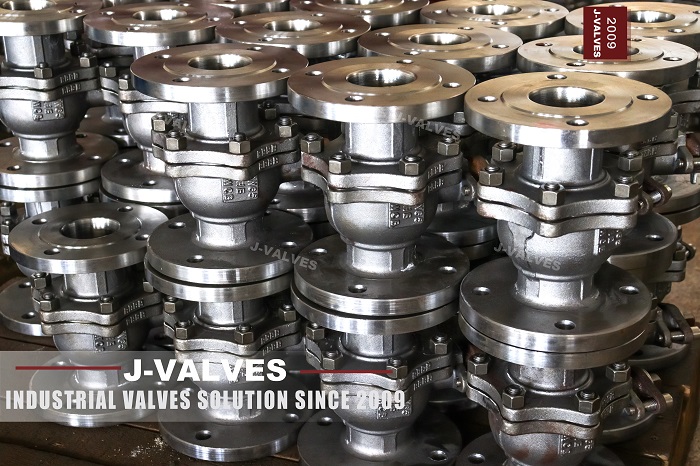
Overview of the J-VALVES 6 Inch Class 900 Three Piece Trunnion Ball Valve
This is a 6 inch (DN150) flanged ball valve built to API 6D at Class 900, which the same standard also designates PN 150. The body is forged ASTM A182 F316, split into three bolted  pieces so the centre section carrying the ball, seats and stem lifts out while both end caps stay on the pipe flanges. The ball is carried on upper and lower trunnions rather than resting on the seats, and the bore is full at the 150.0 mm minimum that API 6D Table 1 sets for this size and class.At the Class 900 rating a 150 mm bore puts roughly 263 kN on the seat face, about 26 tonnes, and a floating ball would transfer that load into the stem and the seat. The trunnion bearings take it instead, so the stem sees torque only and the seat sees a controlled spring load plus whatever the line pressure adds. The trunnion decision at 6 inch therefore follows class, not diameter: the same size at Class 300 is often built with a floating ball, and at Class 900 it cannot be.
F316 is specified for the medium, not for the pressure. The 2 to 3 per cent molybdenum addition lifts the pitting resistance equivalent number to about 25, against roughly 18 for 304, which holds chloride pitting and crevice attack in check in chemical, produced water and sour service. It also has no ductile to brittle transition, so the body itself is rated down to -196 C. What it does not do is survive continuous seawater immersion; that is super duplex or 6Mo territory.
Typical duty is high pressure gas metering and custody transfer, HP steam, aggressive chemical and petrochemical streams, sour service inside ISO 15156 limits, and LNG send-out where a PEEK or metal seat is fitted.
Design and Construction
The body is three pieces: two end caps, each carrying one flange, bolted to a centre section that holds the ball, both seats, the stem and the trunnion bearings. To service the valve the two body joints are opened; the end caps stay bolted to the pipe flanges and the centre section comes out as a unit. Nothing is cut, re-welded or spread, which is why this construction is chosen where the pipe cannot be pulled apart or the valve sits in a congested rack.
The price of that access is two pressure joints instead of one. A two piece valve has a single body joint and one gasket; this one has two spiral wound gaskets and two bolt rings, and both must be re-torqued to the specified sequence after any intervention. They are rated for the full Class 900 pressure, but they depend most on assembly discipline, so gaskets are renewed rather than reused and bolt torque is recorded.
At 6 inch and above the trunnion bearings sit in separate bearing blocks rather than being bored directly into the body. In a three piece valve this matters more than in a two piece: the two blocks are machined as a pair, and the centre section is the only thing holding the upper and lower bearing bores coaxial once the end caps come off. If the blocks are swapped or a joint face is damaged, the ball stops turning freely and the torque climbs.
The ball is F316 with electroless nickel, running between two metal backed self-lubricating bearings. The stem is 17-4PH, independent of the ball and therefore free of the side load, with a blow-out proof shoulder retained by the body to API 6D, two O-rings plus a graphite gland ring as a triple barrier, and an anti-static path from stem to ball to body. Both seats are spring energised single piston effect rings, so the body cavity relieves to the lower pressure side instead of needing an external relief device, and a seat sealant injection fitting is standard at this size.

Material Options
The standard build is forged F316 through the wetted path. F316L is the low carbon alternative where the body will be welded or the finished part cannot be solution annealed again; it carries about 17 per cent less yield and a correspondingly lower rating, so it is not a free substitution. F44 and F904L are the step up for chloride levels that 316 cannot hold.
| Component | Standard Material | Optional Upgrade | Service Notes |
|---|---|---|---|
| Body and end caps | ASTM A182 F316 forged | F316L, F321, F347, F44, F904L | Forged and solution annealed, no cast porosity |
| Ball | ASTM A182 F316 + ENP | Hard chrome, HVOF tungsten carbide, Stellite | ENP 0.05 to 0.10 mm for soft seat duty |
| Stem | 17-4PH stainless | F316 + ENP, Inconel 718 | 17-4PH supplies the hardness the packing runs on |
| Trunnion and bearings | Hardened F316 / 17-4PH, metal backed | Inconel 718 | Bearings take the ball side load, not the stem |
| Seat ring | PTFE or RPTFE | PPL, PEEK, metal with graphite | Soft seat gives bubble tight shut-off to 200 C |
| Seat springs | Inconel 718 | Hastelloy | Holds seat load at low differential pressure |
| Body gasket | Flexible graphite spiral wound, 316 windings | Ring joint gasket for RTJ ends | Renewed at every body joint opening |
| Packing | Flexible graphite with Inconel wire | PTFE for low emission duty | Graphite is the fire safe choice |
| Bolting | ASTM A193 B8M with A194 8M nuts | B7 and 2H for non wetted joints | Stainless bolting avoids a galvanic couple |
A note on the F grades, because catalogues are inconsistent. F316, F316L, F321, F347, F44 and F904L are all ASTM A182 forging grades and each maps to a UNS number. A code such as F236 does not: it is an elastomer compound reference, not a metal. When a data sheet shows an F number with no UNS equivalent, check which attribute row it sits in before assuming it describes the body.
Technical Specifications
| Item | Value |
|---|---|
| Nominal size | 6 inch, DN150 |
| Pressure class | Class 900, PN 150 |
| Bore | Full bore, 150.0 mm minimum per API 6D Table 1 |
| Body construction | Three piece, bolted, centre section removable |
| Body and end caps | ASTM A182 F316 forged |
| Ball | ASTM A182 F316, ENP |
| Stem | 17-4PH |
| Seat | PTFE / RPTFE, spring energised single piston effect |
| End connection | Flanged RF or RTJ, ASME B16.5 Class 900 |
| Flange dimensions | 381 mm OD, 317.5 mm bolt circle, 12 x 1-1/8 in bolts, 55.6 mm thick |
| Face to face | 610 mm, ASME B16.10 long pattern |
| Rating at 38 C | 149 bar, A182 F316 material group |
| Shell test | 224 bar |
| Seat test | 164 bar |
| Temperature range | -46 to 200 C with PTFE seat, -196 to 450 C body only |
| Operator | Worm gear, IP65, lockable |
| Anti-static | Stem to ball to body, 10 ohm or less |
| Certification | EN 10204 3.1 mill certificate per heat |
Two figures deserve a second read. Full bore does not mean the bore equals the pipe inside diameter: it means the valve meets the API 6D Table 1 minimum, which at NPS 6 is 150.0 mm, while a Schedule 40 pipe of the same size has a 154 mm bore. The second is the face to face length: at Class 900, NPS 6 ball valves are 610 mm long, and a valve ordered to another length will not drop into an existing spool.
Standards and Compliance
API 6D is the design basis, and API 608 is not. API 6D carries the requirements that matter on a pipeline block valve: the bore table, double block and bleed, the shell and seat test regime, the anti-static path, the fire safe qualification and the stem blow-out retention. API 608 is the general industrial ball valve standard and does not contain those clauses, so a quotation that lists both is describing one valve to two different design bases.
PN 150 is correct on the nameplate and impossible at the flange. API 6D clause 7.2 lists PN 20, 50, 64, 100, 150 and 250 as its metric designations for Class 150, 300, 400, 600, 900 and 1500, so PN 150 means Class 900 and nothing else. EN 1092-1 has no PN 150: its steps run 100 and then 160. The nearest European rating is PN 160, and it will not bolt to this valve: Class 900 is 381 mm across with a 317.5 mm bolt circle and twelve inch series bolts.
| Requirement | Standard | Supplied |
|---|---|---|
| Design and manufacture | API 6D / ISO 14313 | Yes, primary basis |
| Pressure temperature rating | ASME B16.34 | Yes, material group for F316 |
| Flange dimensions | ASME B16.5 Class 900 | Yes, RF or RTJ |
| Face to face | ASME B16.10 | Yes, 610 mm long pattern |
| Shell and seat test | API 6D and API 598 | Yes, every valve |
| Fire safe | API 607 / ISO 10497 | Yes, certified |
| Fugitive emission | ISO 15848-1 | Yes, on request |
| Sour service | NACE MR0175 / ISO 15156 | Yes within hardness limits |
| Material certificate | EN 10204 3.1 | Yes, per heat |
The rating falls faster on stainless than on carbon steel, which is the figure most data sheets leave out. Class 900 is 153 bar at 38 C for carbon steel and about 149 bar for F316, because the allowable stress of the austenitic group is lower. At 200 C the F316 figure is near 116 bar and at 316 C it is near 91 bar, while a carbon steel valve of the same class would still be at 104 bar. Anyone selecting this valve on the ambient rating alone will oversize the line pressure at temperature.
Manufacturing Process
Bodies, end caps and balls are forged and machined at the J-VALVES plants in Wenzhou and Lishui, on a 15000 square metre base running 40 CNC lathes, 5 machining centres and 8 drilling machines. Forging starts from a billet with a known heat number, is worked in the 1150 to 900 C range, then solution annealed at a minimum of 1040 C and water quenched, which is what ASTM A182 requires and what restores corrosion resistance after hot working. Air cooling does not meet it.
Machining F316 is not machining carbon steel. The alloy work hardens under a dull tool, carries heat poorly and moves when metal is removed, so roughing and finishing are separate operations, inserts are changed on a schedule rather than on failure, and the part is left to settle between the two. On this valve two features decide whether it works: the body joint faces, flat and parallel across both joints, and the coaxiality of the upper and lower trunnion bearing bores.
After machining, every stainless part is degreased, pickled where welds or heat tint are present, and passivated to ASTM A380, then tested for free iron. Skipping that step is invisible at dispatch and shows up two years later as rust spots on a valve that was sold as stainless.

Quality Control and Testing
| Step | What Is Checked | Standard or Acceptance |
|---|---|---|
| Incoming material | Mill certificate, heat number, chemical composition | EN 10204 3.1, ASTM A182 |
| Grade verification | PMI on body, ball and stem | Cr, Ni, Mo within F316 range |
| Forging | Surface and ultrasonic inspection | No laps, seams or internal defects |
| Machining | Joint face flatness, bearing bore coaxiality, face to face | Drawing tolerance, 610 mm |
| Passivation | Free iron and surface condition | ASTM A380, no rust bloom |
| Assembly | Seat torque, ball rotation, bearing fit | Torque within drawing band |
| Shell test | Body joints and gland at 224 bar water | API 6D, 2 minutes, no weeping |
| Seat test | 164 bar each seat, both directions | API 6D, zero visible leakage |
| Final | Breakaway torque, anti-static continuity, marking | Recorded per valve, 10 ohm or less |
The seat test is the one that separates a soft seated valve from a metal seated one. A PTFE seat is accepted on zero visible leakage in both directions; a metal seat is accepted on a permitted rate, which is a different claim and a different price. Breakaway torque is measured on every valve rather than quoted from a table, because the operator and any later actuator are sized from the measured figure with a margin, and because a torque that has drifted upward since the last service is the first sign of seat or bearing wear.

Applications and Industry Service
The valve belongs on high pressure lines where a positive block and a verifiable double block and bleed are required. Gas metering and custody transfer stations use it because the full bore lets a pig pass and the cavity can be bled to prove both seats are holding before a meter run is opened. HP steam headers, boiler feedwater and turbine bypass lines use it where the class rather than the size sets the specification. Chemical and petrochemical plants use the F316 body for chloride bearing streams that would pit a carbon steel valve, and sour gas service uses it inside the hardness and chemistry limits of ISO 15156.
The boundaries are as important as the applications. This is not a seawater valve: 316 handles splash zones and intermittent wetting, but continuous immersion needs super duplex or a 6Mo grade. It is not a slurry valve with a PTFE seat, which would be cut. And it is not cryogenic as built, even though the body is rated to -196 C, because the seat and gasket set decide the low limit.
Installation, Operation and Maintenance
Any orientation works because the seat does not depend on gravity, but the gear operator should end up where a person can stand and turn it, and a valve of this weight needs its own support rather than hanging on the flange bolts. Flange faces are cleaned, a new gasket is used, and the bolts are tightened in a cross pattern; the body joint bolts are not used to pull mismatched flanges together.
To replace a seat, isolate the line, vent and drain both sides, confirm the cavity is depressurised through the drain, then open both body joints and lift the centre section out. Both gaskets are renewed, both seats are replaced as a set, and the joints are closed in a cross pattern to the drawing torque. Seat sealant injection is a temporary measure that buys time to the next shutdown, not a repair, and using it repeatedly hides a seat that should have been changed.
How to Specify and Order
A complete enquiry fits in eight lines: size and class, 6 inch Class 900 or PN 150; design standard, API 6D; bore, full or reduced; body material, A182 F316 with the alternative named if chlorides are severe; seat grade and the temperature it must survive; end connection, RF or RTJ; face to face length, if it goes into an existing spool; operator, gear or actuated with supply details. Add the certification and any third party inspection, and the quotation will compare with the next one.
Standard builds are accepted from one piece, with 2 to 4 weeks for a standard configuration and 4 to 8 weeks for a custom build. Drawings are issued for signature before machining on any valve with a non standard face to face length, a special seat grade or an actuator mounting that has to match an existing bracket.
FAQ
Q: Does PN150 mean the same as Class 900?
A: Yes on an API 6D valve. Clause 7.2 of API 6D lists PN 150 as the metric designation for Class 900, so the two markings describe one rating of about 149 bar at 38 C in F316. What PN 150 does not give you is a European flange: EN 1092-1 steps from PN 100 to PN 160 with nothing between, and a PN 160 flange has a different bolt circle and metric bolts, so it will not bolt to this valve.
Q: Why specify a three piece body instead of a two piece?
A: Because the centre section can be lifted out with both end caps still bolted to the pipe flanges, so seats and ball are replaced without cutting, welding or spreading the line. The cost is a second body joint, which means two gaskets and two bolt rings to control, and a body joint that must be re-torqued to the drawing sequence every time it is opened.
Q: Is the temperature range -29 to 425 C, as the catalogue says?
A: No. That is the metal seated variant. With a PTFE seat this valve runs from about -46 to 200 C; PPL raises the top to about 260 C and PEEK is similar. The F316 body itself has no ductile to brittle transition and is rated to -196 C, but the seat and gasket set decide the limit of the assembled valve, not the body.
Q: Can it be repaired in line while the line is under pressure?
A: No. The three piece body gives access, not pressure isolation. The body joint is part of the pressure boundary, so the line must be isolated, vented, and the cavity drained and confirmed at zero pressure before either joint is opened. Seat sealant injection is a temporary measure to reach the next shutdown, not a substitute for replacing the seats.


Hot Products


News
Ball Valves in A Kraft Pulp Mill: Black Liquor, Green Liquor And The Cost of Choosing The Alloy by Habit
White liquor at pH 14 cracks carbon steel welds, black liquor sets solid below 100 C, green liquor dregs grind seats: alloy choice and torque in a kraft mill.
Read More
Slug Flow And Ball Valves: What Actually Arrives At The Seat
A slug is liquid mass with momentum, not a pressure spike. What changes at the seat, in the cavity and at the actuator when liquid reaches a ball valve.
Read More
Ball Valves in Direct Lithium Extraction: PH 1 Eluate, Gypsum Scale And 438,000 Cycles in Twenty-Five Years
Direct lithium extraction swings valves from pH 1 eluate to pH 12 caustic, 48 column switches a day and gypsum scale. Materials, seats and torque.
Read More
Ball Valves in Geothermal Brine: Silica Scale, Chloride Cracking And The Cooling Trap
Why geothermal brine destroys ball valves: retrograde silica scale, calcite at the flash point, chloride cracking above 60 C and the 250 C seat limit.
Read More