

CHINA J-VALVES Offers Various High-quality I ndustrial Ball Valves
J-VALVES, a distinguished professional ball valve manufacturer rooted in China, takes pride in its extensive product portfolio. Our offerings span a wide range, including trunnion-mounted ball valves, floating ball valves, high-temperature ball valves, high-pressure ball valves, metal-sealed ball valves, ultra-low temperature ball valves, DBB ball valves, Three-way And Four-way Ball Valve, and fully welded ball valves. Each product is a testament to our commitment to precision engineering and reliable performance. Meticulously crafted, they are designed to not only meet but exceed the most stringent industrial demands, ensuring stable operation even under extreme conditions. This enables us to provide our clients with high-value services and makes our valves widely sought-after in industries.
Product Category
Contact Us

Size Range: 1/4 to 4 inch (DN8 to DN100)
Pressure Rating: 1000 WOG (about 69 bar at 20°C)
Body Material: ASTM A351 CF8, CF8M, A216 WCB
Body Type: Three piece, swing out centre section
Ball: Solid SS304 / SS316, hard chrome or ENP
Seat: PTFE, RPTFE, PPL, PEEK
Port: Full port
End Connection: NPT, BSPP, BSPT, DIN 259, DIN 2999
Design Standard: API 608, ASME B16.34
Test Standard: API 598
Temperature Range: -29°C to 180°C PTFE, to 220°C PPL
Operation: Lever, ISO 5211 pad for actuator
-
Q11F-1000WOG
-
J-VALVES
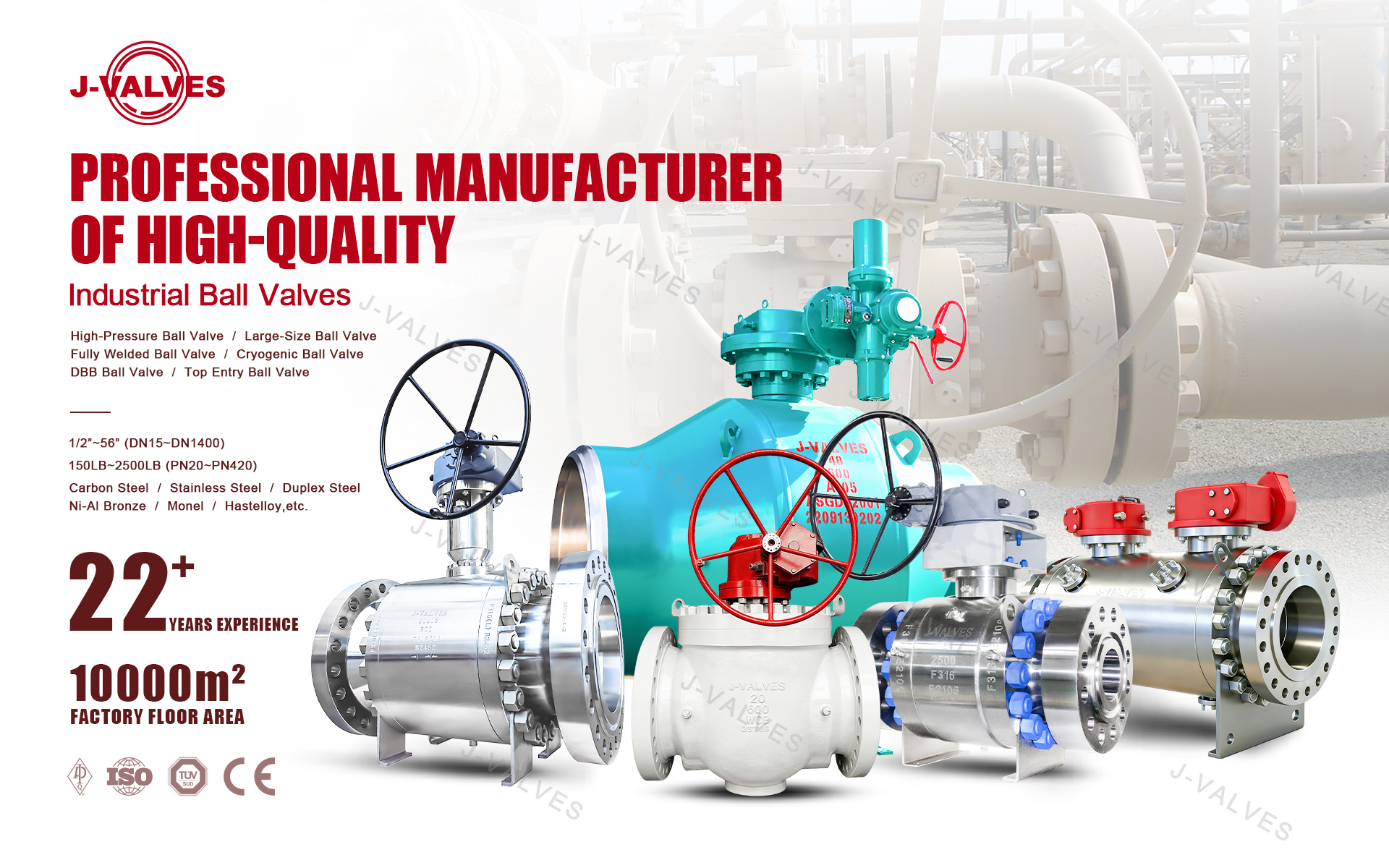
A three piece screwed ball valve is a floating ball valve whose body is split into a centre section and two threaded end caps, so the centre can be swung out and the ball, seats and packing replaced while both pipe ends stay installed. It is rated 1000 WOG, built in CF8 or CF8M from 1/4 to 4 inch, and used wherever a valve has to be serviceable in place: manifolds, skids, dosing lines, instrument air and small process branches.
J-VALVES machines the three body parts as a matched set with a common bore, then assembles them with four through-bolts. Because the parts are matched, a replacement centre section from stock will fit the original end caps only if the casting pattern and the face-to-face dimension are unchanged, which is why the model code and the heat number should be recorded at installation.
What the Third Piece Actually Buys
A two piece valve splits once, and the ball goes in through the downstream end. The pipe on that side has to be disconnected to get the ball out. A three piece valve splits twice, and the centre section drops out between the two end caps, which stay bolted to the pipe. On a 1 inch line with 40 mm of clearance on one side, that is the difference between a 15 minute seat change and a shutdown.
The maintenance sequence is short enough to put in a work instruction: isolate, vent, leave the valve half open, undo the four body bolts, swing the centre out, lift out the seats and ball, inspect the ball for scoring, fit new seats and packing, reassemble to the torque marked on the cap, then leak test at the seat. The pipe does not move, no thread has to be remade, and no sealant has to cure.
That is the whole reason the type exists. Everything else about it is a consequence.
The Cost: Two Static Joints Instead of One
Every body joint is a potential leak path, and a three piece valve has two of them. That is the honest trade, and it shows up in three ways.
| Aspect | 2 piece | 3 piece | What it means on site |
|---|---|---|---|
| Static joints | One | Two | Twice the gasket area to seat correctly |
| Body length | Shorter | Longer for the same bore | Matters on a dense manifold |
| Bolt count | 4 | 4 through-bolts, 8 nuts | Torque sequence has to be even on both ends |
| Repair in line | No | Yes | The reason to pay for it |
| Cost at equal bore | Lower | 10 to 25 percent higher | Recovered on the first seat change |
The joints fail for a predictable reason: uneven bolt torque. The centre section is clamped between two caps, and if one cap is tightened before the other, the gasket on the slack side is loaded unevenly and weeps at the lower edge. The correct sequence is to bring all four bolts up in stages, alternating diagonally across both joints, and to finish at the torque stamped on the cap, usually 20 to 35 Nm for a 1 inch body and 40 to 60 Nm at 3 inch.
The gasket material then decides the temperature. PTFE gaskets are standard and are limited to about 180°C. Above that a graphite laminate is used, and above 250°C the joint should not be a soft gasket at all, which is the point at which a welded or a flanged design becomes the better answer.
Screwed Ends: Four Threads That Do Not Interchange
The thread is the most common source of a returned valve, and almost every case is a mismatch rather than a defect. NPT and BSPT are both tapered and will start to engage, which is exactly why the error survives until the joint is pressure tested.
| Standard | Form | Angle | Seals on | Typical market |
|---|---|---|---|---|
| NPT, ASME B1.20.1 | Taper 1:16 | 60° | Thread flanks, sealant required | North America, oil and gas |
| BSPT, ISO 7-1 | Taper 1:16 | 55° | Thread flanks, sealant required | UK, Middle East, Japan |
| BSPP, ISO 228-1 | Parallel | 55° | Flat face or O-ring, not the thread | Europe, water and pneumatic |
| DIN 2999 / DIN 259 | Taper / parallel | 55° | As BSPT / BSPP in practice | Germany, legacy plant |
Two practical tests settle it before an order is placed. Count the threads per inch: 1/2 inch NPT has 14, 1/2 inch BSP has 14 as well, so count is not enough on its own at small sizes, and the thread angle has to be checked with a gauge at 60° or 55°. At 1 inch and above the counts diverge and a caliper is sufficient.
BSPP is the one that catches people, because it does not seal on the thread at all. It seals on a flat face or an O-ring, so a BSPP valve screwed into a BSPT port will bottom on the thread and still leak. If the port is tapered and the valve is parallel, an adaptor with a bonded washer is the correct fix, not more tape.
1000 WOG and What It Really Means
WOG stands for water, oil, gas, and 1000 WOG means the valve has been rated at 1000 psi on those non-aggressive media at ambient temperature. That is about 69 bar, and it is a cold, clean-fluid rating, not a steam rating and not a rating at 150°C.
| Service | Usable pressure at 20°C | Usable pressure at 150°C | Limit that applies first |
|---|---|---|---|
| Water, 1/4 to 1 inch | 69 bar | 40 bar | Seat creep |
| Water, 2 to 4 inch | 69 bar | 35 bar | Body wall and thread engagement |
| Air and gas | 69 bar | Not recommended above 60°C | Seat extrusion under gas |
| Saturated steam | — | 25 bar with PPL, 40 bar with metal seat | Seat, never the body |
The number to distrust is the headline 1000 psi. A 4 inch screwed body has less wall than a 1/2 inch body, and the thread cuts a groove that reduces the effective section at exactly the point of highest stress. At 4 inch the practical limit for a screwed stainless body in continuous water service is closer to 40 bar, and the 1000 WOG figure should be read as a proof test rather than a working pressure.
Gas service needs a separate note. A soft-seated valve under gas pressure can extrude the seat into the clearance gap when the pressure is released quickly, and the failure looks like a damaged seat rather than an operating error. Slow depressurisation, or a PEEK seat, avoids it.

Where the Three Piece Screwed Valve Belongs
It is the right valve for a line that is small, clean and likely to be opened for maintenance. Typical positions are instrument and impulse lines, analyser sampling, chemical dosing skids, compressed air drops, small cooling water branches, and the isolation point on a pump seal flush. In all of these the valve is cheap relative to the labour around it, and being able to change a seat without a permit is worth more than the price difference.
It is the wrong valve for four situations. Buried lines, because the joints cannot be inspected. Steam above 220°C, because the body joints and the soft seat both reach their limit. Slurry and abrasive service, because the seat pocket fills and the ball scores. And any line where a screwed joint is not permitted at all, which in most refineries means anything above 1 inch in hydrocarbon service, where flanged or welded ends are mandatory.

Installation Details That Decide Service Life
Thread sealant is the first. PTFE tape applied to the first two threads enters the bore and can hold a seat off its seat or jam a small ball. Paste sealant applied to the male thread, leaving the first thread bare, is the safer method, and on stainless-to-stainless joints a nickel-based anti-gallant is worth the extra step because stainless threads gall when tightened dry.
Support is the second. A screwed joint is not a structural connection. A 3 inch valve with a gear operator hanging on a horizontal run puts a bending moment on two threads, and the leak appears at the joint rather than in the body. Support the pipe within 300 mm of the valve on both sides.
Orientation is the third. The centre section swings out on the side away from the pipe, so the valve needs clearance on that side equal to its face-to-face length plus the handle. A valve installed tight against a wall cannot be repaired in line, which removes the only reason it was bought.
FAQ
What is the difference between a 2 piece and a 3 piece ball valve?
A two piece body splits once and the ball is inserted through one end, so the pipe on that side has to be disconnected to service it. A three piece body splits twice and the centre section lifts out between two end caps that stay on the pipe, so the seats and ball can be replaced in line. The three piece has one more static joint and costs 10 to 25 percent more.
Can a BSPP valve be fitted to a BSPT port?
No, not reliably. BSPP is parallel and seals on a flat face or an O-ring, while BSPT is tapered and seals on the thread flanks. A parallel male thread in a tapered port bottoms before the faces meet and leaks. Use an adaptor with a bonded washer, or fit the correct thread.
What does 1000 WOG mean in bar?
About 69 bar at ambient temperature on water, oil or gas. It is not a steam rating and it derates with temperature and size. At 4 inch in hot water the practical continuous limit is nearer 40 bar, set by the body wall at the thread and by seat creep rather than by the headline figure.
Can the centre section be replaced on its own?
Yes, if the casting pattern and face-to-face dimension are unchanged. The three parts are machined as a matched set, so a centre from a different production batch may not align with older end caps. Record the model code and the heat number at installation, and order the centre against those.
Why does the valve weep at the body joint after reassembly?
Almost always uneven bolt torque or a gasket that was reused. The centre is clamped between two caps, so the bolts must be brought up in stages diagonally across both joints. A compressed PTFE gasket does not recover, so it should be replaced, not retightened.
Hot Products


News
Ball Valves in Amine CO2 Capture: Heat Stable Salts, Rich Amine, And The Three Places The Body Thins
Rich amine at 110 C with heat stable salts is where capture plant ball valves fail. Materials, velocity limits, cavity gas and seat choice, with numbers.
Read More
Fail-Safe Ball Valve Actuators: Spring Return, Stored Air, And The Torque Nobody Checks
Spring return or stored air? The answer is a torque curve, not a datasheet box. Sizing, receiver volume, closing time and four silent failures.
Read More
Ball Valve Stem Leak: The Gland, The Backseat And The Repair That Cannot Be Done Live
A stem leak on a quarter turn valve is four different failures. What gland tightening buys you, why the backseat is usually absent, and what needs a shutdown.
Read More
Ball Valves in A Kraft Pulp Mill: Black Liquor, Green Liquor And The Cost of Choosing The Alloy by Habit
White liquor at pH 14 cracks carbon steel welds, black liquor sets solid below 100 C, green liquor dregs grind seats: alloy choice and torque in a kraft mill.
Read More