


CHINA J-VALVES Offers Various High-quality I ndustrial Ball Valves
J-VALVES, a distinguished professional ball valve manufacturer rooted in China, takes pride in its extensive product portfolio. Our offerings span a wide range, including trunnion-mounted ball valves, floating ball valves, high-temperature ball valves, high-pressure ball valves, metal-sealed ball valves, ultra-low temperature ball valves, DBB ball valves, Three-way And Four-way Ball Valve, and fully welded ball valves. Each product is a testament to our commitment to precision engineering and reliable performance. Meticulously crafted, they are designed to not only meet but exceed the most stringent industrial demands, ensuring stable operation even under extreme conditions. This enables us to provide our clients with high-value services and makes our valves widely sought-after in industries.
Product Category
Contact Us

Pressure Rating: 1000 WOG (about 69 bar at 20°C)
Body Type: Two piece, split at downstream end
Body Material: CF8, CF8M, A216 WCB
Port: Full port
End Connection: NPT, BSPP, BSPT, DIN 259, DIN 2999
Seat: PTFE, RPTFE, PPL
Design Standard: API 608, ASME B16.34
Test Standard: API 598
Temperature Range: -29°C to 180°C PTFE, to 220°C PPL
Handle: Lockable lever, ISO 5211 pad on request
Options: Locking device, panel mount, actuation pad
-
Q11F-1000WOG
-
J-VALVES
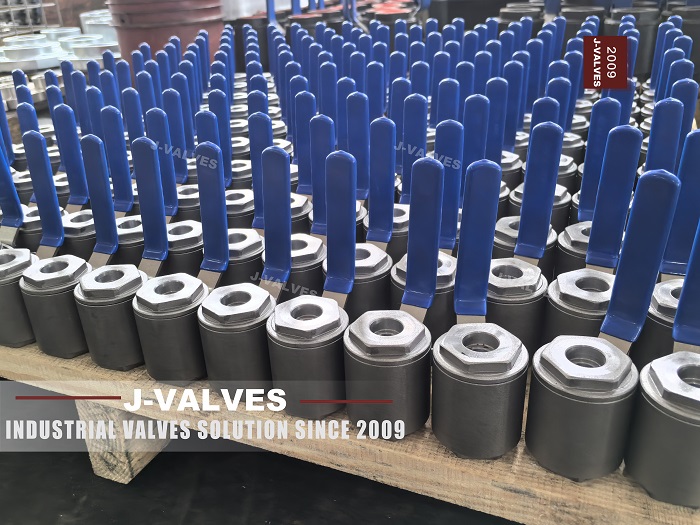
A 2 piece screwed ball valve is a floating ball valve with a body split once at the downstream end and threaded connections, full port, rated 1000 WOG, built in CF8 or CF8M from 1/4 to 4 inch. It is the cheapest way to put a quarter-turn isolation valve on a small bore line, and it is the type most often returned for a reason that has nothing to do with the valve: the wrong thread.
This page covers the two piece screwed pattern specifically. The three piece version is a different trade, covered separately, and the difference is one static joint against in-line repairability.
Two Piece or Three Piece, in One Paragraph
A two piece body is shorter, has one body joint instead of two, and costs 10 to 25 percent less than a three piece of the same bore. The ball goes in through the downstream end, so servicing it means disconnecting that side of the pipe. If the valve will be opened for maintenance on a line that cannot be disturbed, the three piece is worth the extra; if the line can be drained and a union broken, the two piece is the correct and cheaper choice.
On threaded lines the practical split is at about 2 inch. Below that, the labour to break and remake a joint is small and the two piece is standard. Above it, the valve is heavier, the joint is harder to break, and a three piece or a flanged valve starts to make more sense.
The Thread Is the Specification
NPT, BSPP and BSPT are three different threads that share a nominal size and nothing else. Two of them are tapered and will start to engage with each other, which is why the error survives until the pressure test.
| Standard | Form | Thread angle | Seals on | Marked as |
|---|---|---|---|---|
| NPT, ASME B1.20.1 | Taper 1:16 | 60° | Thread flanks, sealant required | NPT or MNPT |
| BSPT, ISO 7-1 | Taper 1:16 | 55° | Thread flanks, sealant required | BSPT, R, or PT |
| BSPP, ISO 228-1 | Parallel | 55° | Flat face or O-ring, not the thread | BSPP, G, or PF |
| DIN 2999 | Taper | 55° | As BSPT in practice | DIN 2999 |
| DIN 259 | Parallel | 55° | As BSPP in practice | DIN 259 |
The thread angle is the only reliable field test at small sizes, because the pitch is often identical. A 1/2 inch NPT and a 1/2 inch BSP both have 14 threads per inch; the difference is 60 degrees against 55 degrees, which is visible with a thread gauge and invisible to the eye.
| Nominal size | NPT threads per inch | BSP threads per inch | Field test |
|---|---|---|---|
| 1/4 inch | 18 | 19 | Pitch differs; a gauge settles it |
| 3/8 inch | 18 | 19 | Pitch differs slightly |
| 1/2 inch | 14 | 14 | Pitch identical; angle 60° against 55° |
| 3/4 inch | 14 | 14 | Pitch identical; angle is the only difference |
| 1 inch | 11.5 | 11 | Pitch differs; measurable over 10 threads |
| 1-1/2 inch | 11.5 | 11 | Pitch differs; measurable |
| 2 inch | 11.5 | 11 | Pitch differs; measurable |
At 1 inch and above, a caliper across ten threads separates NPT from BSP without any special tool: 11.5 threads per inch means 22 threads over two inches, and 11 means 22 as well, so measure over a longer length or count against a known fitting. At 1/2 and 3/4 inch only a thread gauge will do.
Why the Wrong Thread Leaks and How It Fails
A tapered male thread in a tapered female port of the wrong angle contacts on a narrow band rather than along the flanks. Sealant bridges the band at low pressure and is pushed out at high pressure, so the joint passes a 6 bar test and weeps at 15 bar. The leak usually appears as a stain at the base of the valve after a few weeks, not as a visible spray.
A parallel male thread in a tapered port is worse. The thread bottoms before the sealing face contacts, the joint is tight to the touch and has no seal at all, and it will leak at any pressure. The correct fix is not more tape: it is an adaptor with a bonded washer or the correct valve.
Two installation habits prevent most of these failures. First, use a paste sealant on the male thread, leaving the first thread bare, rather than tape, which can shred and enter the bore. Second, hold the valve body with a second wrench when tightening, so the torque goes into the joint rather than into the body joint and the stem.
Full Port: What It Costs and What It Buys
A full port valve has a bore equal to the pipe inside diameter. A reduced port valve has a bore one nominal size down. The full port body is larger, heavier and 10 to 20 percent more expensive, and it passes more flow with less pressure drop.
| Size | Full port bore, approximate | Reduced port bore, approximate | Why full port is chosen |
|---|---|---|---|
| 1/2 inch | 13 mm | 10 mm | Viscous media, small flow margin |
| 1 inch | 25 mm | 20 mm | Pigging, drain lines, sampling |
| 2 inch | 50 mm | 40 mm | Slurry, fibres, CIP cleaning |
| 3 inch | 76 mm | 62 mm | Low pressure drop on long runs |
| 4 inch | 100 mm | 80 mm | Drain and vent, sphere passage |
Full port is the default on this valve because most screwed installations are small bore lines where the pressure drop of a reduced port would be a real fraction of the available head, and because a full port valve can be rodded or pigged. The cost difference is small at these sizes and the flow difference is not.
1000 WOG in Real Service
The rating is 1000 psi on water, oil or gas at ambient, about 69 bar. It is not a steam rating and it is not valid for corrosive media. Two derating effects matter.
The first is temperature. An RPTFE seat at 180°C has lost most of its compressive strength and will creep under load, so the practical pressure at that temperature is nearer 25 to 30 bar regardless of the body rating. A PPL seat extends the range to about 220°C at a similar pressure.
The second is size. The body wall at 4 inch is proportionally thinner than at 1/2 inch, and the thread cuts a groove at the section of highest stress. For a 4 inch screwed body in continuous hot water, 40 bar is a more honest working limit than 69 bar, and the 1000 WOG figure should be read as a proof pressure.

Where This Valve Belongs
It belongs on utility water, compressed air, instrument air, small cooling branches, dosing lines, and the isolation point on a pump discharge below 2 inch. It is the default valve in a mechanical room and on a small packaged skid, because it is cheap, available, and can be replaced from stock.
It does not belong on steam above 200°C without a seat upgrade, on slurry where the seat pocket fills, on a line subject to water hammer, or on a hydrocarbon line above 1 inch in a plant where screwed joints are prohibited. It is also a poor choice where the valve will be operated frequently, because the screwed joint is not designed to be broken and remade many times.

The Four Failures Worth Knowing
Thread leak at the joint is the most common, and it is an installation issue rather than a valve issue. Body joint weep is the second, and it comes from a body gasket that was compressed and then retightened, or from uneven bolt torque. Ball scoring is the third, and it comes from solids in the seat pocket or from a valve left partly open as a throttle. Handle failure is the fourth, and it is almost always a valve that was seized and forced; the handle breaks before the stem, which is the intended design.
None of these is a reason to reject the type. All of them are reasons to specify the seat and the thread correctly and to install with a backing wrench.

Ordering Notes
State size, thread standard (not just “screwed”), pressure rating as 1000 WOG, body grade, port, seat material, and whether a lockable handle is required. Add the temperature, because it decides the seat, and state the medium if it is not water, oil or air.
Delivery is typically 3 to 5 weeks in CF8 for stock sizes and 5 to 7 weeks in CF8M. A valve with a BSPP end and a flat face seal is a standard option, not a special, and it should be stated explicitly rather than assumed from the market.
FAQ
How can I tell NPT from BSP?
Use a thread gauge. NPT is 60 degrees and BSP is 55 degrees; at 1/2 and 3/4 inch the pitch is identical at 14 threads per inch, so counting does not help. At 1 inch and above, NPT is 11.5 threads per inch and BSP is 11, which can be measured over a longer length.
Can I use a BSPP valve in an NPT port?
No. BSPP is parallel and seals on a flat face or an O-ring, while NPT is tapered and seals on the thread. A parallel thread in a tapered port bottoms before the faces meet and leaks at any pressure. An adaptor with a bonded washer is the only workable fix.
What is the difference between full port and reduced port?
A full port bore matches the pipe inside diameter, so pressure drop is minimal and the line can be pigged. A reduced port is one nominal size smaller, which makes the body cheaper and shorter but adds a permanent restriction. On small bore screwed lines the flow difference matters more than the price difference.
What pressure can a 1000 WOG valve take at 150°C?
Roughly 30 to 35 bar with an RPTFE seat, well below the 69 bar ambient figure, because the seat creeps at temperature. The body is not the limit; the seat is. Above 200°C the seat should be PPL or metal.
Why does the handle break instead of the stem?
Because the handle is designed as the weak link. On a seized valve the handle yields before the stem or the body, which protects the pressure boundary. A broken handle is a sign the valve was forced, not a manufacturing defect.
Hot Products


News
Ball Valves in Amine CO2 Capture: Heat Stable Salts, Rich Amine, And The Three Places The Body Thins
Rich amine at 110 C with heat stable salts is where capture plant ball valves fail. Materials, velocity limits, cavity gas and seat choice, with numbers.
Read More
Fail-Safe Ball Valve Actuators: Spring Return, Stored Air, And The Torque Nobody Checks
Spring return or stored air? The answer is a torque curve, not a datasheet box. Sizing, receiver volume, closing time and four silent failures.
Read More
Ball Valve Stem Leak: The Gland, The Backseat And The Repair That Cannot Be Done Live
A stem leak on a quarter turn valve is four different failures. What gland tightening buys you, why the backseat is usually absent, and what needs a shutdown.
Read More
Ball Valves in A Kraft Pulp Mill: Black Liquor, Green Liquor And The Cost of Choosing The Alloy by Habit
White liquor at pH 14 cracks carbon steel welds, black liquor sets solid below 100 C, green liquor dregs grind seats: alloy choice and torque in a kraft mill.
Read More