

CHINA J-VALVES Offers Various High-quality I ndustrial Ball Valves
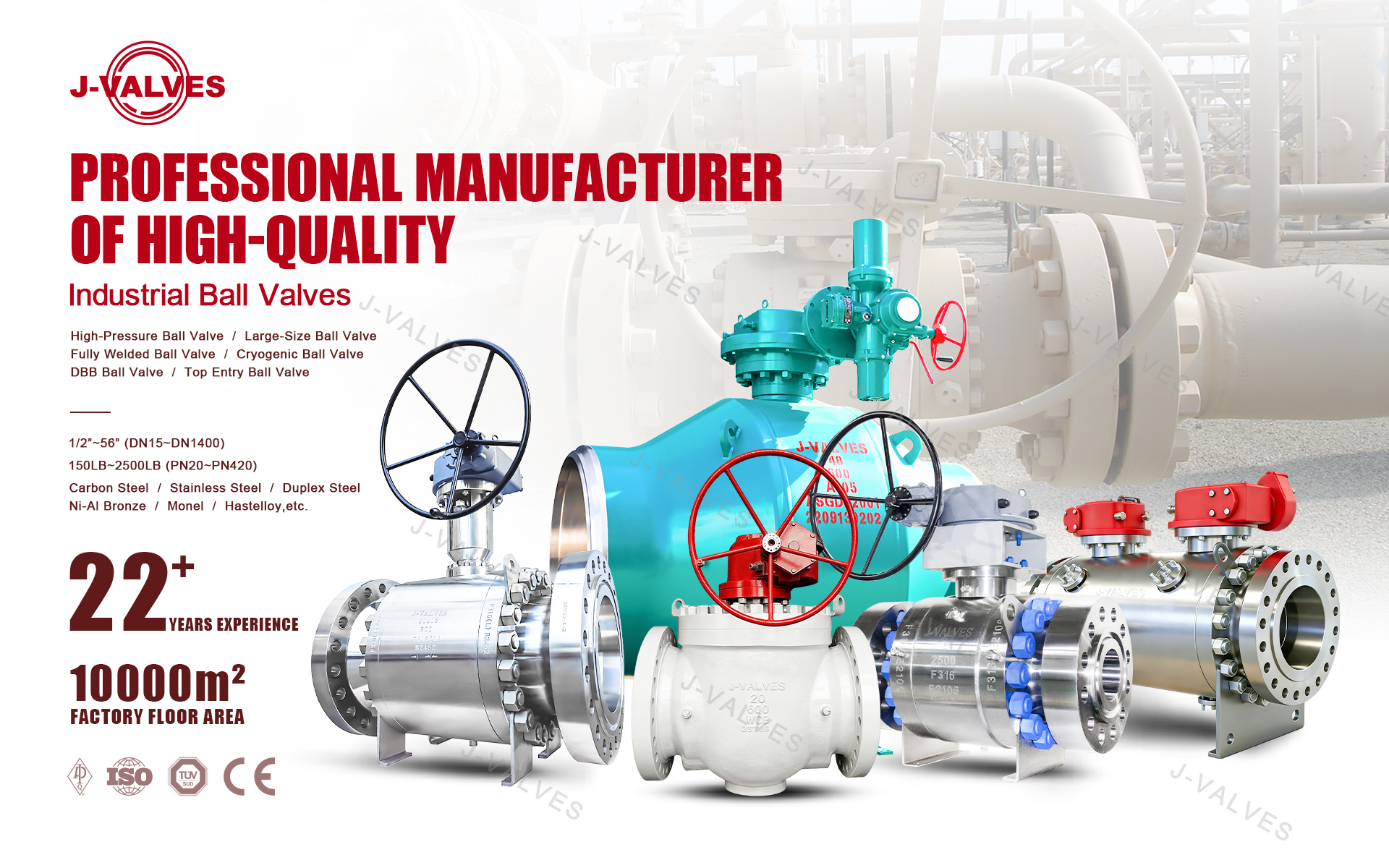
J-VALVES, a distinguished professional ball valve manufacturer rooted in China, takes pride in its extensive product portfolio. Our offerings span a wide range, including trunnion-mounted ball valves, floating ball valves, high-temperature ball valves, high-pressure ball valves, metal-sealed ball valves, ultra-low temperature ball valves, DBB ball valves, Three-way And Four-way Ball Valve, and fully welded ball valves. Each product is a testament to our commitment to precision engineering and reliable performance. Meticulously crafted, they are designed to not only meet but exceed the most stringent industrial demands, ensuring stable operation even under extreme conditions. This enables us to provide our clients with high-value services and makes our valves widely sought-after in industries.
Product Category
Contact Us

Pressure Rating: 1000 WOG / 1000 psi / 69 bar at 38°C, non-shock
Port: Full port standard, reduced port optional
Body Material: ASTM A351 CF8M stainless steel
Ball: CF8M, mirror polished
Seat: PTFE standard, RPTFE or PEEK for higher temperature
Stem: 316 stainless, blowout proof, anti-static under 10 ohm
Thread: NPT female to ASME B1.20.1, BSPP or BSPT on request
Temperature Range: -20°C to +180°C PTFE, up to +230°C PEEK
Cv Range: 5.5 at 1/4 inch to 480 at 4 inch (full port)
Operation: Lever with lockout hole, panel mount nut optional
Design Standard: MSS SP-110, API 608, ASME B16.34
Test Standard: API 598 shell 1.5x and seat 1.1x, 100% tested
Options: Panel mounting nut, lockable handle, actuator pad
-
Q14F-1000WOG P
-
J-VALVES
A 1000 WOG NPT ball valve is a stainless steel quarter-turn valve threaded at both ends with a tapered pipe thread, and rated 1000 psi cold working pressure for water, oil and gas. It is the default small valve on instrument air, water treatment, dosing, HVAC and packaged equipment, and it is sold in two way and three way bodies from 1/4 inch to 4 inch.
The number and the thread are the two things buyers most often get wrong. 1000 WOG is not a pressure class, it is a cold, non-shock rating, and it falls steeply as temperature rises. NPT is not the only tapered thread in the world, and the other one fits just well enough to leak. This page deals with both, then with the body and the trim.
What 1000 WOG Actually Means
WOG stands for water, oil and gas. It is a North American convention for small general purpose valves, standardised for ball valves in MSS SP-110, and it describes the maximum non-shock pressure at about 38 degrees C in those three media. 1000 WOG is therefore 1000 psi, or about 69 bar, at ambient, and it says nothing at all about steam, about cycling, or about temperature above ambient.
It is not the same as ASME Class 600, even though the numbers look close. Class 600 is a flanged rating system with a defined body wall in ASME B16.34, a defined flange in B16.5, a defined face to face in B16.10 and a defined test in API 598; a Class 600 stainless valve carries about 102 bar at 38 degrees C. A 1000 WOG threaded valve carries about 69 bar at the same temperature, has no flange standard behind it, and is proved by a different test regime. The two ratings are not interchangeable and a threaded valve should never be substituted for a Class 600 flanged item on the strength of the number.
| Rating | Cold pressure | Basis | Body standard | Typical use |
|---|---|---|---|---|
| 600 WOG | 600 psi / 41 bar | MSS SP-110 convention | Manufacturer design | Brass and light stainless utility valves |
| 1000 WOG | 1000 psi / 69 bar | MSS SP-110 convention | Manufacturer design, CF8M wall | Instrument air, water, dosing, packaged plant |
| 2000 WOG | 2000 psi / 138 bar | MSS SP-110 convention | Heavier wall, often forged | Hydraulic, high pressure gas skids |
| ASME Class 600 | 102 bar at 38 C for group 2.2 | ASME B16.34 rating tables | B16.34 minimum wall, B16.5 flange | Process plant, hydrocarbon, flanged pipe |
The trap is steam. A 1000 WOG valve is often assumed to be good for 1000 psi of saturated steam, and it is not. Steam at 1000 psi is about 285 degrees C, far above what a PTFE seat will hold, and the convention itself is defined for water, oil and gas rather than steam. Where steam service is intended, ask for a steam working pressure (WSP) figure at the actual temperature, and expect it to be a fraction of the WOG number.
Pressure and Temperature: The Derating Nobody Reads
The body will take far more than the seat will. A CF8M body at 1 inch has a burst margin well above 69 bar, but the PTFE seat starts to creep at about 120 degrees C and has lost most of its preload by 180 degrees C. The usable pressure is therefore set by the seat, not by the shell.
| Temperature | PTFE seat | RPTFE seat | PEEK seat | Comment |
|---|---|---|---|---|
| 38 degrees C | 1000 psi / 69 bar | 1000 psi / 69 bar | 1000 psi / 69 bar | The rating point |
| 100 degrees C | 800 psi / 55 bar | 850 psi / 59 bar | 1000 psi / 69 bar | Hot water, most heating duty |
| 150 degrees C | 550 psi / 38 bar | 650 psi / 45 bar | 950 psi / 65 bar | PTFE is creeping, RPTFE preferred |
| 180 degrees C | 400 psi / 28 bar | 500 psi / 34 bar | 900 psi / 62 bar | Top of the soft seat range |
| 230 degrees C | Not recommended | Not recommended | 750 psi / 52 bar | PEEK only, torque roughly doubles |
The figures are typical published values for a stainless threaded body and are given to show the slope, not to replace a test. Two practical consequences follow. First, an 180 degree C line at 30 bar needs RPTFE or PEEK, not standard PTFE. Second, a valve that holds 1000 psi cold will not necessarily hold its seat after a few thermal cycles, because the seat has taken a compression set even if the pressure never exceeded the cold rating.
NPT Female Thread: Dimensions, Engagement and Sealant
NPT to ASME B1.20.1 is a 60 degree thread with a 1 in 16 taper, and it seals on the thread itself. The female port has a countersink and the male pipe end has a chamfer, and the joint is made by deforming the thread crests into the flanks with a sealant in between. There is no shoulder and no gasket, which is why the number of engaged threads decides whether the joint holds.
| Nominal size | Threads per inch | Pitch | Hand tight engagement | Wrench make up | Practical note |
|---|---|---|---|---|---|
| 1/4 inch | 18 | 1.411 mm | 4 turns | 2 to 3 turns | Small body, easy to split the port |
| 3/8 inch | 18 | 1.411 mm | 4 turns | 2 to 3 turns | Instrument tubing adaptors common here |
| 1/2 inch | 14 | 1.814 mm | 4 turns | 2 to 3 turns | Most common size on a skid |
| 3/4 inch | 14 | 1.814 mm | 4 turns | 2 to 3 turns | Do not use a pipe wrench on the body |
| 1 inch | 11.5 | 2.209 mm | 4 turns | 2 to 3 turns | Where NPT and BSPT get confused |
| 1-1/4 inch | 11.5 | 2.209 mm | 4 turns | 2 to 3 turns | Support the pipe |
| 1-1/2 inch | 11.5 | 2.209 mm | 4 turns | 2 to 3 turns | Lever operation only |
| 2 inch | 11.5 | 2.209 mm | 4 turns | 2 to 3 turns | Above this consider flanged |
| 2-1/2 to 4 inch | 8 | 3.175 mm | 3 turns | 2 turns | Heavy body, two wrenches mandatory |
Three rules cover most NPT failures. Use PTFE tape two turns back from the first thread, or a PTFE paste, never both and never a hardening compound. Leave two to three threads visible after tightening; if the port swallows the pipe end, the pipe is too long or the port was reamed. And hold the body hex with a second wrench on anything above 1 inch, because the torque you apply to the pipe also twists the body.
If the plant is European, the port will probably be BSPP (ISO 228-1), which is parallel and does not seal on the thread. That is a different product, covered on the three way threaded page, and mixing the two is the single most common cause of a weeping joint on imported equipment.

Two Way and Three Way in the Same Rating
The same 1000 WOG body family covers two way isolation valves and three way diverting and mixing valves, and they share the seat, stem and handle design. The difference is the ball and the number of ports. A two way valve has one seat pair and a straight bore; a three way has three or four seats and a ported ball.
Buyers often compare them on pressure rating alone, which hides the real difference: a three way valve has a Cv roughly 40 to 60 percent lower than a two way valve of the same size, because the flow has to turn inside the ball. If a line was sized on a two way valve and the two way is replaced by a three way for diverting duty, the pressure drop will rise and the pump curve will move.
Full Port, Reduced Port and Cv
A full port valve has a bore equal to the pipe inside diameter, so the pressure drop is close to that of an equivalent length of pipe. A reduced port valve has a bore one size smaller, which makes the body shorter and cheaper and costs pressure drop. On instrument and utility lines the difference rarely matters; on a pump suction or a gravity drain it always does.
| Size | Full port bore | Typical Cv, full port 2 way | Typical Cv, reduced port | Typical Cv, 3 way L-port |
|---|---|---|---|---|
| 1/4 inch | 8 mm | 5.5 | 3.5 | 3.5 |
| 1/2 inch | 13 mm | 12 | 8 | 8 |
| 3/4 inch | 19 mm | 20 | 13 | 12 |
| 1 inch | 25 mm | 32 | 21 | 20 |
| 1-1/2 inch | 38 mm | 70 | 48 | 42 |
| 2 inch | 50 mm | 120 | 80 | 65 |
| 3 inch | 76 mm | 280 | 190 | 140 |
| 4 inch | 100 mm | 480 | 320 | 230 |
Body, Stem and the Details That Matter in Service
The body is a CF8M investment casting, with a one piece design up to 1 inch and a bolted or screwed retainer at the end port above that. The stem is inserted from inside the body, so it cannot be blown out by pressure even if the gland nut is removed, which is what the term blowout proof means in practice.
An anti-static device connects the stem to the body through a spring, with a resistance under 10 ohm, so a charge cannot build on a ball that is isolated by a plastic seat. This is not a decorative feature: on gas and solvent duty it is the difference between a spark and no spark.
The handle is a flat lever with a stop that shows open and closed, and a lockout hole that takes a padlock hasp. A panel mounting nut under the bonnet lets the valve be fixed to a bracket or a panel face so the lever is accessible from the front of a cabinet. An adjustable gland nut allows the packing to be tightened in service, and on this range the packing can be replaced with the line under pressure only if the valve is a two way with pressure on the downstream side, so in practice depressurise first.
Testing
Every valve is tested, not sampled: shell at 1.5 times the cold rating, seat at 1.1 times, with a minimum hold of 15 seconds up to 2 inch, in both directions for a two way valve and in both ball positions for a three way. Air seat testing is available for gas duty, and it is the test that finds a seat nick that a water test passes.
The valve is drained and dried before packing, the bore is capped, and the port threads are protected with plastic plugs. A material certificate to EN 10204 3.1 is issued against the heat number when requested; without it the valve is still tested but the traceability stops at the batch.

Frequently Asked Questions
What does 1000 WOG mean on a ball valve?
WOG means water, oil and gas. 1000 WOG is 1000 psi (about 69 bar) non-shock cold working pressure at roughly 38 degrees C, defined for those three media in MSS SP-110. It is not a steam rating, it is not an ASME class, and it falls as temperature rises because the seat softens before the body does.
Can I use a 1000 WOG valve for steam?
Only within the derated figure at the actual steam temperature, which is far below 1000 psi. Steam at 1000 psi is about 285 degrees C and no PTFE seat survives that. Ask for the WSP (steam working pressure) at your temperature, and expect a PTFE seated valve to be limited to low pressure saturated steam.
Is 1000 WOG the same as Class 600?
No. 1000 WOG is about 69 bar at ambient; Class 600 stainless is about 102 bar at 38 degrees C under ASME B16.34, with a defined wall, flange, face to face and test basis. The numbers are close enough to confuse, and the standards behind them are entirely different.
Why does my NPT joint leak even though it is tight?
Usually because the thread is mismatched: a BSPT male in an NPT female engages a few turns and then weeps, and the pitches differ (11 against 11.5 threads per inch at 1 inch). The second cause is too little engaged thread, and the third is overtightening, which splits the port or distorts the seat pocket.
What is the difference between full port and reduced port?
A full port valve has a bore equal to the pipe inside diameter and a pressure drop close to an equivalent length of pipe. A reduced port valve has a bore one size smaller, so the body is shorter and cheaper but the Cv drops by roughly a third. Use full port on suction, drain and low pressure drop duty.
Can the packing be replaced without removing the valve?
On a two way valve with the line isolated and the pressure released, yes: undo the gland nut, pick out the rings, fit new ones and re-tighten. Do not attempt it under pressure, and do not over-tighten the gland to cure a leak from a scored stem, because the stem will be damaged further and the leak will return.
Do you supply this valve with a panel mounting nut and a lockable handle?
Yes, both are standard options on 1/4 to 2 inch. The panel nut fixes the body through a bracket or cabinet face so the lever sits on the front, and the lockable handle takes a padlock hasp to hold the open or closed position during maintenance. State both on the order, because they change the bonnet height.
Hot Products


News
Ball Valves On A Bottom Loading Gantry: Creep, Dry Break And The Test That Proves Neither
A loading gantry cycles a ball valve far more than it is designed for and still cannot prove shut-off. Where creep starts, and what to specify.
Read More
Lined Ball Valves in Acid Service: The Liner Does Not Fail, The Steel Behind It Does
The valve came out of the line looking better than most valves that come out of a hydrochloric acid line. Three inch, PFA lined, cast body, Class 150, fourteen months in service on a 32 percent acid transfer duty at 55 to 60 degrees C, about forty open and close cycles a week. The paint was intact.
Read More
Ball Valves in Amine CO2 Capture: Heat Stable Salts, Rich Amine, And The Three Places The Body Thins
Rich amine at 110 C with heat stable salts is where capture plant ball valves fail. Materials, velocity limits, cavity gas and seat choice, with numbers.
Read More
Fail-Safe Ball Valve Actuators: Spring Return, Stored Air, And The Torque Nobody Checks
Spring return or stored air? The answer is a torque curve, not a datasheet box. Sizing, receiver volume, closing time and four silent failures.
Read More