

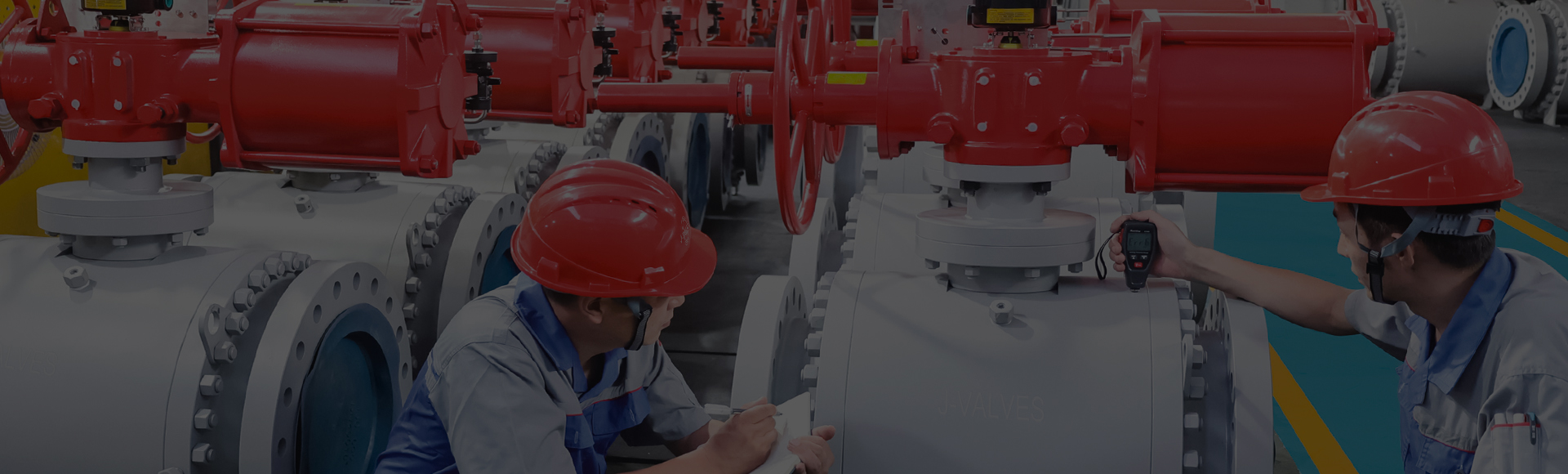
CHINA J-VALVES Offers Various High-quality I ndustrial Ball Valves
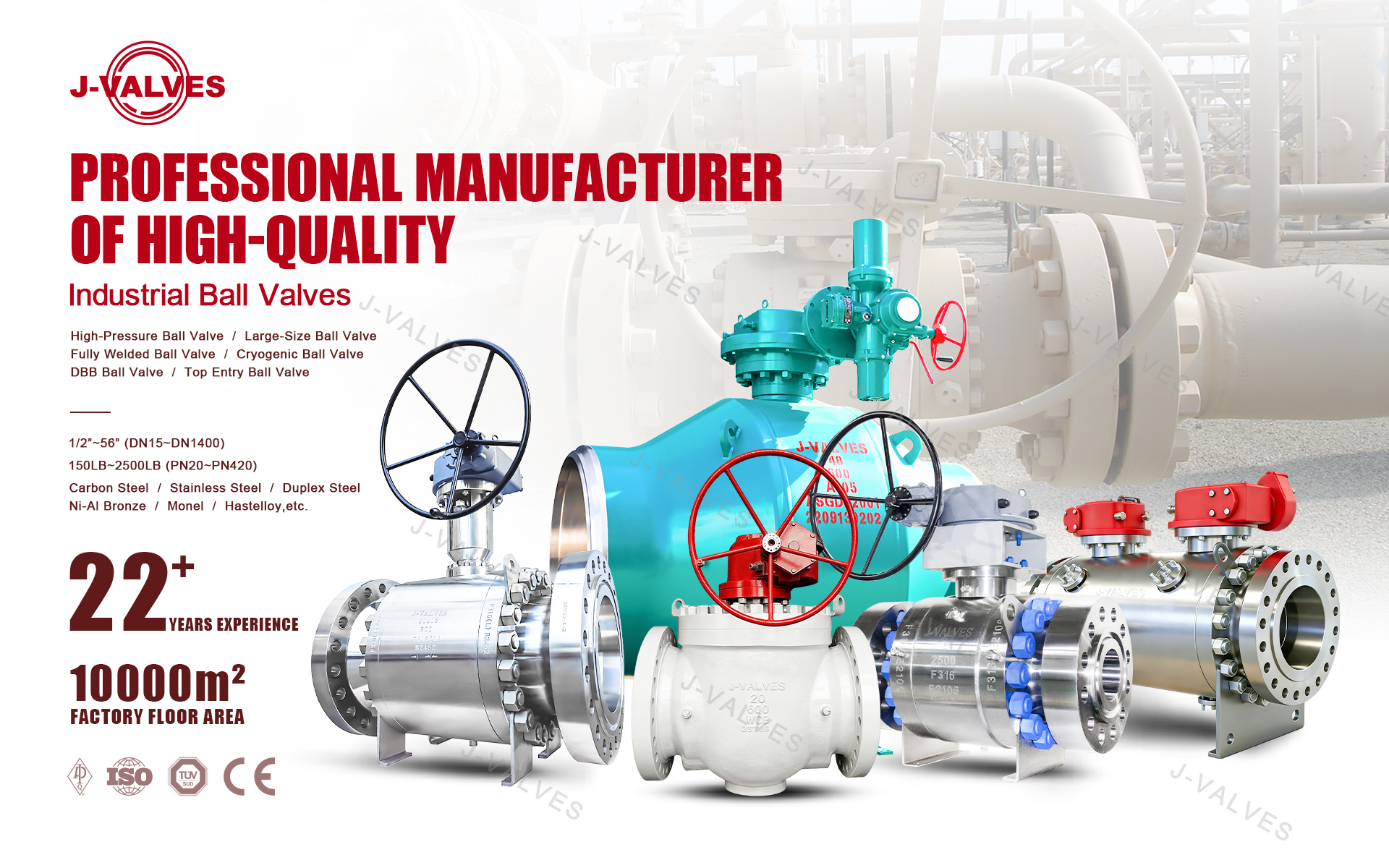
J-VALVES, a distinguished professional ball valve manufacturer rooted in China, takes pride in its extensive product portfolio. Our offerings span a wide range, including trunnion-mounted ball valves, floating ball valves, high-temperature ball valves, high-pressure ball valves, metal-sealed ball valves, ultra-low temperature ball valves, DBB ball valves, Three-way And Four-way Ball Valve, and fully welded ball valves. Each product is a testament to our commitment to precision engineering and reliable performance. Meticulously crafted, they are designed to not only meet but exceed the most stringent industrial demands, ensuring stable operation even under extreme conditions. This enables us to provide our clients with high-value services and makes our valves widely sought-after in industries.
Product Category
Contact Us


Pressure Class: ASME Class 150 to 2500 / PN20 to PN420
Trim Type: V-notch ball 60 or 90 degree, or eccentric segmented plug
Flow Characteristic: Equal percentage, rangeability 50:1 to 100:1
Body Material: WCB, CF8M, CF3M, F316
Ball Material: CF8M or F316, hard chrome, ENP, Stellite 6 or tungsten carbide
Seat Material: PTFE, RPTFE, PEEK, Stellite 6, tungsten carbide
Leakage Class: ISO 5208 rate A soft seat, Class IV to V metal seat
Design Standard: API 6D, API 608, ASME B16.34, ISO 5211
Test Standard: API 598, ISO 5208, API 607 fire safe
Operation: Lever, gear, pneumatic or electric with positioner
Temperature Range: -29 to 540 degrees Celsius depending on trim
Certification: EN 10204 3.1, NACE MR0175 on request
-
QV640F
-
J-VALVES
A v port ball valve is a quarter-turn valve whose ball carries a V-shaped notch, so the open area grows with rotation and the valve can hold a setpoint instead of only opening or closing. The notch turns the ball into a throttling trim with usable travel from 15 to 80 degrees.
J-VALVES builds v port and segmented ball valves from 1/2 to 56 inch in ASME Class 150 to 2500 at its works in Wenzhou, Zhejiang, for pulp mills, mineral processing plants, gas letdown stations and water utilities that need a control valve which does not plug. This page covers geometry, characteristic, sizing, cavitation, trim choice, actuation and the enquiry data.
A Ball Valve That Is Meant to Sit Half Open
A standard ball valve is an isolation device, and almost all of its capacity arrives in the first quarter of the handle movement. Hold a full-bore ball at 30 percent open and the flow is already around 80 percent of maximum, the seat edge sees the whole drop across a narrow crescent, and the jet cuts the seat and shakes the trim.
A notch changes the geometry rather than the material. The opening is a triangle that grows from a point as the ball rotates, so the flow area rises roughly with the square of the angle and the characteristic comes out close to equal percentage. A 60 degree notch gives a flatter, more linear curve; a 90 degree notch gives the wider range.
The segmented design adds an eccentric shaft. The plug swings out of the seat in the first two degrees and only then turns, so seat and plug never rub. That is why it survives grit and fibre where a ball with two fixed seats grinds particles into the sealing line. The trade is a longer face-to-face and a body that is hard to make below 3 inch.
V-Port, Segmented and Standard Port Compared
Three products are sold under similar names and they are not interchangeable. The choice follows from which of the three the process can tolerate.
Item | V-port ball valve | Segmented (eccentric plug) valve | Standard port ball valve |
|---|---|---|---|
Structure | Standard body, ball cut with a 60 or 90 degree V, floating or trunnion, two seats | Part-spherical plug on an eccentric shaft, single metal seat, plug swings clear before rotation | Full or reduced bore ball, two seats in contact through the stroke |
Flow area | V segment opening from a point, area grows with angle | V or parabolic window on the plug face, cam shaped | Circular bore, full area almost at once |
Characteristic | Modified equal percentage with 90 degree V, nearer linear with 60 degree V | Equal percentage, close to modified parabolic with a characterised cam | On-off, no usable characteristic |
Rangeability | 50:1 typical, 100:1 with long pattern and 90 degree notch | 100:1 typical, 200:1 with cam and smart positioner | 3:1 to 5:1 |
Shutoff | ISO 5208 rate A soft seat, Class IV to V metal seat | Class IV to VI metal seat, torque seated | Rate A, bubble tight both directions |
Typical use | Water, gas letdown, stock below 3 percent, light slurry | Paper stock, tailings, lime slurry, dirty fluids | Isolation only |
The V-port valve is cheaper and easier to fit, because it is a standard body with a modified ball. Its weakness is the seat: two seats press on the ball, so in a slurry particles are trapped at the sealing line on every stroke.
The segmented valve removes that contact and lasts longer on dirty service, at roughly 1.3 to 1.6 times the price for the same size and class. It also holds a better leakage class on metal to metal, because the plug is wedged in by the last few degrees of rotation.
Flow Characteristic and Rangeability
Two numbers describe a control valve and buyers confuse them. Rangeability is the ratio between the largest and smallest Cv at which the valve still follows its characteristic within a stated tolerance. The characteristic is the shape of the curve between those limits, and a valve can have one without the other.
Relative travel | Relative Cv, equal percentage, R = 50 | Relative Cv, equal percentage, R = 30 | Relative Cv, linear trim |
|---|---|---|---|
20 percent | 4.4 percent | 6.6 percent | 20 percent |
40 percent | 9.6 percent | 13.0 percent | 40 percent |
60 percent | 20.9 percent | 25.7 percent | 60 percent |
80 percent | 45.7 percent | 50.7 percent | 80 percent |
100 percent | 100 percent | 100 percent | 100 percent |
The equal percentage curve follows Cv/Cv100 = R raised to the power of x minus one, where R is the rangeability and x the fraction of travel. With R equal to 50, ten percent of travel passes about 3 percent of full Cv and fifty percent passes about 14 percent. That steepness at the top is what a loop needs.
In a fixed-speed pump loop the valve takes a larger share of the total pressure as flow falls, so an equal percentage inherent curve behaves almost linearly once installed. A linear trim in the same loop behaves equal percentage instead, too sensitive at low flow and too coarse at high flow. That is why equal percentage is the default here.
Cv, Sizing and the Formula
Liquid sizing starts from Cv equal to Q times the square root of SG divided by dP, with Q in US gallons per minute, SG relative to water at 20 degrees Celsius and dP in psi. Gas sizing adds the expansion factor and uses absolute pressures; steam adds the superheat correction. The formula is not the difficult part. Deciding which dP belongs to the valve is.
Take DN80, water at 20 degrees, 60 cubic metres per hour, and 1.2 bar of drop available at that flow. Sixty cubic metres per hour is 264 gpm, SG is 1.0 and 1.2 bar is 17.4 psi, so Cv equals 264 divided by the square root of 17.4, which is 63. A valve rated at 63 would sit at 100 percent travel with nothing in reserve, so size for 1.3 to 1.5 times that figure.
Ball angle | Relative travel | Trim Cv, DN80, 90 degree V | Trim Cv, DN80, 60 degree V |
|---|---|---|---|
0 degree | 0 | 0 | 0 |
15 degree | 16.7 percent | 4 | 7 |
30 degree | 33.3 percent | 12 | 22 |
45 degree | 50.0 percent | 27 | 45 |
60 degree | 66.7 percent | 48 | 72 |
75 degree | 83.3 percent | 78 | 98 |
90 degree | 100 percent | 112 | 118 |
The last row is the trap. A DN80 full-bore ball passes about 265 at 90 degrees, while the same body with a V-notch trim passes about 112. Sizing from the full-bore figure gives a valve two sizes too large that runs at 25 percent travel, where the notch is a slit a few millimetres wide.
One correction matters at high drop. The table is measured where the flow is not choked, and above a dP of roughly half the upstream absolute pressure the flow stops rising. Piping reducers shift the effective Cv by 5 to 15 percent, and working between 60 and 80 percent absorbs both effects.

Cavitation, Flashing and Noise
Liquid at the vena contracta accelerates and its pressure falls. Whether that matters is decided by sigma equal to P1 minus Pv, divided by P1 minus P2, in absolute pressure. Below about 1.8 for a V-port trim the bubbles begin to form; near 1.0 the flow is choked and damage peaks. A globe sits near 2.5 because its recovery is lower.
Flashing and cavitation are different failures with different damage sites. If the downstream pressure stays below the vapour pressure the bubbles never collapse inside the valve, and the damage appears downstream at elbows and the first reducer. If the pressure recovers above it, the bubbles collapse just past the trim and the damage is on the ball, the seat and the wall behind the notch.
Splitting the drop is the remedy that works. Two valves in series, a multistage trim or a fixed orifice downstream each halve the drop and lift sigma above the limit. Hard facing buys time but not physics. In gas keep Mach below 0.3 and noise under 85 dB(A) at one metre; in liquid keep body velocity under 5 to 6 m/s.

Seat, Trim and Hard Facing
The seat decides what the valve can carry. A soft seat in PTFE or RPTFE gives ISO 5208 rate A and a smooth characteristic, limited to about 180 to 200 degrees Celsius and to clean fluid. A metal seat in Stellite 6 or tungsten carbide takes grit and heat, and gives Class IV to V.
Trim option | Hardness | Temperature limit | Leakage class | Where it is used |
|---|---|---|---|---|
PTFE seat, chrome plated 316 ball | Coating 700 to 900 HV | 180 degrees Celsius | ISO 5208 rate A | Water, clean gas, utility loops |
RPTFE or PEEK seat, ENP ball | ENP 500 to 600 HV | 200 to 250 degrees Celsius | Rate A to B | Hot water, light hydrocarbon |
Stellite 6 on ball and seat | 380 to 450 HV | 540 degrees Celsius | Class IV to V | Steam, slurry, stock above 3 percent |
Tungsten carbide HVOF on ball and seat | 1100 to 1400 HV | 540 degrees Celsius | Class IV to V | Tailings, lime slurry, sand laden water |
Solid carbide seat ring, Stellite plug | Seat 1200 HV | 450 degrees Celsius | Class V | Severe abrasive duty, high cycle count |
The V edge fails first. It is a knife edge a fraction of a millimetre thick at the tip, and the whole drop passes over it at the highest velocity in the valve. Erosion rounds the tip, the characteristic shifts toward open, and the small-opening resolution is gone before the seat shows wear. Hard facing is normal above 2 percent solids and lowers trim Cv by 2 to 5 percent, so the quotation must size the coated trim.
Where the leak rate matters more than the curve and the fluid is abrasive at temperature, a metal seated ball valve of the conventional kind is the better answer; the seat design and lapping detail is on the metal seated ball valve page. A V-port trim is a control device with a shutoff function, not an isolation device with a control function.
The Actuator and Positioner
A v port ball valve without a positioner is an on-off valve with an expensive ball. A solenoid and a double-acting cylinder can only drive the stem to one end or the other. Modulation needs a positioner that compares the 4-20 mA demand with the actual stem position and moves the piston until the error sits inside the dead band.
Ask for dead band and hysteresis in writing. A smart positioner holds 0.1 to 0.5 percent dead band and reports position over HART; an electropneumatic unit without feedback sits at 0.5 to 1.0 percent. Hysteresis comes from stem friction, packing and the two seat contacts, and shows as a gap between the up-scale and down-scale curve.
Compared with adjacent designs the V-port sits in the middle. A gate valve has a long sliding stem, a wedge and a deep packing box, so its hysteresis is the largest. A butterfly has one disc on one shaft with a light seal, so its hysteresis is the smallest. A ball carries two seats and a trunnion bearing set, so expect roughly twice the butterfly figure for the same actuator.
Torque for a throttling ball is not the isolation torque. Running torque at 60 degrees with the full drop across the trim can reach 1.5 times the break-to-open torque of the same valve closed, so a spring-return actuator is sized on the higher of the two. Actuator sizing is on the actuated ball valve page.
Where Throttling Ball Valves Win
The table is ordered by how badly a globe fails in the same duty. The reason is the same in every row: the throttling element must not trap the process, and a plug sliding inside a cage does.
Duty | Why the ball trim wins | Typical size | Trim and class |
|---|---|---|---|
Pulp stock and black liquor | Fibre bridges across a cage; the V-notch shears the stock instead | DN80 to DN300 | Segmented, Stellite, Class 300 |
Mineral slurry and tailings | Plug lifts off the seat before turning, no solids crushed on the sealing line | DN100 to DN600 | Segmented, tungsten carbide, Class 150 to 300 |
Solids bearing wastewater, lime slurry | Straight bore, no cavity to settle in, one wearing part | DN50 to DN200 | V-port, Stellite, Class 150 |
Natural gas letdown | Multistage trim takes 100 bar to 20 bar in one body where a globe needs a train | DN50 to DN200 | V-port, 2 or 3 stage, Class 600 to 900 |
Steam reducing and attemperation | Spray water needs fine low-flow resolution without a cage to erode | DN25 to DN150 | V-port, Stellite, Class 300 to 600 |
Level and flow loops | Short stroke, low hysteresis, cheap to actuate, easy to overhaul | DN25 to DN100 | V-port, soft seat, Class 150 to 300 |
Pulp and paper is where the segmented valve was invented. Stock at 3 to 5 percent consistency will not pass a cage; the fibres bridge and the loop loses control. A notch shears the stock as it passes, and the eccentric plug lifts clear before it turns, so neither fibre nor seat is crushed.
Slurry and tailings add abrasion to the same problem. A conventional ball with a fixed seat grinds solids between ball and seat on every stroke and the seat is gone in a season. The eccentric plug has no sliding contact, so the wear surface is the plug face only, and on gas letdown the noise limit sets the stages.
Compared with Globe and Butterfly Valves
For a DN100 line at Class 300 the three options differ by a factor of two in capacity and by an order of magnitude in solids tolerance. The single seat globe is the reference because it is what a V-port usually replaces.
Item | Single seat globe | V-port ball | Butterfly, soft seat |
|---|---|---|---|
Cv at DN100, full open | 100 to 160 | 160 to 190 | 380 to 450 |
Rangeability | 30:1 to 50:1 | 50:1 to 100:1 | 20:1 |
Pressure drop at full open | Highest of the three | Low, about one velocity head | Lowest, disc in the stream |
Solids tolerance | Poor, cage clearance 0.1 to 0.2 mm | Good, single opening, no guide in the flow | Fair, solids lodge at the disc edge |
Relative cost, same size and class | 1.0 | 0.7 to 0.9 | 0.5 to 0.7 |
Maintenance | Plug and seat changed in line | Body split or top entry, ball and seats as a set | Seat ring and disc changed in line |
The solids argument decides most projects. A globe guides its plug in a cage with 0.1 to 0.2 mm radial clearance, and any larger particle jams the plug or is crushed until the guidance is gone. A ball trim has no guide in the flow path; the only close clearance is at the seat, and the eccentric design opens even that before rotation.
The cost argument reverses above DN300, where a butterfly is a third of the price and takes a third of the space. The V-port wins where the loop needs resolution at low flow, or where the fluid carries solids.
What to Send with an Enquiry
A control valve cannot be quoted from a line size and a fluid name. These ten items are what the sizing and trim selection need.
Line size, ASME class or PN, end connection, face-to-face dimension, and pipe schedule.
Maximum, normal and minimum flow, with the unit stated. Gas in normal cubic metres per hour, steam in kilograms per hour.
Upstream and downstream pressure at maximum and minimum flow, and whether the figures are gauge or absolute.
Fluid, operating temperature, specific gravity, vapour pressure at that temperature, viscosity, and solids content with particle size.
Whether the duty flashes or cavitates, the allowable noise at one metre, and the allowable outlet velocity.
Leakage class required: ISO 5208 rate A for a soft seat, Class IV or V for a metal seat.
Fail position, fail closed, fail open or fail last, and the air supply pressure available on site.
Positioner signal 4-20 mA, and whether HART, limit switches, a solenoid or a filter regulator are in scope.
Body and trim material, hard facing, and NACE MR0175 if the service is sour.
Test standard, certification, quantity and required delivery date.
Delivery is 4 to 8 weeks depending on configuration and material. Non-standard face-to-face dimensions and extended stems are drawn and confirmed before machining, and the trim Cv table is supplied with the quotation.
V-Port Ball Valve FAQ
Can a V-port ball valve be used as a shutoff valve?
It can close, but it should not be the isolation device on a line. A soft seated version gives ISO 5208 rate A and will hold, but the notch edge is thin and erodes, so the leak rate drifts after a few thousand cycles. A metal seated version is Class IV to V, which is a control rating. Fit a separate isolation valve upstream.
What is the difference between a V-port ball valve and a standard ball valve?
A standard ball has a round bore and reaches almost full capacity in the first 20 percent of travel, so it has no usable characteristic and wears quickly when throttled. A V-port ball has a V-shaped notch cut into the ball, so the opening grows gradually with rotation and capacity follows an equal percentage curve. The bodies are often identical; the ball and sometimes the seat differ.
What rangeability does a V-port ball valve have?
Fifty to one is typical for a 60 degree notch, and 100:1 for a 90 degree notch in a long pattern body. A segmented valve with a characterised cam reaches 100:1 to 200:1. The figure is only meaningful with a tolerance attached, usually plus or minus 2 percent of rated Cv. A standard ball valve is 3:1 to 5:1, which is why it cannot hold a setpoint.
Can a V-port ball valve be used for steam?
Yes, with a metal seat and Stellite or carbide trim, to about 540 degrees Celsius depending on packing and body material. It is common for attemperation spray water and for moderate ratio reducing stations. Above 400 degrees at high drop a globe or a dedicated steam conditioning valve is often better, because the trim and packing, not the body, set the limit.
Will solids block a V-port ball valve?
Less often than a globe, because there is no cage and no guide clearance in the flow path. The risk sits at the seat, where particles can be trapped between ball and seat on each stroke. The eccentric segmented design removes that risk by lifting the plug off the seat before it turns. Above 5 percent solids by weight, specify the segmented type with a carbide face.
Does a V-port ball valve need a positioner?
Yes, if it is to modulate. Without one the actuator only drives to the end stops, so the valve is on-off regardless of the trim. A smart positioner with a 4-20 mA input and stem feedback holds a dead band of 0.1 to 0.5 percent and reports position over HART. For pure on-off duty a solenoid and a double-acting cylinder are sufficient and cheaper.
Hot Products


News
Ball Valves in Geothermal Brine: Silica Scale, Chloride Cracking And The Cooling Trap
Why geothermal brine destroys ball valves: retrograde silica scale, calcite at the flash point, chloride cracking above 60 C and the 250 C seat limit.
Read More
Ball Valve Face To Face Dimensions: Why A Correctly Ordered Replacement Still Does Not Fit
A 6 inch Class 150 ball valve can be 267 or 305 mm face to face and both are compliant. How B16.10, EN 558 and flange drilling decide whether it fits.
Read More
Ball Valve Stem Key And Keyway: What Gives Way First, And What The Handle Cannot Tell You
Between the handle and the ball there are four fits. Which one shears, which one cracks, and how a few degrees of lost motion hides a valve that never seated.
Read More
Ball Valve Datasheet: Six Blocks That Decide Whether Two Quotes Are Comparable
A ball valve datasheet only works when six blocks are fixed: pressure basis, bore, temperature ceiling, test, end connection, operator. How each is written.
Read More