


CHINA J-VALVES Offers Various High-quality I ndustrial Ball Valves
J-VALVES, a distinguished professional ball valve manufacturer rooted in China, takes pride in its extensive product portfolio. Our offerings span a wide range, including trunnion-mounted ball valves, floating ball valves, high-temperature ball valves, high-pressure ball valves, metal-sealed ball valves, ultra-low temperature ball valves, DBB ball valves, Three-way And Four-way Ball Valve, and fully welded ball valves. Each product is a testament to our commitment to precision engineering and reliable performance. Meticulously crafted, they are designed to not only meet but exceed the most stringent industrial demands, ensuring stable operation even under extreme conditions. This enables us to provide our clients with high-value services and makes our valves widely sought-after in industries.
Product Category
Contact Us


-
J-VALVES-Q347F
-
J-VALVES
Overview of the J-VALVES DN50x40 Class 1500 Two Piece Ball Valve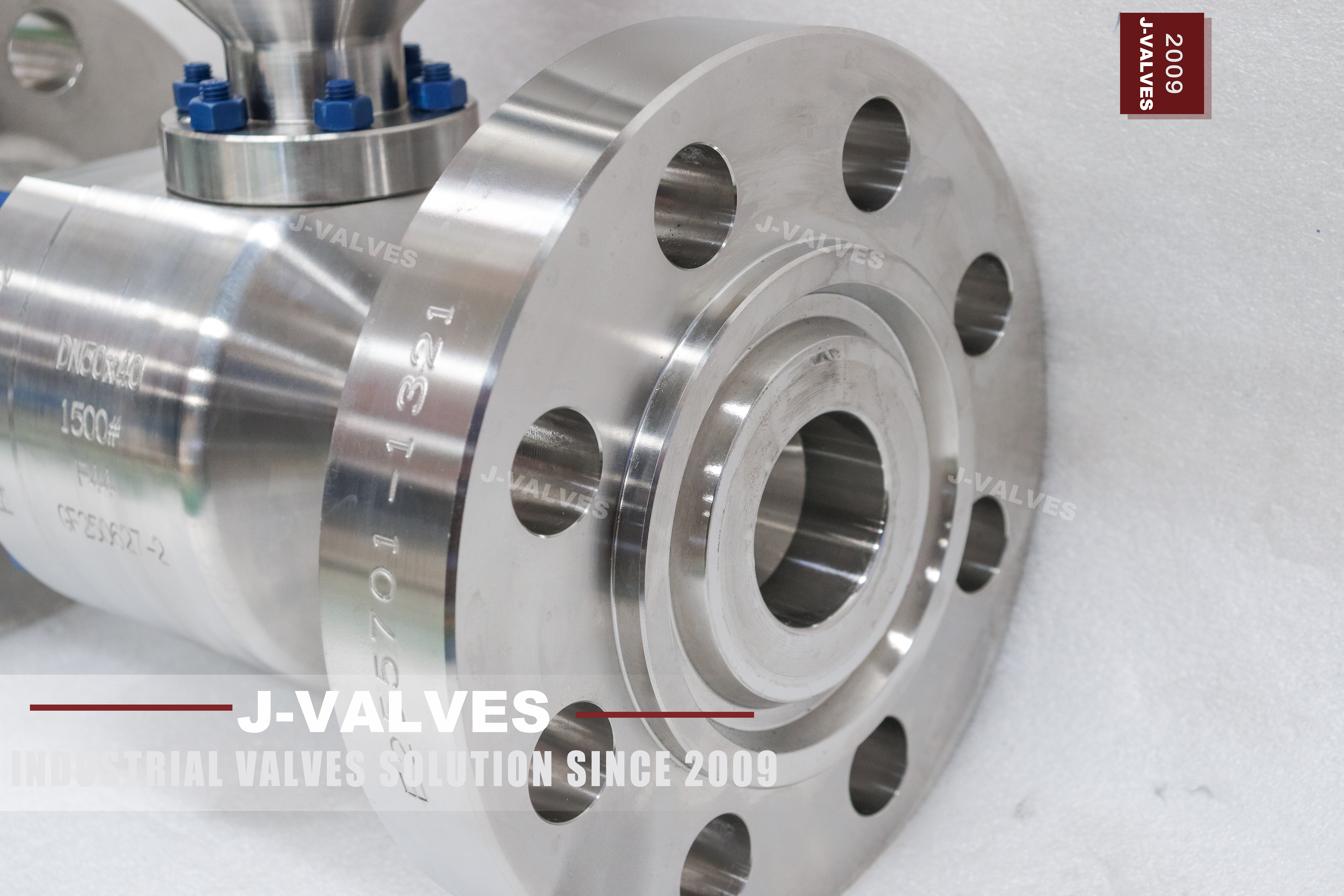
This is a two piece floating ball valve at Class 1500, with a 2 inch flange, a 1.5 inch bore and a forged F44 body. High pressure floating valves are a small family: above this class the seat load on a floating ball becomes impractical and a trunnion design takes over, so Class 1500 is close to the ceiling for this construction. What makes the valve work at this class is the joint and the seat, not the material.
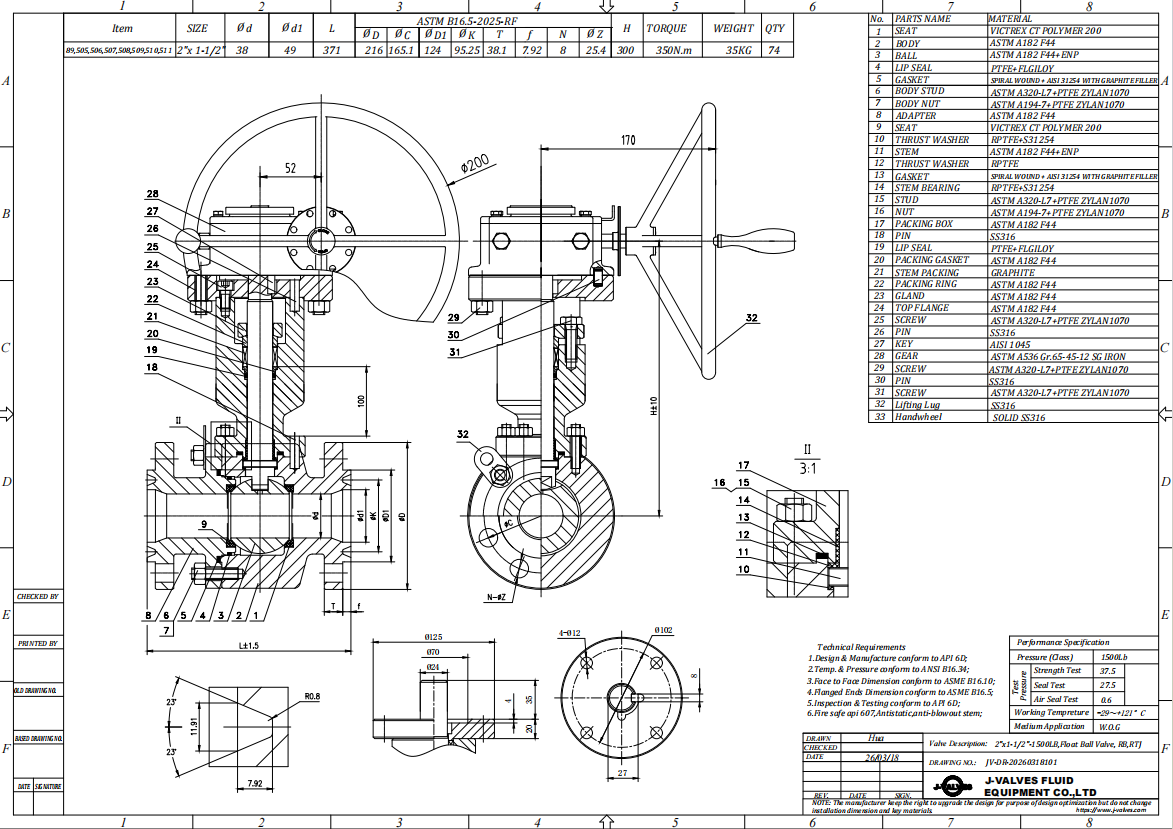
The number that matters most on the drawing is the torque, and it is the number most often left as a catalogue value. At Class 1500 the breakaway torque moves with the seat compound, the temperature and the pressure, so it has to be measured on the assembled valve and issued with the drawing. An actuator or a gearbox sized on a table figure is how a valve ends up unable to open against its own seat load.
Design and Construction
The body is forged in two pieces and joined at one flange with a machined spigot and recess. At Class 1500 that joint is the critical feature of the whole valve: the internal pressure tries to open it, the studs have to hold it closed, and the gasket has to stay in its groove while they do. The spigot locates the two halves so the seats stay coaxial, which is why the joint faces are cut before the seat pockets rather than after.
The ball floats, which at this pressure means the seat load is high and the seat ring has to be supported rather than allowed to extrude. That is why the seat is PEEK rather than PTFE above 150 C, and why the metal seated option exists. The end cap faces downstream, so the joint sits on the low pressure side while the valve is closed, which is the only reason a single joint is workable at this class.
Material Options
F44 is specified for chloride resistance, and at Class 1500 it also has to carry the wall, which is why the body is forged rather than cast. The alloy is ASTM A182 F44, which is UNS S31254, and the certificate chemistry is the only reliable proof of it: F44, 316 and 904L are indistinguishable on a shelf and a mixed charge at the forge does not show up in the finished part.
The seat is the part that sets both the temperature and the price. PTFE at 150 C, RPTFE at 180 C, PEEK at 260 C and PPL at 280 C, with a hardfaced metal seat for the top of the range. At Class 1500 the step from PTFE to PEEK is usually about temperature rather than pressure, but it also changes the torque, which is why the seat compound has to be on the order before the actuator is sized.
| Component | Standard Material | Optional Upgrade | Service Notes |
|---|---|---|---|
| Main body | ASTM A182 F44 forging, UNS S31254 | None, F44 is already the high grade | Carries the stem, packing and upstream seat |
| End cap | ASTM A182 F44 forging | Same heat as the main body | Carries the downstream seat, joint on the low pressure side |
| Ball | F44, hard chrome or nitrided | Alternate hardfacing on request | Floats on line pressure at Class 1500 |
| Stem | F44 | 17-4PH for a harder stem | Blowout proof shoulder above the packing |
| Stem extension | F44 tube with a guide bush | Length to the operating level | Moves the operator, not the packing |
| Seat | PTFE or PEEK | RPTFE, PPL, hardfaced metal | PEEK is the usual step up at this class |
| Packing | High density flexible graphite | None, graphite is the standard here | Adjusted at the gland on the body |
| Joint gasket | Ring type joint, metal | Soft iron or stainless ring by medium | Confined in the groove, no extrusion path |
| Bolting | A193 B7 with A194 2H | B7M for sour service | Torque figure from the drawing, not from a table |
| Operator | Lever at the extension top | Worm gear or actuator | ISO 5211 pad at the extension top |
Technical Specifications
Two size numbers, one pressure number and one length. DN50 is the flange, DN40 is the bore, Class 1500 is the rating whose API 6D code is PN250, and the face to face follows ASME B16.10. On an extended stem valve the drawing has to carry the body length and the overall length separately, otherwise the valve arrives either too short for the jacket or too long for the space.
At this class the flange is a ring type joint, and the ring is a separate purchased item whose material is chosen for the medium: soft iron for general service, stainless for corrosive, and a matched alloy where the flange is stainless. A ring joint that is reused after being compressed once is a leak, which is why the ring is a consumable on the spares list rather than a part that comes off and goes back on.
| Item | Value |
|---|---|
| Product type | Two piece flanged floating ball valve, extended stem |
| Nominal size | DN50 x DN40, 2 x 1.5 inch, reduced bore |
| Pressure class | Class 1500 (marked 1500LB), PN250 in the API 6D designation |
| Body material | ASTM A182 F44 forged stainless, UNS S31254 |
| Body material note | F44 as stamped; no trade name or alias is used on this page |
| Body construction | Two piece, one bolted joint, ring type joint facing |
| Joint design | Machined spigot and recess, four studs at this size |
| Ball | F44, hard chrome plated or nitrided |
| Stem | F44, or 17-4PH where a harder stem is wanted |
| Stem extension | Length to the insulation or to the operating level |
| Seat | PTFE to 150 C, PEEK to 260 C |
| Seat option | RPTFE to 180 C, PPL to 280 C, hardfaced metal seat |
| Seat design | Floating ball, downstream seat loaded by line pressure |
| Packing | Flexible graphite, high density |
| Body joint gasket | Ring type joint, metal to metal, confined in the groove |
| Bolting | A193 B7 with A194 2H, torque from the drawing |
| End connection | Flanged ring type joint (RTJ), ASME B16.5 Class 1500 |
| Face to face | ASME B16.10, body and overall dimensions stated separately |
| Bore | DN40 through the body, reduced from the DN50 flange |
| Design standard | ASME B16.34, API 608 |
| Test standard | API 598 |
| Shell test | 1.5 times the Class 1500 rating, per valve |
| Seat test | 1.1 times the rating, both directions |
| Temperature range | -29 to 425 C body, ceiling set by the seat |
| Media | High pressure water, gas, chloride bearing liquid, chemical process |
| Operation | Lever at the extension top |
| Operation option | Worm gear, pneumatic or electric on the extension |
| Mounting | ISO 5211 pad at the top of the extension |
| Torque | Measured at the rated pressure, issued with the drawing |
| Traceability | EN 10204 3.1 certificate with the heat number and chemistry |
Standards and Compliance
At Class 1500 the compliance question is almost entirely about the joint. ASME B16.34 sets the wall, ASME B16.5 sets the flange and its ring groove, ASME B16.20 sets the ring itself, and API 598 sets how the assembly is proved, which means four documents describing the same joint from four different angles. API 608 then adds the three ball valve requirements that have nothing to do with pressure: anti static, blowout proof stem, nameplate.
The material certificate to EN 10204 3.1 does more work on this valve than on a carbon steel one, because the grade cannot be checked with a magnet or by eye. The certificate carries the heat number and the chemistry, and the heat number is what ties the certificate to the body in front of you. A certificate that names a grade without a heat number cannot be tied to a specific valve.
| Requirement | Standard | What J-VALVES Supplies |
|---|---|---|
| Wall and rating | ASME B16.34 | Forged wall tabulated for Class 1500 in austenitic material |
| Valve design and marking | API 608 | Anti static path, blowout proof stem, nameplate content |
| Flange drilling and facing | ASME B16.5 Class 1500 | Ring type joint groove, not a raised face, at this class |
| Face to face | ASME B16.10 | Body length and overall length on the drawing |
| Pressure test | API 598 | Shell 1.5 times and seat 1.1 times the rating |
| Joint gasket | ASME B16.20 | Ring joint ring material matched to the medium |
| Material certificate | EN 10204 3.1 | Heat number and chemistry, which is how F44 is verified |
| Pressure code | API 6D clause 7.2 | Class 1500 is PN250 |
| Actuator interface | ISO 5211 | Pad at the extension top, drive size on the drawing |
Manufacturing Process
The body is forged, solution annealed and then machined as a pair so the joint faces and the seat pockets come from the same setting. Solution annealing is not a formality on a super austenitic grade: the molybdenum and nitrogen stay in solution only if the cooling is fast enough, and a slow cooled forging precipitates secondary phases at the grain boundaries and loses the corrosion resistance the grade was bought for.
The ring groove is cut after the joint faces and checked against ASME B16.20 with a profile gauge, because a groove that is a few hundredths deep will leak with a perfect ring. The seat pockets are then cut, the ball is lapped in place, and the assembly is torqued to the drawing figure before the shell test, so that the test reflects the joint as it will be in service.

Quality Control and Testing
The shell test at Class 1500 is the test that finds a joint problem, and it is run before painting so that a weep at the joint does not have to be found through a coating. Both the body and the joint are pressurised, the joint is watched for the full holding time, and a joint that weeps is opened, examined for groove damage and reassembled with a new ring rather than retorqued.
Torque is measured at the rated pressure with the seat compound fitted, at the top of the extension where the operator applies it. That figure goes on the drawing and it is what an actuator is sized against. Anti static continuity is measured from the ball to the body flange on every valve, because a dry seat insulates the ball and the path has to be built with a spring loaded contact rather than assumed.
| Step | What Is Checked | Standard or Acceptance |
|---|---|---|
| Chemistry | Chromium, nickel, molybdenum, nitrogen for the PREN | Spectrographic analysis per heat on the 3.1 certificate |
| Grade identity | F44 against 316 or 904L on the finished body | Positive material identification on every body |
| Joint face flatness | Both joint faces before assembly | Checked on a surface plate |
| Ring groove | Groove profile and surface finish | Gauged against ASME B16.20 |
| Shell test | Body and joint at Class 1500 | 1.5 times the rating, held to API 598 |
| Seat test | Both directions | 1.1 times the rating, no visible leakage |
| Torque | Breakaway torque at the rated pressure | Measured, issued with the drawing |
| Extension runout | Stem square over the extension length | Dial gauge at the top of the extension |
| Anti static | Ball to body continuity | Measured in ohms per valve |

Applications and Industry Service
The valve is used on high pressure water and gas lines, chemical process lines where chlorides rule out 316, and injection skids where the pressure is set by the process rather than by the pipe class. The reduced bore is deliberate on most of those duties: the line is sized for a flow that a DN40 bore can pass, and a full bore valve at Class 1500 would cost more and weigh more for no gain.
It should not be sold into a line that needs a full bore for pigging, into a duty above the seat ceiling, or into a service where the pressure cycles often enough that a soft seat would creep. Above Class 1500 the floating construction stops being practical and a trunnion valve is the right product, which is a design limit rather than a catalogue gap.

Installation, Operation and Maintenance
The valve goes in with the end cap downstream, the ring joint correctly seated in its groove, and the studs lubricated before assembly. At Class 1500 the stud preload is high and an uneven pull distorts the joint face, so the cross pattern is done in three stages with a torque wrench rather than with a spanner. The valve is not a pipe support and must not be used to pull two flanges together.
The maintenance discipline on this valve follows from the joint rather than from the seat. A seat change still means opening the joint and lifting the end cap, but at Class 1500 the studs come out only after the line is isolated and the pressure is proven zero at the drain, and they go back in with a new ring and a torque wrench rather than a spanner. The old ring is discarded even if it looks unmarked, because it has taken a set and will not seal again at this class however hard the flange is pulled.
How to Specify and Order
An order needs DN50 flange with DN40 bore, Class 1500, F44 body and trim, ring type joint facing with the ring material, the seat compound with its temperature, and the extension length if one is required. The two items most often missing are the ring material and the seat compound, and both change the price and the delivery more than the body grade does.
Ask for the EN 10204 3.1 certificate with the heat number and chemistry, the pressure test record, the ring groove inspection and the measured torque at the top of the extension. Spares worth holding are a ring joint, a seat and O ring kit and a set of packing rings. On a Class 1500 valve the ring is the cheapest item on that list and the one that stops a reassembly.
FAQ
Q: Is Class 1500 the same as PN260?
A: No. API 6D clause 7.2 lists Class 1500 as PN250, and no flange table contains a PN260 row. The valve is ordered and marked as Class 1500, and a drawing that says PN260 is using a rounded bar conversion as if it were a designation.
Q: Why is the seat PEEK rather than PTFE at this class?
A: Because PTFE creeps under the seat load at high pressure and high temperature, and a crept seat leaks. PEEK holds its shape to 260 C and carries a higher load, so the step from PTFE to PEEK is usually about temperature but is also about extrusion resistance at Class 1500.
Q: Why use a ring type joint instead of a flat gasket?
A: At Class 1500 a flat gasket is pushed outward by the internal pressure faster than the bolts can hold it. A ring joint confines the ring in a machined groove so it has nowhere to extrude to, and the seal is metal to metal rather than a compressed sheet.
Q: Can the ring joint be reused?
A: No. The ring is compressed once and takes a set, so a reused ring leaks. It is a consumable and belongs on the spares list. The groove is inspected for damage every time the joint is opened, because a dented groove will leak with a new ring as well.
Q: Why is the torque measured instead of quoted from a table?
A: Because at Class 1500 the breakaway torque moves with the seat compound, the temperature and the pressure. A catalogue figure is a guess for a specific build, and an actuator sized on a guess is how a valve ends up unable to open against its own seat load.
Q: What does DN50x40 mean here?
A: DN50 is the flange size and DN40 is the bore, so the valve bolts to a two inch line and passes a 1.5 inch flow. It is a reduced bore design, and the pressure drop across the reduction should be checked against the duty before ordering.


Hot Products


News
Ball Valves in Geothermal Brine: Silica Scale, Chloride Cracking And The Cooling Trap
Why geothermal brine destroys ball valves: retrograde silica scale, calcite at the flash point, chloride cracking above 60 C and the 250 C seat limit.
Read More
Ball Valve Face To Face Dimensions: Why A Correctly Ordered Replacement Still Does Not Fit
A 6 inch Class 150 ball valve can be 267 or 305 mm face to face and both are compliant. How B16.10, EN 558 and flange drilling decide whether it fits.
Read More
Ball Valve Stem Key And Keyway: What Gives Way First, And What The Handle Cannot Tell You
Between the handle and the ball there are four fits. Which one shears, which one cracks, and how a few degrees of lost motion hides a valve that never seated.
Read More
Ball Valve Datasheet: Six Blocks That Decide Whether Two Quotes Are Comparable
A ball valve datasheet only works when six blocks are fixed: pressure basis, bore, temperature ceiling, test, end connection, operator. How each is written.
Read More