


CHINA J-VALVES Offers Various High-quality I ndustrial Ball Valves
J-VALVES, a distinguished professional ball valve manufacturer rooted in China, takes pride in its extensive product portfolio. Our offerings span a wide range, including trunnion-mounted ball valves, floating ball valves, high-temperature ball valves, high-pressure ball valves, metal-sealed ball valves, ultra-low temperature ball valves, DBB ball valves, Three-way And Four-way Ball Valve, and fully welded ball valves. Each product is a testament to our commitment to precision engineering and reliable performance. Meticulously crafted, they are designed to not only meet but exceed the most stringent industrial demands, ensuring stable operation even under extreme conditions. This enables us to provide our clients with high-value services and makes our valves widely sought-after in industries.
Product Category
Contact Us


-
J-VALVES-Q347F
-
J-VALVES
Overview of the J-VALVES 16 Inch 300LB WCB Two Piece Trunnion Ball Valve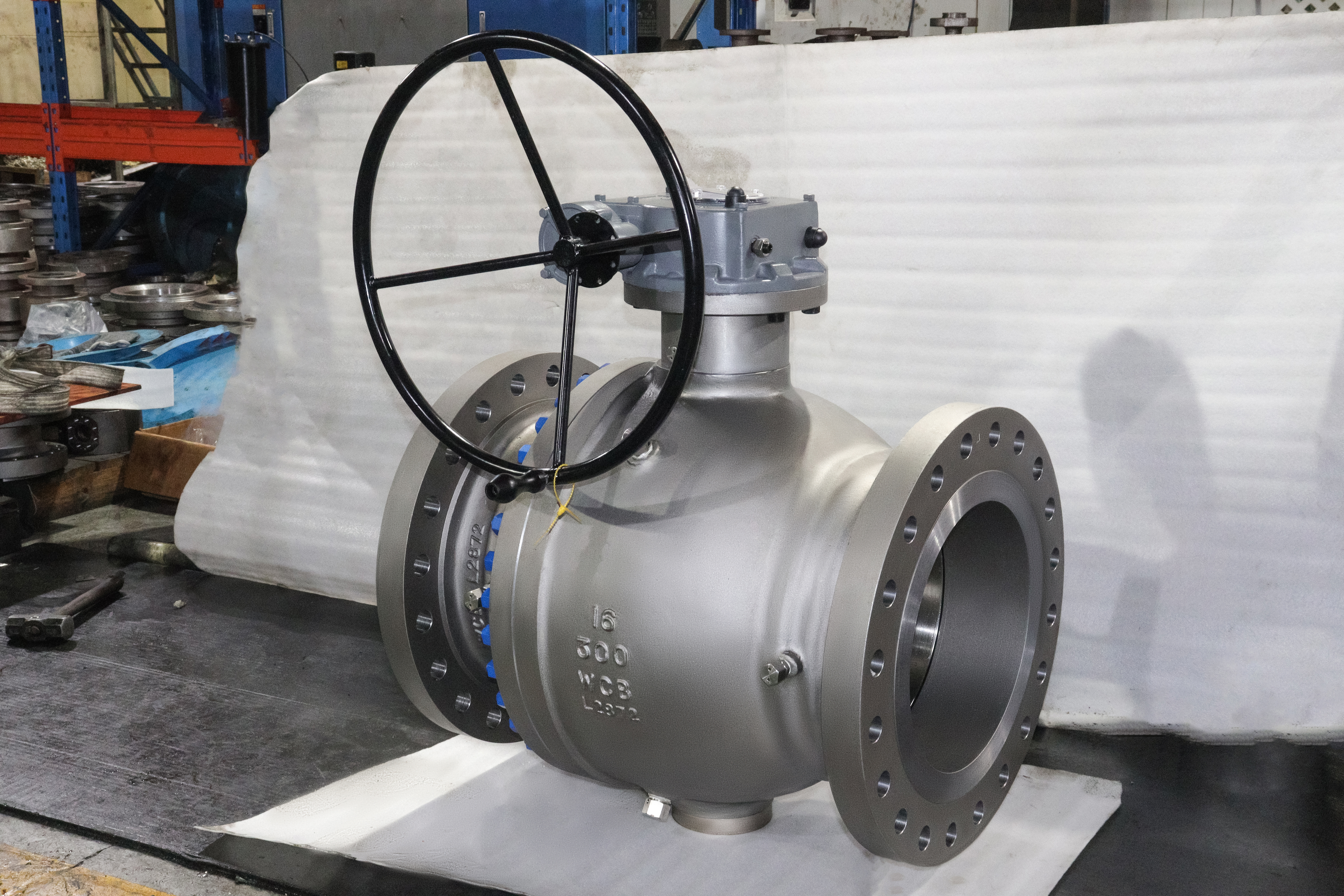
This valve is described as maintainable in line, and the phrase is true for part of it and false for the rest. Three jobs can be done with the valve still bolted between its flanges: the upper stem seal, the seat injection fittings, and the drain in the body cavity. The fourth, replacing the ball or a seat ring, needs one side of the line opened. The page does not draw that line, so a maintenance plan built on it rests on a promise the valve cannot keep.
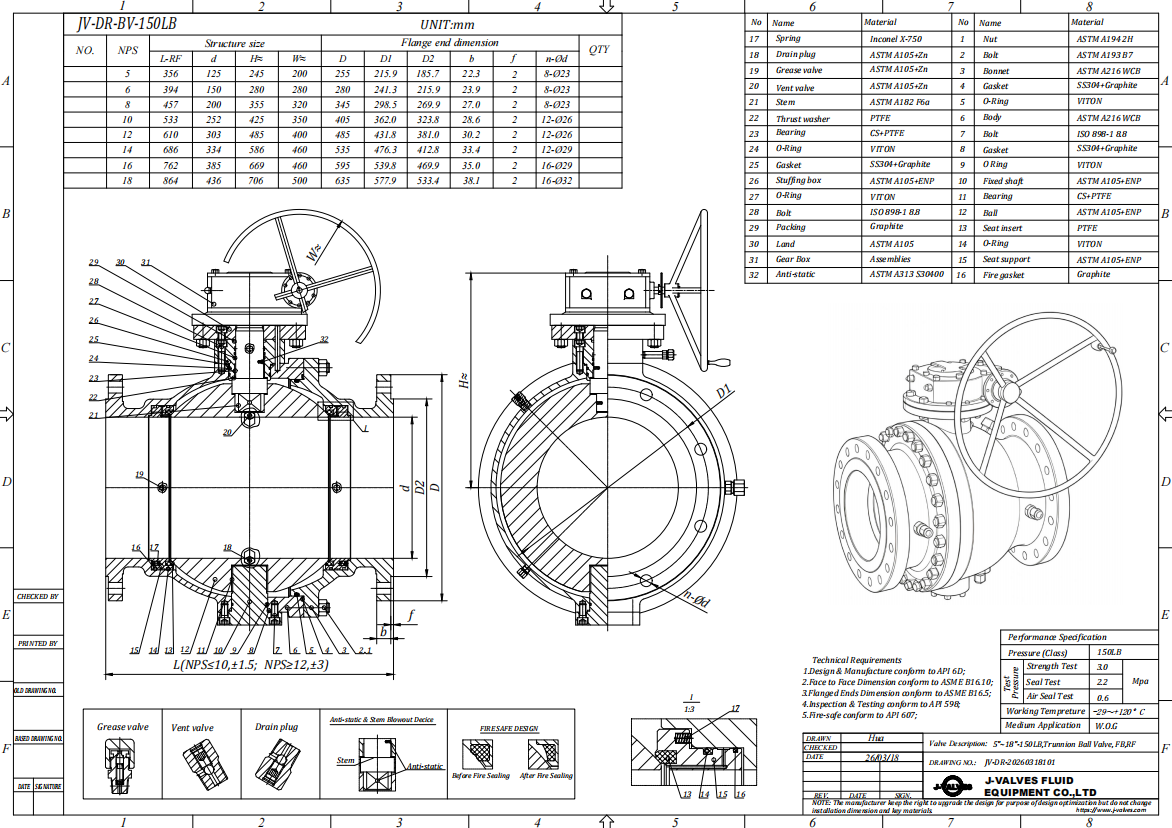
What puts the ball on the far side of the line break is the body style. At sixteen inch the ball goes in through the end opening and is carried by an upper and a lower trunnion in bearing blocks, so it cannot pass through the bore or the stem opening. Every part that wears on the sealing path therefore sits behind a flanged joint. This page is about that boundary, and about what to write on the order so the boundary is agreed before the valve is built.
Design and Construction
The body is two pieces: a main body that carries the trunnions and the stem, and one end cap on a bolted joint. At this size the joint is a ring of studs around a gasket and it is a pressure boundary in its own right, tested with the shell rather than after it. Two piece means one joint instead of two, which is cheaper to make and slightly slower to open, because the end cap carries a seat and the ball has to come past it.
The ball is supported at top and bottom. In the smaller sizes of this series the trunnions sit in the primary body; from six inch upward they sit in two bearing blocks, which is what allows a ball of this diameter to be machined, carried and replaced as one part. The trunnions take the side load from line pressure so that the stem does not, and the ball turns on them instead of being pressed into the downstream seat by the whole differential.
The stem enters through the body, is retained by the body cover, and carries an anti blowout shoulder as API 6D requires. Above that shoulder sit the gland and the packing, and the point of the arrangement is that the shoulder, not the gland, holds the stem against pressure. A gland plate can therefore be lifted and the upper stem seal renewed while the valve is closed and the cavity vented, which is the first of the three in line jobs claimed for this valve.
Material Options
The body is cast carbon steel, WCB, and the ball is WCB or A105 with a nickel deposit, a hard chrome deposit or a stainless overlay. The trunnions are surface hardened A105 or 17-4PH, and the stem is 17-4PH. Those codes are what the plate carries and what the certificate is written against; where a particular alloy family is needed for the medium, that is a question for the certificate rather than for the product name.
The seat list runs from PTFE through reinforced PTFE, PPL and PEEK to a metal seat with a graphite seal. Each of them sets a ceiling lower than the body rating, and the metal seat is the only one that reaches the top of the published temperature range. The seat is also the part that the in line work cannot reach, which is why the seat choice decides how often the line has to be opened rather than how often the valve is serviced.
The packing is graphite with a wire reinforcement or PTFE V rings, and the choice follows the seat rather than the body: a metal seat run hot needs graphite above it, and a soft seat run cool does not. Where the plant is regulated for fugitive emissions, the stem arrangement is tested and certified to ISO 15848 as a separate claim, and a fire certificate does not stand in for it. The two certificates answer different questions, and neither one is a statement about seat tightness.
| Component | Standard Material | Optional Upgrade | Service Notes |
|---|---|---|---|
| Body | WCB cast carbon steel | on the order | code on the plate |
| End cap joint | one bolted joint with a gasket | spiral wound or ring joint | renewed at every break |
| Ball | WCB or A105 with nickel, chrome or stainless overlay | on the order | enters through the end opening |
| Trunnion | surface hardened A105 or 17-4PH | bearing blocks from six inch up | takes the side load |
| Stem | 17-4PH with an anti blowout shoulder | on the order | gland sits above the shoulder |
| Seat | PTFE | reinforced PTFE, PPL, PEEK or metal with graphite | sets the temperature ceiling |
| Seat injection | standard from six inch up | option on smaller sizes | buys time, not life |
| Body cavity | drain plug in the lower body | vent combined on small sizes | proves a passing seat |
| Operator | worm gear | pneumatic, electric or hydraulic | gear is standard at this size |
Technical Specifications
Class 300 is written as PN 50 in the API 6D pressure code list, and the two designations describe one rating rather than two. Writing both is harmless; writing neither, or writing a number taken from a conversion table, is what produces a valve that cannot be matched to a flange. At sixteen inch the flange is still inside ASME B16.5, which runs to twenty four inch, so no series decision is needed here. Above that size the flange moves to B16.47 and the series has to be chosen.
The face to face length comes from ASME B16.10 for this size and class, and the value belongs in the size table rather than in a paragraph. What matters for this valve is that the end preparation is part of that length: a raised face and a ring joint are two different preparations with two different overall lengths, and they are two different valves. A ring joint groove cannot be cut on site, so the choice has to be made on the order.
Testing is to API 598 or to API 6D, and both apply the same multiples: one and a half times the rating for the shell, one and a tenth for the seat, each in both directions. The in line claim on this page has no effect on the test. What does change with the seat is the acceptance, because a soft seat is expected to show no visible leakage and a metal seat is judged against a permitted rate instead.
| Item | Value |
|---|---|
| Nominal size | 16 inch (DN400) |
| Pressure class | class 300, written as PN 50 in the API 6D code list |
| Body style | two piece, one bolted body joint |
| Ball support | trunnion mounted, upper and lower |
| Trunnion housing | bearing blocks from six inch upward |
| Bore | full bore or reduced bore to API 6D table 1 |
| Body material | WCB cast carbon steel, code as stamped |
| Ball material | WCB or A105 |
| Ball finish | nickel deposit, hard chrome or stainless overlay |
| Trunnion material | surface hardened A105 or 17-4PH |
| Stem material | 17-4PH with an anti blowout shoulder |
| Stem retention | stem retained by the body cover |
| Seat material | PTFE as standard |
| Seat options | reinforced PTFE, PPL, PEEK or metal with graphite |
| Seat injection | standard from six inch upward |
| Body cavity | drain plug in the lower body |
| Packing | graphite with wire reinforcement, or PTFE V rings |
| Fugitive emission option | ISO 15848 tested arrangement on request |
| End connection | ASME B16.5 raised face or ring joint |
| Face to face | ASME B16.10 for this size and class |
| Design standard | API 6D, with ASME B16.34 and API 608 underneath |
| Test standard | API 598 or API 6D |
| Shell test | one and a half times the rating |
| Seat test | one and a tenth times the rating, both directions |
| Temperature range | minus 29 to plus 425 Celsius, metal temperature |
| Temperature ceiling | set by the seat and the packing, not by the body |
| Operation | worm gear as standard at this size |
| Service access | stem seal, injection and cavity drain in line; ball and seats need the line broken |
Standards and Compliance
Three documents meet on this valve. API 6D is the specification for a pipeline valve and carries the design, the marking and the test requirements. ASME B16.34 supplies the pressure and temperature ratings and the minimum wall that goes with them. API 608 is the general ball valve standard and overlaps both. Where an order names all three, it has to say which one governs when they disagree, because a certificate written to one is not evidence for the other two.
The specification block on the page lists API 6D, API 6DSS and API 6A PSL4 as licences. The first applies. The second is the subsea version of the same specification and the third is a wellhead standard with its own temperature classes, and neither describes a flanged process valve at class 300. A licence list is a statement about the workshop, not about the item on the page, and an order should quote the standard that governs the delivery.
Fire safe is a type test and the procedures are separate: API 607, API 6FA and ISO 10497 are not interchangeable certificates, and a page listing all three has to say which one was run on which size. Anti static is a separate requirement again, met by a device that keeps a conductive path between ball, stem and body. Neither of them says anything about seat tightness in normal service, which is what the seat test is for.
| Requirement | Standard | What J-VALVES Supplies |
|---|---|---|
| Pressure boundary | ASME B16.34 | rating and minimum wall |
| Pipeline valve | API 6D | design, marking and test |
| General ball valve | API 608 | overlapping requirements |
| Flange | ASME B16.5 | sixteen inch is inside the size limit |
| Face to face | ASME B16.10 | value stated in the size table |
| Testing | API 598 or API 6D | 1.5 times shell, 1.1 times seat |
| Anti blowout | API 6D | stem retained by the body cover |
| Fire test | API 607, 6FA or ISO 10497 | named, and not interchangeable |
| Fugitive emissions | ISO 15848 | separate claim and separate test |
Manufacturing Process
The body is cast, cleaned and machined from the flange faces inward, so that the bore, the seat pockets and the bearing bores are cut from the same reference. On a ball this size the two bearing bores have to be coaxial with each other, because the trunnions run in them and any offset shows up as a ball that is hard to turn or a seat that loads unevenly. That alignment is set in the machining sequence and is not something assembly can correct.
Assembly puts the ball in through the end opening, fits the seats and the trunnions, and closes the joint on a new gasket with the studs taken down in a cross pattern. The gasket is a consumable: every time the joint is opened, whether for a seat or for an inspection, a new one goes in and the joint is re-tested afterwards. That recurring cost belongs in the maintenance plan rather than in the spare parts budget, because it is bought with every intervention.

Quality Control and Testing
The certificate is written against the heat number stamped on the plate, and a material identification report is issued against the same heat when the order asks for one. It matters here because a cast carbon steel body and a cast stainless body can leave the foundry looking alike after painting, and the plate code is the only thing at goods in that says which one arrived. The certificate follows the plate; it does not replace the check.
The shell test is run at one and a half times the rating with the joint assembled, so it tests the body wall and the joint at the same time. The seat test follows in both directions, and on a trunnion valve the cavity is monitored as well, because a seat that passes on one side and leaks into the cavity is still a valve that fails its function. The record names the standard and the size it was run on.
The dimensional check is where a large valve is won or lost: the flange is measured against ASME B16.5 at sixteen inch, the face to face against B16.10, and the stem shoulder and the gland are checked so that the upper seal can actually be reached from outside. A valve that is correct on paper and short of shoulder travel cannot be serviced in line, which is the whole claim being made for it: service access is a dimension on the drawing, not a promise in a feature list.
| Step | What Is Checked | Standard or Acceptance |
|---|---|---|
| Casting | heat number and certificate | read against the plate code |
| Material identity | report against the same heat | quoted when the order asks |
| Bearing bores | coaxial with the bore | set in the machining sequence |
| Flange | measured to ASME B16.5 | sixteen inch, class 300 |
| Face to face | measured to ASME B16.10 | includes the end preparation |
| Shell test | wall and joint at 1.5 times | run with the joint assembled |
| Seat test | both directions, cavity monitored | a leak into the cavity fails |
| Marking | plate, certificate and drawing | size, class, code, heat |

Applications and Industry Service
The valve suits a large line that is cycled rarely and has to be repairable without a crane: tank farm headers, utility headers, metering runs and plant isolation points where the valve is worked a few times a year and the cost of a shutdown is the cost of the day. At sixteen inch the operator is a worm gear as standard, because the torque at this diameter is past what a lever can be trusted with, and the gear also gives the advantage needed to seat the ball fully.
It is the wrong valve where the line has to be pigged, because a two piece trunnion valve of this size is not a pig trap and its bore, seats and cavity are not built to pass a tool. It is also the wrong valve where the process demands a seat inspection at every shutdown rather than a seat renewal, and where the line is subsea or on a wellhead, since those are different specifications with different certification and nothing on this page changes that.

Installation, Operation and Maintenance
The three in line jobs are these. The upper stem seal is the one replacement that needs no line break: it can be renewed after the valve is closed and the cavity vented, because the anti blowout shoulder holds the stem while the gland is lifted. The emergency seat injection fittings, standard from six inch upward, let sealant be pushed to a seat ring that is passing, which buys time rather than life. The drain plug in the lower body empties and samples the cavity, and that is how a passing seat is proved rather than assumed.
The three that need the line broken are the ball, the seat rings and the body gasket. Isolate, drain, vent the cavity, release the joint studs in a cross pattern, take the end cap off, and the ball and one seat are in front of you. The other seat is behind the ball and comes out the same way. The joint goes back on a new gasket and the valve is re-tested before it returns to service, which is why the gasket belongs in the store.
How to Specify and Order
The order needs the size, the class written once as class 300 or PN 50, the flange as ASME B16.5 with the facing named, the bore, the body code, the ball finish, the seat, the packing, the operator, the test standard and the certificate grade. Of those, the facing and the seat are the two that cannot be changed afterwards without changing the valve, and both are settled at the quotation rather than at delivery.
Then write which items have to be serviceable in line, and make the drawing show the shoulder that allows it. An order that asks for in line maintenance without naming the item will be met with whatever is standard, and the standard answer is the stem seal and the injection fittings, not the seat. Naming the item is what turns a feature list into a specification that can be checked on arrival.
FAQ
Q: Can the ball be replaced with the valve still in the line?
A: No. At sixteen inch the ball enters through the end opening and runs on two bearing blocks, so it cannot pass the bore or the stem opening. One side of the line has to be opened and the end cap removed. What can be done in line is the upper stem seal, the seat injection fittings and the cavity drain, and those are the three jobs the standard answer refers to.
Q: Which parts are actually serviceable in line?
A: The upper stem seal, because the anti blowout shoulder holds the stem while the gland is lifted; the seat injection fittings, which are standard from six inch upward and push sealant to a passing seat ring; and the drain plug in the lower body, which empties and samples the cavity. All three need the valve closed and the line isolated, and none of them restores a worn seat.
Q: Why do the trunnions sit in bearing blocks at this size?
A: Because the ball has to be machined, carried and replaced as one part, and at this diameter that means it is held at top and bottom in separate blocks rather than in the body itself. The blocks take the side load that line pressure puts on the ball, so the stem does not carry it, and they are also the reason the ball can only leave through the end opening.
Q: Is class 300 the same as PN 50?
A: They are two designations for the same rating. The API 6D pressure code list pairs class 300 with PN 50, in the same way that it pairs class 150 with PN 20 and class 600 with PN 100. The flange itself is a separate decision, and at sixteen inch it is an ASME B16.5 flange whether the order calls the rating class 300 or PN 50.
Q: Does the API 6DSS licence on the page apply to this valve?
A: No. API 6DSS is the subsea version of the specification and API 6A PSL4 is a wellhead standard with its own temperature classes. Neither describes a flanged process valve at class 300. The licence list describes what the workshop is approved for; the order should quote API 6D, which is the document this valve is built and tested to.
Q: What has to be on the order for in line service?
A: The facing, the seat, and a sentence naming the items that must be serviceable with the valve in the line. Ask for the drawing that shows the anti blowout shoulder and the gland arrangement, because that is what makes the stem seal reachable. An order that does not name the item gets the standard set: stem seal, injection fittings and drain, not the seat.


Hot Products


News
Ball Valve Spare Parts for Overseas Projects: The Wear Part List, The Quantity Math, And Four Traps
Why isolation valves fail on calendar time, not cycles. Wear part lists, Poisson stock maths, seat kit traps and the clauses that decide year six.
Read More
Ball Valves On A Bottom Loading Gantry: Creep, Dry Break And The Test That Proves Neither
A loading gantry cycles a ball valve far more than it is designed for and still cannot prove shut-off. Where creep starts, and what to specify.
Read More
Lined Ball Valves in Acid Service: The Liner Does Not Fail, The Steel Behind It Does
The valve came out of the line looking better than most valves that come out of a hydrochloric acid line. Three inch, PFA lined, cast body, Class 150, fourteen months in service on a 32 percent acid transfer duty at 55 to 60 degrees C, about forty open and close cycles a week. The paint was intact.
Read More
Ball Valves in Amine CO2 Capture: Heat Stable Salts, Rich Amine, And The Three Places The Body Thins
Rich amine at 110 C with heat stable salts is where capture plant ball valves fail. Materials, velocity limits, cavity gas and seat choice, with numbers.
Read More