


CHINA J-VALVES Offers Various High-quality I ndustrial Ball Valves
J-VALVES, a distinguished professional ball valve manufacturer rooted in China, takes pride in its extensive product portfolio. Our offerings span a wide range, including trunnion-mounted ball valves, floating ball valves, high-temperature ball valves, high-pressure ball valves, metal-sealed ball valves, ultra-low temperature ball valves, DBB ball valves, Three-way And Four-way Ball Valve, and fully welded ball valves. Each product is a testament to our commitment to precision engineering and reliable performance. Meticulously crafted, they are designed to not only meet but exceed the most stringent industrial demands, ensuring stable operation even under extreme conditions. This enables us to provide our clients with high-value services and makes our valves widely sought-after in industries.
Product Category
Contact Us


-
J-VALVES-Q47F
-
J-VALVES
Overview of the J-VALVES 6x4 Inch 2500LB F316 Three Piece Stainless Steel Trunnion Mounted Ball Valve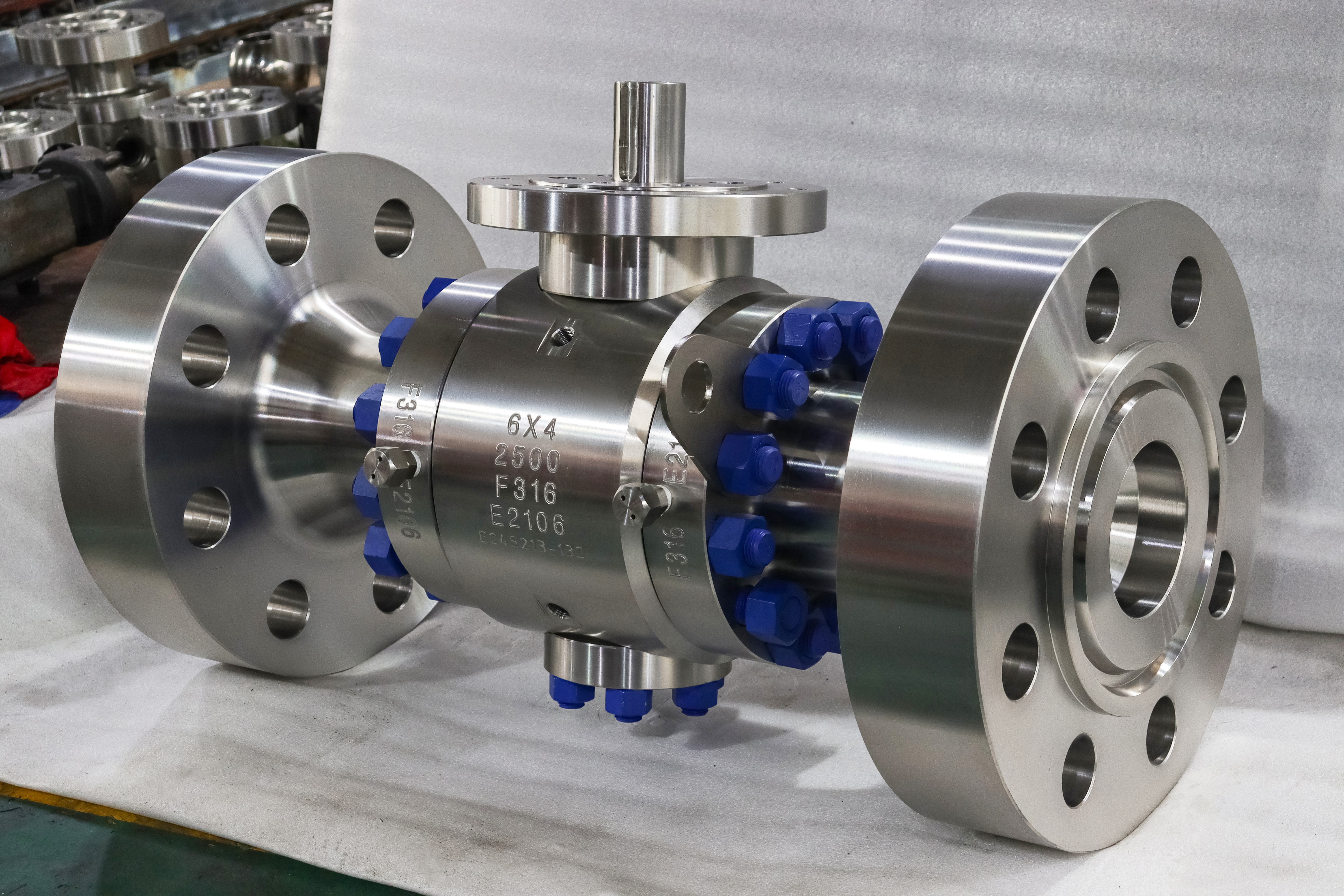
Six inch flanged ends, four inch bore, Class 2500, forged F316 body, three pieces, trunnion mounted ball, ring joint ends, gear operated. At this class the wall is thick, the flange is heavy and the test pressure is high, but none of those decide whether the valve can be opened. What decides that is the path the thrust takes: line pressure acting on the ball has to be carried somewhere, and in a trunnion valve it is carried by the bearings rather than by the seats.
The page lists the bearing as a line near the bottom of the specification: a martensitic stainless grade with a self lubricating liner, with a nickel alloy as the alternative. That line deserves more attention than the position it is given. The bearing sets the operating torque, it sets how the valve behaves after years of standing in one position, and it is the part whose failure is not obvious until the stem starts taking load it was never meant to take.
Design and Construction
The ball is pinned to upper and lower shafts, and those shafts run in bearings set into the body. Pressure on the ball becomes a thrust along the shaft axis, and the bearings pass it into the body instead of into the downstream seat. That is the whole reason a trunnion design exists: it separates sealing from carrying. The seats then only have to seal, which is why a metal seated valve can work at this class at all.
Reducing the bore from six inch to four inch changes the arithmetic. Thrust follows the bore area, so a four inch ball produces a little over half the thrust of a six inch one at the same pressure, and the torque the gearbox has to supply comes down with it. What does not change is the body, the flanges and the bearing arrangement, which are those of the six inch pattern. The reduction buys torque and weight, not a lighter pressure boundary.

Material Options
F316 is the forged austenitic stainless grade in the 316 family, and at Class 2500 it is bought for corrosion resistance rather than strength, because the wall is set by the class and the alloy has to be allowed to carry it. The body, both end pieces and the centre section are forged, and the certificate is what states the grade and the heat treatment. The ball is the same grade with hard chrome or nitriding, or a low carbon grade where the medium calls for it.
The bearing is the interesting choice. A martensitic stainless grade with a self lubricating liner is the standard answer: hard enough to take the thrust, with a liner that keeps the friction low without external lubrication. A nickel alloy is offered as the alternative where the medium or the temperature rules the standard bearing out. That alternative is a proprietary alloy on the page, so the order should name the requirement and let the certificate name the alloy.
| Component | Standard Material | Optional Upgrade | Service Notes |
|---|---|---|---|
| Body and end pieces | forged F316 austenitic stainless | as the certificate states | three pieces, two bolted joints |
| Ball | F316 with hard chrome or nitriding | low carbon grade | matched to the seat for hardness |
| Stem | precipitation hardening stainless or F316 | as the order states | takes load only if the bearing fails |
| Seat | metal primary seal with hard facing | polymer auxiliary seal | accepted on a leakage rate |
| Trunnion bearing | martensitic stainless with a self lubricating liner | nickel alloy where the medium requires | sets the operating torque |
| Packing | graphite | as the order states | gland adjustable |
| Operator | worm gear or bevel gear with bearings | pneumatic, electric or hydraulic | required at this class |
Technical Specifications
The size sheet gives the bore, the face to face to the ASME valve length standard for this size and class, and the ring joint dimensions for the Class 2500 flange. The face to face is taken from the standard rather than chosen, which is what allows a replacement valve to land in an existing spool. Overall height depends on the gearbox, so it is dimensioned on the signed drawing rather than printed as a catalogue number.
Class 2500 is written as PN 420 in the pressure class notation used for pipeline valves, and the page uses that designation correctly. The end facing at this class is ring joint; a raised face valve of the same size is a different product, with a different groove, a different gasket and a different face to face allowance. The bore is reduced from six inch to four inch, so the valve will not pass a pig even though its flanges are the size of the line.
| Item | Value |
|---|---|
| Nominal size | 6 x 4 inch (DN150 flanges, DN100 bore) |
| Pressure class | Class 2500, written as PN 420 |
| Body construction | three piece, forged, two bolted joints |
| Ball support | trunnion mounted on upper and lower shafts |
| Bore | reduced bore, DN100 |
| Body material | forged F316 austenitic stainless |
| Ball material | F316 with hard chrome or nitriding, low carbon grade optional |
| Stem | precipitation hardening stainless or F316 |
| Seat | metal primary seal with hard facing, polymer auxiliary |
| Seat acceptance | leakage rate to the order, not zero leakage |
| Trunnion bearing | martensitic stainless with a self lubricating liner, nickel alloy optional |
| Packing | graphite |
| End connection | ring joint to ASME B16.5, Class 2500 |
| Face to face | to ASME B16.10 for this size and class |
| Design standards | ASME B16.34 and API 6D |
| Test standards | API 598 and API 6D |
| Test pressure | shell 1.5 times and seat 1.1 times the class rating |
| Operating torque | measured at the gearbox input and shipped with the valve |
| Pressure class notation | PN 420 |
| Anti static | bonding between ball, stem and body per API 6D |
| Operation | worm gear or bevel gear; pneumatic, electric or hydraulic optional |
| Temperature range | minus 29 to plus 425 Celsius, metal temperature |
| Marking | size, class, body code, heat number |
| Documentation | EN 10204 3.1 plus the API 6D record package |
| Country of manufacture | China |
Standards and Compliance
ASME B16.34 sets the wall and the pressure temperature rating, and at Class 2500 both are the highest in the standard. API 6D adds the pipeline requirements: double block and bleed behaviour, cavity relief, anti static bonding, marking and a documentation package. API 608 is also listed and it is the general industrial ball valve standard; at this class and this size the pipeline specification is the one that carries weight.
The metal seat needs a word of its own, because it changes what acceptance means. A metal seated valve does not seal at zero leakage, and the standards accept it on a leakage rate rather than on a bubble count. The order has to state which rate applies, because a valve accepted on a soft seat criterion will be rejected on the test bench and a valve accepted on a metal seat criterion may be rejected at site by someone expecting a soft seat result.
| Requirement | Standard | What J-VALVES Supplies |
|---|---|---|
| Pressure boundary | ASME B16.34 | wall and rating table at Class 2500, written as PN 420 |
| Pipeline valve specification | API 6D | DBB, cavity relief, anti static, marking, documentation |
| Ball valve design | API 608 | general industrial requirements |
| Face to face | ASME B16.10 | length fixed by the standard for this size and class |
| Shell and seat test | API 598 | 1.5 times the rating for the shell, 1.1 times for the seat |
| Metal seat acceptance | leakage rate to the order | not zero leakage |
| Marking | API 6D and the order | size, class, body code, heat number |
Manufacturing Process
The forging is heavy for a four inch bore, because the body has to carry the six inch flange pattern and the Class 2500 wall. The critical machining is the pair of trunnion bearing bores: they have to be coaxial with each other and square to the ball centre, or the ball will run tight on one side, the torque will rise and the seat will wear unevenly. That alignment is checked before the seats are cut, not after.
The ball is ground and then plated or nitrided, and the seat is machined and hard faced where the design calls for it. Because the primary seal is metal, the ball and the seat have to be finished as a pair with a hardness difference between them; two surfaces of the same hardness will gall rather than slide. Assembly is vertical, the body joints are drawn down in stages, and the gearbox is set to the stops before the valve is tested.

Quality Control and Testing
Shell and seat tests follow API 598 and, where ordered, the additional 6D checks. At Class 2500 the test pressures are high, and the shell test is the point at which a defective forging or a badly made body joint shows. The seat test is run in both directions and, for a metal seat, is judged against the leakage rate written in the order rather than against zero. The result is recorded against the serial number.
Two checks are specific to this design and are worth naming on the order. The first is the bearing fit and the resulting operating torque, measured on the assembled valve with the gearbox fitted, because a bearing that is too tight shows up as torque rather than as a leak. The second is material identification on the body, the ball and the stem, since at this class a grade substitution is both easy to miss and expensive to discover.
| Step | What Is Checked | Standard or Acceptance |
|---|---|---|
| Forging | grade, heat number, mechanical properties | 3.1 certificate against the stamped code |
| Bearing bores | coaxiality and squareness to the ball centre | checked before the seats are cut |
| Ball and seat | hardness difference and surface finish | matched pair, checked before assembly |
| Assembly | body joint torque, gearbox stops | controlled torque, stops set before test |
| Shell test | no leakage through body or joints | API 598 at 1.5 times the rating |
| Seat test | both directions, metal seat by leakage rate | API 598 at 1.1 times the rating |
| Operating torque | measured at the gearbox input | recorded and shipped with the valve |

Applications and Industry Service
Six inch Class 2500 valves with a four inch bore turn up where the line size is fixed but the flow is smaller: wellhead and choke manifold piping, high pressure gas injection, chemical and petrochemical processes at high pressure, and test loops where a six inch connection is standard but the flow is modest. In all of those the flange is a connection standard and the bore is the process decision.
The valve is not suitable for a line that has to be pigged, because the reduction stops a pig, and it is not the economic choice where the flow really needs six inch, because a full bore valve of the same class is what that service wants. It is also not the right answer for a medium that would attack the forged austenitic grade, however good the pressure capability; at this class a material mistake is expensive in both directions.

Installation, Operation and Maintenance
Support the body and the gearbox; at this class the valve is heavy and the operator is a lever arm on the stem. Ring joint faces go together dry and clean with a new ring, studs brought down in a cross pattern in stages, and the faces confirmed parallel before the studs are loaded. Leave the cavity drain and vent accessible, and record the gearbox input torque at commissioning so that a later rise can be recognised as a bearing problem rather than blamed on the seat.
Maintenance is seat and ball replacement through the centre section, with the bearings inspected at the same time. A bearing that has seized or worn shows as a step in the torque curve, as play in the ball, or as a stem that turns without moving the ball. Because the primary seal is metal, the ball and seat are a matched pair and replacing one without the other usually results in a leak that was not there before.
How to Specify and Order
The order needs the flange size and the bore as two numbers, the class written once, the body grade, the seat type including the leakage rate for a metal seat, the facing as ring joint, the bearing requirement, the operator and the standards. The bearing line is easy to leave out and it is the line that decides the torque, so it should be written as a requirement rather than left to the standard build.
Before shipment, check that the nameplate, the certificate and the drawing agree, and ask for the measured operating torque to be recorded with the valve. Two valves of this size can look identical and behave very differently if one has a tight bearing and the other does not, and the torque figure is the only evidence that arrives with the valve rather than being discovered when it is installed.
FAQ
Q: Why does the bearing matter more than the seat at Class 2500?
A: Because thrust follows pressure and bore area, and at this class both are large. In a trunnion valve that thrust is carried by the bearings rather than by the seats, so the bearings decide how much torque the gearbox has to supply and how the valve behaves after standing in one position for a long time. The seat decides whether it seals; the bearing decides whether it can be turned to find out.
Q: What happens if a trunnion bearing fails?
A: The torque rises, and if the bearing seizes the load transfers to the stem, which was never sized to carry the ball thrust. The symptoms are a step in the torque curve, play in the ball, or a stem that turns without moving the ball. That is why the operating torque is worth recording at commissioning: a later rise is the earliest evidence of a bearing problem, and it is cheaper to act on than a sheared stem.
Q: Why is this valve reduced bore?
A: Because the line is six inch and the flow needs four. The reduction lowers the thrust on the ball, which lowers the torque and lets a smaller gearbox do the job, while keeping the six inch flanges that the pipe needs. The cost is that the valve will not pass a pig and that it restricts the line. Where neither of those matters, the reduced bore is the lighter and cheaper way to build a Class 2500 valve.
Q: Is the seat metal or soft?
A: The primary seal is metal, with a polymer auxiliary seal. That is why the valve is accepted on a leakage rate rather than on zero leakage, and why the order has to state the rate. A metal seat is chosen at this class because a polymer seat would extrude or deform under the seat load, but it comes with a different acceptance criterion, and the two are not interchangeable on a test certificate.
Q: What is the face to face dimension?
A: It follows the ASME valve length standard for a six inch Class 2500 valve, which is what allows a replacement to fit an existing spool without re-making pipe. It is not derived from the bore, and a four inch bore valve does not get a shorter face to face because of the reduction. Overall height is a different matter and depends on the gearbox, so it comes from the drawing rather than the length standard.
Q: Is PN420 the same as Class 2500?
A: Yes, in the pressure class notation used for pipeline valves, Class 2500 is written as PN 420. The page uses that designation correctly. What matters on an order is that one designation is used consistently across the nameplate, the test record and the flange drilling, because a certificate that mixes the two systems is a certificate that has to be queried before the valve can be accepted.


Hot Products


News
Ball Valves in Geothermal Brine: Silica Scale, Chloride Cracking And The Cooling Trap
Why geothermal brine destroys ball valves: retrograde silica scale, calcite at the flash point, chloride cracking above 60 C and the 250 C seat limit.
Read More
Ball Valve Face To Face Dimensions: Why A Correctly Ordered Replacement Still Does Not Fit
A 6 inch Class 150 ball valve can be 267 or 305 mm face to face and both are compliant. How B16.10, EN 558 and flange drilling decide whether it fits.
Read More
Ball Valve Stem Key And Keyway: What Gives Way First, And What The Handle Cannot Tell You
Between the handle and the ball there are four fits. Which one shears, which one cracks, and how a few degrees of lost motion hides a valve that never seated.
Read More
Ball Valve Datasheet: Six Blocks That Decide Whether Two Quotes Are Comparable
A ball valve datasheet only works when six blocks are fixed: pressure basis, bore, temperature ceiling, test, end connection, operator. How each is written.
Read More