


CHINA J-VALVES Offers Various High-quality I ndustrial Ball Valves
J-VALVES, a distinguished professional ball valve manufacturer rooted in China, takes pride in its extensive product portfolio. Our offerings span a wide range, including trunnion-mounted ball valves, floating ball valves, high-temperature ball valves, high-pressure ball valves, metal-sealed ball valves, ultra-low temperature ball valves, DBB ball valves, Three-way And Four-way Ball Valve, and fully welded ball valves. Each product is a testament to our commitment to precision engineering and reliable performance. Meticulously crafted, they are designed to not only meet but exceed the most stringent industrial demands, ensuring stable operation even under extreme conditions. This enables us to provide our clients with high-value services and makes our valves widely sought-after in industries.
Product Category
Contact Us


-
J-VALVES-Q347F
-
J-VALVES
Overview of the J-VALVES DN300 25 F316L Three Piece Trunnion Mounted Ball Valve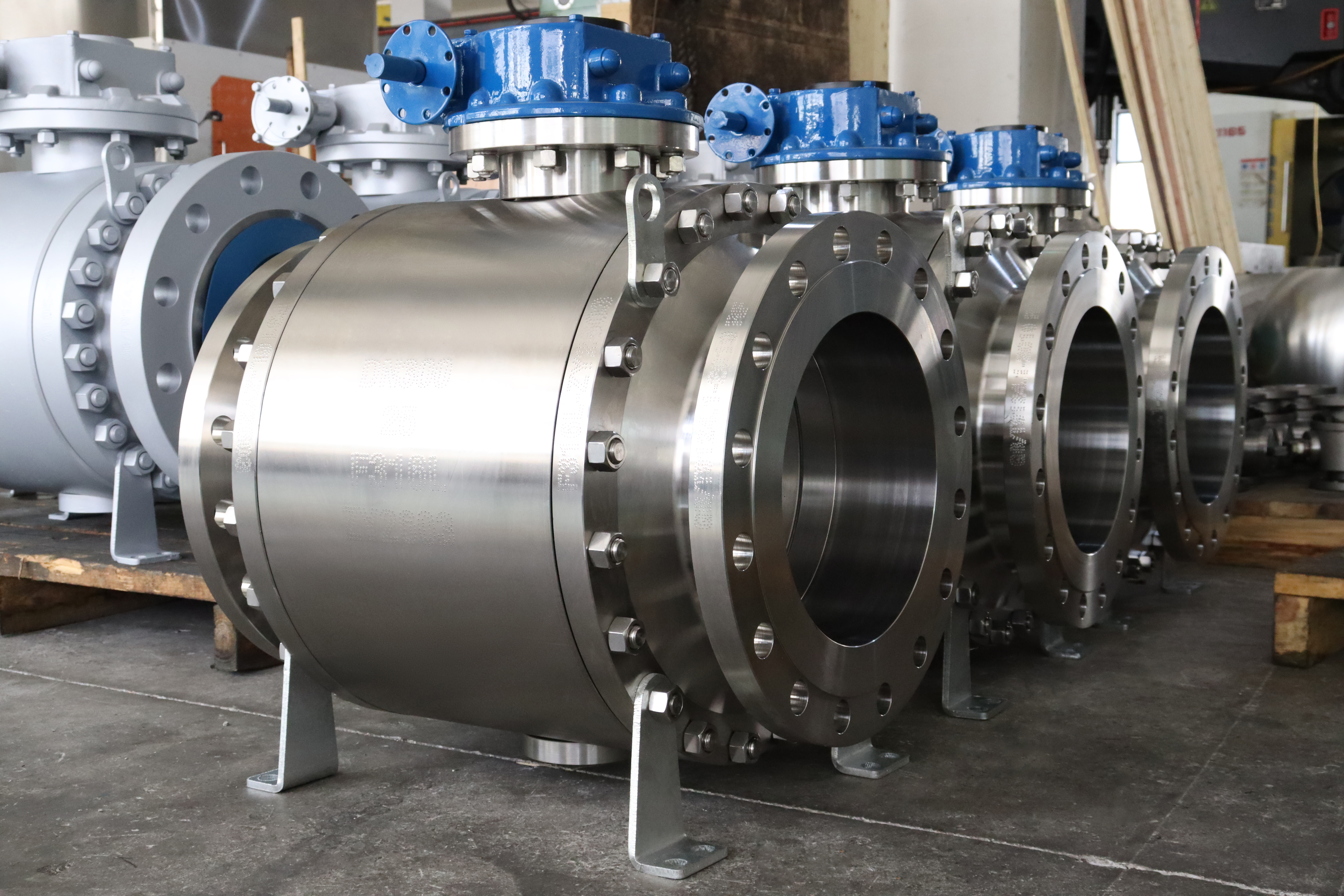
This is a twelve inch full bore valve in a three piece forged body, trunnion mounted, with gear operation. The size explains most of that. DN300 is past the point where a floating ball can be turned by hand, so the ball sits on trunnions, the thrust goes into bearings and the operator gets a gearbox. The three piece body is there for the centre section, which comes out with the ball and the seats still in it while the two end pieces stay bolted to the pipe.
The page prints the pressure class as 150LB, then puts PN25 in brackets beside it. Those are not two names for one rating. Class 150 is the ASME number and PN25 is a European nominal pressure, and the two do not convert into each other; a DN300 Class 150 flange and a DN300 PN25 flange are separate drawings with separate drilling. Since the valve carries one pair of flanges, the bracket is not a translation. It is a second option, and the order has to say which.
Design and Construction
Three pieces means two bolted joints, and at DN300 each of them is a large flange with a full ring of studs. That is twice the joint count of a two piece valve of the same size, and each joint has to be made up evenly or the bore distorts. The return is access: the centre section carries the ball, both seats and the trunnion bearings, and it can be lifted out with a crane while the end pieces stay in the line. On a twelve inch line that is the difference between a shutdown and an afternoon.
The trunnion takes the thrust. Line pressure acting on a DN300 ball would otherwise press the whole ball into the downstream seat, and the seat load rises with the bore, so at this size a floating design stops being practical. Fixing the ball to upper and lower shafts puts that force into bearings, which leaves the seats with only sealing to do and leaves the gearbox with only friction and preload to overcome. That is why the input torque stays manageable at twelve inches.

Material Options
The L in F316L is about carbon, not about strength. The low carbon version is chosen where the part will be welded and has to resist intergranular corrosion in the heat affected zone; it is not a higher pressure grade and it is not stronger than the standard grade. On this valve the body is forged, so the L is really bought for the medium and for the weld that will join it to the pipe, not for the forging process. The certificate is what proves the carbon level.
Trim follows the same rule as the body: name the code and let the certificate carry the chemistry. The ball is normally the same low carbon grade with hard chrome or nitriding; the stem can be the same alloy or a precipitation hardening stainless; the seats are reinforced PTFE, PEEK or PPL, with a metal seat available where temperature or medium rules polymers out. Hard facing on a metal seat is a proprietary alloy and belongs on the order as a requirement, not as a trade name.
| Component | Standard Material | Optional Upgrade | Service Notes |
|---|---|---|---|
| Body, ends and centre | forged F316L, low carbon austenitic | standard carbon 316 | three pieces, two bolted joints |
| Ball | F316L with hard chrome or nitriding | F316 | trunnion mounted, no seat load from thrust |
| Stem | F316L or precipitation hardening stainless | higher strength grade | anti static bonding to body |
| Seat | reinforced PTFE, PEEK or PPL | metal seat with hard facing | double piston effect standard |
| Packing | flexible graphite | PTFE | gland adjustable |
| Trunnion bearing | self lubricating | as the drawing states | carries the ball thrust |
| Ends | raised face or ring joint | ASME B16.5 or EN 1092-1, one only | drilling follows the standard named |
Technical Specifications
The size data sheet gives the bore, the face to face for the DN300 pattern and the flange dimensions for the facing chosen. Everything else follows the class and the standard: wall thickness from the pressure boundary document, bolt count and bolt size from the flange standard, test pressures from the test standard. Overall height depends on the gearbox fitted, so it is dimensioned on the signed general arrangement drawing rather than printed as a catalogue number that would only be right for one operator.
Full bore at DN300 means the passage matches the pipe internal diameter, which is what lets a pig pass and keeps the pressure drop close to that of a plain length of pipe. The consequence is a large ball, a large seat ring and a long face to face dimension, and that length is fixed by the flange standard for the class rather than by the maker. Two valves of this size from two suppliers should therefore measure the same and still not interchange, because the facing and the drilling behind it can differ.
| Item | Value |
|---|---|
| Nominal size | DN300 (12 inch) |
| Pressure class | Class 150 to ASME B16.5, or PN25 to EN 1092-1, one only |
| Body construction | three piece, forged, two bolted joints |
| Ball support | trunnion mounted on upper and lower shafts |
| Bore | full bore |
| Body material | forged F316L, low carbon austenitic stainless |
| Ball material | F316L with hard chrome or nitriding |
| Stem | F316L or precipitation hardening stainless |
| Seat | reinforced PTFE, PEEK or PPL; metal seat optional |
| Seat arrangement | double piston effect standard, self relieving optional |
| Packing | flexible graphite |
| End connection | raised face or ring joint, one standard only |
| Face to face | dimension on the signed GA drawing |
| Design standards | ASME B16.34 and API 6D |
| Test standards | API 598 and API 6D |
| Test pressure | shell 1.5 times and seat 1.1 times the class rating |
| Fire test | API 607 to the ISO 10497 method, type test |
| Anti static | bonding between ball, stem and body per API 6D |
| Operation | worm gear or bevel gear with bearings; pneumatic, electric or hydraulic optional |
| Temperature range | minus 29 to plus 425 Celsius, metal temperature |
| Marking | size, class, body code, heat number, standard |
| Documentation | EN 10204 3.1 plus the API 6D record package |
| Non destructive examination | radiograph or ultrasonic to the order |
| Weight | quoted with the drawing for the size and trim ordered |
| Country of manufacture | China |
Standards and Compliance
Three standards are listed and they are not interchangeable. ASME B16.34 is the pressure boundary document, and it is where wall thickness and the pressure temperature rating come from. API 6D is the pipeline valve specification: it adds the functional requirements a pipeline operator expects, including double block and bleed behaviour, cavity relief, anti static bonding, marking and a documentation package. API 608 is the general industrial ball valve standard, and of the three it is the weakest claim to make for a twelve inch pipeline valve.
The page claims fire safe to API 607 and ISO 10497, and that pairing is correct in a way many pages get wrong. API 607 is the test standard written for quarter turn valves with soft seats; ISO 10497 is the international method that the same test follows; API 6FA is the version written for pipeline valves to API 6D. They are not three names for one certificate. A tender that asks for API 6FA will not accept an API 607 report, and the difference is the standard the valve was designed to rather than the one it was tested to.
| Requirement | Standard | What J-VALVES Supplies |
|---|---|---|
| Pressure boundary | ASME B16.34 | wall thickness and the rating table for F316L at the class |
| Pipeline valve specification | API 6D | DBB, cavity relief, anti static, marking, documentation |
| Ball valve design | API 608 | general industrial requirements, the weaker claim |
| Shell and seat test | API 598 and API 6D | 1.5 times the rating for the shell, 1.1 times for the seat |
| Fire test | API 607 to the ISO 10497 method | type test on the design, not a per unit check |
| Pipeline fire test | API 6FA | a different standard, named separately if the tender asks |
| Non destructive examination | to the order | radiograph or ultrasonic on stated areas |
Manufacturing Process
A DN300 forging is a heavy blank, and the centre section decides the cost, because it has to be thick enough to carry the bore, the seat pockets and the trunnion bores without distortion. Machining runs from the bore outwards so the two seat pockets stay coaxial with the ball; if they do not, the seats leak on one side and the torque rises on the other. The end pieces are machined to the flange standard for the facing and the drilling that the order names, and the two are checked against each other before assembly.
Assembly starts with the ball and the trunnion bearings, then the seats, then the centre section between the two end pieces. The body joints are tightened in a cross pattern in stages, because a single pass at final torque cocks the centre section and pinches the bore. After that the gearbox is set so the ball stops exactly at both ends of the quarter turn and the stops are locked. The valve is cycled and tested as a complete unit rather than as a stack of parts.

Quality Control and Testing
API 6D does not stop at the shell and seat test that API 598 describes. It adds a documentation and marking regime, a double block and bleed check, cavity pressure relief behaviour and an anti static resistance check between ball, stem and body. For this valve the practical consequence is that the test record is a package rather than a single sheet: shell and seat results, material certificates for the pressure retaining parts, the non destructive examination report if one was ordered, and the marking record that ties them together.
A hydrostatic test at one and a half times the rating will find a through wall defect, a bad weld or a cracked forging. It will not find a body made from the wrong grade, and on a low carbon stainless valve that is the failure that matters, because the L is the whole reason the grade was specified. Positive material identification on the finished body, plus the mill certificate behind the 3.1 documentation, covers that gap. The order should name both when the medium is aggressive.
| Step | What Is Checked | Standard or Acceptance |
|---|---|---|
| Forging | grade, heat number, mechanical properties | 3.1 certificate against F316L |
| Machining | seat pocket coaxiality, flange face squareness | in process gauging against the drawing |
| Body joints | stud tension and cross pattern | controlled torque in stages |
| Shell test | no leakage through the body wall | API 598 at 1.5 times the rating |
| Seat test | no visible leakage, both directions | API 598 at 1.1 times the rating |
| Double block and bleed | one seat at a time isolates the cavity | API 6D sequence |
| Anti static | continuity between ball, stem and body | resistance checked per API 6D |

Applications and Industry Service
Twelve inch full bore trunnion valves belong on transmission and gathering lines, on station piping and on the suction and discharge of pumps where a pig has to pass or the pressure drop has to stay low. They also turn up on brine and produced water lines, which is where the low carbon stainless body earns its place, and on processes where the medium would attack carbon steel while the pressure is still high enough to need a trunnion design rather than a floating one.
It is the wrong choice for most of the small bore isolation jobs it gets quoted for, because a twelve inch valve on a two inch branch is money spent on nothing. It is also wrong where the line has to be welded out and cannot be flanged, since a fully welded body would remove two joints from the leak path. And it is wrong where the medium is abrasive enough to wear a soft seat in months, because the seat, not the body, is what fails first.

Installation, Operation and Maintenance
Set it on a support rather than hanging it on the flanges. A DN300 trunnion valve weighs enough that unsupported weight will bend the pipe at the joint, and a bent joint leaks. Bolt it up with the ball in the open position, tighten the flange studs in a cross pattern in at least two passes, and check that the two flange faces are parallel before the studs are loaded. Gearboxes are normally mounted with the input shaft horizontal or pointing down, and that orientation should be followed.
The gearbox needs its grease checked at the intervals in its own manual, and the stops should be verified after any work on the operator. If the valve is left in one position for years, cycle it occasionally; a seat that has sat loaded in one place takes a set and leaks when it is finally moved. The body joints should not be disturbed in service. Cavity pressure has to be released before any joint is broken, through the drain or vent provided for that purpose.
How to Specify and Order
The order has to settle the flange question first: the size, the class written in one system, and which flange standard and facing go with it. Then the body code as stamped, the ball and stem codes, the seat material, the operator, and whether the seats are double piston effect or self relieving. If the enquiry arrived as 150LB with PN25 in brackets, the reply should not repeat both. It should ask which pipe the valve goes into and answer with one.
On delivery four documents should line up: the nameplate, the material certificates, the test record and the general arrangement drawing. The nameplate gives size, class, body code, heat number and the standard the valve was built to. The certificates cover each pressure retaining part. The test record covers shell, seat and the 6D checks that were ordered. The drawing covers face to face, flange drilling and overall height. If the class on the nameplate disagrees with the flange on the drawing, stop.
FAQ
Q: Is 150LB the same as PN25?
A: No. Class 150 is the ASME rating and PN25 is a European nominal pressure, and there is no exact conversion between them. In the pressure class table used for pipeline valves, Class 150 is written as PN 20, not PN 25. A DN300 Class 150 flange and a DN300 PN25 flange are separate drawings with separate bolt counts and separate outside diameters, so a valve built to one will not bolt to a pipe flanged to the other.
Q: Which flange will I actually receive?
A: Whichever the purchase order names. The page lists both because the valve is made in both, but a valve has one pair of ends and both ends match. If the enquiry came in with both written together, the order is not yet complete: the buyer has to say which standard the pipe is flanged to and which facing it has. That single answer decides the casting pattern, the drilling and the face to face dimension.
Q: What does the L in F316L actually buy?
A: Lower carbon, and with it resistance to intergranular corrosion after welding. It does not raise the pressure rating and it does not make the body stronger. On a valve that will be welded into a stainless line, the low carbon grade protects the heat affected zone in the pipe rather than the forging. If the body will only ever be flanged, the standard grade will do the same job, and the certificate is what shows which one arrived.
Q: Can this valve be pigged?
A: Yes, because it is full bore: the passage through the ball matches the pipe internal diameter, so a pig passes without meeting a step. That is one of the reasons full bore is specified on transmission lines, alongside the low pressure drop. A reduced bore valve of the same size would stop the pig, and no amount of correct flange drilling makes up for that. If pigging matters, the bore is the first thing to confirm on the drawing.
Q: What is the three piece body for at this size?
A: Access to the centre section. It carries the ball, both seats and the trunnion bearings, and it can be lifted out while the two end pieces stay bolted to the line. At DN300 that saves a full line shutdown for a seat change. The cost is two large body joints instead of one, each of which has to be made up evenly, and a heavier centre section that needs lifting equipment to handle.
Q: Does the API 607 claim cover a pipeline tender asking for 6FA?
A: No. API 607 is written for quarter turn valves with soft seats and API 6FA is written for pipeline valves to API 6D. Both refer to fire testing and both are type tests on a design, but a tender that names 6FA is asking for the pipeline version and will not accept a 607 report in its place. If a project requires 6FA, it has to be quoted as 6FA from the start, because the design review behind it is different.


Hot Products


News
Ball Valves in Geothermal Brine: Silica Scale, Chloride Cracking And The Cooling Trap
Why geothermal brine destroys ball valves: retrograde silica scale, calcite at the flash point, chloride cracking above 60 C and the 250 C seat limit.
Read More
Ball Valve Face To Face Dimensions: Why A Correctly Ordered Replacement Still Does Not Fit
A 6 inch Class 150 ball valve can be 267 or 305 mm face to face and both are compliant. How B16.10, EN 558 and flange drilling decide whether it fits.
Read More
Ball Valve Stem Key And Keyway: What Gives Way First, And What The Handle Cannot Tell You
Between the handle and the ball there are four fits. Which one shears, which one cracks, and how a few degrees of lost motion hides a valve that never seated.
Read More
Ball Valve Datasheet: Six Blocks That Decide Whether Two Quotes Are Comparable
A ball valve datasheet only works when six blocks are fixed: pressure basis, bore, temperature ceiling, test, end connection, operator. How each is written.
Read More