


CHINA J-VALVES Offers Various High-quality I ndustrial Ball Valves
J-VALVES, a distinguished professional ball valve manufacturer rooted in China, takes pride in its extensive product portfolio. Our offerings span a wide range, including trunnion-mounted ball valves, floating ball valves, high-temperature ball valves, high-pressure ball valves, metal-sealed ball valves, ultra-low temperature ball valves, DBB ball valves, Three-way And Four-way Ball Valve, and fully welded ball valves. Each product is a testament to our commitment to precision engineering and reliable performance. Meticulously crafted, they are designed to not only meet but exceed the most stringent industrial demands, ensuring stable operation even under extreme conditions. This enables us to provide our clients with high-value services and makes our valves widely sought-after in industries.
Product Category
Contact Us


-
J-VALVES-Q347F
-
J-VALVES
Overview of the J-VALVES 16 Inch 300LB WCB Two Piece Trunnion Ball Valve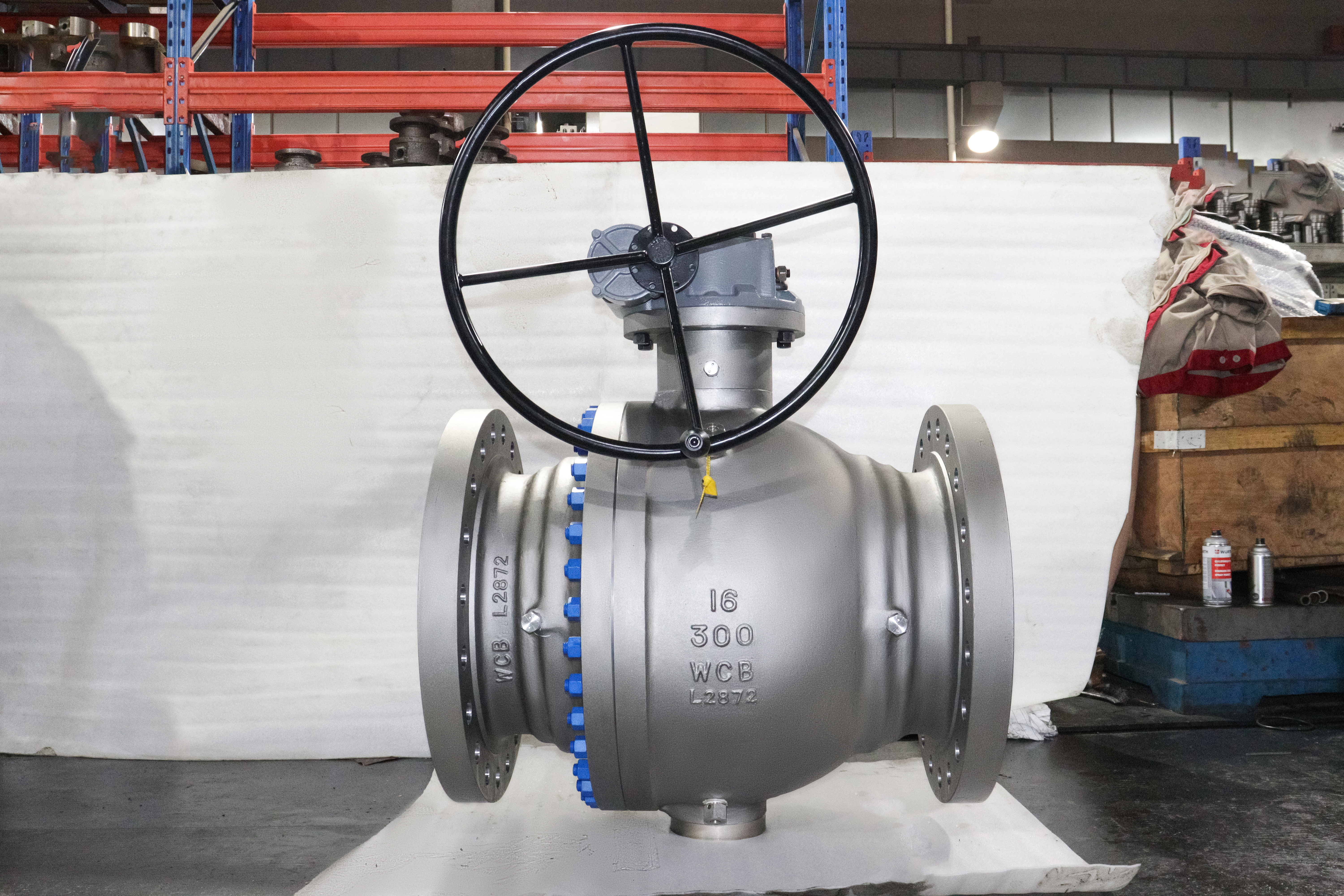
This is a sixteen inch trunnion mounted valve: DN400 bore, Class 300, which API 6D writes as PN50. The body is cast ASTM A216 WCB carbon steel in two bolted pieces, the ends are raised face flanges to ASME B16.5 Class 300, the ball runs on upper and lower trunnions, and the operator is a worm gear with a handwheel. The valve is supplied with a gearbox and a handwheel as standard, and the same bonnet interface takes an actuator when the line is automated later.
At sixteen inch the valve is no longer something two fitters can swing on a lever, and the reason is geometry rather than preference. The area the pressure acts on grows with the square of the bore, so the torque needed to break a seated ball away grows with it, and the gearbox is what converts a hand movement into that torque. The handwheel may take a hundred turns to move the ball a quarter turn, and that is normal.
The other thing that changes at this size is that the body has one joint instead of two. A two piece body means a single ring of studs closing a single gasketed face, which is one pressure boundary to assemble correctly and one to monitor. It also means the ball and both seats have to come out through that one opening, in one direction, which is why the joint is designed where it is.
Design and Construction
Sixteen inch is where a body stops being a container and starts being a structure. The ball rests on two trunnions, so the pressure load goes into bearings instead of into the seats, and each seat is a piston that line pressure pushes onto the ball. What carries the pipe is the body: on a two piece design the centre section and the single end cap are joined by one circle of studs, and that circle has to hold cavity pressure while the raised face flanged ends absorb the bending from the connected pipe.
The single body joint is the part that deserves attention. It sees the cavity pressure across the full joint area and it also carries the bending that comes from the pipe, and at DN400 that is a large gasketed face. It is closed on a spiral wound gasket with a stainless hoop and a graphite filler, taken up on studs in a cross pattern in several passes, and the flatness of the two faces is what makes that preload even.
Seat effect is chosen with the order. Double piston effect gives a seal from either side and is what a double block and bleed duty needs; single piston effect lets the upstream seat be pushed clear so the cavity vents upstream. On a Class 300 line the pressures are moderate, but the choice still changes parts and still has to be written down rather than assumed from the drawing.
The gearbox is bolted to a mounting flange on the bonnet and drives the stem through a keyed coupling. The travel stops are set on the gearbox, not on the valve, so they are adjusted at assembly and locked; a stop that drifts lets the ball over travel and the seat takes the load instead of the stop. A handwheel that turns freely past the closed position is a stop that has moved.
Material Options
WCB is the body grade: cast carbon steel with good strength and toughness, rated from minus 29 to plus 425 degrees Celsius, and the default for water, oil, gas and steam condensate at this class. It is a casting, so the body can be radiographed and, within the rules of the standard, repaired; that is a genuine advantage at DN400, where a forged body would be difficult to produce and expensive to buy.
The trim is stainless by default: ball in CF8 or CF8M with electroless nickel plating, or with a cobalt alloy hardfacing where the medium carries sand or scale; stem in 304 or 316 stainless, or 17-4PH for the torque a sixteen inch valve puts through the key. Seat in RPTFE as standard, polyamide or PEEK where the temperature rises, and metal with a graphite seal above the polymer range.
| Component | Standard Material | Optional Upgrade | Service Notes |
|---|---|---|---|
| Body and end piece | ASTM A216 WCB cast carbon steel | A350 LCB for low temperature | two pieces, one bolted joint |
| Ball | A351 CF8 or CF8M with ENP | cobalt alloy hardfacing | carried on trunnions |
| Trunnion and bearings | Hardened steel | 17-4PH | takes the pressure load off the seats |
| Stem | A276 304 or 316 | 17-4PH | keyed to the ball, blowout proof |
| Seat ring | RPTFE | polyamide, PEEK, metal with flexible graphite | single or double piston effect |
| Body gasket | Spiral wound, stainless hoop, graphite filler | ring type joint metal ring | new gasket at every joint opening |
| Packing | PTFE V-ring | Flexible graphite | fire safe configuration |
| Body studs | ASTM A193 B7 with A194 2H nuts | B7M with 2HM | taken up in a cross pattern in stages |
| Operator | Worm gear with handwheel | pneumatic, electric | mounting flange and keyed stem |
Technical Specifications
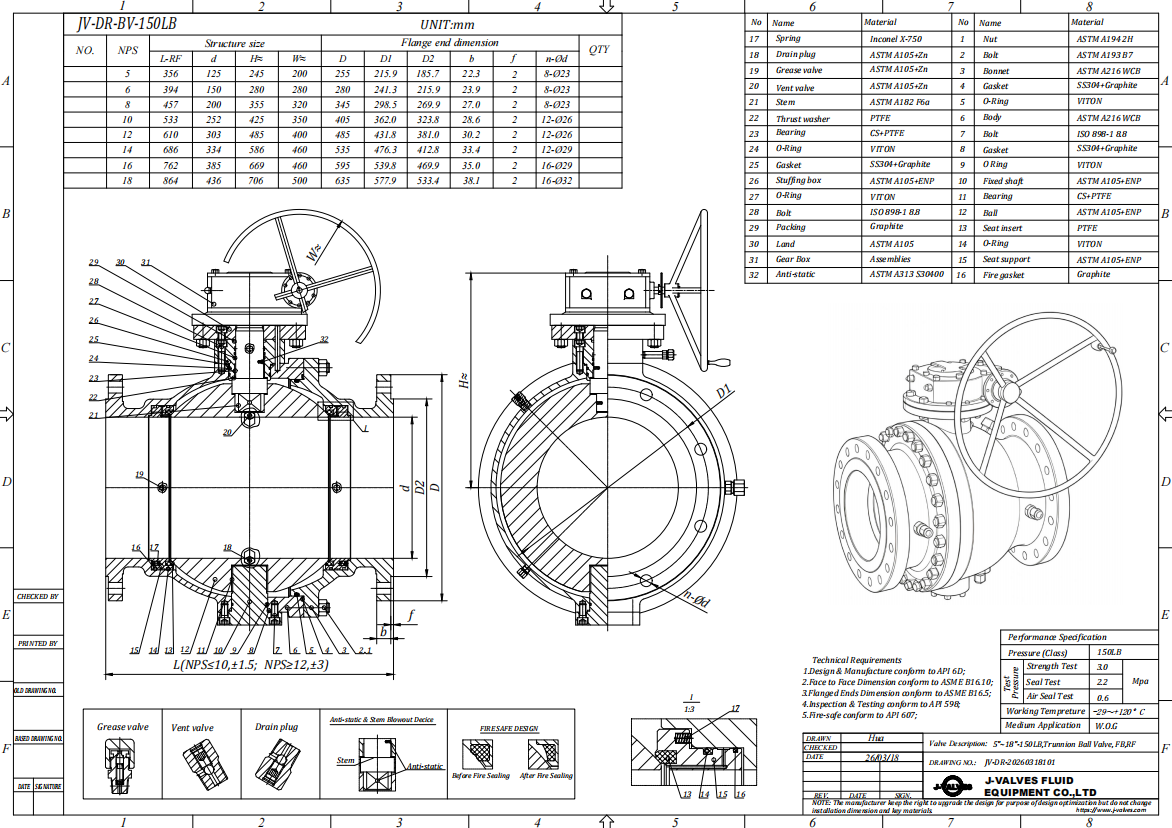
The envelope is DN400, Class 300, two piece body in WCB, raised face flanges to ASME B16.5, face to face to ASME B16.10, worm gear operator, and pressure testing to API 598 and API 6D. Ring type joint flanges are available as an option, and the facing then has to be stated on the order because it changes the machining and the gasket. The valve is supplied with a general arrangement drawing, and the face to face and the operator interface on that drawing are what the pipe and the actuator have to match.
Three decisions belong in the enquiry: the seat compound against the temperature, the seat effect against the duty, and whether the gearbox will be replaced by an actuator now or later. All three change parts inside the valve, and the third also changes the stem top and the mounting flange, which are machined before assembly. Getting any of them wrong is not a field adjustment; it is a valve that has to come out of the line again.
| Item | Value |
|---|---|
| Nominal size | 16 inch (DN400) |
| Pressure class | Class 300 (PN50) |
| Body construction | two piece, one bolted joint |
| Ball support | trunnion mounted, upper and lower bearings |
| Body material | ASTM A216 WCB cast carbon steel |
| Body option | A350 LCB for low temperature |
| Material group | ASME B16.34 group 1.1 carbon steel |
| Rating at 38 C | Class 300 = 51.1 bar |
| Temperature range | minus 29 to plus 425 C for WCB |
| Ball | A351 CF8 with electroless nickel plating |
| Ball options | CF8M, cobalt alloy hardfacing |
| Trunnion | hardened steel |
| Trunnion option | 17-4PH |
| Stem | A276 304 or 316 stainless |
| Stem option | 17-4PH |
| Seat | RPTFE |
| Seat options | polyamide, PEEK, metal with flexible graphite |
| Seat effect | single or double piston effect, stated on the order |
| Body gasket | spiral wound with stainless hoop and graphite filler |
| Gasket option | ring type joint metal ring |
| Body studs | ASTM A193 B7 with A194 2H nuts |
| Stud option | B7M with 2HM |
| Bore | full bore, DN400 |
| End connection | raised face flange to ASME B16.5 Class 300 |
| End option | ring type joint flange |
| Face to face | ASME B16.10 |
| Wall thickness | ASME B16.34 |
| Design standards | ASME B16.34, API 6D and API 608 |
| Pressure testing | API 598 and API 6D, shell and seat |
| Operator | worm gear with handwheel |
| Actuation options | pneumatic, electric |
| Marking | size, class, WCB and heat number on the body and nameplate |
| Documentation | EN 10204 3.1, test record, general arrangement drawing |
Standards and Compliance
WCB is carbon steel, group 1.1 in ASME B16.34, and the group carries a ceiling: the table stops at 425 degrees Celsius, past which graphitisation of the steel matters more than loss of wall strength. Class 300 in that group is 51.1 bar at 38 degrees. B16.34 also sets the wall thickness, though at sixteen inch the wall that ships is well above the code minimum, because a body that size has to survive handling and pipe loads as well as pressure. API 6D adds the pipeline requirements, API 608 the ball valve details and the nameplate.
The flange facing is the part buyers most often leave to the supplier. Raised face takes a spiral wound or sheet gasket and is the normal choice at Class 300; ring type joint takes a metal ring in a groove and is chosen where the joint will be opened repeatedly or where the medium is light gas. The two facings are not interchangeable and the gasket is not the same.
| Requirement | Standard | What J-VALVES Supplies |
|---|---|---|
| Wall thickness and rating | ASME B16.34 | group 1.1 carbon steel, Class 300 = 51.1 bar at 38 C |
| Pipeline valve requirements | API 6D | cavity relief, anti static, marking |
| Ball valve specifics | API 608 | blowout proof stem, nameplate content |
| Flanges | ASME B16.5 | Class 300 raised face, ring type joint as an option |
| Face to face | ASME B16.10 | long pattern for DN400 Class 300 |
| Pressure testing | API 598 and API 6D | shell at 1.5 times, seat at 1.1 times |
| Fire safety where ordered | API 607 | fire test certificate |
| Material certificate | EN 10204 3.1 | certificate per heat |
Manufacturing Process
The body and end piece are cast, heat treated and then machined, with the bore, the seat pocket and the joint face cut in one setting so the seat sits square to the ball axis and the joint faces stay parallel. At DN400 the joint face is large enough that flatness has to be measured rather than felt, because a face that is out by a few hundredths over that diameter will leak whatever the stud load.
The ball is machined, ground and lapped, then plated, and checked for roundness against the seat rings. Assembly is the body on stands, seats and trunnions in, ball lowered in with a sling, the end piece on with a new gasket, the studs taken up in a cross pattern in stages to the specified load, then the gearbox fitted and the travel stops set so the ball lands exactly on both seats.

Quality Control and Testing
Casting soundness is checked on the pressure retaining areas and around the joint, and the heat is certified with composition and mechanical properties. The machined joint faces are checked for flatness and parallelism, the flange facing and drilling against ASME B16.5, and the bore against DN400. Hardness is checked on the seat facing where a hardness difference between ball and seat is specified. The test record and the material certificate are issued together with the valve, and both are traceable to the heat number on the body.
Every valve is shell tested at one and a half times the rating and seat tested at one point one times, to API 598 and API 6D, with the body joint watched separately from the seats because a weep at the joint is a body leak and a weep at the seat is a trim leak, and the two have different causes. Torque is measured with the gearbox fitted and recorded for actuator sizing.
| Step | What Is Checked | Standard or Acceptance |
|---|---|---|
| Casting | soundness on pressure retaining areas and around the joint | visual and radiographic where specified |
| Machining | joint face flatness and parallelism, seat pocket squareness | drawing tolerance, measured over the full face |
| Flange | facing, drilling, bolt circle, thickness | ASME B16.5 Class 300 |
| Ball and seat | roundness, surface finish, hardness difference | drawing range |
| Body joint | gasket, stud grade, tightening sequence and final load | specified torque in three passes |
| Shell test | body and joint at 1.5 times | API 598 and API 6D, no leak |
| Seat test | each seat in both directions at 1.1 times | API 598, no visible leak |
| Gearbox | travel stops at open and closed, indicator setting | ball lands on both seats without over travel |
| Torque | breakaway and running torque with the gearbox fitted | recorded and issued for actuator sizing |

Applications and Industry Service
The duty is isolation on medium pressure, large diameter lines: water transmission and distribution, cooling water, oil and gas gathering, tank farm headers, pump station suction and discharge, and steam and condensate mains where the temperature stays inside the carbon steel band. Most of these valves are open for months and closed for maintenance or for an isolation. In each of those the valve is bought against a project specification that names the body grade and the facing, which is why the facing question comes up on almost every enquiry.
It is not a throttling valve and not a control valve. At sixteen inch the flow energy through a part open ball will damage the seat and the ball surface, and the resulting leak is not repairable without taking the body apart. Where regulation is needed, the ball valve isolates and a control valve does the work. A ball valve used that way loses its seat long before its design life, and the repair is a body strip rather than an adjustment.

Installation, Operation and Maintenance
Lift on the body, never on the gearbox or the stem, and support the pipe on both sides so the valve is not carrying the line. Check that the two flanges are parallel before the studs are drawn up: pulling a sixteen inch joint closed puts a bending load into the body joint that no pressure test will reveal and that shows up later as a leak.
Open and close through the gearbox, and never fit an extension bar to the handwheel. If the valve is stiff, the cause is usually pressure trapped in the cavity or a seat that has taken a set, and forcing it damages the stem key before it moves the ball. On a valve that is rarely operated, work it through a full cycle on a schedule and leave it in the position the procedure asks for.
How to Specify and Order
Write the size, the class, the body grade, the bore, the facing, the seat effect, the seat compound and the operator. A typical line reads: sixteen inch, Class 300, body A216 WCB, full bore, raised face flanges to ASME B16.5, double piston effect seats, RPTFE seat, worm gear with handwheel, tested to API 598 and API 6D. The bore and the facing matter as much as the size, because a full bore valve and a reduced bore valve in the same body are not the same product.
Add the medium, the design temperature and whether an actuator will follow. The medium decides the ball and seat trim, the temperature decides the seat, and the actuator decides the stem top and the mounting flange. Sending all three with the enquiry avoids a valve that arrives correct in every respect except the interface. The same enquiry should say whether the line will be pigged, because that one question decides the bore and cannot be answered after the body is cast.
FAQ
Q: Why a two piece body at this size?
A: Because one joint is one pressure boundary. A three piece body gives access from either end, which is useful on small valves that are opened for trim changes; at DN400 the body is not being opened in the field, so the second joint would add a leak path and a gasket without adding anything the operator needs. The ball and both seats still come out through the single opening.
Q: Which gasket goes in the body joint?
A: A spiral wound gasket with a stainless hoop and a graphite filler as standard, which suits the temperature and the pressure of a Class 300 WCB valve. Where the joint will be opened repeatedly or the medium is light gas, a ring type joint with a metal ring is the better answer. The two need different flange facings, so the choice is made at the order, not at the store.
Q: Why is a gearbox needed at sixteen inch?
A: Because the torque needed to break a seated ball away rises with the bore and the pressure, and at DN400 it is beyond what a lever can deliver by hand. The gearbox multiplies the hand movement into that torque, which is why the handwheel turns many times for one quarter turn of the ball. Fitting a longer lever instead is how stems get twisted.
Q: Can it be actuated?
A: Yes. The gearbox mounts on a flange on the bonnet and drives the stem through a keyed coupling, and the same interface takes a pneumatic or electric actuator. Decide it with the order, because the stem top and the mounting flange are machined to suit, and the actuator supplier will want the measured torque from the test record.
Q: What is the temperature limit of WCB?
A: Minus 29 to plus 425 degrees Celsius. The upper limit is a material limit rather than a wall thickness limit: above 425 degrees carbon steel is subject to graphitisation, so the answer is a different grade such as F11 or F22 low alloy steel, or an austenitic stainless, not a thicker body.
Q: Is it full bore?
A: Yes, this build is full bore at DN400, so it passes a pig and adds no restriction to the line. A reduced bore version exists in the same body size and is written as a size pair with a smaller bore; it is cheaper and lighter but it will not pass a pig, and it cannot be converted later.


Hot Products


News
Ball Valves in Geothermal Brine: Silica Scale, Chloride Cracking And The Cooling Trap
Why geothermal brine destroys ball valves: retrograde silica scale, calcite at the flash point, chloride cracking above 60 C and the 250 C seat limit.
Read More
Ball Valve Face To Face Dimensions: Why A Correctly Ordered Replacement Still Does Not Fit
A 6 inch Class 150 ball valve can be 267 or 305 mm face to face and both are compliant. How B16.10, EN 558 and flange drilling decide whether it fits.
Read More
Ball Valve Stem Key And Keyway: What Gives Way First, And What The Handle Cannot Tell You
Between the handle and the ball there are four fits. Which one shears, which one cracks, and how a few degrees of lost motion hides a valve that never seated.
Read More
Ball Valve Datasheet: Six Blocks That Decide Whether Two Quotes Are Comparable
A ball valve datasheet only works when six blocks are fixed: pressure basis, bore, temperature ceiling, test, end connection, operator. How each is written.
Read More