


CHINA J-VALVES Offers Various High-quality I ndustrial Ball Valves
J-VALVES, a distinguished professional ball valve manufacturer rooted in China, takes pride in its extensive product portfolio. Our offerings span a wide range, including trunnion-mounted ball valves, floating ball valves, high-temperature ball valves, high-pressure ball valves, metal-sealed ball valves, ultra-low temperature ball valves, DBB ball valves, Three-way And Four-way Ball Valve, and fully welded ball valves. Each product is a testament to our commitment to precision engineering and reliable performance. Meticulously crafted, they are designed to not only meet but exceed the most stringent industrial demands, ensuring stable operation even under extreme conditions. This enables us to provide our clients with high-value services and makes our valves widely sought-after in industries.
Product Category
Contact Us

-
J-VALVES-Q347F
-
J-VALVES
Overview of the J-VALVES Forged Steel Three Piece Trunnion Ball Valve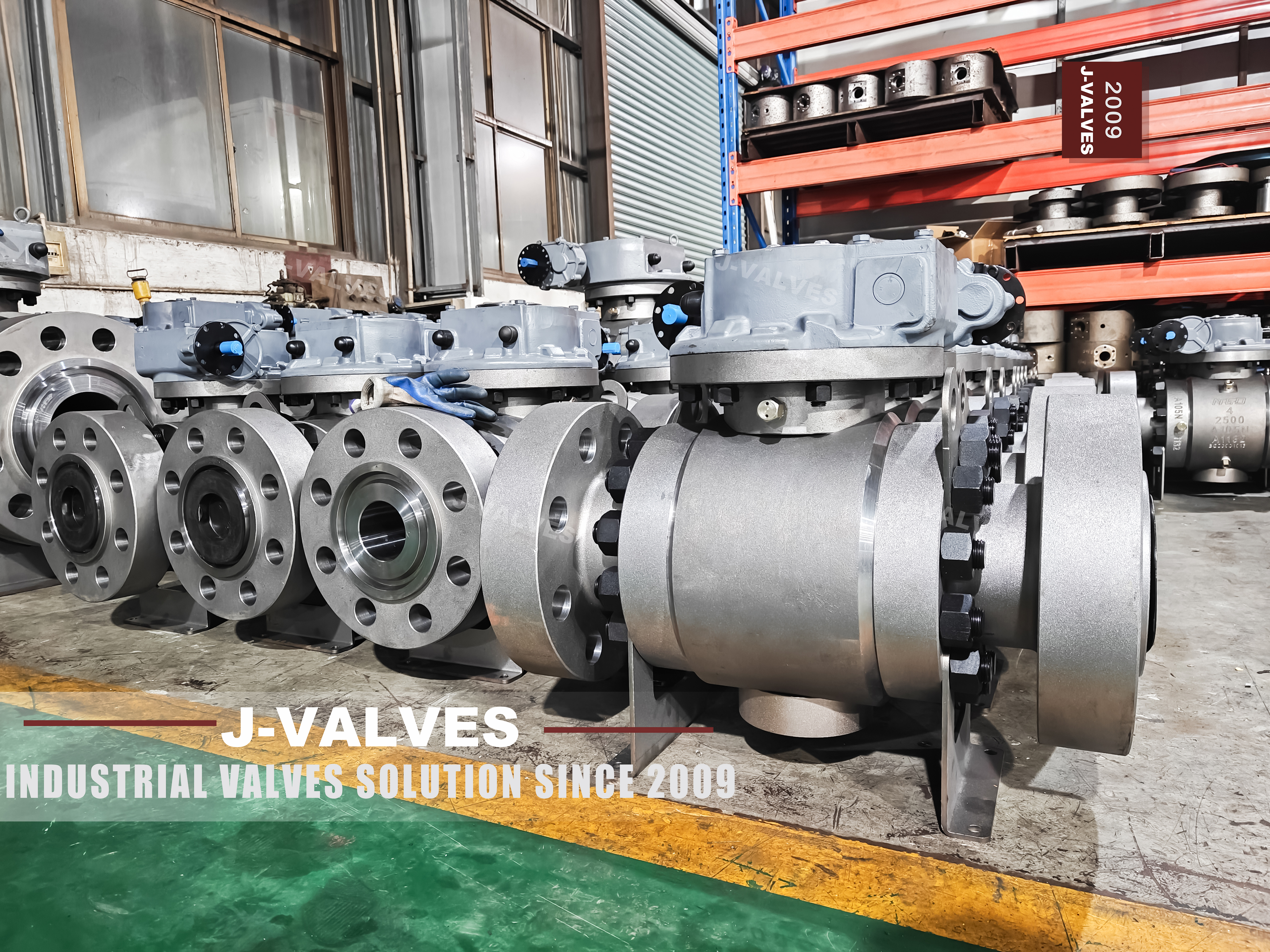
This is the forged steel version of the three piece trunnion mounted ball valve, covering 2 to 56 inch and Class 150 to 2500. The body is forged rather than cast, the ball is carried on trunnions above and below, and the ends are flanged raised face or ring joint to ASME B16.5, with butt weld ends to ASME B16.25 available. The operator is a lever at the small sizes and a worm gear above them.
What makes this page different from every other three piece trunnion page on the site is the material list. The same drawing is produced in A105 carbon steel, A350 LF2 low temperature steel, A182 F304 and F316 stainless, A182 F11 and F22 chrome molybdenum, F51 duplex and a nickel alloy such as UNS N06625. Those are not eight models of valve. They are one valve with eight sets of boundaries, and the boundaries are set by temperature and by medium rather than by preference.
That is why the page is organised around selection rather than around features. A buyer who knows the medium and the design temperature can leave this page with a grade, a heat treatment, an inspection route and a gasket choice. A buyer who picks a grade because it sounds stronger ends up with a certificate that does not match the line, or with a valve that fails at the first thermal cycle because the seat was chosen for the body and not for the duty.
Design and Construction
The body is three forged pieces: a centre section carrying the trunnion bearings and the stem, and two end caps bolted to it. Forging is used because a forged part has no shrinkage cavity, no gas porosity and no sand inclusion, and because the grain flow follows the shape instead of being cut through by machining. At high class and large bore that difference is what the wall calculation is standing on.
The ball is held on a shaft above and below, so the line pressure does not push it into the seat. Each seat is pushed onto the ball by a spring ring at low pressure and by the medium acting on the seat piston at higher pressure, which keeps the seat load controlled. The result is that the torque stays within reach of a gear even at 36 inch, and the seat does not have to be forced onto the ball by the full line pressure the way it is in a floating design.
The stem passes through the centre section, is retained against blowout, and carries an anti static path to the body. The body joints are bolted and gasketed, and the centre section carries the cavity connections and the drain. The photograph shows the painted body with its bolted joints, the gear on its mounting flange and the feet that take the weight off the pipe; on a valve of this size those feet are a structural part of the installation, not an accessory.

Material Options
A105 carbon steel is the default for water, oil and gas up to the point where the temperature starts to matter. It sits in B16.34 group 1.1, rated from minus 29 to 538 degrees, but above 425 degrees the carbide phase can graphitise and the standard permits the duty without recommending it for long service. In practice that means A105 is the right answer below 425 and the wrong answer above it, which is a more useful rule than the rating table on its own.
A350 LF2 is the low temperature carbon steel, impact tested at minus 46 degrees, and it is what a cold climate or a refrigerated line needs when stainless is not required. F11 and F22 are the chrome molybdenum grades, 1.25Cr-0.5Mo and 2.25Cr-1Mo, both rated to 593 degrees, and they exist for one reason: above 425 degrees carbon steel loses creep strength and these do not. F22 is chosen over F11 where the temperature or the wall is higher and more creep margin is wanted.
F304 and F316 are the austenitic stainless option, group 3.1, rated from minus 254 to 538 degrees, with 316 chosen where chlorides are present. Above 538 the carbon content has to be at least 0.04 percent, which is why the low carbon variants cannot simply be pushed higher. F51 duplex covers chloride stress corrosion where the 300 series would crack, and a nickel alloy such as UNS N06625 covers acid and high temperature duty that nothing in the iron based list survives.
The material choice drags three other decisions with it, and this is the part buyers underestimate. The heat treatment changes: solution annealing for austenitic, normalising and tempering for chrome moly, quenching and tempering for duplex. The inspection changes: impact testing for LF2, hardness limits for the chrome moly and duplex grades, positive material identification for anything that looks like carbon steel. And the seat and the gasket change, because they have to survive the temperature the body allows.
| Component | Standard Material | Optional Upgrade | Service Notes |
|---|---|---|---|
| Body and end caps | ASTM A105 forged carbon steel | LF2, F304, F316, F11, F22, F51, nickel alloy | same drawing, eight material families |
| Ball | Forged base with ENP | Hard chrome, tungsten carbide spray | coating matched to the medium |
| Trunnion and bearings | Forged steel, surface hardened, or 17-4PH | Stainless with bearing sleeve | carries the ball, not the seat |
| Stem | 17-4PH | F316 with ENP, nickel alloy | blowout proof, anti static |
| Seat ring | RPTFE | PTFE, PPL, PEEK, metal with graphite | must survive the temperature the body allows |
| Seat spring | Stainless steel | Nickel alloy for corrosive duty | sets the low pressure seal |
| Body gasket | Graphite spiral wound with stainless hoop | Metal ring gasket for ring joint | grade matched to body and temperature |
| Operator | Lever to 6 inch, worm gear above | Pneumatic, electric, hydraulic | chosen on measured torque |
Technical Specifications
The envelope is 2 to 56 inch, Class 150 to 2500, three forged pieces, trunnion mounted ball, flanged raised face or ring joint, face to face to ASME B16.10, lever or gear, tested to API 598 with a fire test to API 607 where ordered. Body material is stated on the order by its ASTM or UNS designation, and the heat treatment and the inspection level follow from that designation rather than being listed separately.
Two things decide the build beyond the size and class. The first is the material grade, because it sets the temperature band, the heat treatment and the inspection route. The second is the seat, because the body may be rated to 593 degrees while the seat inside it is good for 280. A valve is only as hot as its softest part, so the seat and the packing are chosen after the body and not before it.
| Item | Value |
|---|---|
| Size range | 2 to 56 inch (DN50 to DN1400) |
| Pressure range | Class 150 to 2500 (PN20 to PN420) |
| Body construction | three piece, forged, bolted end caps |
| Ball support | trunnion mounted, bearings above and below |
| Body material | ASTM A105 forged carbon steel |
| Body option | ASTM A350 LF2 low temperature steel |
| Body option | ASTM A182 F304 or F316 stainless steel |
| Body option | ASTM A182 F11 or F22 chrome molybdenum steel |
| Body option | F51 duplex stainless steel |
| Body option | nickel alloy, UNS N06625 or N08825 |
| Material group | B16.34 group 1.1, 1.2, 2.1, 2.2 or 3.1 by grade |
| Carbon steel limit | A105 rated to 538 C, graphitisation above 425 C |
| Low temperature grade | A350 LF2 impact tested at minus 46 C |
| Chrome moly rating | F11 and F22 rated to 593 C |
| Austenitic rating | F304 and F316 rated from minus 254 to 538 C |
| Ball | forged base with electroless nickel plating |
| Ball options | hard chrome, tungsten carbide spray |
| Trunnion | forged steel surface hardened, or 17-4PH |
| Stem | 17-4PH |
| Stem options | F316 with ENP, nickel alloy |
| Seat | RPTFE |
| Seat options | PTFE, PPL, PEEK, metal with graphite |
| Seat effect | single or double piston effect, stated on order |
| Body gasket | graphite spiral wound with stainless hoop |
| End connection | flanged raised face to ASME B16.5 |
| End options | ring joint to ASME B16.5, butt weld to ASME B16.25 |
| Face to face | ASME B16.10 |
| Bore | full port or reduced bore |
| Wall thickness | ASME B16.34 |
| Design standard | API 6D |
| Sour service | NACE MR0175 / ISO 15156 where required |
| Pressure testing | API 598 shell and seat, both directions |
| Operator | lever to 6 inch, worm gear above |
| Documentation | EN 10204 3.1, heat treatment and impact records |
Standards and Compliance
ASME B16.34 governs the wall and the rating, and the material group is what translates a grade into a temperature band: group 1.1 for A105, 1.2 for A350 LF2, 2.1 for F11, 2.2 for F22, 3.1 for F304 and F316. API 6D governs the trunnion design, the fire test, the anti static requirement, the cavity relief and the marking. API 598 covers the pressure test, ASME B16.5 the flange and ASME B16.10 the face to face length.
Two compliance points are specific to a forged multi-material page. Positive material identification is not optional when the same drawing is produced in F11 and F22, because the two are visually identical and a mixed billet produces a valve that passes every test and carries the wrong certificate. And for sour service, NACE MR0175 or ISO 15156 sets hardness limits that decide whether a grade can be used at all, which is a question that has to be asked before the material is fixed.
| Requirement | Standard | What J-VALVES Supplies |
|---|---|---|
| Wall thickness and rating | ASME B16.34 | group 1.1, 1.2, 2.1, 2.2 or 3.1 by grade |
| Trunnion design and documentation | API 6D | fire test, anti static, cavity relief, marking |
| Fire safety where ordered | API 607 | fire test certificate |
| Flange dimensions and facing | ASME B16.5 | raised face as standard, ring joint on request |
| Face to face length | ASME B16.10 | length confirmed on the drawing |
| Butt weld ends where ordered | ASME B16.25 | end preparation drawing |
| Sour service where required | NACE MR0175 / ISO 15156 | hardness limits and certificate statement |
| Pressure testing | API 598 | shell at 1.5 times, seat at 1.1 times, both directions |
Manufacturing Process
Each body part starts as a forged billet or a forged near shape, is heat treated to the grade, and is then machined. The heat treatment is where the grades separate: an austenitic part is solution annealed and quenched, a chrome moly part is normalised and tempered, a duplex part is solution annealed and water quenched to keep the ferrite and austenite balance. Getting that wrong does not show up in a hydro test, it shows up in hardness and in corrosion resistance years later.
Machining follows the same sequence whatever the grade: joint faces, seat pockets and trunnion bores in one setting, then the flange facing and the stem bore. The ball is machined, ground and coated, the trunnion is ground to its bearing fit, and assembly runs from the centre section outward with the seats and springs in place before the end caps go on. The gear is fitted last and the stops are set at open and closed.

Quality Control and Testing
The material record is the first half of the inspection. Chemistry per heat, mechanical properties per heat treatment batch, impact testing for LF2 at minus 46 degrees, hardness for the chrome moly and duplex grades, and positive material identification on every body and trim part. The PMI result is what makes the certificate worth reading, because without it the paper says F22 and the metal may say something else.
The second half is the valve itself. Shell test at one and a half times the rating with the body joints included, seat test at one point one times in both directions, cavity relief proven by pressurising the cavity, and the operator checked for full quarter turn travel with the stops set. Torque is measured and recorded, and the figure is issued with the drawing because it is what the gear or the actuator was sized on.
| Step | What Is Checked | Standard or Acceptance |
|---|---|---|
| Incoming forging | heat number, chemistry, reduction ratio | EN 10204 3.1 against the ordered grade |
| Heat treatment | hardness and mechanical properties per batch | drawing requirement for the grade |
| Impact test | charpy values for low temperature grades | A350 LF2 at minus 46 degrees, recorded |
| Positive material identification | body and trim alloy check | 100 percent, recorded against the certificate |
| Machining | seat pocket and trunnion bore concentricity | drawing tolerance, checked in one setting |
| Flange gauge | outside diameter, bolt circle, hole diameter, facing | ASME B16.5 for the class ordered |
| Shell test | body, both body joints and the gland at 1.5 times | API 598, no leak |
| Seat test | each seat in both directions at 1.1 times | API 598, no visible leak |
| Torque and gear | breakaway torque, gear travel and stops | recorded, stops set at open and closed |

Applications and Industry Service
The grade usually names the industry. A105 goes to water, oil, gas and general plant piping. LF2 goes to cold climates, refrigerated storage and low temperature process. F11 and F22 go to refinery and power applications above 425 degrees: steam headers, hydrogen and hydroprocessing, hot oil and catalytic service. F304 and F316 go to chemical, pharmaceutical, food and desalination lines, and F51 duplex to seawater, offshore and chloride bearing process where stress corrosion cracking rules out the 300 series.
The nickel alloy grades go where nothing else survives: acid, high temperature and high chloride duty in chemical plants and flue gas systems. They are ordered by UNS number rather than by trade name, so that the certificate, the purchase order and the nameplate all say the same thing. A trade name on an order is the fastest way to receive a valve that is close to what was wanted and impossible to prove equivalent to it.

Installation, Operation and Maintenance
The material changes the installation. A chrome moly body expands more than carbon steel over the same temperature rise, so the cold spring and the support spacing have to account for it. A duplex body must not be welded without the qualified procedure and the ferrite check that goes with it. An austenitic body galls more readily on the threads, so a lubricant is used on the studs rather than brute force on the wrench.
Operate the valve fully open or fully closed, and support it on its feet. Where the line runs hot, bring it up to temperature slowly with the valve open, so the body and the pipe expand together and the flange joint is not loaded by a differential. On a ring joint flange use a new gasket every time. On a valve with injection fittings, use only the grease the certificate names, because the wrong one can swell the seat insert beyond recovery.
How to Specify and Order
The order line has to name the grade, not the family. Write it out: 10 inch, Class 600, body A182 F22, heat treated normalised and tempered, ball F22 with ENP, metal seat with flexible graphite, double piston effect, ring joint flanges to ASME B16.5, face to face to ASME B16.10, worm gear. Add the inspection level as well, because impact testing and hardness checks are ordered with the grade rather than assumed from it.
Then add the two questions that the grade list cannot answer. Is the service sour, and does the line run above 425 degrees? The first decides whether NACE MR0175 hardness limits apply and whether the grade is allowed at all; the second decides whether carbon steel is still honest. Answer both before the material is fixed, because changing grade after the forging is cut is the most expensive change on the whole order.
FAQ
Q: Which body material should I choose?
A: Start from the design temperature and the medium. Below 425 degrees and without corrosion, A105 carbon steel is the honest answer. Above 425, F11 or F22, because carbon steel loses creep strength and graphitises. Below minus 29, A350 LF2. For corrosion, F304 or F316, and for chlorides where the 300 series would crack, F51 duplex. Nickel alloy only where nothing in the iron based list survives.
Q: Is A105 suitable at 500 degrees?
A: The group 1.1 rating table runs to 538 degrees, so it is permitted, but above 425 degrees the carbide phase can graphitise and the standard allows the duty without recommending it for long service. At 500 degrees the correct answer is F11 or F22, which exist for exactly that band and are rated to 593. Choosing carbon steel there saves money once and costs it back at every shutdown.
Q: What is the difference between F11 and F22?
A: F11 is 1.25Cr-0.5Mo and F22 is 2.25Cr-1Mo. Both are rated to 593 degrees, and F22 carries more creep margin, so it is chosen where the temperature or the wall is higher. They look identical on the bench, which is why positive material identification is run on every body: a mixed billet produces a valve that passes every test and carries the wrong certificate.
Q: Can the body be forged at 56 inch?
A: There is a practical limit, and at the top of the size range the forged route becomes uneconomic or impossible, which is where cast or welded construction takes over. Within the range that is offered as forged, the benefit is the absence of cast defects and the grain flow through the shape, and that benefit is largest exactly where the pressure is highest.
Q: Why is positive material identification necessary?
A: Because the grades are visually identical. F11 and F22, F304 and F316, A105 and LF2 all look the same once machined, and a certificate proves what was melted, not what is in the crate. PMI on every body and trim part is what ties the paper to the metal, and it is the check that catches the one mistake a hydro test never will.
Q: Does the seat change with the body material?
A: Yes, and the seat is usually the lower limit. A body rated to 593 degrees is of little use with a seat good for 280, so the seat and the packing are chosen after the body grade is fixed, not before. A metal seat with flexible graphite is what a high temperature body needs, and the low temperature grades need a seat that stays flexible rather than going brittle.


Hot Products


News
Ball Valves in Geothermal Brine: Silica Scale, Chloride Cracking And The Cooling Trap
Why geothermal brine destroys ball valves: retrograde silica scale, calcite at the flash point, chloride cracking above 60 C and the 250 C seat limit.
Read More
Ball Valve Face To Face Dimensions: Why A Correctly Ordered Replacement Still Does Not Fit
A 6 inch Class 150 ball valve can be 267 or 305 mm face to face and both are compliant. How B16.10, EN 558 and flange drilling decide whether it fits.
Read More
Ball Valve Stem Key And Keyway: What Gives Way First, And What The Handle Cannot Tell You
Between the handle and the ball there are four fits. Which one shears, which one cracks, and how a few degrees of lost motion hides a valve that never seated.
Read More
Ball Valve Datasheet: Six Blocks That Decide Whether Two Quotes Are Comparable
A ball valve datasheet only works when six blocks are fixed: pressure basis, bore, temperature ceiling, test, end connection, operator. How each is written.
Read More