


CHINA J-VALVES Offers Various High-quality I ndustrial Ball Valves
J-VALVES, a distinguished professional ball valve manufacturer rooted in China, takes pride in its extensive product portfolio. Our offerings span a wide range, including trunnion-mounted ball valves, floating ball valves, high-temperature ball valves, high-pressure ball valves, metal-sealed ball valves, ultra-low temperature ball valves, DBB ball valves, Three-way And Four-way Ball Valve, and fully welded ball valves. Each product is a testament to our commitment to precision engineering and reliable performance. Meticulously crafted, they are designed to not only meet but exceed the most stringent industrial demands, ensuring stable operation even under extreme conditions. This enables us to provide our clients with high-value services and makes our valves widely sought-after in industries.
Product Category
Contact Us


-
J-VALVES-Q47F
-
J-VALVES
Overview of the J-VALVES 6x4 Inch Class 300 F236 Trunnion Ball Valve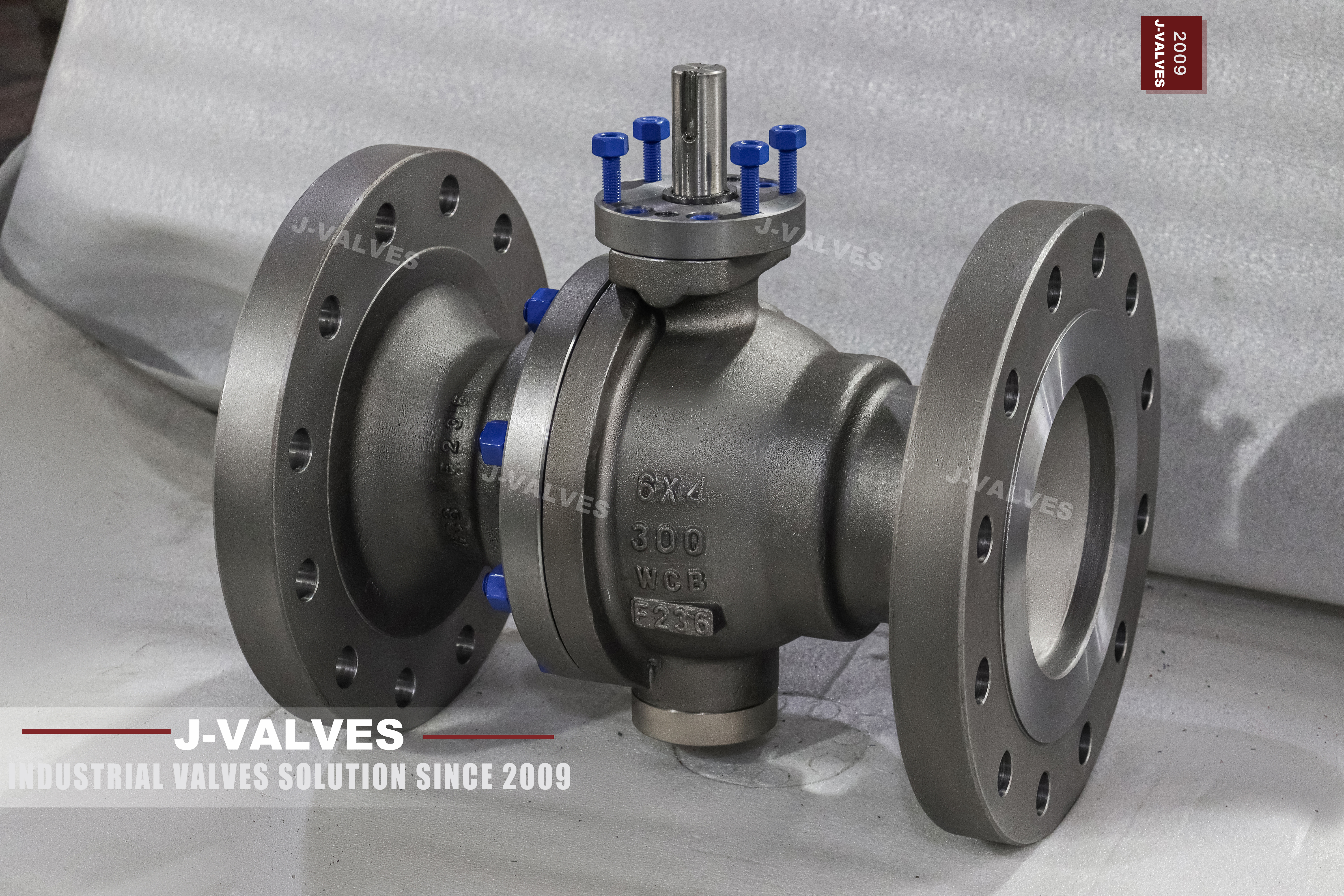
This is a six by four inch, Class 300, two piece trunnion mounted ball valve with a cast WCB body and a seat made from an F236 fluoroelastomer. DN150 is the flange size, DN100 is the bore, the ends are flanged to ASME B16.5 in raised face or ring joint form, and the design follows API 6D. The ball runs on trunnions, so the line pressure loads the bearings rather than the seat.
F236 in the model number is the part of this page that most needs saying plainly. It is a compound code for a fluorocarbon elastomer, the family usually written FKM, and it is a seat material rather than a body material. It does not appear in ASTM A216, which is where the WCB body comes from, and it is not a steel grade at all. A buyer who reads the model number as WCB body plus F236 body and expects two metal options has misread the product, and that misreading is common enough to be worth a paragraph.
Design and Construction
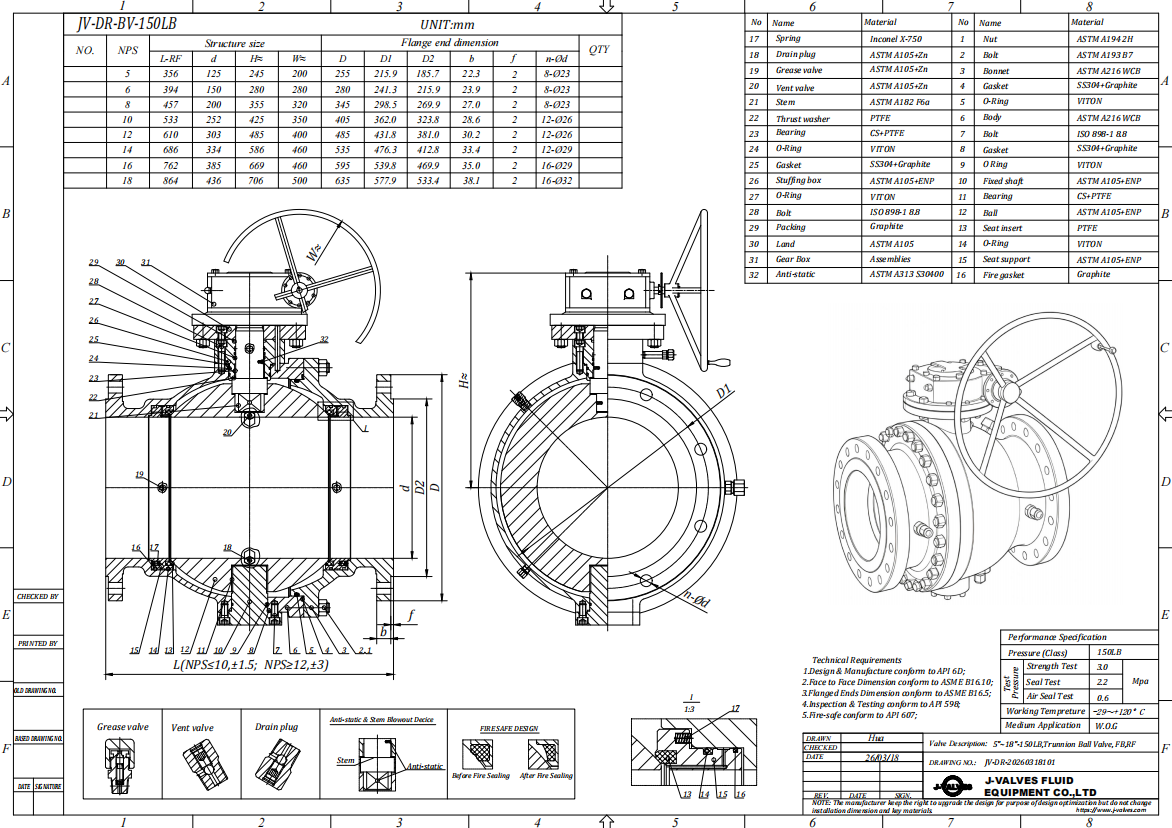
The trunnion is the structural choice that makes this size and class straightforward. A floating ball at DN150 Class 300 would press onto the downstream seat with the full line pressure acting on the ball area, and the torque needed to break it away would climb with the pressure. With the ball carried on an upper and a lower trunnion, that load goes into bearings, the seat load is set by springs, and the operating torque stays low enough for a gear or a lever.
The six by four marking describes a DN150 body around a DN100 bore. The reduction is made in the body and at the seat pockets, not by fitting a smaller ball with an adaptor, so the flow path through the ball is a clean cylinder and the step is where the bore meets the seat. That is why the valve is a reduced bore valve against the six inch line and a full port ball against its own DN100 bore, and both statements are true at once.
Material Options
The body is cast WCB, the normal carbon steel for water, oil and gas at moderate temperature. A105 forged is available where a wrought body is preferred, and A350 LF2 for low temperature. Those are body decisions. The seat is the separate decision and it is the one the model number is pointing at: F236 is a fluorocarbon compound chosen for oil resistance and for a higher temperature than a conventional nitrile would survive.
That choice has consequences that go beyond temperature. A fluorocarbon seat is resistant to mineral oils, fuels, lubricants and many solvents, and it is the wrong seat for hot water and steam, where an EPDM seat is the correct answer, and for some amines and low molecular weight esters. PTFE, RPTFE, PPL and a metal seat with a cobalt alloy facing are the other options in this body, and moving between them changes the service envelope without changing any dimension.
| Component | Standard Material | Optional Upgrade | Service Notes |
|---|---|---|---|
| Body and end cap | ASTM A216 WCB cast carbon steel | A105 forged, A350 LF2 | body grade is separate from the seat compound |
| Ball | A105N or WCB with hard chrome | 316 stainless | trunnion mounted, not floating |
| Trunnion and bearings | A105 with surface hardening | 17-4PH trunnion | carries the load so the seat does not |
| Stem | 17-4PH stainless | 316 stainless | blowout proof, retained by the body |
| Seat ring | F236 fluoroelastomer, FKM family | PTFE, RPTFE, PPL, nylon, metal with cobalt alloy facing | F236 is the compound named in the model number |
| Body gasket | PTFE or spiral wound | Graphite filled for higher temperature | replaced every time the body is opened |
| Stem packing | PTFE V-ring | Graphite for higher temperature | matched to the seat temperature |
| Operator | Worm gear or bevel gear | Pneumatic, electric, hydraulic | gear is standard at this size |
Technical Specifications
The envelope is six by four inch, Class 300 which is PN50, two piece cast body, flanged to ASME B16.5, face to face to ASME B16.10, trunnion mounted ball, and an F236 fluoroelastomer seat. The bore is DN100 inside a DN150 body. The valve is operated by a worm gear or a bevel gear as standard at this size, with pneumatic, electric and hydraulic actuation available on the mounting pad.
Two figures on the drawing matter more than the rest. The first is the reduced bore: DN100 through a DN150 body means the valve will not pass a DN150 pig and the pressure drop across it is higher than across a full port valve of the same size. The second is the torque, which is measured on the assembled valve and issued with the drawing, because it moves with the seat compound and the temperature and cannot be read from a size table.
| Item | Value |
|---|---|
| Nominal size | 6 x 4 inch (DN150 body, DN100 bore) |
| Pressure rating | Class 300 (PN50) |
| Body construction | two piece, bolted end cap |
| Ball support | upper and lower trunnion in bearings |
| Bore type | reduced bore, DN100 in a DN150 body |
| Body material | ASTM A216 WCB cast carbon steel |
| Body options | A105 forged, A350 LF2 |
| Ball | A105N or WCB with hard chrome plating |
| Ball option | 316 stainless |
| Trunnion | A105 with surface hardening, or 17-4PH |
| Stem | 17-4PH precipitation hardening stainless |
| Stem option | 316 stainless steel |
| Seat | F236 fluoroelastomer, FKM family |
| Seat options | PTFE, RPTFE, PPL, nylon, metal with cobalt alloy facing |
| Seat compound note | F236 is a seat compound code, not a steel grade |
| Body gasket | PTFE or spiral wound |
| Packing | PTFE V-ring |
| End connection | flanged to ASME B16.5, raised face or ring joint |
| Face to face | ASME B16.10 |
| Wall thickness | ASME B16.34 |
| Design standard | API 6D and API 608 |
| Pressure testing | API 598 shell and seat, both directions |
| Operator | worm gear or bevel gear as standard |
| Operator options | pneumatic, electric, hydraulic |
| Anti static | spring loaded path from body to stem to ball |
| Stem retention | blowout proof, retained by the body |
| Body cavity | self relieving through the seat |
| Pigging | not suitable, reduced bore |
| Marking | size, class, WCB, F236 and heat number on the nameplate |
| Documentation | EN 10204 3.1, seat compound declaration, test record, GA drawing |
Standards and Compliance
No valve standard lists F236, so the seat has to be pinned by the order and confirmed by the certificate rather than assumed from a general description. That is the one place where this valve needs more specification than a standard build, and it is the field most often left vague. Everything else is conventional: API 6D for the pipeline requirements, API 608 for the ball valve specifics, ASME B16.34 for the wall and the rating, ASME B16.5 for the flange, ASME B16.10 for the length and API 598 for the test.
That last point is the practical one for a buyer writing a specification. If the seat material matters, the specification has to name it and the certificate has to confirm it, because a generic reference to a soft seated ball valve does not exclude a different elastomer. Fire safe certification to API 607 or ISO 10497 is a separate question again, and on a soft seated valve it rests on the seat and the packing surviving the test rather than on the body.
| Requirement | Standard | What J-VALVES Supplies |
|---|---|---|
| Pipeline valve requirements | API 6D | design document, GA drawing, test record |
| Ball valve specifics | API 608 | anti static path, blowout proof stem, nameplate content |
| Wall thickness and rating | ASME B16.34 | wall calculation for DN150 Class 300 |
| Flange dimensions and facing | ASME B16.5 | raised face or ring joint as ordered |
| Face to face length | ASME B16.10 | length confirmed on the drawing |
| Ring joint gasket where used | ASME B16.20 | gasket supplied with the valve |
| Pressure testing | API 598 | shell at 1.5 times, seat at 1.1 times, both directions |
| Seat compound declaration | On the material certificate | F236 declared against the order line |
| Material certificate | EN 10204 3.1 | per heat number for the body, per batch for the seat |
Manufacturing Process
The body and the end cap are cast in WCB and machined, with the seat pockets cut square to the trunnion bores so that the ball axis and the seat axis stay concentric. The trunnion bores are line bored, the bearings are fitted, and the ball is checked for free rotation before the end cap closes. The flange face is turned to the ASME B16.5 profile and the joint face is checked for flatness on a surface plate.
The seat is where the compound matters to the process. An elastomer seat is moulded or machined to the seat ring, and the grade has to be the one on the order rather than a visually identical substitute, because fluoroelastomer compounds differ in filler and in cure and look the same. The seat is fitted, the valve assembled, and the seat test is run before the gear is mounted, so that a seat problem is found before the operator is on the valve.

Quality Control and Testing
Each valve is shell tested at one and a half times the rating and seat tested at one point one times in both directions to API 598. The seat test is done in both directions because a trunnion valve has two independently loaded seats and a single direction test only proves one of them. The test medium, pressure and hold time are recorded per valve rather than per batch.
The material checks are where a seat substitution would be caught. The body is verified against A216 WCB by heat number, and the seat compound is verified against the order line and declared on the certificate. The reduced bore is checked against DN100, the flange against ASME B16.5, the face to face length against ASME B16.10, and the torque is measured last on the assembled valve and recorded against the figure used to select the gear.
| Step | What Is Checked | Standard or Acceptance |
|---|---|---|
| Incoming casting | heat number and chemical composition | EN 10204 3.1 against A216 WCB |
| Seat compound | compound identity against the order line | declared on the certificate, not substituted by appearance |
| Machining | trunnion bore alignment, seat pocket squareness | line bored, drawing tolerance |
| Reduced bore | DN100 bore through a DN150 body | gauged against the drawing |
| Flange gauge | outside diameter, bolt circle, bolt hole diameter, facing | ASME B16.5 Class 300, gauged |
| Shell test | body and both joints at 1.5 times | API 598, no leak |
| Seat test | each seat in both directions at 1.1 times | API 598, no visible leak |
| Torque | breakaway and running torque on the assembled valve | recorded, compared against the gear selection |
| Marking | nameplate against the order | size, class, WCB, F236, heat number |

Applications and Industry Service
The duty this build suits is hydrocarbon isolation where an elastomer seat is preferred: fuel and lube oil systems, oil gathering and transfer lines, produced water with oil present, and plant piping where a PTFE seat would be attacked or where a slightly higher temperature than PTFE allows is needed. The F236 seat is the reason those lines are specified this way rather than with a standard soft seat.
The reduced bore is a separate reason to buy it. Where a six inch line has to be reduced to four inch at the valve station, or where the valve sits in a run that is already DN100 downstream, a six by four valve does the reduction and the isolation in one item instead of a valve plus two reducers. That saves two joints, two gaskets and the space between them, which on a skid is often the actual reason the order is written this way.

Installation, Operation and Maintenance
Install with the stem up or horizontal, check the gasket against both faces, and support the pipe either side so the valve does not carry the line load. Because the bore is reduced, check that no pig or scraper is expected to pass this station; if one is, this is the wrong valve and no amount of installation care will fix it. Leave access to the gear or the lever through the full quarter turn.
Operate the valve fully open or fully closed and do not use it to throttle, because a reduced bore valve used as a throttle puts the seat edge into an already accelerated flow. When the seats are replaced, replace the body gasket and the stem packing at the same time and fit the same seat compound that was ordered; an elastomer seat of a different compound will fit and will fail earlier for a reason that is very hard to diagnose afterwards.
How to Specify and Order
State body size and bore, class, body grade, seat compound, flange facing, face to face standard, operator and any actuation. A typical line reads: six by four inch, Class 300, WCB body, F236 fluoroelastomer seat, ball A105N with hard chrome, raised face to ASME B16.5, face to face to ASME B16.10, worm gear. The seat compound has to be named, because F236 is not a default that a generic description will produce.
Send the fluid, the concentration, the design pressure and temperature and whether the line will ever be pigged. The fluid decides the seat compound, the temperature decides whether an elastomer is viable at all, and the pigging question decides whether a reduced bore valve can be used. Those three answers at enquiry stage are the difference between a valve that lasts and a valve that is replaced inside a year.
FAQ
Q: Is F236 a steel grade?
A: No. F236 is a compound code for a fluorocarbon elastomer, the family written FKM, and it is the seat material. The body of this valve is WCB, a cast carbon steel to ASTM A216. The two codes sit next to each other in the model number, which is why buyers read F236 as a second body option, and it is not one.
Q: What is a fluorocarbon seat good for?
A: Mineral oils, fuels, lubricants and many solvents, at a higher temperature than a conventional nitrile seat would survive. It is the wrong choice for hot water and steam, where EPDM is correct, and for some amines and low molecular weight esters. The fluid decides the compound, and the compound has to be named on the order.
Q: Why is the bore four inch on a six inch valve?
A: Because the valve is a reduced bore design: DN150 flanges around a DN100 bore. It is used where a six inch line reduces to four inch at the valve station, so one item does the reduction and the isolation and saves two reducers and two joints. The trade off is a higher pressure drop and no pig passage.
Q: Can a pig pass this valve?
A: No. The bore steps down at the seat pockets and a DN150 pig will not pass a DN100 bore. Where the line is pigged, order a full port valve of the same size instead. On a line that is only ever liquid or gas without cleaning runs, the reduced bore is a cost and space advantage rather than a limitation.
Q: Why does this valve have a trunnion at only six inch?
A: Because the class is 300 and the bore is reduced to DN100, the seat load is manageable, but the trunnion is still the better structural choice at this size: it takes the pressure load on bearings so the operating torque stays low and the seat is not squeezed by the line pressure. The same body without a trunnion would need a heavier gear and would wear the seat faster.
Q: Which other seat options are available in this body?
A: PTFE, RPTFE, PPL, nylon, and a metal seat with a cobalt alloy facing. All of them fit the same body and change no dimension, which is why the seat is a separate line on the order rather than something implied by the size. A different compound in the same body is a different service envelope.


Hot Products


News
Ball Valves in Geothermal Brine: Silica Scale, Chloride Cracking And The Cooling Trap
Why geothermal brine destroys ball valves: retrograde silica scale, calcite at the flash point, chloride cracking above 60 C and the 250 C seat limit.
Read More
Ball Valve Face To Face Dimensions: Why A Correctly Ordered Replacement Still Does Not Fit
A 6 inch Class 150 ball valve can be 267 or 305 mm face to face and both are compliant. How B16.10, EN 558 and flange drilling decide whether it fits.
Read More
Ball Valve Stem Key And Keyway: What Gives Way First, And What The Handle Cannot Tell You
Between the handle and the ball there are four fits. Which one shears, which one cracks, and how a few degrees of lost motion hides a valve that never seated.
Read More
Ball Valve Datasheet: Six Blocks That Decide Whether Two Quotes Are Comparable
A ball valve datasheet only works when six blocks are fixed: pressure basis, bore, temperature ceiling, test, end connection, operator. How each is written.
Read More