


CHINA J-VALVES Offers Various High-quality I ndustrial Ball Valves
J-VALVES, a distinguished professional ball valve manufacturer rooted in China, takes pride in its extensive product portfolio. Our offerings span a wide range, including trunnion-mounted ball valves, floating ball valves, high-temperature ball valves, high-pressure ball valves, metal-sealed ball valves, ultra-low temperature ball valves, DBB ball valves, Three-way And Four-way Ball Valve, and fully welded ball valves. Each product is a testament to our commitment to precision engineering and reliable performance. Meticulously crafted, they are designed to not only meet but exceed the most stringent industrial demands, ensuring stable operation even under extreme conditions. This enables us to provide our clients with high-value services and makes our valves widely sought-after in industries.
Product Category
Contact Us


-
J-VALVES-Q347F
-
J-VALVES
Overview of the J-VALVES API 6D Forged Steel Trunnion Ball Valve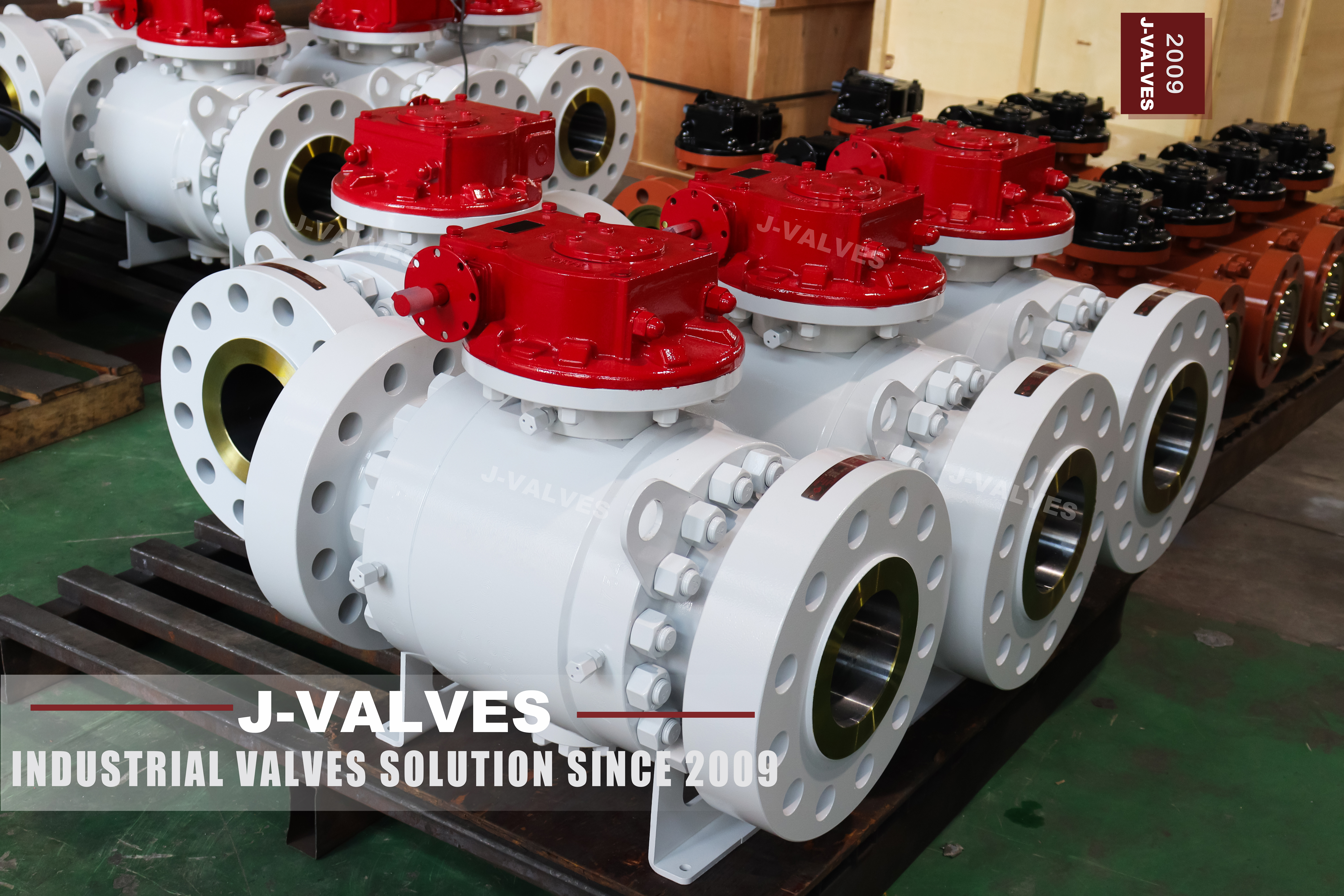
This is a family page rather than a single valve. It covers three piece forged steel trunnion mounted ball valves from two inch to fifty six inch, Class 150 to 2500, with flanged or butt weld ends and a full bore as standard. The body is forged A105N unless a stainless or duplex grade is ordered, and the centre section comes out between two joints for service.
What separates this family from a plant piping ball valve is the standard it is built to. API 6D is the pipeline valve standard, and it asks for a design document, a documentation package and a set of structural requirements that API 608 does not. A buyer who specifies a pipeline valve by size and class alone gets a valve that works, but not necessarily one whose paperwork a pipeline operator will accept.
Design and Construction
The three piece layout puts the stem, the packing and both seat pockets in the centre section, with an end piece on each side. Both joints open, the centre drops out with the ball and both seats in it, and the pipe stays where it is. On a pipeline that is the difference between a seat change and a cut out, and it is the main reason this construction is specified on lines that cannot be shut for long.
The ball is carried on a trunnion at the bottom and driven by the stem at the top, so it rotates in place and does not travel with line pressure. The seats are spring loaded onto the ball and relieve if cavity pressure rises above line pressure, which is where the API 6D cavity relief requirement is met without a vent on the body. The relief direction is marked so that the valve can be installed the right way round.

Material Options
Forged A105N is the default because at high class and large size a forging carries the wall without the porosity risk of a casting. The forging is ultrasonic tested where ordered, and the test is on the billet rather than the finished body, because that is where a shrinkage defect would be. Above about Class 900 and above 12 inch, forging is the normal route rather than an upgrade.
A182 F316 or a duplex grade replaces A105N where the medium is corrosive, and the choice between them follows the chloride content and the temperature rather than the pressure. On the trim side the ball can be A105N with ENP, stainless, or duplex to match the body, and the seat runs from PTFE to a hardfaced metal seat depending on the temperature the line actually reaches.
| Component | Standard Material | Optional Upgrade | Service Notes |
|---|---|---|---|
| Centre section | ASTM A105N forging | A182 F316 or duplex forging | Carries the stem, packing and both seat pockets |
| End pieces | ASTM A105N forging | A182 F316 or duplex | Two joints, allows the centre to be removed |
| Ball | A105N with ENP or hard chrome | Stainless or duplex ball | Trunnion mounted, full bore as standard |
| Trunnion | Forged steel, surface hardened | 17-4PH or stainless | Takes the seat load on a bearing |
| Stem | 17-4PH | A105N with ENP, F316 | Blowout proof, keyed to the ball |
| Seat | PTFE or RPTFE | PPL, PEEK, metal with graphite | Spring loaded, self relieving |
| Packing | PTFE V rings | Flexible graphite | Adjusted at the gland |
| Joint gaskets | Spiral wound, graphite filler | Ring type joint at Class 900 and above | Two per valve, both single use |
| Bolting | A193 B7 with A194 2H | B7M for sour service | Torque from the drawing, per size |
| Operator | Lever to 6 inch | Worm gear, pneumatic or electric | ISO 5211 pad on the centre section |
Technical Specifications
Because this is a family page, the numbers are ranges rather than a single specification: two to fifty six inch, Class 150 to 2500, with the face to face length, the wall and the flange pattern all following the size and class ordered. A buyer who needs one specific valve should take the range from here and the dimensions from the page for that size, because a range cannot answer a question about a particular installation.
One rule holds across the whole range: from Class 900 upward the flange facing changes from raised face to ring type joint, because a flat gasket at those pressures is pushed outward faster than the bolts can hold it. That single transition is the most common ordering error on a pipeline valve, and it is not visible until the gasket is being fitted.
| Item | Value |
|---|---|
| Product type | Three piece forged steel trunnion mounted ball valve |
| Size range | 2 to 56 inch, DN50 to DN1400 |
| Pressure class | Class 150 to 2500, PN20 to PN420 |
| Body material | Forged carbon steel ASTM A105N |
| Body option | Forged stainless ASTM A182 F316, F304, or duplex on request |
| Body construction | Three piece, two bolted joints, centre section removable |
| Ball support | Trunnion mounted, upper and lower bearing |
| Ball | A105N with ENP or hard chrome, stainless on request |
| Stem | 17-4PH, A105N with ENP, or F316 |
| Trunnion | Forged steel with surface hardening, or stainless |
| Seat | PTFE or RPTFE to 180 C, PPL to 280 C |
| Seat option | PEEK to 260 C, metal with graphite to 425 C |
| Seat design | Spring loaded, both seats independently energised |
| Cavity relief | Self relieving through the seat, direction marked |
| Packing | PTFE V rings, flexible graphite option |
| Body joint gasket | Spiral wound with graphite filler, two joints |
| End connection | Flanged raised face or ring type joint, ASME B16.5 |
| End option | Butt weld ends to ASME B16.25 |
| Face to face | ASME B16.10, held on the drawing per size and class |
| Bore | Full bore as standard, reduced bore on request |
| Design standard | API 6D, ASME B16.34, API 608 |
| Test standard | API 598, API 6D |
| Fire safe | API 607 with the seat compound supplied |
| Anti static | Ball to body continuity, measured per valve |
| Temperature range | -29 to 425 C body, ceiling set by the seat |
| Media | Oil, gas, water, pipeline products, process liquid |
| Operation | Lever to 6 inch, gear or actuator above that |
| Operation option | Pneumatic or electric actuator to ISO 5211 |
| Documentation | API 6D certification package with the valve, per order |
| Traceability | EN 10204 3.1 certificate with the heat number |
Standards and Compliance
API 6D is the governing standard and it is more demanding than API 608 on documentation rather than on dimensions. It requires a design that has been validated for the pressure and the loads, records for the pressure test and the material, and marking that identifies the valve against those records. ASME B16.34 supplies the wall, ASME B16.5 the flange, ASME B16.10 the length and API 598 the test method.
The practical difference shows up at a customer audit. A valve built to API 608 can be perfectly good and still fail a pipeline operator review because the documentation package is not the one named in the specification. That is why the standard belongs on the enquiry next to the size and the class rather than being assumed from the product description.
| Requirement | Standard | What J-VALVES Supplies |
|---|---|---|
| Pipeline valve design | API 6D | Full 6D documentation package, including the records listed below |
| Wall and rating | ASME B16.34 | Forged wall tabulated per class |
| Ball valve specifics | API 608 | Anti static path, blowout proof stem, nameplate content |
| Flange drilling | ASME B16.5 | Raised face to Class 600, ring type joint from Class 900 |
| Face to face | ASME B16.10 | Length on the signed drawing per size and class |
| Pressure test | API 598 | Shell 1.5 times and seat 1.1 times the rating |
| Fire test | API 607 | Certificate against the seat compound supplied |
| Butt weld ends | ASME B16.25 | Where the line is welded rather than flanged |
| Material certificate | EN 10204 3.1 | Heat number traced from the forging |
Manufacturing Process
The centre section and the end pieces are forged from the same grade and machined as a set. The joint faces are cut first, the three pieces are bolted together, and the bore and both seat pockets are cut through the assembly so that the bore runs true across both joints. At the top of the size range the machining is done on a borer rather than a lathe, and the trunnion bore is cut in the same setting as the seat pockets.
The flange is drilled last from the ASME B16.5 table for the size and class ordered, and the facing is cut to the ring joint groove profile where that is what the class requires. Welded end variants are welded before the final machining so that the weld does not distort a finished flange face.

Quality Control and Testing
Every valve gets a shell test with both joints assembled and torqued, a seat test in both directions, and a cavity relief check. On a three piece valve there are two pressure boundary joints and both are tested, because the second joint is the one that gets less attention during assembly and is the one that weeps in service.
The checks that scale with size are bore alignment across both joints, measured with the valve assembled, and torque, measured at the rated pressure and issued with the drawing. On a family that runs to fifty six inch, a torque figure from a table is not a specification, it is a guess that changes with the seat, the temperature and the bore.
| Step | What Is Checked | Standard or Acceptance |
|---|---|---|
| Chemistry | A105N or F316 against the certificate | Spectrographic analysis per heat |
| Forging soundness | Ultrasonic test of the centre section | UT per order, on the forged billet |
| Joint faces | Flatness of both joints | Checked on a surface plate before assembly |
| Shell test | Centre section and both joints | 1.5 times the rating, held to API 598 |
| Seat test | Both directions | 1.1 times the rating, no visible leakage |
| Cavity relief | Seat lift at the designed differential | Checked on assembly, recorded |
| Bore alignment | Bore true across both joints | Checked with the joints closed and torqued |
| Torque | Breakaway torque at the rated pressure | Measured per size, issued with the drawing |
| Anti static | Ball to body continuity | Measured in ohms per valve |

Applications and Industry Service
The family is used on oil and gas gathering and transmission, pipeline stations, water transmission mains, and process isolation where the line is large and the valve is expected to be serviced rather than replaced. The forged body and the three piece layout both point at the same duty: high pressure, large bore, and a maintenance plan that assumes the valve stays in the line.
It is the wrong family for small bore plant piping, where a two piece cast valve is cheaper and adequate, and for any duty where the medium attacks carbon steel without a stainless or duplex upgrade. It is also wrong where the two extra joints are seen as two extra leak paths with no service requirement to justify them, which is a real consideration on a line that will never be opened.

Installation, Operation and Maintenance
Installation follows the class. Up to Class 600 the flange is normally raised face and the gasket a spiral wound; from Class 900 it is a ring joint in a groove, and the ring is a consumable that is replaced every time the joint opens rather than reused. Studs are lubricated before assembly on stainless flanges, and the cross pattern is done in stages with a torque wrench.
A seat change is the reason for the three piece layout: isolate, drain, open both joints, lift the centre section out, and the ball and both seats are on the bench. Both joint gaskets and the seat O rings are replaced, and the trunnion bearing is inspected while the centre is out. The packing can be adjusted in service at the gland, and replacing it is a centre section job.
How to Specify and Order
An order needs size, class, body material, trim, end connection and the governing standard. For this family that means naming API 6D explicitly, because a valve built to API 608 will not carry the documentation a pipeline operator expects even when the dimensions match. The end connection matters as much: flanged, ring joint or butt weld are three different products at the same size and class.
Ask for the material certificate to EN 10204 3.1, the pressure test record covering both joints, the cavity relief check, the ultrasonic report on the forging where ordered, and the measured torque. Spares worth holding are a pair of joint gaskets, a seat and O ring kit and a set of packing rings; on a three piece valve the gaskets are what stop it being reassembled.
FAQ
Q: What does API 6D require that API 608 does not?
A: API 6D is the pipeline valve standard and it requires a validated design, a documentation package with material and test records, and structural requirements including cavity relief. API 608 covers the ball valve specifics such as the anti static path and the blowout proof stem. A valve can meet both, and on a pipeline it should.
Q: Why forged steel rather than cast at high class?
A: Because a forging carries the wall thickness at high class without the porosity risk of a casting at the same section. Above about Class 900 and above 12 inch, forging is the normal route rather than an upgrade, and the billet is ultrasonic tested where ordered.
Q: What is the size and pressure range of this family?
A: Two to fifty six inch, Class 150 to 2500. The face to face length, the wall and the flange pattern all follow the size and class ordered, which is why a specific installation should be quoted from the page for that size rather than from this range.
Q: When does the flange change from raised face to ring joint?
A: At Class 900. From that class upward a flat gasket is pushed outward by the internal pressure faster than the bolts can hold it, so the gasket is confined in a machined groove. The facing is not interchangeable, and the ring is a consumable replaced at every joint opening.
Q: Can the centre section be removed with the pipe in place?
A: Yes, that is the purpose of the three piece layout. Both joints open and the centre drops out with the ball and both seats, so the pipe stays where it is. The line still has to be isolated, drained and vented, and both joint gaskets are replaced on reassembly.
Q: Does this valve need an external cavity relief vent?
A: No. The seats are self relieving, so pressure trapped in the body cavity lifts a seat and escapes to the low pressure side. That is how the API 6D cavity relief requirement is met on this design, and the relief direction is marked on the body.


Hot Products


News
Ball Valves in Geothermal Brine: Silica Scale, Chloride Cracking And The Cooling Trap
Why geothermal brine destroys ball valves: retrograde silica scale, calcite at the flash point, chloride cracking above 60 C and the 250 C seat limit.
Read More
Ball Valve Face To Face Dimensions: Why A Correctly Ordered Replacement Still Does Not Fit
A 6 inch Class 150 ball valve can be 267 or 305 mm face to face and both are compliant. How B16.10, EN 558 and flange drilling decide whether it fits.
Read More
Ball Valve Stem Key And Keyway: What Gives Way First, And What The Handle Cannot Tell You
Between the handle and the ball there are four fits. Which one shears, which one cracks, and how a few degrees of lost motion hides a valve that never seated.
Read More
Ball Valve Datasheet: Six Blocks That Decide Whether Two Quotes Are Comparable
A ball valve datasheet only works when six blocks are fixed: pressure basis, bore, temperature ceiling, test, end connection, operator. How each is written.
Read More