


CHINA J-VALVES Offers Various High-quality I ndustrial Ball Valves
J-VALVES, a distinguished professional ball valve manufacturer rooted in China, takes pride in its extensive product portfolio. Our offerings span a wide range, including trunnion-mounted ball valves, floating ball valves, high-temperature ball valves, high-pressure ball valves, metal-sealed ball valves, ultra-low temperature ball valves, DBB ball valves, Three-way And Four-way Ball Valve, and fully welded ball valves. Each product is a testament to our commitment to precision engineering and reliable performance. Meticulously crafted, they are designed to not only meet but exceed the most stringent industrial demands, ensuring stable operation even under extreme conditions. This enables us to provide our clients with high-value services and makes our valves widely sought-after in industries.
Product Category
Contact Us


-
J-VALVES-Q47F
-
J-VALVES
Overview of the J-VALVES DN600 PN160 Low Temperature Carbon Steel Three Piece Trunnion Ball Valve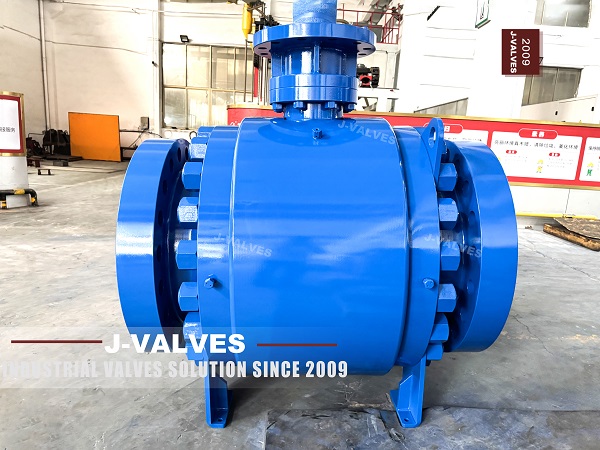
This is a three piece trunnion mounted ball valve in ASTM A350 LF2 low temperature carbon steel, twenty four inch at PN160, with flanged ends to EN 1092-1, two welded support legs and a bare stem on a machined mounting pad. The body is painted, which on a carbon steel valve is a corrosion system rather than a cover up. Three boundaries meet at this one size, and each of them has a consequence for the order. PN160 is a European designation with no entry in the API 6D designation table, so the flange is a European flange and not an American one with a different label.
NPS 24 is the last size at which an ASME B16.5 flange exists at all. And LF2 is a low temperature grade whose impact capability reaches lower than the point at which the ASME rating table begins. Those three facts are why this page spends more space on standards than on adjectives. A valve at this size is bought against a flange standard, a rating table and an impact qualification, and a data sheet that mixes the three is a data sheet that will be argued with at the inspection stage.
A PN number is a designation rather than a rating, and the distinction matters at this size. It identifies a flange and a wall thickness for a family of materials, and the pressure the valve can actually carry at temperature comes from the design code applied to that material. A page that writes PN160 and stops has named a flange; it has not said what the valve will hold at the temperature the line runs at, and on a cold duty that gap is where a specification argument starts.
Design and Construction
Three pieces means a centre body with the ball, both seats and both trunnion bearings, plus two end caps that bolt to it. At this size the caps are heavy: they stay on the pipe flanges when the centre section is lifted out, which is the whole point of the design, but the pipe support has to carry them while that happens. The trunnion carries the ball on an upper driven shaft and a lower locating shaft, and the lower shaft runs in a bearing in a cover bolted to the underside of the body. The seats only have to seal, not to hold the ball against the flow, which is what makes a twenty four inch valve operable at this class.
The stem leaves through a bolted gland at the top of a raised neck, with a machined pad above it and no gearbox fitted as standard. The neck is tall on a valve this size because the trunnion bearing has to sit above the body, and the gland at its top is the only part of the stem assembly that can be serviced with the line under pressure. At NPS 24 the valve is a structural item before it is a fitting, and the lift plan matters as much as the flange. The caps stay on the pipe while the centre section comes out, so the support has to be checked for that condition, and the centre section itself needs slings rated for it and points that are not the stem or the pad.
A valve this size is moved at least twice before it is installed, and the second move is usually the one where somebody improvises. Pigging at NPS 24 is usually the reason the bore has to be full rather than the reason the valve was chosen. A pipeline that will be cleaned and inspected needs an unobstructed path, and a reduced bore body is a step that stops the tool. The consequence for the order is that the bore is a specification item and not a preference, and that the seat arrangement has to be checked for anything that could stand into the bore when the valve is open. A full bore body with a seat that protrudes is still a valve a pig will not pass.

Material Options
LF2 is a forging grade and it is chosen for toughness at low temperature rather than for strength. Its chemistry and its room temperature strength are close to A105, and the difference that matters is the impact test, which is why the certificate has to show the test temperature and not only the grade. The bolting row is the one most often written from memory and written wrong. A193 is the high temperature bolting standard; A320 is the low temperature one, and the two are not interchangeable in a cold duty specification even where the grade numbers look similar. The stem row hides a product form question that rarely gets asked. A276 covers stainless bar, while a forged stem would be A182.
Both can produce a working stem, and only one of them matches a certificate that says forging, so the purchase order should name the form as well as the grade. The impact test is the part of the certificate that is specific to this grade and cannot be inferred from the others. A350 requires it, the test temperature has to be stated, and the results are reported per heat rather than as a general claim about the material. That is also why the product form has to be named: a forging is tested as a forging, and a certificate that describes a casting is describing a different object even when the chemistry matches.
Reading those two lines together is what tells you whether the valve is what was ordered. LF2 and LF2M are two grades and not two spellings, and the difference matters when a specification is copied between pages. The M denotes a modified chemistry with a restriction on the elements that affect notch toughness, and it is normally specified where the impact requirement is tighter rather than where the pressure is higher. Reading the grade off the certificate rather than off a sister page is the only way to know which one was supplied, because both are supplied under the same standard.
| Component | Standard Material | Optional Upgrade | Service Notes |
|---|---|---|---|
| Body and end caps | ASTM A350 LF2 forging | A352 LCC casting for the same duty | Product form named on the certificate |
| Ball | LF2 with ENP, or F316 | Solid F316, or carbide coated | Ball grade to the certificate, not to the photograph |
| Stem | A276 304 or 316 | 17-4PH, or nickel based alloy | A276 is bar stock, a different product form from a forging |
| Trunnion shafts | Surface hardened low alloy | 17-4PH or nickel based alloy | Lower shaft runs in the bearing in the bottom cover |
| Seat | RPTFE | PEEK, nylon, or metal seat with hard facing | Soft seats give tightness, metal seats give temperature range |
| Packing | Flexible graphite | Low temperature graphite specified for cold duty | Packing choice follows the service temperature |
| Gasket | Spiral wound, 316L with graphite filler | Ring joint gasket where the face is RTJ | Two joints, one per end cap |
| Bolting | A320 L7 with A194 Gr.7 nuts | L7M with 7M nuts for sour service | A320 is the low temperature bolting standard, not A193 |
Technical Specifications
The specification separates the European designation from the American one and states the flange standard explicitly, because at this size and this class the two routes do not converge. Two rows are worth reading twice. The face type row says stated on the order because EN 1092-1 has several face forms and only some of them are interchangeable; the raised face forms are B1 and B2, the spigot and recess forms are E and F, and a ring joint is an ASME face rather than a European one. A data sheet that says type E ring joint has combined two systems in one phrase. The temperature row is written the way the standards actually work.
LF2 is impact tested at low temperature, and the ASME group 1.1 rating table begins at minus 29 C. The material reaches lower than the table, which means the cold rating has to be established by the code that governs the piping rather than read off a table that stops. The gasket on a PN160 flange is a decision that has to be made from the facing rather than from habit. A spiral wound gasket with a stainless winding and a graphite filler suits a raised face and needs a defined compression; a ring joint is a metal to metal seal in a groove and belongs to a different facing entirely.
On a cold duty the gasket also has to be qualified at the temperature, which is a separate question from its pressure capability and one that is usually answered by the manufacturer rather than by the standard. The length on a European valve is a series number rather than a single value, and the series has to be stated on the order. EN 558 publishes several length series for the same valve type, and two valves of the same size and class can differ in face to face between them. That is not a subtlety to be left to the drawing: a valve built to one series in a spool designed for another is a pipe modification on site, and the modification is usually cutting and re-welding rather than an adapter.
| Item | Value |
|---|---|
| Type | Three piece trunnion mounted ball valve, side entry |
| Nominal size | DN600, NPS 24 |
| Pressure class | PN160 |
| Pressure designation note | No PN160 entry in the API 6D clause 7.2 table; nearest is PN 150 against Class 900 |
| Rating basis | EN 12516-1 for the pressure boundary, at the design temperature |
| Body material | ASTM A350 LF2 forging, impact tested |
| Bore | Full bore to API 6D Table 1 for NPS 24 |
| End connection | Flanged to EN 1092-1 PN160, face type stated on the order |
| Alternative ends | ASME B16.5 Class 900, available because NPS 24 is the last size in B16.5 |
| Face to face | EN 558 for the valve type and series ordered |
| Trunnion | Upper driven shaft, lower locating shaft in a bolted bottom cover |
| Support | Two steel legs welded under the body |
| Operator interface | Bare stem on a machined mounting pad |
| Temperature, body | LF2 impact qualified below the group 1.1 rating table start |
| Temperature, valve | Set by the seat and the packing ordered |
| Product standard | API 6D, or EN 12516-1 where a European design file is required |
| Test standard | EN 12266-1 or API 598, stated on the order |
| Fire test | API 607 and ISO 10497 when specified |
Standards and Compliance
The compliance chain here is European from end to end where the flange is European, and mixing an American product standard into it is the most common error on pages like this one. Buyers occasionally ask for an API 6D certificate on a PN design and expect an ASME class to appear somewhere on it. The two systems do not map at this point: the API designation table has no PN160 row, so the honest answer is that the valve is a European design with a European flange, tested to a standard that both systems accept.
The two routes do not converge at this size and the order has to pick one. If the line is ASME, the valve is a B16.5 Class 900 body with an American flange and an American length; if the line is European, it is this valve with an EN 1092-1 flange and an EN 558 length. Both are legitimate and both exist at NPS 24, and the mistake is to order one and expect the other, which is discovered when the bolt holes do not line up and there is no adapter that fixes a bolt circle.
The test standard is the one row where the buyer has a real choice, and it is worth making it at the enquiry rather than at the test. EN 12266-1 and API 598 both state a shell and a seat factor, but they do not write the same record, and a project that has to file a European test certificate will usually not accept an American one in its place. Naming the standard in the order costs nothing; naming it after the valve has been tested costs a re-test.
| Requirement | Standard | What J-VALVES Supplies |
|---|---|---|
| Pressure boundary design | EN 12516-1 | Wall thickness and material data on the drawing |
| Product standard | API 6D | Design, marking and documentation to the pipeline valve standard |
| Product standard, note | API 608 does not apply | It indexes classes, not PN designations, and stops at Class 600 |
| Flange dimensions | EN 1092-1 PN160 | Face type stated, drilling recorded at test |
| Face to face | EN 558 | Length per the valve type and series ordered |
| Pressure testing | EN 12266-1 or API 598 | Shell at 1.5 times rating, seat at 1.1 times rating |
| Impact qualification | ASTM A350 with the test temperature on the certificate | Charpy results reported per heat |
| Fire qualification | API 607 and ISO 10497 | Certificate covering the size and class band ordered |
| Material certification | EN 10204 3.1 | Heat numbers on body and caps, impact results included |
Manufacturing Process
The forgings are normalised and impact tested per heat before machining. At this size the body is a large forging with a long machining cycle, and the two body joint faces plus the two trunnion bores are machined in one setup so the alignment is built in rather than assembled. Welding is limited to the legs and to any overlay the order specifies, and both are covered by a procedure qualified for the low temperature service rather than for ambient. A weld procedure qualified at room temperature is not evidence of toughness at the service temperature, which is why the qualification range on the certificate matters.
Coating follows machining and testing. The flange faces and the ring grooves if any are masked, the body is blasted and primed, and the finish coat goes on after the legs are welded so that no bare patch is left around a weld. The tall neck on this valve is not a styling choice. The trunnion bearing has to sit above the body, so the stem is long and the gland sits at the top of a raised neck, which is also what puts the only serviceable part of the stem assembly outside the insulation.
That geometry is worth knowing before the lagging is detailed, because a drawing that insulates up to the pad has made the gland unreachable and turned a packing change into a strip of the cladding. Machining a forging this size is a long single operation and the alignment is what the operation is for. The two body joint faces and the two trunnion bores are cut in one setup so that the ball axis is square to both joints by construction rather than by measurement afterwards. Once the body is off the machine that relationship cannot be corrected without re-cutting, which is why the sequence is fixed before the first cut and why a change of drawing at that stage is expensive rather than inconvenient.

Quality Control and Testing
The sequence below is the usual one with three additions that cold duty forces: impact results per heat with the test temperature printed rather than implied, a welding procedure qualified at the service temperature for the legs and for any overlay, and a flange record that states which face form was machined. A data sheet written for warm duty will not ask for any of the three, which is why they belong in the order rather than in the works. The flange record matters more than usual on a PN valve because the same nominal size and class exists in more than one face form.
Recording what was actually machined, rather than what the order was supposed to say, is the only way to catch a mismatch before the valve leaves. Bolting on a cold duty is installed at ambient and works cold, and those are two different conditions. The studs should be lubricated to a stated coefficient, tightened to a figure rather than to feel, and re-torqued after the first thermal cycle, because a joint that was correct at assembly relaxes when it goes cold. On a large flange the difference between a joint that weeps and one that does not is usually the second tightening rather than the first.
The operating test is where a cold valve can be caught before it ships. The valve is turned through its full travel under pressure and the torque is recorded at each end of the stroke, because that figure is what the operator will be sized from. A valve that is stiff at ambient is stiffer with cold packing, and a gearbox or an actuator bought against a catalogue curve rather than against this record is an operator that will not close the valve it was fitted to.
| Step | What Is Checked | Standard or Acceptance |
|---|---|---|
| 1 Incoming material | Grade, product form, impact test temperature and results | A350 LF2, certificate with charpy values per heat |
| 2 Dimensional | Bore, joint faces, trunnion bores, leg positions | Drawing, EN 558 length, EN 1092-1 flange |
| 3 Flange record | Face type, outside diameter, bolt circle, bolt count | Face type stated on the order, record kept |
| 4 Weld qualification | Procedure and welder range against service temperature | Qualified for the low temperature range |
| 5 Shell test | Body, two body joints, bottom cover | EN 12266-1 or API 598, 1.5 times rating |
| 6 Seat test | Both seats, both directions | 1.1 times rating, acceptance per seat type |
| 7 Operating test | Quarter turn under pressure, torque recorded | Full travel, no ball lift |
| 8 Records | Stamping, heat traceability, impact and test sheets | Document pack issued with the valve |

Applications and Industry Service
Low temperature carbon steel is chosen where the service temperature is below the range that ordinary carbon steel is qualified for and where stainless is not justified by the medium. LPG and ammonia storage and transfer, cold climate stations, refrigeration circuits and low temperature process lines are the usual duties. Twenty four inch at PN160 is a large isolation valve for a main line rather than a branch, and the full bore means it can pass a pig.
The legs and the trunnion exist because the valve is a structural item at this size: it carries its own weight into steel and its centre of gravity into the pipe stress model. The duty it should not be given is high temperature. LF2 is a low temperature grade and its useful range is at the cold end; a valve selected for both extremes is usually a valve selected twice. Throttling is the second thing to avoid, for the same reason as on any soft or metal seated isolation valve.
The media this valve is bought for bring their own rules. LPG and ammonia are stored cold and the valve is an isolation point rather than a control element; refrigeration circuits cycle and the packing sees the movement. Ammonia also has a rule that is easy to forget: no copper alloy in the trim, because ammonia attacks it. A carbon steel body with a bronze seat retainer would be a mistake that passes every drawing check and fails in service.

Installation, Operation and Maintenance
Set the valve on its legs and shim them before the flange bolts are tightened, so the weight goes into the structure and the bolts only have to seal. The end caps stay on the pipe flanges when the centre section is removed, which means the pipe support has to be designed for that condition rather than for the assembled valve. Insulation is normal on cold duty and it changes the maintenance access. Keep the gland at the top of the neck and the mounting pad outside the lagging, and leave a removable section where the body joints are, because those joints have to be opened to reach the seats.
Maintenance above the body is limited to the packing, which can be renewed with the line under pressure once the cavity is vented. Everything below that is a pressure boundary item and needs the valve isolated, drained and warmed before it is opened, because a cold valve full of liquid does not come apart cleanly and the gasket will not release from a face it has frozen to. The two body joints are renewed rather than reused, one gasket per cap, and the faces are checked for damage before the new gasket goes in.
One habit makes a difference on cold duty and costs nothing: label the valve with the date it was installed and the torque its joints were closed to. A joint that weeps two winters later can then be compared with what was done rather than with what somebody remembers, and a re-torque becomes a planned job rather than a reaction. The same label is the only place the operator interface gets recorded, which matters when an actuator is added and nobody knows what the pad was machined for.
How to Specify and Order
Six fields decide the valve. Size and bore. The pressure class and, just as importantly, the flange standard, since PN160 and Class 900 are not the same flange and only one of them has a table entry at this size in each system. The face type, named from one system rather than a mixture of two. Body material and its impact test temperature. Seat and packing materials, which set the cold end of the operating range. And the operator package, with the pad size, the stem dimensions and whether a gearbox or an actuator is fitted.
Ask for the EN 10204 3.1 certificate with impact results per heat, the shell and seat test record, the welding procedure qualification for the legs if they are welded to the body, the fire certificate where required, and the general arrangement drawing with the leg height, the face to face length and the flange face type. At this size, and with two flange systems in play, the drawing is the specification. A valve this size travels on its own skid, and the condition it arrives in is part of what was ordered.
Flange faces are protected with blanks rather than tape, the bore is dry, and the stem is braced so that nothing leans on it in transit. The order should also say whether the operator travels fitted or on a separate pallet, because a gearbox strapped to a stem for six weeks at sea is a stem that has been loaded sideways for six weeks, and the first thing it does on site is weep at the gland.
FAQ
Q: Why is there no PN code for PN160?
A: Because the API 6D clause 7.2 table lists seven designations against classes and PN160 is not one of them; the nearest is PN 150 against Class 900. The honest description is a European design with a European flange, tested to a standard both systems accept, rather than an American class wearing a different label.
Q: Is PN160 the same as Class 900?
A: No. They are different flange standards with different bolt circles and different rating tables, and at this size both can exist, so the order has to pick one. A valve machined to one will not bolt to a mating flange made to the other.
Q: Does API 608 apply to a PN rated valve?
A: No. API 608 indexes classes rather than PN designations and its flanged scope stops at Class 600, so a PN160 valve has nothing to be measured against in it. The product standard here is API 6D, with EN 12516-1 where a European design file is required.
Q: Why A320 bolts rather than A193?
A: Because A320 is the low temperature bolting standard and A193 is the high temperature one. The grade numbers look similar, which is exactly why the prefix is written from memory and written wrong; on a cold duty specification the two are not interchangeable.
Q: Is type E a ring joint face?
A: No. In EN 1092-1, type E is a spigot and type F is the matching recess; the raised face forms are B1 and B2. A ring joint is an ASME facing, so the phrase type E ring joint combines two systems that do not meet.
Q: Can the centre section be taken out with the line in service?
A: No. The end caps stay on the pipe flanges, which is what three piece buys, but the line still has to be isolated, drained and warmed before the centre section is lifted out. Only the stem packing can be worked on with pressure in the line, and only once the cavity is vented.


Hot Products


News
Ball Valves in Geothermal Brine: Silica Scale, Chloride Cracking And The Cooling Trap
Why geothermal brine destroys ball valves: retrograde silica scale, calcite at the flash point, chloride cracking above 60 C and the 250 C seat limit.
Read More
Ball Valve Face To Face Dimensions: Why A Correctly Ordered Replacement Still Does Not Fit
A 6 inch Class 150 ball valve can be 267 or 305 mm face to face and both are compliant. How B16.10, EN 558 and flange drilling decide whether it fits.
Read More
Ball Valve Stem Key And Keyway: What Gives Way First, And What The Handle Cannot Tell You
Between the handle and the ball there are four fits. Which one shears, which one cracks, and how a few degrees of lost motion hides a valve that never seated.
Read More
Ball Valve Datasheet: Six Blocks That Decide Whether Two Quotes Are Comparable
A ball valve datasheet only works when six blocks are fixed: pressure basis, bore, temperature ceiling, test, end connection, operator. How each is written.
Read More