

CHINA J-VALVES Offers Various High-quality I ndustrial Ball Valves
J-VALVES, a distinguished professional ball valve manufacturer rooted in China, takes pride in its extensive product portfolio. Our offerings span a wide range, including trunnion-mounted ball valves, floating ball valves, high-temperature ball valves, high-pressure ball valves, metal-sealed ball valves, ultra-low temperature ball valves, DBB ball valves, Three-way And Four-way Ball Valve, and fully welded ball valves. Each product is a testament to our commitment to precision engineering and reliable performance. Meticulously crafted, they are designed to not only meet but exceed the most stringent industrial demands, ensuring stable operation even under extreme conditions. This enables us to provide our clients with high-value services and makes our valves widely sought-after in industries.
Product Category
Contact Us


Pressure Class: Class 150 to 900 typical for this pattern
Body Material: ASTM A216 WCB cast carbon steel
Ball: WCB with ENP, or A351 CF8M with hardfacing
Stem: A182 F6a or F316
Seat: PTFE, RPTFE, nylon, PEEK, or metal hardfaced
Seat Effect: Double piston effect standard, for DBB
Vent Valve: 1/2 inch or 3/4 inch NPT needle valve, stainless, capped
End Connection: Flanged RF / RTJ to ASME B16.5
Temperature Range: -29°C to +200°C; -46°C or +425°C option
Bore Type: Reduced bore, 12 inch flanges with 10 inch passage
Design Standard: API 6D, ASME B16.34
Test Standard: API 598, ISO 5208; vent tested separately
-
Q347Y
-
J-VALVES
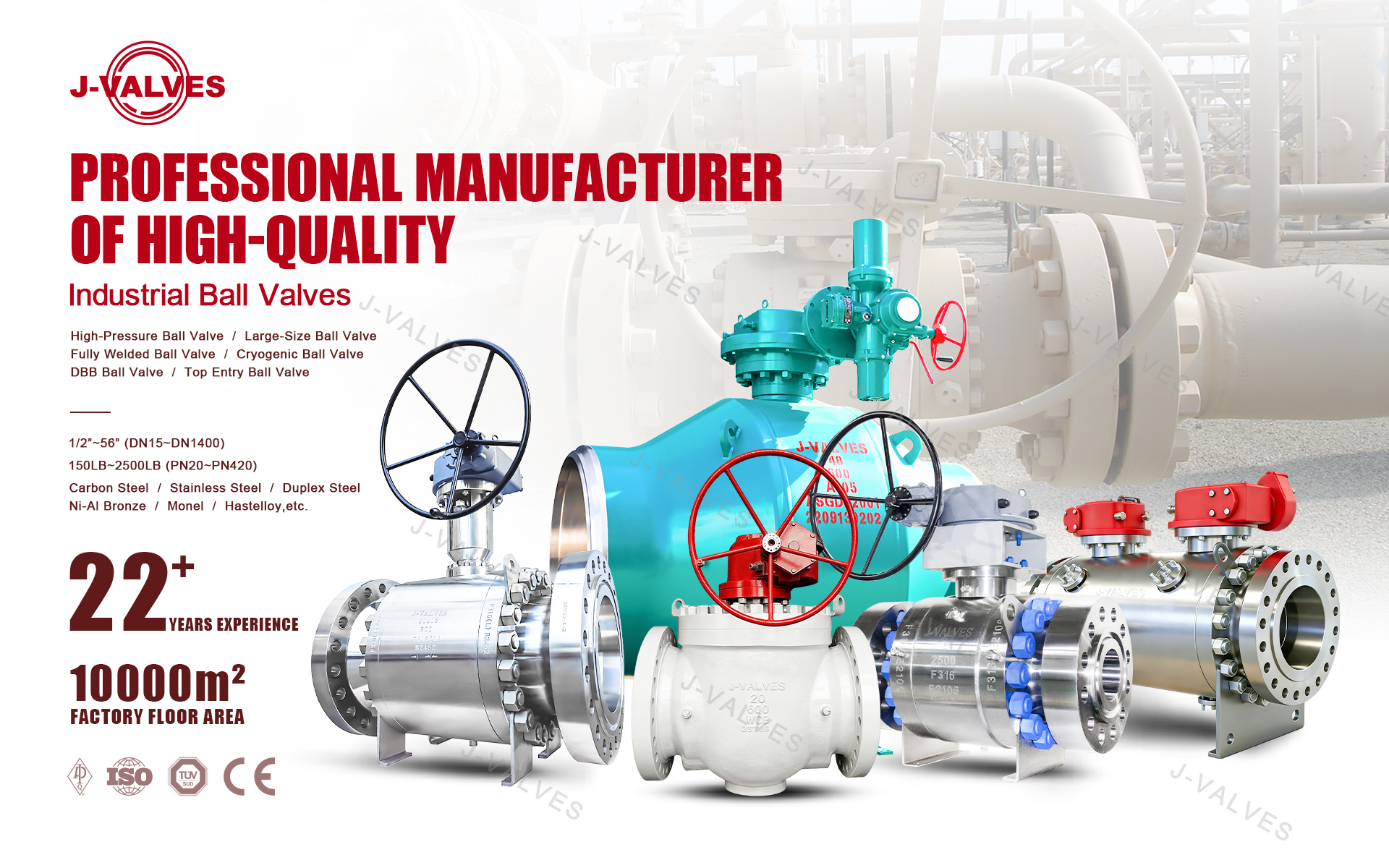
A 12x10 inch reduced bore trunnion ball valve is a valve whose flanges are 12 inch and whose bore is 10 inch, fitted with a needle vent valve in the body cavity. The size mismatch is deliberate: it lets a 10 inch line terminate in a 12 inch valve, so the valve can be stocked and interchanged on a header that steps between the two sizes, while the smaller bore keeps the seat load, the torque and the cost down.
J-VALVES builds this pattern in ASTM A216 WCB from 1/2 inch to 56 inch, in Class 150 to 2500, with a 1/2 inch or 3/4 inch NPT stainless needle valve screwed into the body. The needle valve is the feature that makes the valve safe to maintain on a liquid line, and it is the part most often left off a purchase order because it looks like an accessory. It is not an accessory; it is the cavity relief.
Parameter | This valve |
|---|---|
Size | 12 inch flanged, 10 inch bore (DN300 x DN250) |
Pressure class | Class 150 to 900 typical for this pattern |
Body | ASTM A216 WCB cast carbon steel |
Ball | WCB with ENP, or A351 CF8M with hardfacing |
Stem | A182 F6a or F316 |
Seat | PTFE, RPTFE, nylon, PEEK, or metal hardfaced |
Vent | 1/2 inch or 3/4 inch NPT needle valve, stainless, with cap |
Ends | Flanged RF or RTJ to ASME B16.5 |
Seat effect | Double piston effect standard, for DBB |
Temperature | -29°C to +200°C standard; -46°C or +425°C optional |
Standard | API 6D, ASME B16.34; test API 598, ISO 5208 |

What 12x10 Means in Practice
The notation is always flange size by bore size. A 12x10 valve has 12 inch flanges, a 12 inch body and a 10 inch flow passage. Both ends are 12 inch, so the valve drops into a 12 inch spool; the 10 inch bore is an internal restriction, not a size change at the flange.
This is different from a reducer, and the difference matters for the piping designer. A 12x10 valve does not connect a 12 inch line to a 10 inch line — a 12x10 reducer does that. The valve replaces a 12 inch valve with a smaller bore, usually because the line is oversized for future capacity, because the flow is lower than the header size suggests, or because a 10 inch valve is substantially cheaper and lighter than a 12 inch one at the same class.
Arrangement | Flanges | Bore | What it does |
|---|---|---|---|
12x12 full bore | 12 inch | 12 inch | No restriction, piggable |
12x10 reduced bore | 12 inch | 10 inch | Restriction inside a 12 inch spool |
12x10 reducer + 10 inch valve | 12 and 10 inch | 10 inch | Changes line size, needs two reducers |
The practical case for the reduced bore valve is a header that runs at part capacity. A 12 inch line carrying the flow of a 10 inch line has a velocity low enough that the extra bore buys nothing, and the 10 inch bore valve costs less, weighs less and needs a smaller actuator. What it does buy is a permanent pressure loss, and that has to be checked rather than assumed.
The Cost of the Restriction
A reduced bore creates two sudden contractions and a smaller passage, and the loss is not negligible at high velocity. The check is straightforward: the bore area ratio gives the velocity increase, and the loss coefficient for a reduced bore ball valve is typically in the range of 2 to 4 velocity heads at full open, compared with well under 1 for a full bore valve.
At 2 m/s in the 12 inch line the 10 inch bore runs at about 2.9 m/s, and the extra loss is a fraction of a bar. At 4 m/s line velocity the bore runs at 5.8 m/s, the loss rises with the square of that, and erosion at the seat edge becomes the bigger concern. The rule of thumb is that a reduced bore is comfortable up to about 3 m/s in liquid service and becomes questionable above it.
The other cost is pigging. A 12x10 valve cannot pass a 12 inch pig, and a line that will be inspected needs full bore throughout. If the line is pigged, this is the wrong valve regardless of the economics.
WCB and Its Boundaries
ASTM A216 WCB is the standard cast carbon steel for valve bodies: 0.30 percent maximum carbon, 250 MPa minimum yield, 485 to 655 MPa tensile, and good weldability. It is Group 1.1 in ASME B16.34, so its ratings are the same as A105 forging: 19.6 bar at Class 150, 51.1 at Class 300, 102.1 at Class 600 and 153.2 at Class 900, all at 38°C.
Its boundaries are temperature and chemistry. Below -29°C it is not suitable, and A352 LCC or A350 LF2 is required. Above about 425°C the tensile and creep properties fall away and a chrome-moly body is needed. And in sour or wet CO₂ service the carbon steel body is acceptable only within the NACE limits, with hardness control on the welds and the trim.
Being a casting, the body should be radiographed at the seat pocket and the flange necks. A 12 inch WCB body is a thick section casting, and that is exactly where shrinkage porosity forms. A supplier who offers WCB at a price well below the market is usually not radiographing those regions.
Why a Needle Vent Valve, and What It Is Really For
The needle valve is screwed into the body cavity, the space between the two seats and around the ball. Its job is to let that cavity be depressurised and drained. There are two reasons this matters, and the second one is a safety case.
Double block and bleed. With the ball closed, the upstream seat and the downstream seat are two barriers and the cavity between them is a testable space. Opening the needle valve proves whether both seats are holding. That is the DBB function, and without a bleed point the valve cannot deliver it, whatever the seat design.
Thermal relief. This is the part that gets skipped. A liquid trapped in a closed cavity with the ball shut expands when it warms, and because liquid is nearly incompressible the pressure rise is enormous. Take a 30 litre cavity filled with water, warmed by 30 K. Water expands by roughly 0.0003 per kelvin in that range, so the volume tries to grow by about 0.27 litre, or 0.9 percent. Water's compressibility is about 4.5 × 10⁻¹⁰ per pascal, so if the cavity and the pipe were perfectly rigid the pressure would rise by roughly 200 bar. Nothing is perfectly rigid, so the real figure is lower, but the mechanism is why a blocked-in liquid line splits a body.
On a single piston effect seat the cavity self-relieves into the line, so this is not an issue. On a double piston effect seat, which is what a welded or buried valve uses and what a DBB requirement usually brings, the cavity is blocked in both directions and the relief has to be provided externally. The needle vent valve is that relief.
Sizing and Positioning the Vent
The vent does not need to flow much; it needs to be openable by a technician with a wrench and to be reliable after years of no operation. A 1/2 inch NPT needle valve is adequate for most sizes up to 12 inch; 3/4 inch is used on larger bodies where the cavity volume is bigger and faster draining helps.
Needle rather than ball or plug, for three reasons. It throttles finely, so the cavity can be bled slowly rather than dumped. It seals metal-to-metal on a hardened needle and seat, so it survives the temperature and does not rely on a polymer. And it fails in a predictable way: a needle valve that has been overtightened can be reseated, where a ball valve that has been left part open erodes its seat.
The valve should point downward or sideways from the lowest point of the cavity, so that liquid drains rather than accumulates. It should be capped, with the cap drilled or marked, so that a technician knows it is a vent and not a grease point. And it should be accessible from the operating platform, because a vent that requires scaffolding will not be used.

The DBB Procedure, Written Out
A double block and bleed check is a sequence, and doing it in the wrong order gives a false pass. The procedure below is the one that works on a trunnion valve with DPE seats.
Confirm the valve is fully closed, with the position indicator at the closed stop.
Open the needle vent slowly and drain the cavity to a safe location. A liquid cavity will discharge; a gas cavity will vent. Stand clear of the outlet.
Close the needle valve and observe the cavity pressure for a defined period, typically 5 to 15 minutes depending on the specification. A rising pressure indicates a seat passing.
If the pressure holds, both seats are sealing and the cavity is tight. If it rises, one or both seats are passing, and the valve should be scheduled for seat injection or replacement.
Reopen the needle valve to confirm the cavity can still be vented, then close it and refit the cap. A vent that cannot be reopened is a relief device that does not exist.
The test proves the seats are holding at the moment of the test. It does not prove they will hold tomorrow, and the trend of repeated checks is more informative than any single result.
Installation Notes for This Pattern
Orientation matters less on a trunnion valve than on a soft seated floating valve, because the seat load does not depend on gravity. The stem should still be vertical or horizontal, not inverted, because an inverted stem collects water in the gland.
The vent should be installed at the lowest point of the cavity in the installed orientation. If the valve is rotated on site from the drawing orientation, the vent may end up at the top of the cavity and stop draining liquid. That is a small detail with a large consequence, and it belongs on the installation drawing rather than in a manual.
The 12 inch flanges need the correct gasket and the correct bolt grade, and the pair should be torqued in a cross pattern. On a 12 inch Class 600 joint the bolt load is significant and an impact wrench applied in sequence around the flange will leave the joint uneven; a torque wrench in stages is the only way to get a uniform gasket compression.
Testing
The shell test at 1.5 times the rating and the seat test at 1.1 times follow API 598, with leakage compared against ISO 5208. The needle valve is tested separately at its own rating, and it should be fitted before the shell test so that the body tapping is proved under pressure.
The functional test includes stroking the valve and operating the vent. A vent that is seized from the factory is a vent that will be seized on site, and it is worth requiring that the vent be operated and recorded during the functional test rather than only pressure tested.

12x10 Reduced Bore Ball Valve FAQ
What does 12x10 mean on a ball valve?
It means 12 inch flanges with a 10 inch bore. Both ends connect to 12 inch pipe; the restriction is inside the valve. It is not a size transition, which would require a reducer.
Why fit a needle vent valve?
To depressurise and drain the body cavity, which serves two purposes: it allows a double block and bleed check to prove both seats, and it provides thermal relief for liquid trapped in a cavity that is blocked in by double piston effect seats.
Can a reduced bore valve be pigged?
No. A pig sized to the line will not pass a 10 inch bore in a 12 inch line. Lines that are pigged or inspected require full bore valves throughout.
How much pressure drop does the reduced bore add?
It depends on velocity. The loss coefficient is typically 2 to 4 velocity heads at full open, compared with well under 1 for full bore. Below about 3 m/s in liquid service the loss is small; above that it rises with the square of velocity and erosion at the seat edge becomes the concern.
Is a needle valve better than a plug or ball for the vent?
For this duty, yes. A needle throttles finely, seals metal-to-metal without a polymer, and can be reseated after overtightening. A ball valve left part open erodes its seat, and a plug valve is harder to throttle.
Why does a double piston effect seat need a vent?
Because DPE seats block the cavity in both directions, so thermal expansion of trapped liquid has nowhere to go. A single piston effect seat self-relieves into the line and does not need external relief, but it also gives only one sealing direction per seat.
Specifying This Valve
Provide flange size and bore, class, design temperature and fluid, body and trim material, seat type and piston effect, whether a DBB function is required, vent size and material, whether the vent needs a cap or a piped outlet, actuation, and the test and certification package.
Delivery is typically 4 to 7 weeks. The approval drawing shows the vent location in the installed orientation, and that drawing should be checked against the piping arrangement before the body is drilled, because the tapping position is fixed once it is made.
Hot Products


News
Ball Valves in Geothermal Brine: Silica Scale, Chloride Cracking And The Cooling Trap
Why geothermal brine destroys ball valves: retrograde silica scale, calcite at the flash point, chloride cracking above 60 C and the 250 C seat limit.
Read More
Ball Valve Face To Face Dimensions: Why A Correctly Ordered Replacement Still Does Not Fit
A 6 inch Class 150 ball valve can be 267 or 305 mm face to face and both are compliant. How B16.10, EN 558 and flange drilling decide whether it fits.
Read More
Ball Valve Stem Key And Keyway: What Gives Way First, And What The Handle Cannot Tell You
Between the handle and the ball there are four fits. Which one shears, which one cracks, and how a few degrees of lost motion hides a valve that never seated.
Read More
Ball Valve Datasheet: Six Blocks That Decide Whether Two Quotes Are Comparable
A ball valve datasheet only works when six blocks are fixed: pressure basis, bore, temperature ceiling, test, end connection, operator. How each is written.
Read More