


CHINA J-VALVES Offers Various High-quality I ndustrial Ball Valves
J-VALVES, a distinguished professional ball valve manufacturer rooted in China, takes pride in its extensive product portfolio. Our offerings span a wide range, including trunnion-mounted ball valves, floating ball valves, high-temperature ball valves, high-pressure ball valves, metal-sealed ball valves, ultra-low temperature ball valves, DBB ball valves, Three-way And Four-way Ball Valve, and fully welded ball valves. Each product is a testament to our commitment to precision engineering and reliable performance. Meticulously crafted, they are designed to not only meet but exceed the most stringent industrial demands, ensuring stable operation even under extreme conditions. This enables us to provide our clients with high-value services and makes our valves widely sought-after in industries.
Product Category
Contact Us


Pressure Class: ASME Class 150 to 2500 / PN20 to PN420
Temperature Range: -29 to 200 degrees C
Body Material: ASTM B148 C95500 nickel aluminum bronze, C95800 optional
Ball: C95500 with hard chrome or ENP plating, C95800 optional
Stem: C95500, 316 stainless, or Monel K500
Seat: PTFE, RPTFE, PCTFE, Nylon, PEEK, or Stellite faced metal
Body Style: Two piece or three piece
End Connection: Flanged RF to ASME B16.5, NPT or BSPT threaded, socket weld, butt weld
Design Standard: API 608, ASME B16.34, ISO 17292
Test Standard: API 598, ISO 5208, MSS SP-61
Fire Safe: API 607 certified
Operation: Lever, gear, pneumatic, electric, hydraulic
-
Q41F
-
J-VALVES

A nickel aluminum bronze ball valve is a quarter-turn isolation valve whose pressure-retaining body is cast in ASTM B148 C95500, the copper alloy designated CuAl10Fe5Ni5, rather than in brass, carbon steel or stainless steel. Roughly ten percent aluminium, five percent iron and five percent nickel are alloyed into the copper, and that combination is what lets the valve keep its shape and its surface in flowing seawater, brine and marine atmosphere, where 316 stainless pits in crevices and brass quietly loses its zinc.
J-VALVES casts and machines these valves from 1/2 inch to 12 inch, ASME Class 150 to 2500, at its foundry in Wenzhou, Zhejiang. The buyers are shipyards, desalination packagers, offshore firewater contractors and coastal power stations, and they buy for one reason: the valve has to still be there, and still turn, after ten years of salt water. This page covers why C95500 works where other materials do not, where its limits actually sit, how the floating ball construction behaves at each size, and how to write a specification a foundry can quote without guessing.

Why Brass and 316 Stainless Both Fail in Seawater
Two cheaper materials get proposed first, and both have a well documented failure mode.
Brass fails by dezincification. Zinc is anodic to copper in the alloy, so in warm, stagnant or low velocity seawater the zinc dissolves selectively and leaves a porous copper sponge behind. In plug type dezincification a local area turns into weak red metal that drops out under pressure; in layer type the whole surface converts. Both are accelerated by water above about 60 degrees C, by chlorination, and by low flow. A brass valve on a dead leg of a marine cooling system is a scheduled replacement, not a permanent installation.
316 stainless fails differently, by pitting and crevice corrosion. Its corrosion resistance depends on a passive chromium oxide film that needs oxygen to repair itself. Under a gasket, inside a seat pocket, beneath a barnacle or a deposit, oxygen is consumed faster than it can diffuse back in, the film breaks down, and the pit that follows is deep and self-propagating. The counter-intuitive result is that 316 often performs worse in quiet seawater than in fast seawater, and worse at a bolted joint than in open pipe. A valve body is almost entirely made of crevices.
Nickel aluminum bronze sits in a different position. It does not depend on a thin passive film in the same way. Aluminium in the alloy forms a complex aluminium-rich surface layer that is thin, adherent and re-forms within seconds of being scratched, and the nickel-stabilised microstructure resists the selective phase attack that ruins other copper alloys. The practical consequence is tolerance: of low velocity, of stagnant periods, of gasket crevices, and of the sand and silt that come with harbour water.
Material | Quiet seawater | Flowing seawater | Typical failure mode |
|---|---|---|---|
Yellow brass | Poor | Poor | Dezincification, then perforation |
Gunmetal | Fair | Fair to good | Erosion at high velocity, tin rich phase attack |
316 stainless | Poor | Good if above 1 m/s | Crevice and pitting corrosion, stress corrosion cracking at welds |
Duplex 2205 | Good | Good | Rare, but crevice attack above 40 degrees C and hydrogen induced cracking if cathodically over-protected |
Nickel aluminum bronze C95500 | Good | Good, up to about 3.5 m/s | Erosion-corrosion above velocity limit, selective phase attack in polluted warm water |
Super duplex 2507 | Very good | Very good | Cost, availability, weld control |
The table is not an argument that bronze beats stainless everywhere. Above 4 m/s in clean seawater, or in chlorinated water above 40 degrees C, super duplex is the safer engineering choice and the price difference is small against the cost of a failure. Bronze wins where the velocity is moderate, the water is dirty, the joints are many, and the budget is real.
What Each Alloying Element Does
C95500 is not a generic bronze. The specification is narrow, and a foundry that misses the nickel or the iron produces a valve that looks identical and behaves completely differently.
Element | Range in C95500 | Function | What happens if it is low |
|---|---|---|---|
Copper | 78.0 min | Base metal, provides nobility and thermal conductivity | Not applicable |
Aluminium | 10.0 to 11.5 | Forms the protective aluminium oxide surface layer, raises strength by forming the hard kappa phase | Soft alloy, weak film, poor cavitation resistance |
Iron | 3.0 to 5.0 | Refines grain size, suppresses coarse beta, improves erosion and impingement resistance | Coarse structure, lower toughness, faster erosion |
Nickel | 3.0 to 5.5 | Stabilises the kappa phase, raises corrosion resistance and toughness, slows selective phase attack | Material behaves closer to plain aluminium bronze, loses seawater performance |
Manganese | 3.5 max | Deoxidation during melting, some solid solution strengthening | Casting porosity from poor deoxidation |
The microstructure matters as much as the chemistry. A correctly cast and heat treated C95500 consists of a copper-rich alpha matrix with hard kappa intermetallics distributed through it. The kappa phase gives the wear and cavitation resistance; the alpha matrix gives the ductility and the corrosion resistance. If the cooling rate is wrong, or the aluminium is on the high side with insufficient nickel, coarse beta appears at grain boundaries and the alloy becomes susceptible to selective attack in exactly the same way as brass, only slower.
C95800 is the sister grade, with higher nickel and a manganese addition, giving higher yield strength and better performance in large castings. For valves above about 8 inch, or for Class 900 and above where section thickness grows, C95800 is often the better cast. Both are acceptable in ASTM B148 and both appear in marine specifications. A datasheet that simply says nickel aluminum bronze without a UNS number is not a specification.
Corrosion, Velocity and Temperature Limits
The alloy's reputation rests on numbers that are worth stating explicitly, because they are what separate a ten-year valve from a two-year valve.
Condition | Practical limit | Notes |
|---|---|---|
Continuous flow, clean seawater | About 3.5 m/s | Above this, erosion-corrosion starts at turbulence points such as seat edges and body transitions |
Continuous flow, sand or silt laden | 2.0 to 2.5 m/s | Suspend solids abrade the protective layer faster than it re-forms |
Intermittent or short duration flow | Up to 6 m/s | Deluge and firewater systems are sized on this basis |
Stagnant seawater | Acceptable | Sulphide from decaying organic matter is the real risk, not the alloy |
General corrosion rate, quiet seawater | Below 0.025 mm per year | Wall thickness allowance in ASME B16.34 covers the design life many times over |
Cavitation | Good resistance | Surface work hardens and re-passivates; still better to avoid cavitating duty by sizing the valve correctly |
Temperature needs care in interpretation. The mechanical rating of a C95500 valve covers -29 to 200 degrees C, but that is a pressure-retaining statement, not a seawater statement. In seawater service the practical concerns start earlier: above roughly 60 degrees C, chlorination combined with warm water accelerates selective phase attack at grain boundaries, and above about 100 degrees C the risk shifts to ammonia and sulphide related stress corrosion in polluted or process contaminated water. Desalination brine is the case worth studying, because multi stage flash plants run brine at 90 to 110 degrees C at high salinity, and nickel aluminum bronze remains a standard material there. The difference is that the water is deaerated and chemically controlled, which is a very different environment from warm chlorinated harbour water.
Galvanic coupling is the other practical limit. Nickel aluminum bronze is cathodic to carbon steel and to cast iron, so a bronze valve bolted into a steel line will protect the steel and concentrate any corrosion at the steel side of the joint. That is usually acceptable, but the bronze area should not be small relative to the steel area, and the flange faces should be isolated or coated where the steel is thin walled. Coupling to 316 stainless is mild in the other direction and rarely a problem. Coupling to zinc anodes is intentional and is how the valve is protected inside a sea water box.
The Floating Ball Design and Where It Stops Working
In a floating ball valve the ball is not mechanically restrained. Line pressure acting on the upstream half of the ball pushes it downstream into the seat, and the seal is produced by that pressure rather than by a spring. The consequence is elegant: sealing force rises with pressure, so a floating ball valve seals better at 20 bar than at 2 bar, and it seals in both directions because whichever side is pressurised becomes the sealing side.
The consequence is also the limit. The same pressure that presses the ball into the seat also loads the seat ring in compression, loads the stem in bending, and generates friction torque at the ball-to-seat interface. Because the seat contact area and the ball radius both grow with size, the torque of a floating ball valve rises roughly with the square of the bore, and the seat deformation rises with pressure. At some point the stem needed to turn the valve becomes absurd, and the seat crushes before it seals.
Size range | Practical construction | Usual class range | Operation |
|---|---|---|---|
1/2 to 1 1/2 inch | Three piece, threaded or socket weld | 150 to 1500 | Lever |
2 to 4 inch | Two piece flanged, or three piece | 150 to 600 | Lever, gear above 4 inch at Class 600 |
6 to 8 inch | Two piece flanged | 150 to 300 | Gear operator standard |
10 to 12 inch | Two piece flanged, heavy section | 150 to 300 | Gear operator, actuator optional |
Above about 12 inch, or above Class 300 at 10 inch, the floating design stops being honest and a trunnion mounted valve is the correct answer. A trunnion valve carries the ball on upper and lower shafts in bearings, so line pressure is reacted by the bearings and never reaches the seat as a crushing load. That is a different product and a different page. What matters here is that a 12 inch Class 150 bronze floating valve is a real, common, working product, and a 12 inch Class 600 bronze floating valve is not.
Seat, Stem and Packing Selection
In a seawater valve the body material solves the corrosion problem and the seat material solves the wear problem. They are separate decisions.
Component | Option | Temperature window | Choose when |
|---|---|---|---|
Seat | PTFE | -29 to 180 degrees C | Clean water, moderate pressure, tightest shutoff wanted |
Seat | RPTFE, glass or carbon filled | -29 to 200 degrees C | Higher pressure or cycling, small loss of elasticity |
Seat | Nylon | -29 to 90 degrees C | Sand laden water, abrasion resistance, but absorbs water and swells |
Seat | PEEK | -29 to 200 degrees C | High pressure, high temperature, accepts higher torque |
Seat | PCTFE | -29 to 120 degrees C | Low temperature variants and low permeability duty |
Seat | Metal, Stellite faced | Full range | Abrasive slurry, fire survival, or where a soft seat would extrude |
Stem | C95500 bronze | Full range | Default, matches body, no galvanic couple |
Stem | 316 stainless | Full range | Higher strength, but check the couple and the crevice at the gland |
Stem | Monel K500 | Full range | Severe marine duty, high torque, best crevice resistance in the gland area |
Packing | PTFE V-ring | -29 to 180 degrees C | Standard, low friction, low emission with the right stack |
Packing | Flexible graphite | Full range | Fire safe requirement, higher temperature |
Bolting | B7 with zinc or Xylan coating, or 316 | Full range | B7 is stronger; 316 is more corrosion tolerant but galling prone |
Two details catch buyers out. The first is that bronze threads gall. An NPT or BSPT joint in C95500 will seize if it is assembled dry, and the fix is a nickel based anti-seize rather than more torque. The second is that the ball is almost always plated rather than left as cast bronze. A hard chrome or electroless nickel layer on the ball gives a smooth, hard, corrosion resistant surface that pairs with the seat far better than raw cast bronze, and it is the surface that actually seals. Ask what the plating thickness is, and ask whether it is on the ball only or on the ball and the stem.
Casting Quality and Body Construction
C95500 valves are sand cast, and casting quality is where the difference between foundries shows up. The defects that matter are shrinkage porosity at the section change between the body barrel and the flange, gas porosity from damp moulds, and cold shuts where two metal fronts met without fusing.
ASTM B148 requires tension testing per heat and permits weld repair under defined conditions, with the repaired area retested. That permission is not a licence. A buyer who cares should ask for the radiography or dye penetrant report on the seat pockets and the body-to-bonnet transition, and should ask how many castings in the last batch were weld repaired. A foundry that answers that question directly is a foundry worth using.
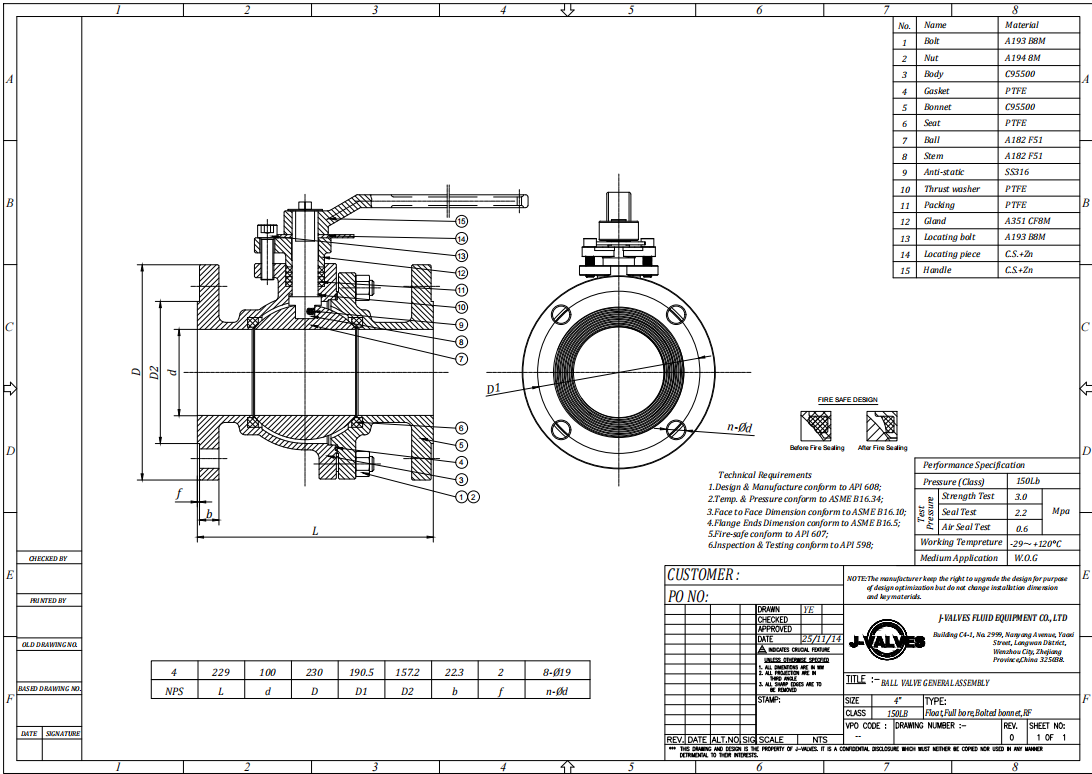
Two body styles cover the range. The three piece body has a central body with two end caps, which allows the ball, seats and stem to be replaced in line without cutting pipe, and is standard on 1/2 to 2 inch instrument and shipboard sizes. The two piece body has one end cap and one integral end, is stronger and cheaper at larger sizes, and is standard from 2 inch upward. Both are available flanged to ASME B16.5 Class 150 to 2500, threaded to NPT or BSPT, or with socket weld and butt weld ends.
Wall thickness is not a foundry choice. It follows ASME B16.34 for the applicable class and material group, and for a bronze body at Class 300 the required wall is modest compared with the wall a foundry needs for a sound casting. That is why bronze valves are heavier than the calculation requires, and why a suspiciously light bronze valve is worth measuring.

Standards, Testing and Certification
Standard | What it controls | What to ask for on the certificate |
|---|---|---|
ASTM B148 | Casting chemistry and mechanical properties for C95500 | Heat number, chemistry, tensile and yield, elongation |
ASME B16.34 | Wall thickness and pressure-temperature ratings | Rating table at the design temperature |
API 608 and ISO 17292 | Floating ball valve design requirements | Declaration of conformity |
ASME B16.5 and B16.10 | Flange dimensions and face-to-face | Dimensional report |
API 598 and ISO 5208 | Shell and seat leakage testing | Test pressure, duration, leakage rate letter |
API 607 and ISO 10497 | Fire safe qualification | Certificate number and the size and class tested |
NACE MR0175 | Sour service material limits | Applicability statement, since copper alloys are covered conditionally |
EN 10204 3.1 | Material traceability | Certificate tied to the heat and to the valve serial number |
The test sequence is the ordinary one and it is worth insisting on: shell test at 1.5 times the 38 degrees C rating, seat test at 1.1 times, both with the valve half open and then closed, and a backseat test where the design provides one. For seawater duty, add a dimensional check of the ball and seat pocket after the hydro test, because a body that has been pressurised to 1.5 times rating and then left wet will show any porosity it has within a week.
Fire safe certification deserves a note. API 607 is a qualification test performed on a specific valve design in a specific size and class, not a general property of the product family. A certificate for a 4 inch Class 150 valve does not cover a 12 inch Class 600 valve. When a specification calls for fire safe, ask which sizes and classes the certificate actually lists.

Where This Valve Is Used
Nickel aluminum bronze ball valves appear wherever seawater is a process fluid rather than an accident.
Desalination. Reverse osmosis seawater intake and brine reject, and multi stage flash brine lines where the combination of 100 degrees C, high chloride and deaerated water makes bronze the conventional choice.
Shipboard. Ballast water systems, fire main and deluge, sea water cooling for engines and heat exchangers, bilge and transfer. The ballast water treatment regulations added a new constraint: the valve must tolerate both seawater and the treated, sometimes chlorinated, sometimes deoxygenated water the treatment system produces.
Offshore. Firewater pump suction and deluge ring mains on platforms and FPSOs, where the valve may sit unused for years and must still open on demand.
Coastal power. Circulating water, screen wash, and service water on plants that take cooling water directly from the sea.
Aquaculture and marine research. Hatcheries, live fish transport, aquarium life support, where copper ion release is both a benefit against biofouling and a hazard to invertebrates, and the material choice is a biological decision as much as a metallurgical one.
It is the wrong choice for ammonia, for strong acids and alkalis, for dry chlorine gas, for high pressure steam, and for any duty where the aluminium in the alloy can be attacked. It is also a poor choice for hydrofluoric acid service, and it should not be used where mercury is present.

Installation, Torque and Maintenance
Three installation points decide whether the corrosion resistance is realised.
Support the valve. A 12 inch bronze valve is heavy, and hanging it between two flanges with the pipe unsupported puts a bending moment into the body that the casting was not designed for. Support the pipe within one diameter of each flange.
Keep it out of stagnant dead legs where possible. Bronze tolerates stagnation better than stainless, but a dead leg in warm harbour water still grows sulphide reducing bacteria, and the sulphide they produce is aggressive to copper alloys. If a dead leg is unavoidable, specify periodic exercising of the valve, which is good practice for the seat as well.
Do not over-torque threaded joints, and do not use PTFE tape as a thread lubricant on bronze to bronze joints, because it does not prevent galling. Use a nickel anti-seize on the male thread and leave the first two threads clean.
On operating torque, the honest statement is that it varies too much to quote a single figure. Torque depends on seat material, on pressure, on the time the valve has been closed, on water temperature, and on whether marine growth has colonised the bore. What a buyer should ask for is the measured break-to-open torque from the factory test on the actual valve, and an actuator sized on that figure with a margin of at least 1.5, because a valve that has been shut for two years in seawater will not turn at its factory figure. Gear operators are standard from 6 inch upward for this reason, not because the valve is hard to turn when new.
Maintenance on a three piece body is straightforward: isolate, vent, remove the end caps, and the ball, seats and stem seals are accessible. On a two piece body the same is possible but the end cap carries the downstream seat. Seat replacement kits are available for the full size range, and the body itself is normally a life-of-plant item.
How to Specify a Nickel Aluminum Bronze Ball Valve
A quotation is only as good as the enquiry. These twelve lines resolve almost every ambiguity.
Size and whether full bore or reduced bore is required.
ASME class, and the design temperature that goes with it.
Body material with the UNS number: C95500, or C95800 where a stronger cast is wanted.
Body style: two piece or three piece.
End connection: flange type and facing, thread standard, or weld end preparation.
Ball material and plating thickness.
Stem material, and whether Monel K500 is required.
Seat material, and whether a metal seat is needed for abrasive duty.
Packing type, and whether API 607 fire safe certification is required.
Operation: lever, gear, pneumatic or electric, with the actuator torque basis.
Test standard and whether a 3.1 certificate and dimensional report are required.
Any NACE, classification society or client specification that applies, quoted by number.
Typical delivery from Wenzhou is 3 to 6 weeks for standard sizes in C95500, longer for C95800 large castings and for valves with Monel trim. Drawings are issued for approval before machining on any non-standard face-to-face, and test records travel with the valve by serial number.
Nickel Aluminum Bronze Ball Valve FAQ
What is the difference between C95500 and C95800 nickel aluminum bronze?
Both are cast nickel aluminum bronze to ASTM B148. C95500 is CuAl10Fe5Ni5 with 3.0 to 5.5 percent nickel; C95800 carries higher nickel plus a manganese addition, which raises yield strength and improves performance in thick sections. C95500 is the general purpose grade for valves up to about 8 inch; C95800 is preferred for large castings and higher classes. Both are suitable for seawater. Always specify the UNS number, because nickel aluminum bronze alone does not define the alloy.
Can a bronze ball valve be used in potable water?
Nickel aluminum bronze is not typically used for potable water because of the copper and nickel release and because the cost is not justified where brass or stainless would do. Where it is used, check the lead and nickel leaching limits of the applicable national standard. For seawater, brine and process water the material is entirely appropriate.
Why does my brass valve fail in seawater when the body still looks solid?
That is dezincification. The zinc dissolves out of the alloy and leaves a porous copper structure that has almost no strength, while the outer surface still looks like metal. It is detected by sectioning, or by a scraping test, and it is accelerated by warm, stagnant or chlorinated water. Nickel aluminum bronze does not contain zinc, so the mechanism does not exist in it.
What is the maximum flow velocity for a nickel aluminum bronze valve?
About 3.5 m/s for continuous clean seawater, 2.0 to 2.5 m/s where sand or silt is present, and up to 6 m/s for intermittent duty such as deluge systems. Above these figures erosion-corrosion begins at turbulence points, particularly at the seat edge and at any step in the bore. If the line velocity is higher, either increase the valve size, use super duplex, or accept a shorter inspection interval.
Is a floating ball valve suitable at 12 inch?
At Class 150, yes, with a gear operator. At Class 300 and above, a 12 inch floating ball valve needs an impractical stem and stem torque, and the seat is loaded heavily enough that deformation becomes a risk. Above about 10 to 12 inch the correct construction is trunnion mounted, where the ball is carried on bearings and line pressure never reaches the seat as a crushing force.
Does nickel aluminum bronze suffer from galvanic corrosion when bolted to steel pipe?
It forms a galvanic couple, and the bronze is the cathode, so the steel is the metal that corrodes. In practice this is usually acceptable because the bronze area is small relative to the steel line. Where the steel is thin walled, or where the joint will be wet for long periods, use an isolating gasket set or coat the steel flange face. Coupling bronze to 316 stainless produces a much smaller potential difference.
What information do you need to quote a C95500 ball valve?
Size, bore type, ASME class, design temperature, body material by UNS number, body style, end connection and facing, ball and stem material, seat material, packing, operation and actuator, test standard, fire safe requirement, certification, quantity, and any classification society or client specification by number. A line class sheet or a marked-up drawing shortens the review considerably.
Related Ball Valve Types
Other pages in this series cover the trunnion construction for large bore and high class duty, the long stem variant for buried and insulated lines, the reduced bore option where line size and bore differ, the jacketed body for media that solidify, and the double block and bleed small bore valve for instrument isolation.
Hot Products


News
Ball Valves in Geothermal Brine: Silica Scale, Chloride Cracking And The Cooling Trap
Why geothermal brine destroys ball valves: retrograde silica scale, calcite at the flash point, chloride cracking above 60 C and the 250 C seat limit.
Read More
Ball Valve Face To Face Dimensions: Why A Correctly Ordered Replacement Still Does Not Fit
A 6 inch Class 150 ball valve can be 267 or 305 mm face to face and both are compliant. How B16.10, EN 558 and flange drilling decide whether it fits.
Read More
Ball Valve Stem Key And Keyway: What Gives Way First, And What The Handle Cannot Tell You
Between the handle and the ball there are four fits. Which one shears, which one cracks, and how a few degrees of lost motion hides a valve that never seated.
Read More
Ball Valve Datasheet: Six Blocks That Decide Whether Two Quotes Are Comparable
A ball valve datasheet only works when six blocks are fixed: pressure basis, bore, temperature ceiling, test, end connection, operator. How each is written.
Read More