

CHINA J-VALVES Offers Various High-quality I ndustrial Ball Valves
J-VALVES, a distinguished professional ball valve manufacturer rooted in China, takes pride in its extensive product portfolio. Our offerings span a wide range, including trunnion-mounted ball valves, floating ball valves, high-temperature ball valves, high-pressure ball valves, metal-sealed ball valves, ultra-low temperature ball valves, DBB ball valves, Three-way And Four-way Ball Valve, and fully welded ball valves. Each product is a testament to our commitment to precision engineering and reliable performance. Meticulously crafted, they are designed to not only meet but exceed the most stringent industrial demands, ensuring stable operation even under extreme conditions. This enables us to provide our clients with high-value services and makes our valves widely sought-after in industries.
Product Category
Contact Us


Pressure Rating: 10K, nominal 1 MPa (about 0.98 MPa)
Body Material: CF8 / JIS G5121 SCS13 (cast 304)
Ball: CF8 / SCS13, mirror finished
Stem:SUS304 stainless steel
Seat: PTFE, RPTFE, or PPL
Ball: Type Floating ball, two piece body
End Connection: JIS B2220 10K RF flanged
Face to Face: JIS B2002
Temperature Range: -20°C to +180°C; +230°C with PPL seat
Design Standard: JIS B2071, JIS B2081, ASME B16.34
Test Standard: JIS B2003, API 598
Wall Thickness: JIS B2001
-
Q41F
-
J-VALVES
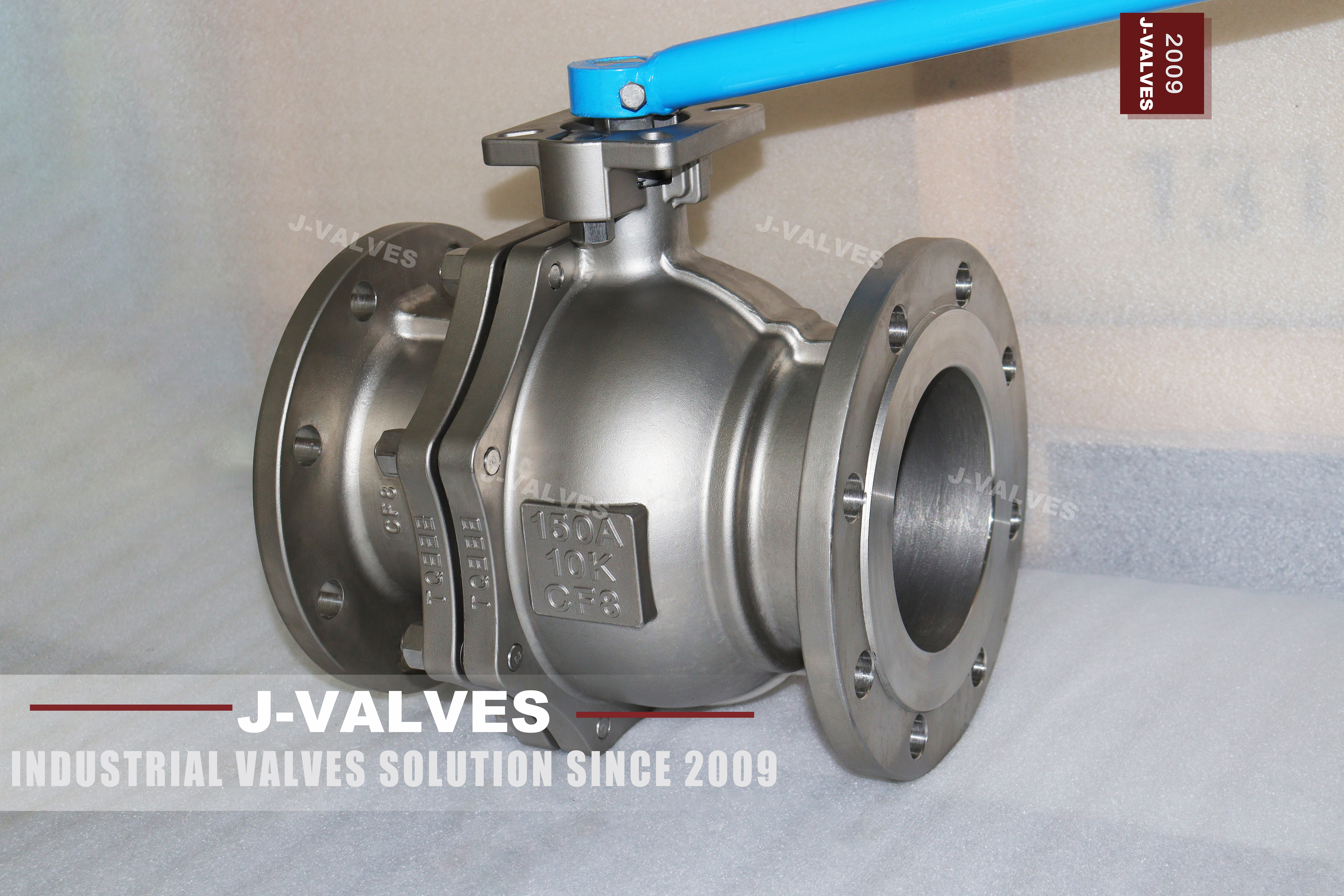
A JIS 10K ball valve is a valve built to Japanese Industrial Standards, where 10K means a nominal pressure rating of about 1 MPa and 150A means a nominal diameter of 150 mm. Neither figure is a pressure in bar and neither is an inch size, and that is the first thing to settle: a 150A 10K valve is a 6 inch valve rated near 10 bar, and it will not necessarily bolt to an ASME Class 150 flange of the same nominal size.
J-VALVES builds this valve from 8A to 350A in CF8 (JIS G5121 SCS13) with JIS B2220 10K RF flanges, as a two piece floating ball valve with a PTFE, RPTFE or PPL seat. It is the standard isolation valve for Japanese, Korean and South East Asian projects in water treatment, HVAC, shipbuilding, food processing and general chemical service, and the specifications that govern it are Japanese rather than American.
Parameter | This valve |
|---|---|
Size | 150A (DN150); 8A to 350A in the family |
Pressure rating | 10K, nominal 1 MPa |
Body | CF8 / JIS G5121 SCS13 (cast 304) |
Ball | CF8 / SCS13, mirror finished |
Stem | SUS304 stainless |
Seat | PTFE, RPTFE, or PPL |
Ends | JIS B2220 10K RF flanged |
Bore | Full bore at 150A |
Temperature | -20°C to +180°C standard; +230°C option with PPL |
Design | JIS B2071, B2081, ASME B16.34 |
Test | JIS B2003, API 598 |
Dimensions | Face-to-face JIS B2002, wall JIS B2001 |
Reading Japanese Valve Designations
The notation is compact and it repays ten minutes of attention, because a wrong reading produces a valve that does not fit.
10K is the pressure rating in kgf/cm², approximately. 10 kgf/cm² is 0.98 MPa, so a 10K valve is nominally a 1 MPa valve. The series runs 5K, 10K, 16K, 20K, 30K, 40K and 63K, which correspond roughly to 0.5, 1, 1.6, 2, 3, 4 and 6.3 MPa.
150A is the nominal diameter in millimetres, following JIS B2001. 150A is 150 mm, which is nominally 6 inch but not dimensionally identical to a 6 inch ASME valve. Sizes are quoted as 8A, 10A, 15A, 20A, 25A, 32A, 40A, 50A, 65A, 80A, 100A, 125A, 150A, 200A, 250A, 300A and 350A.
JIS rating | Approximate MPa | Nearest ASME class | Typical service |
|---|---|---|---|
5K | 0.5 | Below Class 150 | Low pressure water, HVAC |
10K | 1.0 | Class 150, not dimensionally | Water, general chemical, marine |
16K | 1.6 | Class 150 | Steam, process water |
20K | 2.0 | Class 150 / 300 boundary | Steam, shipboard systems |

JIS 10K Against ASME Class 150
On paper both are about 1 MPa. In the flange, they differ, and the difference is why spools get cut and re-welded on site.
Item | JIS 10K | ASME Class 150 |
|---|---|---|
Rating basis | Nominal kgf/cm² series, JIS B2071 | Class designation, ASME B16.34 |
Flange standard | JIS B2220 | ASME B16.5 |
Flange outside diameter | Generally smaller | Generally larger |
Bolt size and count | Metric, M20 at 150A | Inch, 3/4 inch at 6 inch |
Bolt circle | Metric pattern | Inch pattern |
Face-to-face | JIS B2002 | ASME B16.10 |
Interchangeable | No. Adapters or a change of specification are required. | |
The practical consequence is that a project using Japanese piping standards must buy JIS valves, and a project using ASME standards must not, even at the same nominal size and similar pressure. A 150A 10K flange and a 6 inch Class 150 flange have different bolt circles, so the gasket will not seat and the bolts will not pass.
CF8 and SCS13: the Same Alloy, Two Designations
CF8 is the ASTM A351 designation for cast 304 stainless; SCS13 is the JIS G5121 designation for the same material. The chemistry is nominally identical: about 18 to 21 percent chromium, 8 to 11 percent nickel, 0.08 percent maximum carbon, with 205 MPa minimum yield and 485 MPa minimum tensile.
Being a casting matters for a valve body in a way it does not for a pipe. The body has thick sections at the flange necks and the seat pocket, and a sound casting requires a foundry that controls gating and feeding. A CF8 body that has been radiographed at the flange necks and the seat pocket is a different product from one that has not, and the price difference between suppliers is often exactly that examination.
SCS14 (cast 316) is used where chlorides are present. The molybdenum addition is what resists pitting, and for sea water, brine or chloride-bearing chemical service the correct grade is SCS14 or a duplex, not SCS13 with a coating.
How a Floating Ball Seals
In a floating ball valve the ball is not held by trunnions. It sits between two seats with a small clearance, and line pressure pushes it downstream into the downstream seat. The seat is a soft ring, usually PTFE or RPTFE, held in a recess in the body, and the ball pressing into it forms the seal.
The advantage is economy: one moving part, no bearings, no trunnion, and a compact body. The disadvantage is that the seat load and the operating torque both rise with pressure and with bore, because the force on the ball is the pressure times the projected area. On a 150A valve at 1 MPa the force is manageable. On a 300A valve at 2 MPa it is not, and the torque becomes too high for a lever. That is why floating ball valves are made in small and medium sizes and trunnion valves take over as size and pressure rise.
A floating ball is also self-relieving in a useful way. If pressure is trapped in the body cavity — for example when a liquid expands as the line warms — the cavity pressure pushes the ball away from the upstream seat and relieves into the line. That is a genuine advantage on a small valve, and it is why floating ball valves rarely need a cavity relief device.
Body Construction and Maintenance
The two piece body is the standard for this valve. The main body holds the ball and seats, and one end cap closes it. To service the valve the line is isolated, the end cap bolts are released, and the cap, seats and ball come out.
This is a maintenance-friendly arrangement for a small valve, and it is why two piece floating valves dominate water and HVAC service. The limitation is the same as on any split body: the pipe must be able to move enough to release the cap, and the body gasket is a component that has to be replaced rather than reused.
Three piece versions are used where the valve is in a manifold or a skid and cannot be spread, because the centre section drops out between the two end caps. That is worth the extra joint in instrument and packaged equipment service.
Seat Material and Temperature
The seat sets the temperature limit of the whole valve, and the three options cover the normal range.
Seat | Continuous limit | Short excursion | Note |
|---|---|---|---|
PTFE | -20°C to 180°C | 200°C | Best sealing, lowest torque, highest expansion |
RPTFE (glass or carbon filled) | -20°C to 180°C | 200°C | Stiffer, better against extrusion, slightly higher torque |
PPL (polyphenylene) | -20°C to 230°C | 250°C | For steam and hot water; harder, higher torque |
The rating also falls with temperature at the flange, not only at the seat. A 10K valve is a 1 MPa valve at ambient, and at 180°C the allowable working pressure is lower. The pressure-temperature curve for the specific body material and seat combination should be read rather than assumed, and on steam service the 10K rating is often the limiting item rather than the pipe.
Where This Valve Belongs
The 150A 10K pattern is the default isolation valve in several sectors, and its popularity is a function of the piping standard rather than of the valve.
Shipbuilding and marine, where JIS piping standards are common and 10K is the standard rating for bilge, ballast, cooling water and fuel oil systems.
HVAC and district cooling, where 150A is a header size and the valve is operated seasonally rather than daily.
Water treatment and desalination, where SCS13 is acceptable for fresh water and SCS14 is required for brine.
Food and beverage, where the smooth full bore and the absence of a cavity that traps product matter, and where the body is often specified in 316 for cleanability.
General chemical service in Japan, Korea and South East Asia, where the project specification is written to JIS.
It is not the right valve for high pressure, for large sizes, for abrasive slurry, or for a project whose piping is to ASME. In each of those cases the correct answer is a different product, and substituting a JIS valve into an ASME spool is a change of scope rather than a saving.

Testing and Documentation
The pressure test follows JIS B2003 and API 598: a shell test at 1.5 times the rating and a seat test at 1.1 times, with the leakage judged against the specified rate. For a soft seated valve the expectation is no visible leakage at the seat test.
The documentation for a JIS project usually includes a material certificate for the body and the ball, a pressure test report, and a dimensional report against JIS B2002 for face-to-face. Where the valve is for a ship classification society, the class society's certificate and witness may be required, and that has to be stated at enquiry because it changes the inspection schedule.

Flange Mismatch Cases Worth Knowing
Most site problems with this valve are not valve problems. Four mismatches account for nearly all of them.
Situation | What happens | Correct action |
|---|---|---|
JIS 10K valve offered against an ASME Class 150 spool | Bolt holes do not align; gasket will not seat | Buy the ASME valve, or fit a JIS-to-ASME adapter flange |
JIS 10K valve on a 16K line | Bolting pattern may differ and the rating is exceeded | Use 16K, or verify the rating curve at the design temperature |
150A selected as "6 inch" | Face-to-face differs from ASME B16.10 by a few millimetres | Confirm JIS B2002 against the spool drawing |
10K assumed to be 10 bar at 180°C | Allowable pressure is lower than the line design pressure | Read the pressure-temperature rating for the body and seat |
The third case is the subtle one. A few millimetres of face-to-face difference is enough to load a flange joint unevenly, and the leak that follows is blamed on the gasket. Where a JIS valve replaces an ASME valve in an existing spool, the spool should be measured rather than assumed.
Ordering the Right Seat for Hot Water and Steam
Most 150A 10K valves are ordered for water at ambient, where PTFE is correct and cheapest. Hot water and steam need a decision that is often deferred until after the order.
Up to about 100°C, PTFE is fine and gives the best sealing and the lowest torque. Between 100°C and 180°C, RPTFE or PTFE is still workable, but the pressure rating falls and thermal cycling starts to set the seat; a valve that cycles daily between cold and 150°C will show a leak within a few years on a plain PTFE seat. Above 180°C, PPL is required, and the torque rises enough that a lever may no longer be adequate at 150A.
The question to settle at enquiry is not "what is the maximum temperature" but "what is the cycling pattern". A valve that sits at 170°C continuously is easier on the seat than one that swings from 20°C to 170°C twice a day, and the second case is the one that should be specified with RPTFE or PPL even though the temperature alone would not demand it.
JIS 10K Ball Valve FAQ
What does 10K mean on a JIS valve?
It is the nominal pressure rating in kgf/cm², so 10K is about 0.98 MPa, nominally 1 MPa. The series runs 5K, 10K, 16K, 20K, 30K, 40K and 63K. The actual allowable pressure falls with temperature and is read from the pressure-temperature rating, not from the K number alone.
What does 150A mean?
It is the nominal diameter in millimetres, so 150A is 150 mm, nominally 6 inch. It is a size designation, not a pressure rating and not an inch equivalent — a 150A valve is not dimensionally identical to a 6 inch ASME valve.
Will a JIS 10K valve bolt to an ASME Class 150 flange?
No. The bolt circle, bolt size and count, and flange outside diameter differ. A JIS 10K 150A flange uses metric bolts on a metric pattern, and an ASME 6 inch Class 150 flange uses inch bolts. Adapters or a change of valve specification are required.
What is the difference between CF8 and SCS13?
None in chemistry. CF8 is the ASTM A351 designation and SCS13 is the JIS G5121 designation for cast 304 stainless. They are the same alloy under two standards, and a certificate may quote either.
Why use a floating ball instead of a trunnion at this size?
Because at 150A and 1 MPa the force on the ball is manageable, the torque stays within a lever's capability, and the construction is simpler and cheaper. Above about 200A, or at higher pressure, the torque becomes impractical and a trunnion valve is used.
Can the valve be used on steam?
With a PPL seat, to about 230°C. PTFE and RPTFE are limited to about 180°C continuous. On steam service the 10K pressure rating at temperature is usually the limiting item, so the rating curve should be checked rather than assumed.
Specifying This Valve
Provide nominal size in A, rating in K, body material (SCS13 or SCS14), seat material and design temperature, whether the fluid contains chlorides so the grade can be confirmed, flange standard and facing (JIS B2220 10K RF is standard), operation (lever, gear, pneumatic or electric), and whether a classification society certificate is required.
Delivery is typically 3 to 5 weeks for a 150A CF8 valve with a PTFE seat from stock components. Drawings show the JIS B2002 face-to-face and the B2220 flange dimensions, and those two drawings are what should be checked against the piping isometric before the order is placed.
Hot Products


News
Ball Valves in Geothermal Brine: Silica Scale, Chloride Cracking And The Cooling Trap
Why geothermal brine destroys ball valves: retrograde silica scale, calcite at the flash point, chloride cracking above 60 C and the 250 C seat limit.
Read More
Ball Valve Face To Face Dimensions: Why A Correctly Ordered Replacement Still Does Not Fit
A 6 inch Class 150 ball valve can be 267 or 305 mm face to face and both are compliant. How B16.10, EN 558 and flange drilling decide whether it fits.
Read More
Ball Valve Stem Key And Keyway: What Gives Way First, And What The Handle Cannot Tell You
Between the handle and the ball there are four fits. Which one shears, which one cracks, and how a few degrees of lost motion hides a valve that never seated.
Read More
Ball Valve Datasheet: Six Blocks That Decide Whether Two Quotes Are Comparable
A ball valve datasheet only works when six blocks are fixed: pressure basis, bore, temperature ceiling, test, end connection, operator. How each is written.
Read More