
CHINA J-VALVES Offers Various High-quality I ndustrial Ball Valves
J-VALVES, a distinguished professional ball valve manufacturer rooted in China, takes pride in its extensive product portfolio. Our offerings span a wide range, including trunnion-mounted ball valves, floating ball valves, high-temperature ball valves, high-pressure ball valves, metal-sealed ball valves, ultra-low temperature ball valves, DBB ball valves, Three-way And Four-way Ball Valve, and fully welded ball valves. Each product is a testament to our commitment to precision engineering and reliable performance. Meticulously crafted, they are designed to not only meet but exceed the most stringent industrial demands, ensuring stable operation even under extreme conditions. This enables us to provide our clients with high-value services and makes our valves widely sought-after in industries.
Product Category
Contact Us


Pressure Class: Class 150 to 2500 (PN20 to PN420)
Body Material: 304, 316, 316L, 321, 347 stainless steel
Ball: 316 with Stellite hardfacing, or tungsten carbide HVOF
Seat: 316 with Stellite or nickel-based alloy hardfacing
Stem: 316 or 17-4PH, surface hardened
Sealing Type :Metal to metal, lapped contact band 1-3 mm
Leakage Rate: ISO 5208 rate D to B, size and duty dependent
Fire Test: API 607 / API 6FA, metal seat inherent
End Connection: Flanged RF / RTJ to ASME B16.5, B16.47
Temperature Range: -29°C to +425°C, higher on request
Design Standard: ASME B16.34, API 6D, API 608
Test Standard: API 598 shell and seat, helium option
-
Q447Y
-
J-VALVES
A metal seated trunnion ball valve seals by contact between two hard surfaces — a hardened ball and a hardened seat ring — instead of a plastic insert. There is no PTFE or PEEK to conform, so the seal depends on geometric accuracy, contact stress and surface finish, and the reward is a valve that works at temperatures and abrasion levels where a soft seat would be destroyed in weeks.
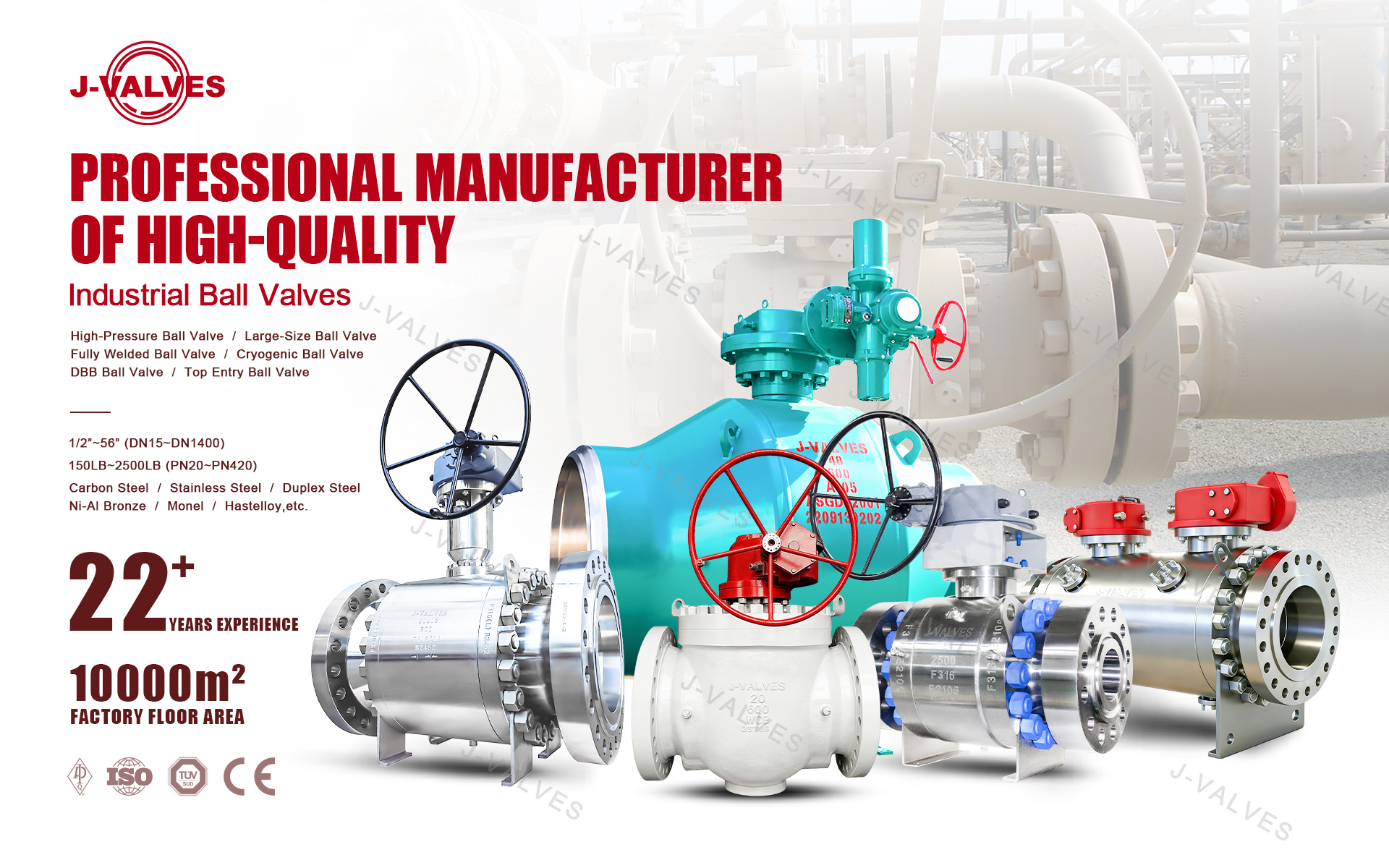
J-VALVES builds this valve from 1/2 inch to 56 inch in Class 150 to 2500, in 304, 316, 316L, 321 or 347 stainless bodies, with Stellite or nickel-based hardfacing on the seat and a hardened or coated ball. It is specified for high temperature service, abrasive slurries, catalyst lines, steam and any duty where a fire-safe claim has to be true rather than a secondary feature.
Parameter | This valve |
|---|---|
Size | 1/2 to 56 inch (DN15 to DN1400) |
Pressure class | Class 150 to 2500 (PN20 to PN420) |
Body | 304, 316, 316L, 321, 347 stainless steel |
Ball | 316 with Stellite hardfacing, or tungsten carbide HVOF |
Seat | 316 with Stellite or nickel-based alloy hardfacing |
Stem | 316 or 17-4PH, surface hardened |
Ends | Flanged RF or RTJ to ASME B16.5 / B16.47 |
Temperature | -29°C to +425°C, higher on request |
Leakage | ISO 5208 rate D to B depending on size and duty |
Fire test | API 607 / API 6FA, inherent rather than secondary |
Standard | ASME B16.34, API 6D, API 608; test API 598 |

When a Metal Seat Is the Right Answer
A soft seat is better at sealing. It conforms to the ball, tolerates small geometric error and reaches Class VI. Metal is chosen when the soft seat cannot survive, and there are five situations where that is true.
Temperature above about 230°C. PTFE softens and creeps, PEEK reaches about 260°C, and above that only metal or a graphite-based seat remains.
Abrasive particles. Sand, catalyst fines, fly ash and slurry grind a plastic seat away. A hardfaced metal seat wears far more slowly, and more importantly it does not lose its shape.
Thermal cycling. A soft seat takes a compression set after a few cycles; a metal seat does not.
Fire survival as a primary requirement. On a soft seated valve the metal seat is a backup that only works after the plastic has burned away. On a metal seated valve the fire-safe behaviour is the normal behaviour.
Radiation and aggressive chemistry. Polymers degrade; Stellite does not.
What metal seating is not good for: tight shutoff on gas, low pressure sealing, and clean service where a soft seat would have lasted twenty years at half the price. Choosing metal where it is not needed buys a heavier, more expensive valve that leaks more than the alternative.

Why Metal Seats Leak, and By How Much
The seal is a line of contact, not an area. Two hard surfaces touch along a narrow band, and the sealing stress is the contact force divided by the width of that band. Any deviation from a perfect sphere — out of roundness, a flat spot, a scratch, a hard particle trapped on the seat — creates a gap that the metal cannot close by deforming.
That is why metal seated valves are rated against ISO 5208 rather than described as bubble-tight. Rate A is no visible leakage; rate B is a defined small drip rate; rate D is a larger allowance. A well-made metal seated valve on clean service can reach rate B on liquid; on gas, rate C or D is often the realistic expectation, and a specification that demands Class VI from a metal seat at 400°C is specifying something that does not exist.
ISO 5208 rate | Liquid leakage | Realistic for metal seat |
|---|---|---|
A | No visible leakage | Small sizes, clean liquid, careful lapping |
B | 0.01 × DN mm³/s, no drops | Typical target for good metal seating |
C | 0.03 × DN mm³/s | Common on larger sizes and gas |
D | 0.08 × DN mm³/s | Acceptable on abrasive or high temperature duty |
The honest way to write the specification is to state the rate, the medium and the differential pressure. "Metal seated, tight shutoff" is not a specification, and it is the phrase that causes most disputes at inspection.
Hardfacing: Which Alloy and Why
Three families are used, and they are not interchangeable.
Hardfacing | Hardness | Temperature | Behaviour | Best for |
|---|---|---|---|---|
Stellite 6 (cobalt based) | 38 to 45 HRC | To about 540°C | Excellent galling resistance, keeps hardness hot, tolerant of impact | General high temperature and abrasive duty |
Nickel-based alloy | 35 to 45 HRC | To about 650°C | Good hot hardness, more corrosion resistant, less galling resistant than Stellite | Sour and chemical service at high temperature |
Tungsten carbide (HVOF) | 68 HRC and above | To about 450°C | Very high wear resistance, thin coating, brittle under impact | Severe abrasion with moderate temperature |
Stellite 6 is the default because it resists galling as well as wear. Two hard surfaces of similar material in sliding contact will pick up and tear; Stellite against a hardened stainless ball, or Stellite against Stellite with a hardness differential, will not. The pairing matters more than the absolute hardness: a 68 HRC tungsten carbide seat against a 68 HRC ball is a worse combination than a 42 HRC Stellite seat against a 55 HRC ball.
Geometry, Lapping and the Contact Band
The ball is ground and then lapped to a sphericity within a few micrometres, and the seat ring is lapped to match. The contact band width is a deliberate design value, not a result. Too narrow and the contact stress exceeds the yield of the hardfacing and it spalls; too wide and the unit pressure drops below what is needed to close the gap, and the valve leaks.
The band is typically 1 to 3 mm wide on a mid-size valve, matched to the seat load available from the springs and from line pressure. On a trunnion valve the springs set the low pressure seal and the line pressure adds to it, so the band width is chosen for the low pressure case and checked at the high pressure case for overstress.
Because the geometry is the seal, a metal seated valve is sensitive to anything that changes it: a body that distorts under bolt load, a seat pocket that is not square to the bore, a ball that is not concentric with the trunnion axis. This is why the machining sequence and the dimensional report matter, and why a cheap metal seated valve is usually a valve whose seat pocket was machined in one pass without stress relief.
The Hot Valve: Differential Expansion
At 400°C a 300 mm stainless body grows by roughly 1.2 mm across its diameter. The ball grows with it, the seat ring grows with it, and because they are usually the same or similar alloys the growth is nearly matched — which is the reason stainless is preferred for high temperature metal seated valves. A carbon steel body with a stainless trim grows differently, and the seat clearance closes or opens by a few tenths of a millimetre, which is enough to change the seal.
Two consequences follow. The valve must be assembled with a cold clearance that becomes the correct interference at temperature, and that clearance is stated on the drawing. And the torque at temperature is higher than at ambient, because the clearances tighten and the hardfacing contact becomes less forgiving. An actuator sized on the ambient torque will stall on a hot valve.
Galling is the other hot failure. Stainless against stainless at temperature, with high contact stress and no lubricant, will cold-weld and tear. Hardfacing one or both surfaces, or using a hardness differential, is what prevents it. A metal seated valve that screeches when operated is a valve that is about to gall.
Abrasive Service
In slurry and catalyst service the failure is erosion rather than leakage. Particles suspended in the flow strike the seat and the ball at the edge of the bore, and the material loss is concentrated exactly where the seal has to be made.
Three design responses help. Hardfacing the ball and the seat raises the erosion resistance. Keeping the valve fully open or fully closed keeps the particles out of the sealing band; a part open valve directs the whole flow at the seat edge. And a cavity purge or a flush connection, where the body cavity can be washed, prevents the accumulation that turns a slurry into a grinding paste every time the valve cycles.
Where the solids are large or the velocity is high, the right answer may not be a ball valve at all. A metal seated ball valve survives abrasive service far better than a soft seated one, but a pinch valve or a knife gate may survive better still, and saying so is part of a useful specification review.
Torque and Actuation
Metal seating has a higher coefficient of friction than a polymer seat and no compliance to absorb misalignment, so the breakaway torque is typically 1.5 to 2.5 times that of the same size in soft seated construction, and it rises further when hot. The stem, the trunnion bearings and the gear have to be sized for that, and the actuator safety factor should be at least 2.0 rather than the 1.5 used on clean soft seated service.
The higher torque also has an operational consequence: a metal seated valve that is left in one position for a long period may require more torque to break away than it did when new, because oxide or deposits form on the contact band. Operating the valve through a full cycle at each planned shutdown is the cheapest way to keep that from becoming a seizure.
Fire Safety, Which Is Different Here
On a soft seated valve, API 607 certification proves that after the seat has burned away, a metal backup still seals. On a metal seated valve the seat is already metal, so the fire test is confirming that the design has no polymer in the sealing path to lose, and that the stem seal and body joint survive.
That is a stronger position, and it is why fire-safe is often written as a requirement rather than an option on this product. The remaining polymer is the stem packing and the body gasket, and both are specified as graphite for high temperature service, which is what makes the claim hold.

Testing Metal Seats
The shell test follows API 598 at 1.5 times the rating. The seat test is where the argument happens, because the acceptance criterion has to be agreed before the test.
For liquid service, water at 1.1 times the rating with the leakage measured in mm³/s against the ISO 5208 rate is the standard method. For gas service, air or nitrogen with the leakage measured by a bubble count or a flow meter, at a differential pressure that must be stated. A metal seated valve tested with air at 6 bar will show a leak rate that a water test at 60 bar would not reveal, and both are legitimate tests of different things.
Where the duty is critical, a helium test with a mass spectrometer gives a number in mbar·l/s that can be compared across suppliers. It is also the test that most reliably finds a scratch on the contact band, because helium finds what water does not.

Maintenance and Relapping
A metal seated valve can be restored, which is one of its advantages. The seat ring can be removed, relapped and returned to service, and the ball can be reground if the coating is intact. What cannot be restored is a spalled hardfacing or a ball whose base material has been exposed; those need replacement.
The decision to relap is made on the leak test, not on appearance. A contact band that looks dull may still seal; a band that looks polished may have a scratch that does not. And the relapping has to restore the band width and position, not just the surface finish, or the valve will seal at the bench and leak in service.
Metal Seated Trunnion Ball Valve FAQ
Can a metal seated ball valve be bubble-tight?
Rarely to Class VI. Metal-to-metal contact cannot conform like a polymer, so metal seated valves are rated against ISO 5208 rate A to D depending on size, medium and differential pressure. A specification asking for Class VI at high temperature is asking for a combination that does not exist in a ball valve.
What is the maximum temperature?
About 425°C as standard, with higher ratings available on request depending on the hardfacing and the body material. Stellite retains hardness to about 540°C and nickel-based hardfacing to about 650°C, but the body, the bolting and the stem seal usually set the limit before the seat does.
Why is the torque higher than on a soft seated valve?
Because the friction coefficient between two hard surfaces is higher, there is no polymer to absorb misalignment, and the contact band is narrow with high unit pressure. Hot service adds further torque as clearances tighten. Actuator sizing should use a safety factor of 2.0 or more.
Is a metal seated valve automatically fire safe?
The seat is, because there is no polymer to burn. The fire test still applies to the stem packing and the body gasket, and both should be graphite for the claim to hold. Certification to API 607 or API 6FA is a test of the whole valve, not of the seat alone.
Can it be used on abrasive slurry?
Yes, and it is far better than a soft seated valve, but erosion still occurs at the seat edge and the bore. Hardfacing, full open or full closed operation, and a cavity flush all extend life. For very coarse or high velocity solids, a different valve type may be the better answer.
How is the seat repaired?
The seat ring is removed and relapped to restore the contact band width and position, and the ball is reground if the hardfacing is intact. Spalled hardfacing or exposed base material requires replacement of the component rather than repair.
Specifying This Valve
Provide size, class, design temperature and whether it cycles hot, fluid and solids content, required ISO 5208 leakage rate and the medium it will be tested with, body material and whether chlorides are present, hardfacing preference, seat piston effect, actuation with the hot torque stated, and the fire test and certification requirements.
Delivery is typically 5 to 8 weeks, longer where a special hardfacing or a witnessed leak test is required. The approval drawing states the hardfacing alloy, the contact band width and the cold assembly clearance, and those three numbers are what determine whether the valve seals hot.
Hot Products


News
Ball Valves in Geothermal Brine: Silica Scale, Chloride Cracking And The Cooling Trap
Why geothermal brine destroys ball valves: retrograde silica scale, calcite at the flash point, chloride cracking above 60 C and the 250 C seat limit.
Read More
Ball Valve Face To Face Dimensions: Why A Correctly Ordered Replacement Still Does Not Fit
A 6 inch Class 150 ball valve can be 267 or 305 mm face to face and both are compliant. How B16.10, EN 558 and flange drilling decide whether it fits.
Read More
Ball Valve Stem Key And Keyway: What Gives Way First, And What The Handle Cannot Tell You
Between the handle and the ball there are four fits. Which one shears, which one cracks, and how a few degrees of lost motion hides a valve that never seated.
Read More
Ball Valve Datasheet: Six Blocks That Decide Whether Two Quotes Are Comparable
A ball valve datasheet only works when six blocks are fixed: pressure basis, bore, temperature ceiling, test, end connection, operator. How each is written.
Read More