


CHINA J-VALVES Offers Various High-quality I ndustrial Ball Valves
J-VALVES, a distinguished professional ball valve manufacturer rooted in China, takes pride in its extensive product portfolio. Our offerings span a wide range, including trunnion-mounted ball valves, floating ball valves, high-temperature ball valves, high-pressure ball valves, metal-sealed ball valves, ultra-low temperature ball valves, DBB ball valves, Three-way And Four-way Ball Valve, and fully welded ball valves. Each product is a testament to our commitment to precision engineering and reliable performance. Meticulously crafted, they are designed to not only meet but exceed the most stringent industrial demands, ensuring stable operation even under extreme conditions. This enables us to provide our clients with high-value services and makes our valves widely sought-after in industries.
Product Category
Contact Us


-
J-VALVES-Q41F
-
J-VALVES
Overview of the J-VALVES 4 Inch 150LB C95500 Two Piece Flanged Floating Ball Valve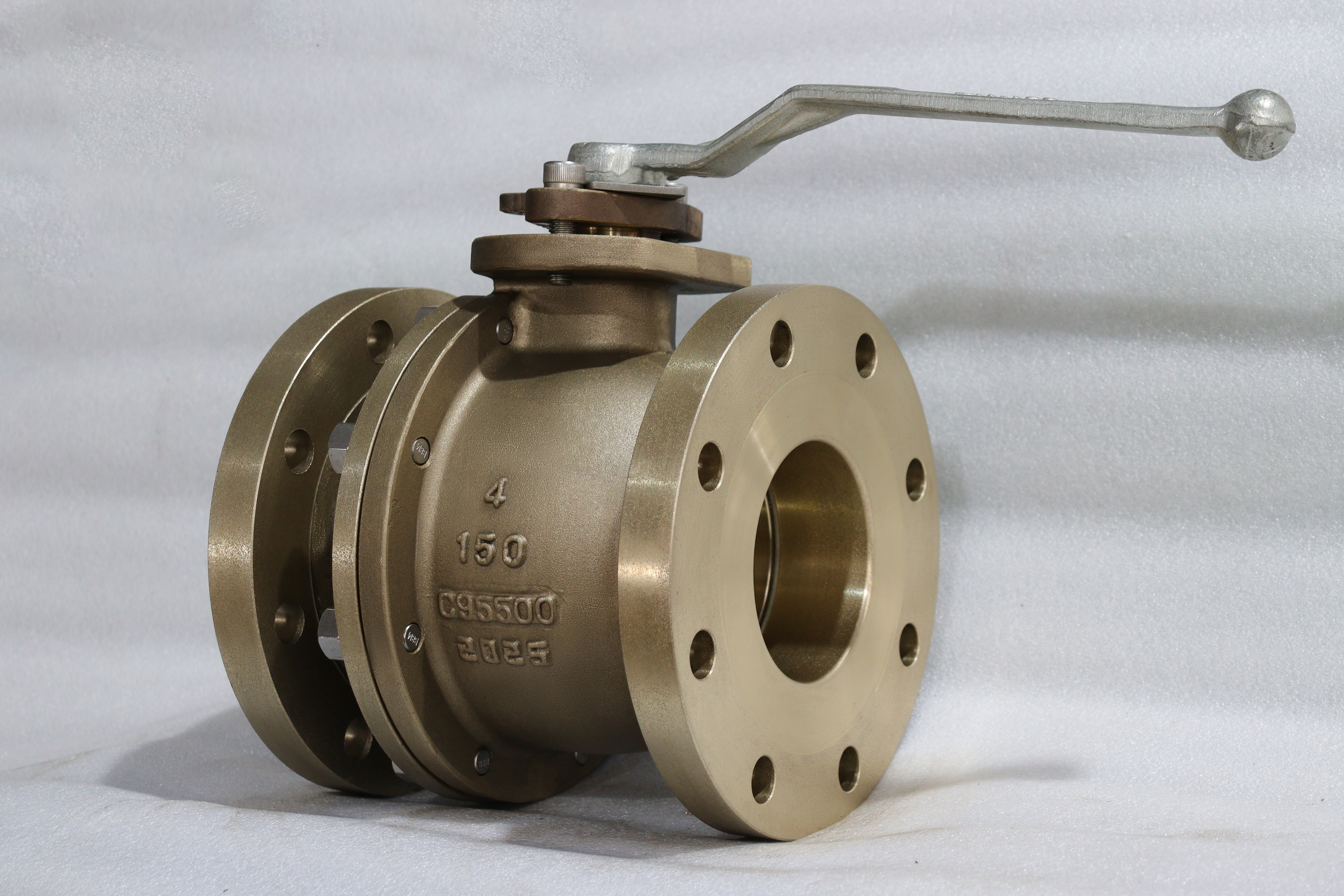
This is a four inch Class 150 floating ball valve with a cast nickel aluminium bronze body, a bronze ball with hard chrome plating, and polymer seats. It is bought for one reason: the medium is seawater, brine or a chloride bearing process, and a bronze body lasts where a carbon steel one would not. Everything else about the valve is ordinary two piece floating ball construction, and the four inch size is well inside where that construction works.
Its two limits sit at different times. In normal service the seat is the weak part: it is a polymer, it wears with cycling, and it sets the temperature the valve can be used at. In a fire the body becomes the weak part, because a copper alloy loses strength and then melts at a temperature well below where steel is still a pressure boundary. Both limits are real and neither is visible on a data sheet, which is why they are worth stating together rather than one at a time.
Design and Construction
Two pieces, one bolted joint, a floating ball and a lever. The body splits at the joint and the internals go in from that side. At four inch the floating design is still comfortable: the seat load grows with bore and pressure, and at Class 150 both are modest, so the ball stays manageable and the lever stays usable without a gearbox. The same body at Class 300 would still be floating; at higher ratings the same bore would need a trunnion.
Bronze changes the body design in a way that is easy to miss. The allowable stress of a cast copper alloy is lower than that of cast carbon steel, so for the same class the wall has to be thicker and the body heavier than a steel valve of the same size. That is not inefficiency, it is what the material needs. It is also why bronze valves stop at the lower classes: the wall thickness required stops being practical long before the sealing design does.
Material Options
C95500 to ASTM B148 is the cast nickel aluminium bronze grade, and the page names the casting standard correctly. The aluminium, nickel and iron additions are what give it its resistance to seawater: a protective oxide film forms and re-forms when it is damaged, which is the property that makes the alloy useful in flowing sea water. It is not a stainless steel substitute, and it is not immune to attack; it is simply the right family for a cast valve body in a marine line.
Trim is where the options are. The ball is the same bronze with hard chrome plating, which gives the seat a harder surface to run against; a higher alloy ball is offered as an alternative where the medium demands it. The stem is stainless or a copper nickel alloy, and that is the one part of the valve that is not the body material. Seats are PTFE, reinforced PTFE or PPL, with a special compound offered for seawater service, and packing is flexible graphite or PTFE.
| Component | Standard Material | Optional Upgrade | Service Notes |
|---|---|---|---|
| Body and cap | ASTM B148 C95500 cast nickel aluminium bronze | as the drawing states | two pieces, one bolted joint |
| Ball | C95500 with hard chrome plating | higher alloy ball where the medium demands | plating wear decides seat life |
| Stem | stainless steel | copper nickel alloy | the one part that is not the body material |
| Seat | PTFE | reinforced PTFE, PPL or seawater compound | sets the service temperature |
| Packing | flexible graphite or PTFE | as the order states | gland adjustable |
| Ends | raised face to ASME B16.5, Class 150 | as the order states | bronze face, easily damaged |
| Operator | lever with locking hole | worm gear, pneumatic or electric | quarter turn |
Technical Specifications
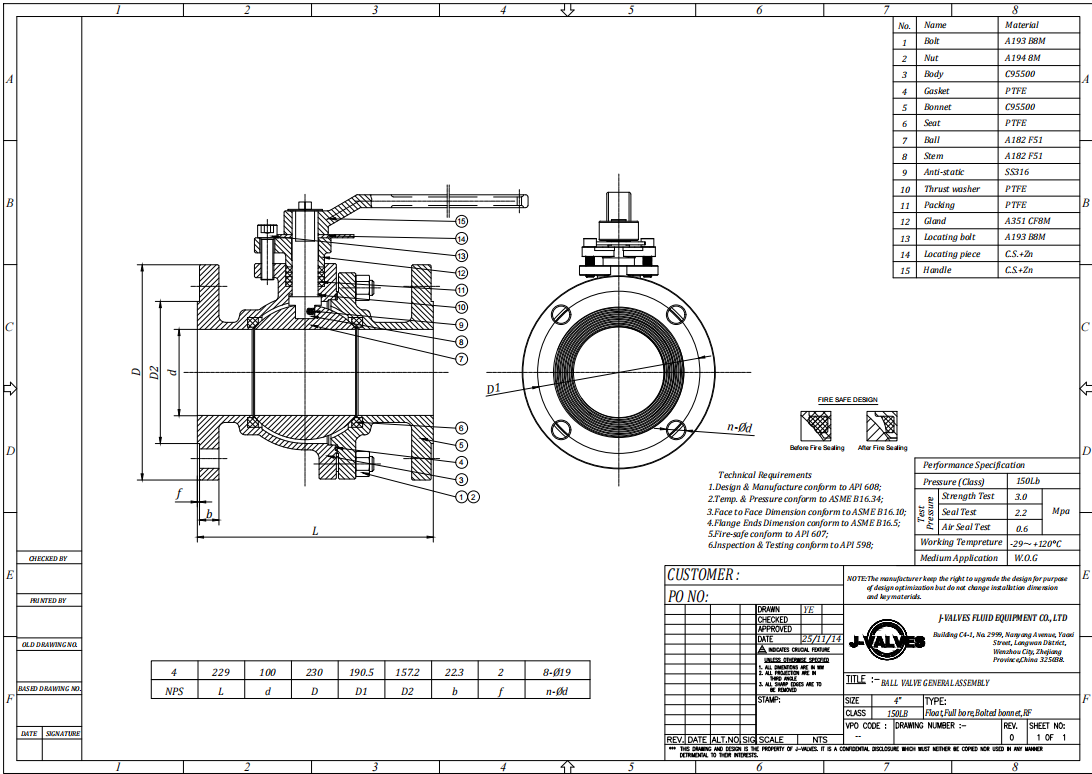
The size sheet gives the bore, the face to face and the flange dimensions for the DN100 pattern at Class 150. The wall thickness does not come from the ASME steel table, because this is a cast copper alloy and its allowable stress is set by its own casting standard; quoting the steel wall as if it applied here would be wrong in both directions. Bore and face to face are what the pipe cares about, and both should be read from the sheet for this pattern.
Full bore at four inch means the passage matches the pipe internal diameter, which keeps the pressure drop low and lets a pig pass. On a seawater line the more useful consequence is that there is no step for sediment to collect behind, because a reduced bore valve in a raw water line becomes a settling chamber at the step. Weight depends on the body pattern and the operator, so it is quoted with the drawing rather than printed as a fixed figure.
| Item | Value |
|---|---|
| Nominal size | 4 inch (DN100) |
| Pressure class | Class 150 (PN 20) |
| Body construction | two piece, one bolted joint |
| Ball support | floating, no trunnion |
| Bore | full bore |
| Body material | C95500 cast nickel aluminium bronze to ASTM B148 |
| Ball material | C95500 with hard chrome plating |
| Stem | stainless steel, copper nickel alloy optional |
| Seat | PTFE, reinforced PTFE or PPL; seawater compound optional |
| Packing | flexible graphite or PTFE |
| End connection | raised face flange, ASME B16.5, Class 150 |
| Face to face | dimension on the signed GA drawing |
| Wall thickness | from the copper alloy casting standard, not the steel table |
| Design standard | API 608 |
| Test standard | API 598 shell and seat test |
| Test pressure | shell 1.5 times and seat 1.1 times the class rating |
| Fire test | API 607, type test on the design |
| Temperature range | minus 29 to plus 425 Celsius, metal temperature, seat limited |
| Limiting part in service | the seat |
| Limiting part in a fire | the body, because a copper alloy melts below steel |
| Operation | lever with locking hole; worm gear, pneumatic or electric optional |
| Marking | size, class, alloy, heat number |
| Documentation | ASTM B148 certificate and EN 10204 3.1 on request |
| Weight | quoted with the drawing for the size and trim ordered |
| Country of manufacture | China |
Standards and Compliance
Three documents are in play. ASTM B148 is the castings standard for the copper alloy body, and it is where the grade, the mechanical properties and the casting quality requirements come from. API 608 is the ball valve standard covering the quarter turn requirements, and API 598 is the test standard for shell and seat. The page also lists ASME B16.34, which is a steel valve document; for a bronze body the casting standard is the governing one and the steel document is a reference rather than a design basis.
The fire claim deserves a note. API 607 is a type test written for quarter turn valves with soft seats, and the valve it was written around has a steel body that survives the fire while the seat is destroyed and the metal-to-metal contact has to hold. On a bronze valve the test is more demanding on the body, because the alloy softens and melts far below steel. The claim is still meaningful, but it means something different here, and a buyer comparing a bronze and a steel valve on the strength of the same certificate is comparing two different examinations.
| Requirement | Standard | What J-VALVES Supplies |
|---|---|---|
| Body casting | ASTM B148 | grade, mechanical properties and casting quality for C95500 |
| Ball valve design | API 608 | quarter turn requirements for this product |
| Shell and seat test | API 598 | 1.5 times the rating for the shell, 1.1 times for the seat |
| Fire test | API 607 | type test on the design, harder on a bronze body than on steel |
| Flange drilling | ASME B16.5 Class 150 | DN100 raised face pattern |
| Steel valve reference | ASME B16.34 | reference only, not the design basis for a copper alloy |
| Marking | API 608 and the order | size, class, alloy, heat number |
Manufacturing Process
The body is cast in the nickel aluminium bronze grade, cleaned, inspected and machined. Casting is the operation that decides the valve, because a copper alloy casting can carry porosity and shrinkage that a pressure test at one and a half times the rating will not necessarily reveal. The bore, both seat pockets and the flange faces are machined in one setup where possible, and the joint face is checked for flatness because a bronze face damages more easily than a steel one.
The ball is cast or machined from the same alloy, ground, then chrome plated; the plating thickness and its adhesion are what stop the soft bronze from galling against the seat. Seats are turned or moulded and lapped flat. Assembly follows the same pattern as any two piece floating valve, with the body joint drawn down to a controlled torque. Because bronze is softer than steel, the studs are the part where over-torque does damage, and the assembly torque matters more here than on a steel valve.

Quality Control and Testing
Shell and seat tests follow API 598 with the same multipliers used for any soft seated valve: one and a half times the rating for the shell and one and one tenth for the seat, held long enough to show a leak. The shell test proves the casting and the body joint hold; the seat test proves the ball and seats close in both directions. Both are recorded by serial number so that a later query can be traced to a unit rather than to a batch.
Casting soundness is checked separately. Radiography or dye penetrant on stated areas, together with the foundry's own inspection record, is what covers the porosity that a hydrostatic test can miss. Chrome plating thickness on the ball is checked before assembly, because a thin plate wears through quickly in seawater and the exposed bronze then wears the seat from the inside. Positive material identification on the finished body confirms the alloy that actually arrived.
| Step | What Is Checked | Standard or Acceptance |
|---|---|---|
| Casting | grade, heat number, soundness of the cast wall | B148 certificate plus penetrant or radiograph where ordered |
| Machining | seat pocket flatness, flange face flatness | checked against the drawing, bronze faces easily marked |
| Ball plating | thickness and adhesion of the chrome | sampled before assembly |
| Assembly | seat crush and body joint torque | controlled torque, no over-tightening on bronze |
| Shell test | no leakage through body or joint | API 598 at 1.5 times the rating |
| Seat test | no visible leakage, both directions | API 598 at 1.1 times the rating |
| Marking | alloy and heat number against the certificate | checked before packing |

Applications and Industry Service
These valves go into seawater cooling systems, desalination trains, fire main systems on marine and offshore installations, brine lines and dockside water services. In all of those the medium is the reason for the material rather than the pressure, and the pressures are modest. They are also used on ships and on shore facilities that follow marine classification practice, where a bronze valve is the conventional answer and a stainless one raises questions about chloride attack.
They are the wrong choice for steam, for dry gases at temperature, for media that attack copper alloys such as ammonia bearing streams, and for lines where the flow is fast enough to strip the protective film continuously. They are also wrong where a fire rated steel valve is mandated by the classification society, because a bronze body does not become a steel body by holding a certificate. Matching the material to the medium is the whole decision, and pressure is rarely the constraint.

Installation, Operation and Maintenance
Treat the body as the soft part it is. Bronze is more easily damaged than steel at the flange face and at the body joint, so gaskets go in clean, studs are tightened in a cross pattern to the specified torque and not beyond it, and a joint that has been over-tightened once should be inspected before it is reused. Support the valve so its weight does not hang on the pipe, and leave the lever room to swing through a quarter turn.
Maintenance is seat replacement through the body joint, with both seats changed as a pair. The ball should be inspected at the same time for plating wear, because a ball with the chrome worn through will destroy a new seat quickly and the whole exercise will have to be repeated. Packing is adjusted at the gland and replaced when the gland runs out of travel. On a seawater line, flush the cavity before opening the body so that sediment does not score the joint face.
How to Specify and Order
Write the size, the class, the body alloy with its casting standard, the bore, the facing, the seat material, the operator and the standards. Naming the casting standard matters more here than on a steel valve, because the wall thickness and the mechanical properties follow from it. If the service is seawater, say so: the seat compound and the ball finish are chosen for it, and a valve built for water will not last as long in brine even though the body is the same.
Before shipment, check that the nameplate, the certificate and the drawing agree. The nameplate should carry the size, the class, the body alloy and the heat number. The certificate should be a B148 casting certificate for that heat, with the mechanical results. The drawing should carry the face to face, the flange drilling and the bore. Where a fire certificate is claimed, the standard it was tested to should be on the document rather than assumed from the product description.
FAQ
Q: Why use bronze instead of stainless steel for seawater?
A: Because the two fail differently. Austenitic stainless steels depend on a passive film that breaks down in chloride bearing water, and once it breaks down in a crevice or under a deposit the attack is local and fast. Nickel aluminium bronze forms an oxide film that re-forms when it is damaged, which suits flowing sea water. It is not immune, and it has its own limits on velocity and temperature, but for a cast body in a marine line it is usually the more predictable choice.
Q: What are the two limits of this valve?
A: The seat and the body, at different times. In normal service the polymer seat is the limiting part: it wears with cycling and it sets the usable temperature. In a fire the body becomes the limiting part, because a copper alloy softens and melts at a temperature well below where steel is still holding pressure. Both are covered by standards, and the two answers do not point at the same component, which is why they are worth stating separately.
Q: Is the ball bronze or stainless?
A: Bronze, with hard chrome plating. The page specifies a C95500 ball with chrome plating, and offers a higher alloy ball as an option for more demanding media. The plating is what gives the soft bronze a hard surface to seal against the seat; once it wears through, the exposed bronze wears the seat from the inside and the valve starts leaking on both counts. That is why plating thickness is checked before assembly.
Q: What does the API 607 claim mean on a bronze valve?
A: It means the design was type tested to that standard, and on a bronze valve the test is harder on the body than it would be on a steel one. API 607 was written around quarter turn valves whose steel bodies survive the fire while the soft seat is destroyed and the metal-to-metal contact has to hold. A copper alloy body is closer to its own limit during the same test, so the certificate is worth having but it is not equivalent to the same certificate on a steel valve.
Q: Can this valve be used above Class 150?
A: The material allows higher classes in principle, and bronze valves are made at Class 300, but this page describes a Class 150 valve and that is what the flange drilling and the test pressures are for. Going up a class changes the wall, the flange and the bolt set, and it is a different valve rather than an upgraded one. If the line is Class 300, the requirement has to be quoted as Class 300 from the start.
Q: Why is the stem a different metal from the body?
A: Because the stem has to do a job the body alloy is not suited to. It carries the torque from the lever, it passes through the packing, and it sits in a narrow clearance where the medium can stagnate. A stainless or copper nickel stem has the strength and the wear resistance for that, while the bronze body gives the corrosion resistance to the bulk medium. The two materials are chosen for different duties in the same valve, which is normal rather than a compromise.


Hot Products


News
Ball Valves in Geothermal Brine: Silica Scale, Chloride Cracking And The Cooling Trap
Why geothermal brine destroys ball valves: retrograde silica scale, calcite at the flash point, chloride cracking above 60 C and the 250 C seat limit.
Read More
Ball Valve Face To Face Dimensions: Why A Correctly Ordered Replacement Still Does Not Fit
A 6 inch Class 150 ball valve can be 267 or 305 mm face to face and both are compliant. How B16.10, EN 558 and flange drilling decide whether it fits.
Read More
Ball Valve Stem Key And Keyway: What Gives Way First, And What The Handle Cannot Tell You
Between the handle and the ball there are four fits. Which one shears, which one cracks, and how a few degrees of lost motion hides a valve that never seated.
Read More
Ball Valve Datasheet: Six Blocks That Decide Whether Two Quotes Are Comparable
A ball valve datasheet only works when six blocks are fixed: pressure basis, bore, temperature ceiling, test, end connection, operator. How each is written.
Read More