

CHINA J-VALVES Offers Various High-quality I ndustrial Ball Valves
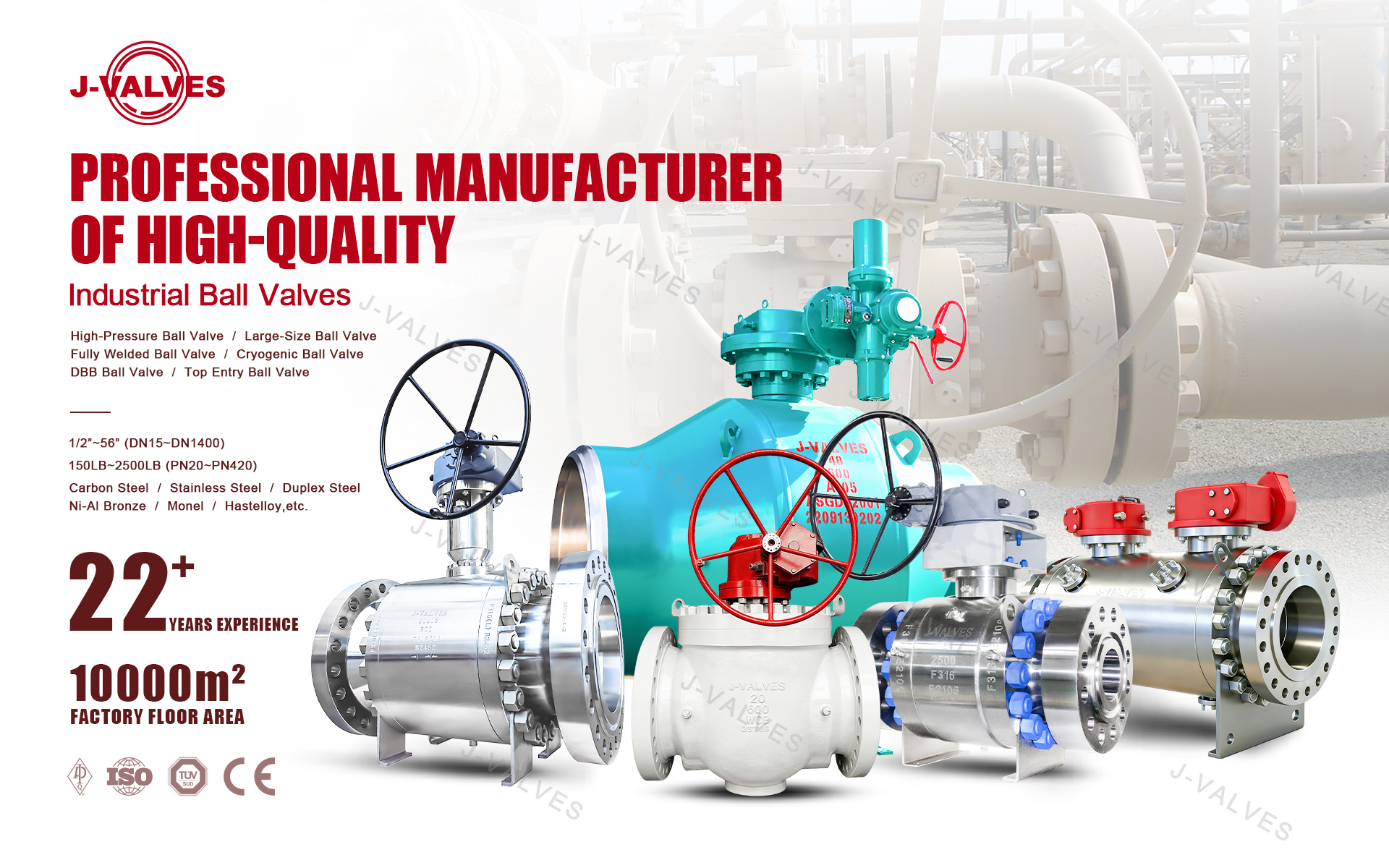
J-VALVES, a distinguished professional ball valve manufacturer rooted in China, takes pride in its extensive product portfolio. Our offerings span a wide range, including trunnion-mounted ball valves, floating ball valves, high-temperature ball valves, high-pressure ball valves, metal-sealed ball valves, ultra-low temperature ball valves, DBB ball valves, Three-way And Four-way Ball Valve, and fully welded ball valves. Each product is a testament to our commitment to precision engineering and reliable performance. Meticulously crafted, they are designed to not only meet but exceed the most stringent industrial demands, ensuring stable operation even under extreme conditions. This enables us to provide our clients with high-value services and makes our valves widely sought-after in industries.
Product Category
Contact Us


Pressure Class: ASME Class 150 to 600 / PN20 to PN100
Body Material: ASTM A216 WCB
Trim Material: 13% chrome stainless steel, ENP on request
Ball: A216 WCB with chrome plate, or 13% chrome
Seat:PTFE, RPTFE, PEEK, or metal seated
Service Temperature: -29°C to 425°C
End Connection: Flanged RF or RTJ to ASME B16.5
Face-to-Face: ASME B16.10, short or long pattern
Design Standard: API 6D, API 608, ASME B16.34
Fire Safe: API 607 / API 6FA certified
Anti-Static: Spring contact, ball to stem to body, under 10 ohm
Operation: Lever, gear, pneumatic or electric
-
Q41F-300LB C
-
J-VALVES
A 6 inch Class 300 WCB floating ball valve is a raised face or ring joint flanged isolation valve with a carbon steel body to ASTM A216 WCB and a ball that is free to move axially between two seats, rated 51.1 bar at 38°C and built to API 6D when it is going into a pipeline rather than into a process unit. It is the most widely bought size and class in the whole ball valve range, and it sits exactly at the point where the floating design stops being obviously correct, which is why it is worth understanding rather than ordering from a table.
J-VALVES builds this valve from 2 inch to 12 inch, Class 150 to 600, in WCB with 13% chrome or ENP trim, with soft or metal seats and with lever, gear or pneumatic operation. Most of the volume goes to pipeline stations, tank farms, water injection and general plant isolation on non-corrosive duty. This page covers the two things a buyer cannot get from a dimension drawing: how much force the floating ball actually puts on the seat at this size, and what API 6D adds over a valve that merely meets ASME B16.34.

The Thrust That Sets the Size Limit
A floating ball seals because line pressure pushes the ball into the downstream seat. The same pressure is also trying to push the ball out through the stem, and that force is simply pressure times the bore area. For a 6 inch valve the bore is 150 mm, so the area is 17,671 mm squared, or 0.0177 square metres. At Class 300 the rating at 38°C is 51.1 bar, which is 5.11 MPa. The product is 90 kN, about nine tonnes, applied to the ball and reacted by the seat ring and the stem.
Size and class | Rating at 38°C | Bore area | Axial thrust on the ball | Practical consequence |
|---|---|---|---|---|
4 inch Class 300 | 51.1 bar | 0.0081 m² | 41 kN | Floating, comfortable, lever operation |
6 inch Class 300 | 51.1 bar | 0.0177 m² | 90 kN | Floating, at the practical limit, lever still usable |
6 inch Class 600 | 102.1 bar | 0.0177 m² | 181 kN | Floating possible but torque and stem size become the problem |
8 inch Class 300 | 51.1 bar | 0.0314 m² | 160 kN | Trunnion preferred, gear operation |
The thrust itself is not what breaks the valve. What it does is load the seat far beyond the value the designer chose, which raises the seating stress, raises the break-to-open torque, and drives the ball into the seat ring hard enough that the seat takes a permanent set. At 90 kN a 6 inch Class 300 valve is still pleasant to operate by hand; at 180 kN in Class 600 the same valve needs a gear and the seat life drops. That is the real reason the industry switches to trunnion at about this point, and it has nothing to do with a catalogue rule.

What API 6D Adds Over a B16.34 Valve
API 6D is a specification for pipeline valves, and a valve built to it is not simply a B16.34 valve with a different nameplate. Six requirements change the hardware.
Requirement | What it means in the valve | Why a pipeline buyer cares |
|---|---|---|
Body cavity pressure relief | Self-relieving seats, or a documented external relief path | Trapped liquid expands on warm-up and splits a body without it |
Anti-static device | Spring contact between stem and ball, and between stem and body, resistance checked at test | Static discharge igniting product during pigging or draining |
Fire safe qualification | Graphite secondary seat and packing, metal backup, tested to API 607 or API 6FA | Soft seats burn away and the valve must still isolate |
Blowout proof stem | Shoulder and retainer so the stem cannot be ejected by pressure | Packing replacement under pressure is a routine field task |
Seat test duration | Test time scales with size, and the leak rate is defined by the spec | A one minute test on a 6 inch valve proves very little |
Traceability and marking | Heat numbers on the body, full documentation package, nameplate to 6D format | Pipeline records have to survive twenty years and three owners |
The fire safe requirement is the one that changes the seat design, and it is where cheap valves are caught out. A fire safe valve has a metal seat carrier that contacts the ball once the PTFE or RPTFE seat has burned away, plus graphite packing and a graphite body seal. Passing API 607 means the valve held its seat leakage limit after a 30 minute burn and a water spray, and the certificate has to be for that valve model, not for a similar one.
The anti-static requirement is small and easily skipped. It is a spring loaded plunger or a set of contact springs that gives a low resistance path from ball to stem to body, typically checked at under 10 ohm. Without it a floating ball insulated by two PTFE seats and a PTFE packing can hold a charge, and the discharge happens when the ball is turned. In gas service that is a credible ignition source.
WCB: A Good Steel With Two Hard Limits
ASTM A216 WCB is a cast carbon steel with 0.30% maximum carbon, 1.00% maximum manganese and 0.60% maximum silicon, 205 MPa minimum yield and 485 to 655 MPa tensile. It is cheap, weldable, and strong enough for every Class 150 to 600 body in this size range. It has two limits that decide whether it can be used at all.
The low limit is -29°C. WCB is impact tested at that temperature when the specification requires it, and below it the Charpy energy falls away. A 6 inch WCB valve is therefore correct for chilled water, for cold climate sites and for refrigerated service down to -29°C, and it is wrong for anything colder. Below -29°C the choices are A350 LF2 at about -46°C, or an austenitic body, and a supplier offering a standard WCB valve at -45°C is offering a valve outside its qualification.
The high limit is softer but still real. The ASME B16.34 rating curve for WCB continues to 538°C with progressive derating, but above about 425°C carbon steel begins to graphitise and to creep, and most project specifications switch to 1.25Cr or 2.25Cr at that point. At 400°C the same Class 300 valve is rated at roughly 70% of its 38°C figure, so the valve that is comfortably adequate at ambient may be marginal on a hot line. This is the calculation that catches out tank farm and steam system designers.
Flanged Ends: RF, RTJ and the Face-to-Face Question
At Class 300 and 6 inch the flange is ASME B16.5, and the choice is between raised face and ring joint. Raised face with a spiral wound gasket is the process default and is easier to break and re-make. Ring joint is the pipeline default above Class 600 and is common in gas service because the metal ring is not affected by temperature or by a bad gasket batch, and because a ring joint cannot be installed in the wrong position without being obvious.
Face-to-face dimensions follow ASME B16.10, which offers a short pattern and a long pattern for many sizes. API 6D permits either, but requires the face-to-face to be marked on the valve and stated in the documentation, because a short pattern valve will not fit a pipe spool cut for a long pattern one. This is a small detail that causes real site delays.
Seat Materials Against Temperature
Seat | Continuous limit | Behaviour and where it is used |
|---|---|---|
Virgin PTFE | 200°C | Best sealing, lowest torque, takes compression set, standard for water and gas at ambient |
RPTFE, glass or carbon filled | 220°C | Stiffer, less creep, the usual upgrade for steam and hot oil |
PEEK | 260°C | Harder, higher torque, good for cycling and for abrasive trace |
Metal, 13% chrome or Stellite | 425°C and above | Fire safe by construction, leak rate agreed to ISO 5208, needs lapping and higher torque |
A soft seat at 300LB is not a compromise; it is the correct choice for clean fluid up to 200°C and it gives a tighter shutoff than any metal seat. The metal seat is chosen when the temperature is above the soft limit, when the fluid is abrasive, or when the fire requirement cannot be met any other way. The mistake is to specify metal seats for a clean water line because they sound stronger, and then discover that the valve leaks at a rate that the process will not accept.

Torque, Actuation and the Practical Operating Envelope
A 6 inch Class 300 floating valve with a PTFE seat breaks open at a torque that a person can apply with a 300 mm lever, which is why most of these valves ship with a lever and no gear. Two conditions change that. The first is a metal seat, which roughly doubles the figure. The second is frequent operation with a pressure differential across a closed valve, which wears the seat and raises friction over time. If the valve is in a duty where it is cycled daily, a gear operator is worth specifying even though a lever would work, because the gear limits the torque a human can apply and protects the seat from being over-driven.
For pneumatic or electric actuation the sizing figure is not the catalogue torque. It is the break-to-open torque at the worst condition, times a safety factor of 1.5 for clean service and 2.0 for dirty or high cycling, plus the seat load that appears when the valve has been closed for a long period and the seat has crept. An actuator sized on the published running torque will stall within a year.

What to Put on the Enquiry
Size, class, body and trim material, seat material, design temperature and whether the -29°C limit of WCB is acceptable, fluid and whether it is sour, end connection and whether RF or RTJ, face-to-face short or long pattern, whether API 6D or API 608 applies, fire safe certificate requirement, anti-static, actuation and fail position, and the certification package. For sour service, NACE MR0175 changes the trim hardness and the bolting, and it should be stated at enquiry rather than after the order.
Frequently Asked Questions
Is a 6 inch Class 300 floating ball valve suitable for a pipeline?
Yes, when it is built to API 6D rather than to a general process standard, which adds cavity relief, anti-static bonding, fire safe qualification, a blowout proof stem and the documentation a pipeline operator needs. At 51 bar the floating design is still practical at 6 inch; the thrust on the ball is about 90 kN and a lever remains usable. At Class 600 or at 8 inch the same duty normally moves to a trunnion mounted valve.
What is the pressure rating of a 300LB ball valve?
51.1 bar at 38°C for a carbon steel body to ASME B16.34 group 1.1. The rating falls as temperature rises, by roughly 30% at 400°C. Class 300 is not the same as PN50 in flange dimensions even though the two are often quoted as equivalent: a PN50 flange will not bolt to a Class 300 flange without an adapter.
What temperature can a WCB ball valve handle?
About -29°C to 425°C in normal project practice. The ASME rating curve runs to 538°C with derating, but carbon steel is usually replaced by an alloy above 425°C. Below -29°C, WCB is outside its impact qualification and A350 LF2 to about -46°C or an austenitic body should be used instead.
What does API 6D require that API 608 does not?
API 6D is written for pipeline valves and adds requirements for body cavity pressure relief, anti-static devices, fire safe testing to API 607 or 6FA, a blowout proof stem, seat test durations that scale with size, and a documentation and marking package tied to heat numbers. API 608 covers general industrial ball valves and does not carry all of these.
How is the valve tested before delivery?
Shell test at 1.5 times the 38°C rating and seat test at 1.1 times, per API 598 or API 6D depending on the order. Anti-static resistance is checked, the stem is proof loaded, and the fire safe certificate is supplied for the model. Material certificates to EN 10204 3.1 travel with the valve.
Hot Products


News
Ball Valves in Geothermal Brine: Silica Scale, Chloride Cracking And The Cooling Trap
Why geothermal brine destroys ball valves: retrograde silica scale, calcite at the flash point, chloride cracking above 60 C and the 250 C seat limit.
Read More
Ball Valve Face To Face Dimensions: Why A Correctly Ordered Replacement Still Does Not Fit
A 6 inch Class 150 ball valve can be 267 or 305 mm face to face and both are compliant. How B16.10, EN 558 and flange drilling decide whether it fits.
Read More
Ball Valve Stem Key And Keyway: What Gives Way First, And What The Handle Cannot Tell You
Between the handle and the ball there are four fits. Which one shears, which one cracks, and how a few degrees of lost motion hides a valve that never seated.
Read More
Ball Valve Datasheet: Six Blocks That Decide Whether Two Quotes Are Comparable
A ball valve datasheet only works when six blocks are fixed: pressure basis, bore, temperature ceiling, test, end connection, operator. How each is written.
Read More