


CHINA J-VALVES Offers Various High-quality I ndustrial Ball Valves
J-VALVES, a distinguished professional ball valve manufacturer rooted in China, takes pride in its extensive product portfolio. Our offerings span a wide range, including trunnion-mounted ball valves, floating ball valves, high-temperature ball valves, high-pressure ball valves, metal-sealed ball valves, ultra-low temperature ball valves, DBB ball valves, Three-way And Four-way Ball Valve, and fully welded ball valves. Each product is a testament to our commitment to precision engineering and reliable performance. Meticulously crafted, they are designed to not only meet but exceed the most stringent industrial demands, ensuring stable operation even under extreme conditions. This enables us to provide our clients with high-value services and makes our valves widely sought-after in industries.
Product Category
Contact Us


-
J-VALVES-Q41F
-
J-VALVES
Overview of the J-VALVES DN80x50 150LB A105 Three Piece Extended Stem Floating Ball Valve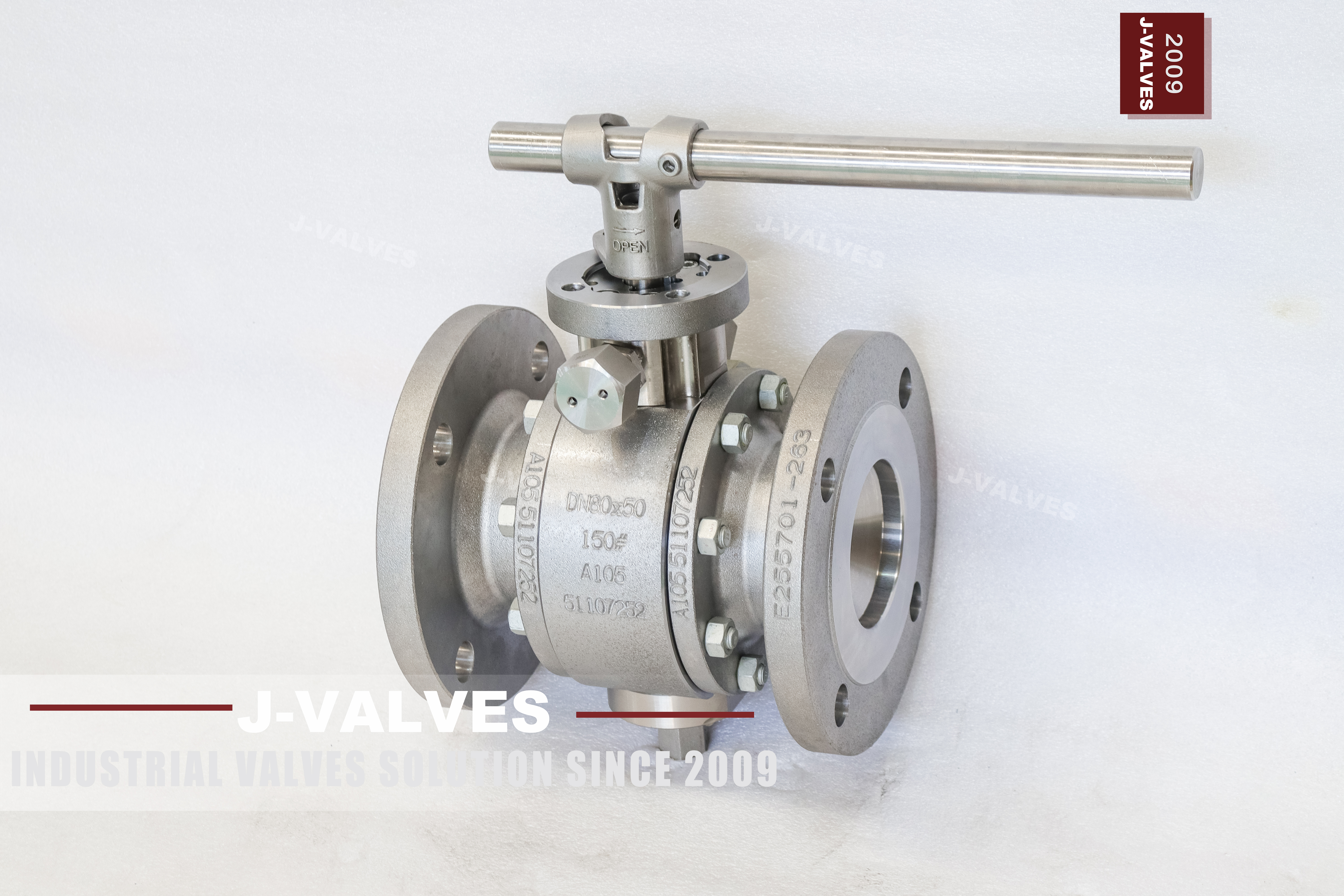
This valve has two positions rather than one. The handle is where the operator is, and the body is where the pipe is, and an extended stem is what separates them. On an insulated line the separation is measured in hundreds of millimetres; on a buried line it is measured in metres. Either way the consequence is the same and it is rarely written down: everything that decides the life of a buried valve is on the outside of it, and everything the catalogue talks about is on the inside.
The size line reads DN80x50, which means three inch flanged ends and a two inch bore. Class 150 is the rating, and at this class the wall is at the minimum the standard allows, so the body is not a heavy part. That matters for a buried installation in a way it does not for an above ground one: a thin walled carbon steel body with a damaged coating has very little corrosion allowance to spend before the wall is a problem.
Design and Construction
A three piece body has two bolted joints, one on each side of the middle section that carries the ball and the seats. That is one more pressure boundary joint than a two piece valve has, and the trade is deliberate: the middle section comes out whole, so a seat can be changed without disturbing either pipe flange. On a line that cannot be shut down for long, that is worth two joints and two gaskets, and it is the reason this body style exists at all.
The extended stem changes the arithmetic. The joints that make the valve serviceable are at the body, not at the handle, and on a buried or insulated installation the body is exactly the part nobody can reach. The serviceability the three piece body was bought for therefore has to be planned for: a pit, a sleeve, or a decision to dig. Without one of those, this valve is as hard to service as a welded body, while still carrying two joints that can leak.
Material Options
The body, the bonnet and the middle section are forged carbon steel, and the page states that the forgings are normalized. Normalizing is the heat treatment that refines the grain and evens out the mechanical properties, and stating it on the order is what makes it a requirement rather than a hope; a forging may otherwise be supplied in the as forged condition. The grade behind the code is settled by the nameplate and the mill certificate, not by this paragraph.
Trim follows the same pattern as the rest of the family. The ball is carbon steel with hard chrome plating or a stainless grade, the stem is 410, 420 or 17-4PH, and the seats are PTFE, reinforced PTFE or PPL. The extension is carbon steel or stainless, and on a buried valve the choice is not cosmetic: a carbon steel extension needs the same coating discipline as the body, while a stainless extension does not, and the two are mixed up more often than they should be.
| Component | Standard Material | Optional Upgrade | Service Notes |
|---|---|---|---|
| Body, bonnet and middle body | forged carbon steel, grade as stamped | normalized as stated on the page | two bolted joints |
| Ball | carbon steel with hard chrome plating | stainless grade | ground, then plated |
| Stem | 410 or 420 stainless | 17-4PH | packing stays in the body |
| Seat | PTFE | reinforced PTFE or PPL | sets the service temperature |
| Packing | flexible graphite or PTFE | gland adjustable | accessible above the extension |
| Extension | carbon steel or stainless | length to the drawing | not a pressure boundary |
| External coating | specified on the order | not covered by API 608 or API 598 | decides buried life |
Technical Specifications
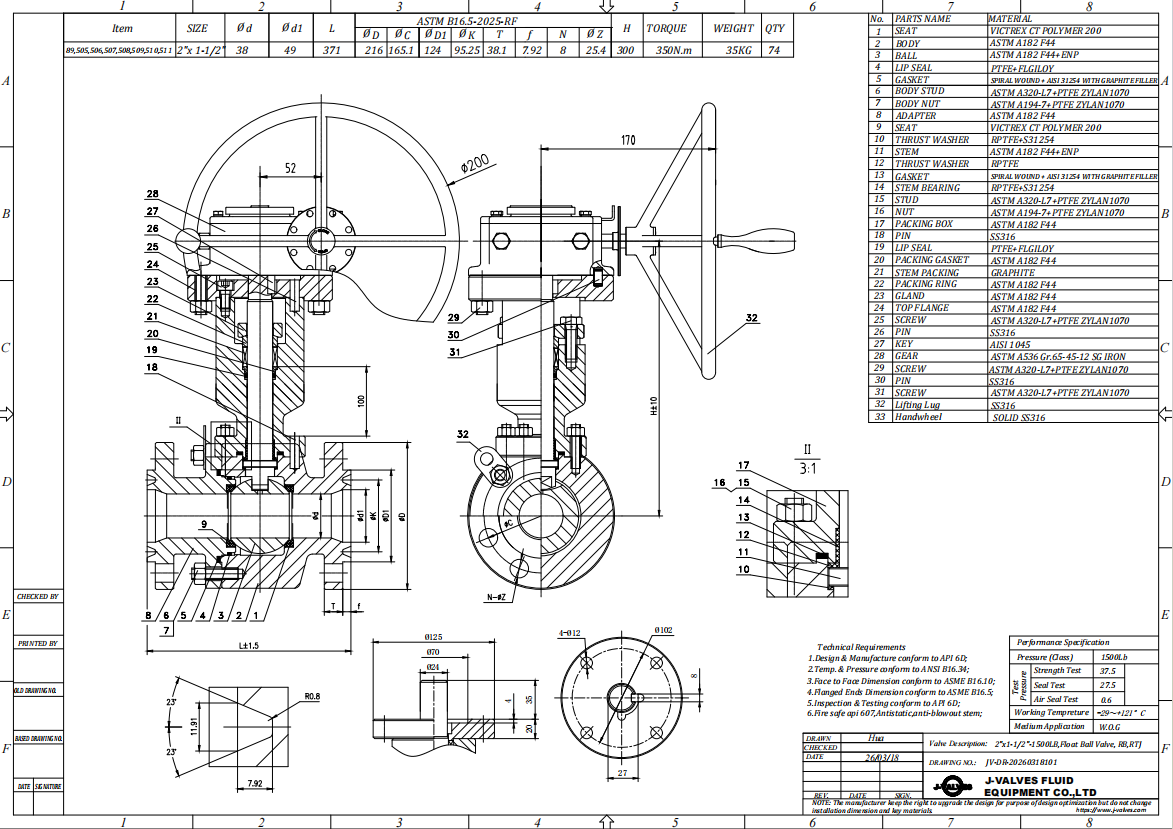
Flange drilling is to ASME B16.5 Class 150, with EN 1092-1 offered as an alternative, and the order has to name one because the two drillings are not interchangeable at the same nominal size. Face to face is held to ASME B16.10 for a flanged valve of this size and class. The pages that quote these as catalogue numbers are quoting the table, not the valve; here they are left to the standard and to the signed drawing, which is where a site engineer should be reading them anyway.
The bore is DN50 in a DN80 body, so the valve is a reduced bore design and the pressure drop is calculated on the bore rather than on the flange. On a buried line this has a second consequence that is easy to miss: the valve is the narrowest point in the run and it cannot be pigged, so any cleaning or inspection tool has to stop before it and be recovered. Depth of cover, bedding and coating are all site decisions and are dimensioned on the installation drawing rather than here.
| Item | Value |
|---|---|
| Nominal size | DN80x50 (3x2 inch, DN80 flanged ends and DN50 bore) |
| Pressure class | Class 150 (PN 20) |
| Body style | three piece per the page name, confirmed against the drawing before order |
| Ball support | floating, no trunnion |
| Bore | reduced bore, DN50 |
| Body material | forged carbon steel, normalized, grade as stamped |
| Ball material | carbon steel with hard chrome plating, stainless grade optional |
| Stem | 410 or 420 stainless, 17-4PH optional |
| Seat | PTFE, reinforced PTFE or PPL |
| Packing | flexible graphite or PTFE |
| Extended stem length | 200 mm to 800 mm typical, set by the service |
| End connection | raised face, ASME B16.5 Class 150 or EN 1092-1 PN 20 |
| Face to face | dimension on the signed GA drawing, held to ASME B16.10 |
| Design standard | ASME B16.34 and API 608 |
| Test standard | API 598 shell and seat test |
| Test pressure | shell 1.5 times and seat 1.1 times the class rating |
| Temperature range | minus 29 to plus 425 Celsius, metal temperature |
| Temperature limit | set by the seat compound, not by the body |
| External coating | system and dry film thickness stated on the order |
| Buried service | joints need a pit or sleeve to stay reachable |
| Operation | lever with locking hole; gear, pneumatic or electric optional |
| Fire test | not claimed on this page, API 607 to be specified if required |
| Anti static device | not claimed on this page |
| Marking | size, class, body code, heat number |
| Documentation | EN 10204 3.1 on request |
| Weight | quoted with the drawing for the size and trim ordered |
| Country of manufacture | China |
Standards and Compliance
Three standards are named on the page and each answers a different question. B16.34 fixes the wall for the size and the class and gives the rating for the alloy group. API 608 covers what a quarter turn valve must do rather than what it must withstand. API 598 says how the shell and seat tests are run and what counts as a failure. Read together they describe a valve that holds pressure and shuts off. None of them describes a valve that survives being buried, because external corrosion sits outside all three.
No fire test is claimed here and no anti static device is described, and on a buried hydrocarbon valve those two lines are the ones a project asks for first. A fire test of the API 607 type qualifies the design rather than the unit, so it is named on the order or it does not exist. The same is true of the coating: no standard named on this page covers it, so the system and the dry film thickness have to be written as a requirement rather than assumed from the fact that the body arrives painted.
| Requirement | Standard | What J-VALVES Supplies |
|---|---|---|
| Pressure boundary | ASME B16.34 | minimum wall and the rating for the alloy group at Class 150 |
| Ball valve design | API 608 | the quarter turn requirements for this product |
| Shell and seat test | API 598 | 1.5 times the rating for the shell, 1.1 times for the seat |
| Flange drilling | ASME B16.5 Class 150 | DN80 raised face pattern, EN 1092-1 on request |
| Face to face | ASME B16.10 | flanged valve length for the size and class |
| External coating | not in the three standards named | coating system and DFT stated on the order |
| Fire test | not claimed on this page | API 607 named on the order if required |
| Documentation | EN 10204 3.1 | issued against the heat number on request |
Manufacturing Process
Forged blanks are machined in one setup where the shape allows, so the bore, the seat pockets and the flange faces stay concentric. On a three piece body there are three parts to keep aligned rather than two, and the middle section carries both seat pockets, which is easier to hold than pockets cut into two separate halves. The ball is ground and plated, and the seats are turned and lapped flat before they go in.
Assembly is dry and clean, and the two joints are drawn to a controlled torque so both seats see the same crush. The extension is fitted afterwards and the coupling is set so the stem turns without side load on the gland. If the valve is destined for burial, the coating is applied after assembly and the flange faces are masked rather than coated, because a coated gasket face is a leak waiting for a hydrostatic test to find.

Quality Control and Testing
On a three piece body there are two bolted joints to prove instead of one, and both are in the shell circuit at the same time. A weep at either joint is a failure even where the body wall is sound, which makes this test as much an assembly check as a material check. The seat test runs afterwards, with the valve cycled between directions so both seats are loaded in turn. Both tests are done before the coating is applied, because a weep is easier to find on bare metal than under paint.
Two things the bench cannot tell you matter more on this valve than on most. The first is the alloy, which is the mill certificate and, if the order asks, positive material identification on the finished body. The second is the coating, which is a thickness and adhesion check rather than a pressure check, and which is not covered by any of the three standards named on the page. On a buried valve the second one is the one that ends the service life.
| Step | What Is Checked | Standard or Acceptance |
|---|---|---|
| Incoming forgings | grade, heat number, normalising record | certificate against the stamped code |
| Machining | bore, seat pocket depth, joint face flatness | in process gauging against the drawing |
| Assembly | seat crush both sides, joint torque | controlled torque on both joints |
| Shell test | no leakage through the body wall or either joint | API 598 at 1.5 times the rating |
| Seat test | no visible leakage, both directions | API 598 at 1.1 times the rating |
| Coating | dry film thickness, holidays, adhesion | checked before the faces are masked off |
| Marking and packing | nameplate against certificate and drawing | checked before crating |

Applications and Industry Service
This valve is bought for lines where the operator cannot stand next to the pipe. That covers buried water and fire main branches, valve chambers and pits, and insulated process lines where the handle has to come out through the cladding. The medium is normally water, oil or gas and the duty is ordinary; what is not ordinary is the access, and that is the whole reason for the extension.
It is the wrong valve in three situations. A line that has to be pigged cannot use a reduced bore body. A medium that attacks carbon steel needs a different alloy rather than a thicker coating, because coating defects are the rule rather than the exception on a buried body. And a location where nobody will ever dig is a location where a three piece body is paying for joints that will never be opened. In that last case a welded or fully welded body is the cheaper answer.

Installation, Operation and Maintenance
On a buried installation the coating is the valve. It has to be continuous over the body, the extension and the flange faces up to the gasket line, and it has to survive handling and backfill. Where the line is cathodically protected, the valve is part of that circuit and the coating is what keeps the current where it is wanted; a holiday in the coating concentrates the current and pits the body faster than no coating at all. Coating inspection before backfill is cheaper than excavation.
The two bolted joints need to stay reachable, which usually means a pit or a sleeve rather than direct burial. If a joint has to be opened, both gaskets are replaced, because a compressed gasket does not seal twice, and the studs are replaced rather than reused where the threads are damaged. On the stem side, the extension has to be plumb within the tolerance on the drawing, or the gland wears oval and the packing leaks long before the seat does.
How to Specify and Order
The order line needs six things: the size written as flange by bore, the class, the body alloy code as it will be stamped, the seat compound, the flange standard, and the extension length with its datum. Two more belong on the order for a buried valve and are usually left off: the external coating system with its dry film thickness, and whether the body is to be three piece or two piece, because the page name and the product photograph do not settle that question.
Two records belong with this valve and only one of them is a document. The first is the usual set: nameplate against mill certificate against general arrangement drawing, covering size, class, body code, heat number, face to face, bore and joint arrangement. The second is the coating record, dry film thickness and holiday check, which is the only evidence that will exist once the trench is closed. A buried valve with a perfect certificate and an uninspected coating has been checked on the thing that will not fail.
FAQ
Q: Does the extended stem change the pressure boundary?
A: No. The extension is a mechanical link between the stem and the handle, and the packing and the stem seal stay in the body where they were. What the extension changes is who can reach the handle and from where. On a buried or insulated line that is the whole point, but it also means the pressure boundary is the part you cannot see, so the coating and the joints deserve more attention than the handle.
Q: Is this valve three piece or two piece?
A: The page name says three piece and the product photograph filed for the same valve shows a body with a single bolted joint, which is a two piece pattern; the image file is named as a two piece. This page does not settle it, and an order should state which body style is required rather than relying on the title. The joint count changes the number of gaskets and the spares list.
Q: Why does the coating matter more than the trim on a buried valve?
A: Because a buried carbon steel body fails from the outside in. The bore and the seats are protected by the medium and by the trim, while the external surface sits in soil, in groundwater and in whatever the backfill contains. A coating holiday concentrates cathodic protection current and pits the wall faster than an uncoated body would, so the coating has to be continuous and inspected before backfill.
Q: What has to be reachable on a buried installation?
A: The two body joints and the gland. The joints carry the gaskets that will eventually need replacing, and the gland is where the packing is adjusted. A pit, a sleeve or a chamber is the usual answer. Direct burial of a three piece body buys joints that cannot be opened, which is the worst of both patterns: the cost of the joints without the serviceability.
Q: Can a reduced bore valve be pigged?
A: No. The DN50 passage in a DN80 body is smaller than the pipe bore, so a pig or a brush stops at the valve. If the line has to be cleaned or inspected in place, this is the wrong body and a full bore valve is needed. On a buried line the consequence is larger than on an accessible one, because recovering a stuck tool means excavation.
Q: What should the order state that the catalogue page does not?
A: The body style, the flange standard, the seat compound and the external coating system with its dry film thickness. Of those, the coating is the one most often left off, and it is the one that decides the life of a buried valve. The seat compound sets the temperature ceiling, the flange standard decides whether the valve bolts up, and the body style decides how many gaskets the spares list needs.


Hot Products


News
Ball Valves in Geothermal Brine: Silica Scale, Chloride Cracking And The Cooling Trap
Why geothermal brine destroys ball valves: retrograde silica scale, calcite at the flash point, chloride cracking above 60 C and the 250 C seat limit.
Read More
Ball Valve Face To Face Dimensions: Why A Correctly Ordered Replacement Still Does Not Fit
A 6 inch Class 150 ball valve can be 267 or 305 mm face to face and both are compliant. How B16.10, EN 558 and flange drilling decide whether it fits.
Read More
Ball Valve Stem Key And Keyway: What Gives Way First, And What The Handle Cannot Tell You
Between the handle and the ball there are four fits. Which one shears, which one cracks, and how a few degrees of lost motion hides a valve that never seated.
Read More
Ball Valve Datasheet: Six Blocks That Decide Whether Two Quotes Are Comparable
A ball valve datasheet only works when six blocks are fixed: pressure basis, bore, temperature ceiling, test, end connection, operator. How each is written.
Read More