


CHINA J-VALVES Offers Various High-quality I ndustrial Ball Valves
J-VALVES, a distinguished professional ball valve manufacturer rooted in China, takes pride in its extensive product portfolio. Our offerings span a wide range, including trunnion-mounted ball valves, floating ball valves, high-temperature ball valves, high-pressure ball valves, metal-sealed ball valves, ultra-low temperature ball valves, DBB ball valves, Three-way And Four-way Ball Valve, and fully welded ball valves. Each product is a testament to our commitment to precision engineering and reliable performance. Meticulously crafted, they are designed to not only meet but exceed the most stringent industrial demands, ensuring stable operation even under extreme conditions. This enables us to provide our clients with high-value services and makes our valves widely sought-after in industries.
Product Category
Contact Us


-
J-VALVES-Q41F
-
J-VALVES
Overview of the J-VALVES DN80x50 900LB F51 Two Piece Extended Stem Floating Ball Valve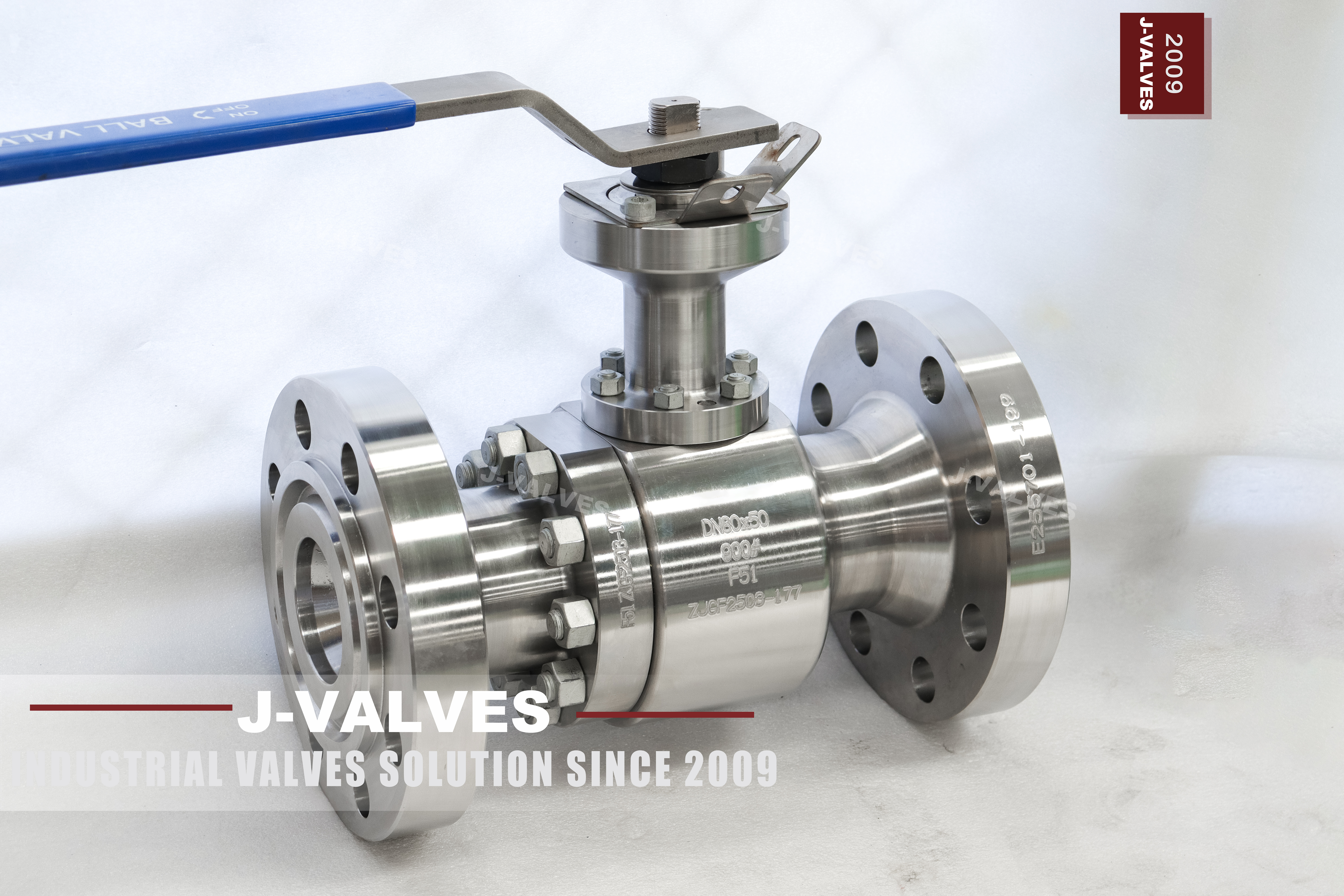
F51 is a duplex stainless grade in forged form, and duplex means the microstructure is roughly half austenite and half ferrite rather than all austenite. That mixture is what gives it its two useful properties together: the ferrite phase resists chloride stress corrosion cracking, which is the failure mode that catches austenitic grades in warm chloride service, and the austenite phase keeps the toughness and the weldability. Neither phase alone would give both.
The trade is equally specific. Duplex grades have a service temperature ceiling above which a brittle phase forms and toughness falls away, so the usual stainless temperature range does not apply without qualification. They need a welding procedure that keeps the phase balance, which matters at the pipe joint rather than inside the valve. And the finished part has to be checked for that balance, which is a test an austenitic valve never needs.
Design and Construction
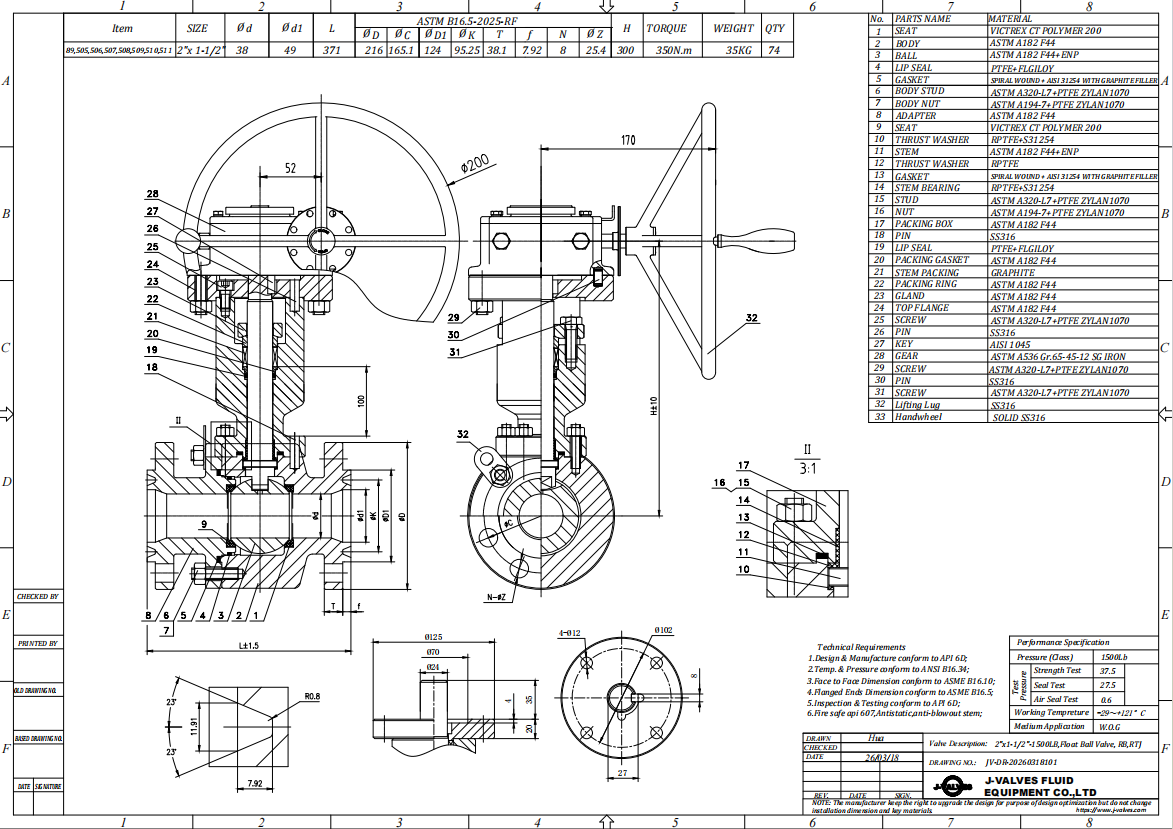
Two pieces, one bolted joint, a floating ball, ring joint or raised face ends and an extended stem. The bore is DN50 under DN80 flanges, so the seat load follows the two inch bore rather than the three inch flange, and at Class 900 that keeps the floating design inside what the seats can carry. The reduction is what allows a simple valve at a high class, and it costs a restriction in the line.
The extended stem lifts the operator clear of insulation or a pit cover while the packing stays in the body where the pressure is. It is not a pressure boundary and it carries no rating; it is a shaft that has to transmit torque without play and without side load on the gland. On a duplex valve the extension is normally the same alloy as the stem, because a dissimilar pair over that length will move differently as the line heats.
Material Options
Duplex is not a universal upgrade and should not be sold as one. It is the right answer where the medium carries chlorides at a temperature where an austenitic grade would crack, and where the strength of the duplex grade allows a thinner or lighter part. It is the wrong answer above its temperature ceiling, in strongly reducing acids where the passive film does not form, and in services where the alloy has to be welded repeatedly without a controlled procedure.
The trim follows the body. The ball is normally the same duplex grade with hard chrome or nitriding, with a super duplex grade offered where the chloride level or the velocity is higher; the stem is duplex or a precipitation hardening stainless. Seats are PTFE, reinforced PTFE, PPL or PEEK, and the packing is graphite or PTFE. As always, the grade on the nameplate is what the certificate has to match, and the composition belongs on the mill certificate rather than on the product page.
| Component | Standard Material | Optional Upgrade | Service Notes |
|---|---|---|---|
| Body and end pieces | forged F51 duplex stainless | super duplex grade where velocity or chloride is higher | two pieces, one bolted joint |
| Ball | F51 with hard chrome or nitriding | super duplex grade | hardness difference needed for a metal seat |
| Stem | F51 or precipitation hardening stainless | as the order states | extension in the same alloy as the stem |
| Seat | PTFE, reinforced PTFE or PPL | PEEK or metal seat | sets the service temperature |
| Packing | flexible graphite or PTFE | as the order states | gland adjustable |
| Extension | F51, 200 mm to 1000 mm typical | length to the drawing | not a pressure boundary |
| Ends | raised face or ring joint to ASME B16.5 | ring joint normal at this class | facing is a product choice |
Technical Specifications
The page prints a pressure class of 900, which is written as PN 150 in the pipeline pressure class notation, and in a later paragraph it describes the flanged connection as Class 150 raised face. Those two statements cannot both be true of one valve. Nine hundred is a high class with a heavy flange; 150 is four steps below it. The class on the nameplate, the class used for the test pressure and the class the flange was drilled to all have to be the same number.
The end connection has a second problem. The page offers raised face flanges to ASME B16.5 or to EN 1092-1, but the European flange standard uses a PN series that does not include a PN 150 designation, so the European reference does not describe a flange at this class. A Class 900 valve is an ASME flanged product, and at this class the facing is normally a ring joint rather than a raised face. Both points belong on the order rather than in a later conversation.
| Item | Value |
|---|---|
| Nominal size | DN80 x DN50 (three inch flange, two inch bore) |
| Pressure class | Class 900, written as PN 150 |
| Body construction | two piece, forged, one bolted joint |
| Ball support | floating, no trunnion |
| Bore | reduced bore, DN50 |
| Body material | forged F51 duplex stainless, grade as stamped |
| Ball material | F51 with hard chrome or nitriding |
| Stem | F51 or precipitation hardening stainless |
| Seat | PTFE, reinforced PTFE, PPL or PEEK |
| Packing | flexible graphite or PTFE |
| Extended stem length | 200 mm to 1000 mm typical, set by the installation |
| End connection | raised face or ring joint to ASME B16.5 |
| Face to face | to the DN80 pattern, dimension on the signed GA drawing |
| Design standard | ASME B16.34 and API 608 |
| Test standard | API 598 shell and seat test |
| Test pressure | shell 1.5 times and seat 1.1 times the class rating |
| Material condition | solution annealed, phase balance checked |
| Service temperature ceiling | set by the duplex grade, below the usual stainless range |
| European flange note | EN 1092-1 has no PN 150 designation |
| Operation | lever, worm gear, pneumatic or electric |
| Marking | size, class, body code, heat number |
| Documentation | EN 10204 3.1 on request |
| Weight | quoted with the drawing for the size and trim ordered |
| Country of manufacture | China |
Standards and Compliance
ASME B16.34 sets the wall and the pressure temperature rating; API 608 covers the quarter turn requirements; API 598 is the test. That part is straightforward. What is specific to a duplex valve is that the material standard has requirements the valve standards do not cover, including the heat treatment condition, the phase balance and, where the order asks for it, a corrosion test on a specimen from the same heat.
The practical consequence is that the certificate matters more here than on a carbon steel valve. A 3.1 certificate for a duplex forging should carry the chemistry, the mechanical results and the heat treatment condition, and it should identify the grade as it was ordered. A certificate that shows the right chemistry but says nothing about the solution annealing condition is not answering the question that decides whether the part will crack in service.
| Requirement | Standard | What J-VALVES Supplies |
|---|---|---|
| Pressure boundary | ASME B16.34 | wall and rating table at Class 900, written as PN 150 |
| Ball valve design | API 608 | quarter turn requirements |
| Shell and seat test | API 598 | 1.5 times the rating for the shell, 1.1 times for the seat |
| Material condition | the duplex material standard | solution annealed condition, phase balance |
| Flange drilling | ASME B16.5 | the European PN series has no PN 150 designation |
| Marking | API 608 and the order | size, class, body code, heat number |
| Documentation | EN 10204 3.1 | chemistry, mechanical results and heat treatment condition |
Manufacturing Process
Forging a duplex grade is a hotter and more delicate operation than forging carbon steel. The alloy has to be worked in a temperature window that is narrow compared with an austenitic grade, and it is then solution annealed and quenched rather than slowly cooled, because slow cooling through the wrong range is what precipitates the brittle phase. Get that wrong and the forging passes its tensile test while its toughness is already compromised.
Machining is harder than on an austenitic grade because duplex work hardens and generates heat at the cut. The body is machined in one setup where possible so the bore, the seat pockets and the flange faces stay related to each other. Welding, where it happens on the pipe side rather than the valve, needs a procedure with controlled heat input and interpass temperature so the phase balance in the heat affected zone survives.

Quality Control and Testing
Shell and seat tests follow API 598 with the usual multipliers. On top of that, a duplex valve needs checks that have nothing to do with pressure. Positive material identification confirms the grade. A metallographic or magnetic check of the ferrite content confirms the phase balance the alloy depends on. And where the order calls for it, a corrosion test on a specimen from the same heat confirms the property the alloy was bought for in the first place.
None of those checks is a substitute for the pressure test, and the pressure test is not a substitute for them. A valve can hold one and a half times its rating with a body that has the wrong phase balance, and it will fail in service by cracking rather than by leaking. That is why a duplex purchase order should name the material checks it wants, rather than assuming that a certificate with a grade code on it covers the question.
| Step | What Is Checked | Standard or Acceptance |
|---|---|---|
| Forging | grade, heat number, solution annealing condition | 3.1 certificate against the stamped code |
| Phase balance | ferrite and austenite proportion | metallographic or magnetic check |
| Machining | seat pocket coaxiality, flange face squareness | in process gauging |
| Assembly | body joint torque, extension alignment | controlled torque, stem turns without side load |
| Shell test | no leakage through body or joint | API 598 at 1.5 times the rating |
| Seat test | no visible leakage, both directions | API 598 at 1.1 times the rating |
| Material identification | body and ball alloy | positive material identification, corrosion test where ordered |

Applications and Industry Service
These valves are bought for chloride bearing service at pressure: seawater and brine systems, produced water, desalination trains where the pressure is high, and offshore topside piping where the medium is wet and salty. In those services the choice of duplex over an austenitic grade is a decision about cracking rather than about general corrosion, and it is usually made by a materials engineer rather than by the valve buyer.
The temperature ceiling is what rules duplex out of some of the places where its corrosion resistance would otherwise be welcome. A hot chloride stream that would crack a 316 valve may also be above where duplex should be used, and in that case the answer is a higher alloy rather than a thicker duplex part. That is a conversation worth having at the selection stage, because no valve specification can fix a material choice made for the wrong temperature.

Installation, Operation and Maintenance
The installation rules are the ordinary ones for a high class flanged valve: support the body, make the flange faces up parallel, bring the studs down in a cross pattern in stages, and leave the joint alone afterwards. The extension needs support of its own, because a long shaft clamped at one end is a lever on the gland. And the pipe weld, where there is one, has to be made to the duplex procedure rather than to whatever the contractor uses for 316.
Maintenance is seat replacement through the body joint, with both seats changed as a pair and the ball checked for plating or hardness loss at the same time. Packing is adjusted at the gland and replaced when the gland runs out of travel. If the valve is taken out of service for a long period, it is worth recording that it is a duplex body, because a later maintenance team that treats it as stainless steel may weld it without the procedure it needs.
How to Specify and Order
The order should carry the flange size and the bore separately, the class written once, the body grade, the seat material, the facing as a product decision rather than an option, the extension length with its datum, and the standards. On a duplex valve, add the material checks required: positive material identification, ferrite content, and a corrosion test if the service justifies it. Those lines change the price, and leaving them out does not remove the requirement.
Before shipment, check that the class on the nameplate, the class used in the test record and the class of the flange drilling are the same number, and that the facing matches what was ordered. Where the page or the quotation has carried more than one class or more than one flange standard, that is the point at which the confusion has to be resolved, because a valve cannot be built to two classes and a flange cannot be drilled to two standards.
FAQ
Q: Why choose duplex instead of 316 for this valve?
A: Because the two fail differently in chloride service. An austenitic grade like 316 resists general corrosion well but is vulnerable to chloride stress corrosion cracking, which appears as cracks rather than as wastage and gives little warning. Duplex has a ferrite phase that resists that cracking, so it is chosen where the medium is salty and warm. It is not simply a stronger version of 316, and it brings its own limits.
Q: What is the temperature limit on a duplex valve?
A: The alloy has a ceiling above which a brittle phase forms and toughness drops, so the wide temperature range printed for stainless valves does not apply to it without qualification. The exact ceiling belongs to the grade and to the standard that governs it, not to a catalogue page. If the service is hot, that number has to be checked against the grade before the valve is ordered, because choosing duplex for corrosion resistance and then running it too hot defeats the purpose.
Q: What does phase balance mean?
A: Duplex steel is roughly half austenite and half ferrite, and the properties it is bought for depend on that ratio surviving the forging, the heat treatment and any welding. A part with the wrong balance can pass a tensile test and still be unsuitable, because the cracking resistance and the toughness are what the balance provides. That is why the ferrite content is checked on the finished part and not only on the mill certificate.
Q: Is this valve really Class 900?
A: The page states Class 900 at the top and then describes a Class 150 raised face connection further down, which cannot both be true of one valve. Class 900 is a high class with a heavy flange and it is four steps above Class 150. The nameplate, the test pressure and the flange drilling all have to carry the same class, and that is the first thing to confirm before a quotation is accepted.
Q: Can a Class 900 valve have an EN 1092-1 flange?
A: Not as the standard is written. The European flange standard uses a PN series, and there is no PN 150 designation in it, so it does not describe a flange at this class. A Class 900 valve is an ASME flanged product, and at this class the facing is normally a ring joint rather than a raised face. The European reference on the page should be read as a general statement about flanges rather than as an option for this valve.
Q: Why is the bore two inch under three inch flanges?
A: Because the line is three inch and the flow needs two. Reducing the bore keeps the ball, the seats and the torque of a smaller valve while presenting flanges that match the pipe, and at Class 900 it is also what keeps the floating design viable: seat load follows the bore area, so a two inch bore at this class stays within what the seats can carry. A pig will not pass through it, which is the trade.


Hot Products


News
Ball Valves in Geothermal Brine: Silica Scale, Chloride Cracking And The Cooling Trap
Why geothermal brine destroys ball valves: retrograde silica scale, calcite at the flash point, chloride cracking above 60 C and the 250 C seat limit.
Read More
Ball Valve Face To Face Dimensions: Why A Correctly Ordered Replacement Still Does Not Fit
A 6 inch Class 150 ball valve can be 267 or 305 mm face to face and both are compliant. How B16.10, EN 558 and flange drilling decide whether it fits.
Read More
Ball Valve Stem Key And Keyway: What Gives Way First, And What The Handle Cannot Tell You
Between the handle and the ball there are four fits. Which one shears, which one cracks, and how a few degrees of lost motion hides a valve that never seated.
Read More
Ball Valve Datasheet: Six Blocks That Decide Whether Two Quotes Are Comparable
A ball valve datasheet only works when six blocks are fixed: pressure basis, bore, temperature ceiling, test, end connection, operator. How each is written.
Read More