


CHINA J-VALVES Offers Various High-quality I ndustrial Ball Valves
J-VALVES, a distinguished professional ball valve manufacturer rooted in China, takes pride in its extensive product portfolio. Our offerings span a wide range, including trunnion-mounted ball valves, floating ball valves, high-temperature ball valves, high-pressure ball valves, metal-sealed ball valves, ultra-low temperature ball valves, DBB ball valves, Three-way And Four-way Ball Valve, and fully welded ball valves. Each product is a testament to our commitment to precision engineering and reliable performance. Meticulously crafted, they are designed to not only meet but exceed the most stringent industrial demands, ensuring stable operation even under extreme conditions. This enables us to provide our clients with high-value services and makes our valves widely sought-after in industries.
Product Category
Contact Us


-
J-VALVES-Q41F
-
J-VALVES
Overview of the J-VALVES 4 Inch 150LB C95500 Floating Ball Valve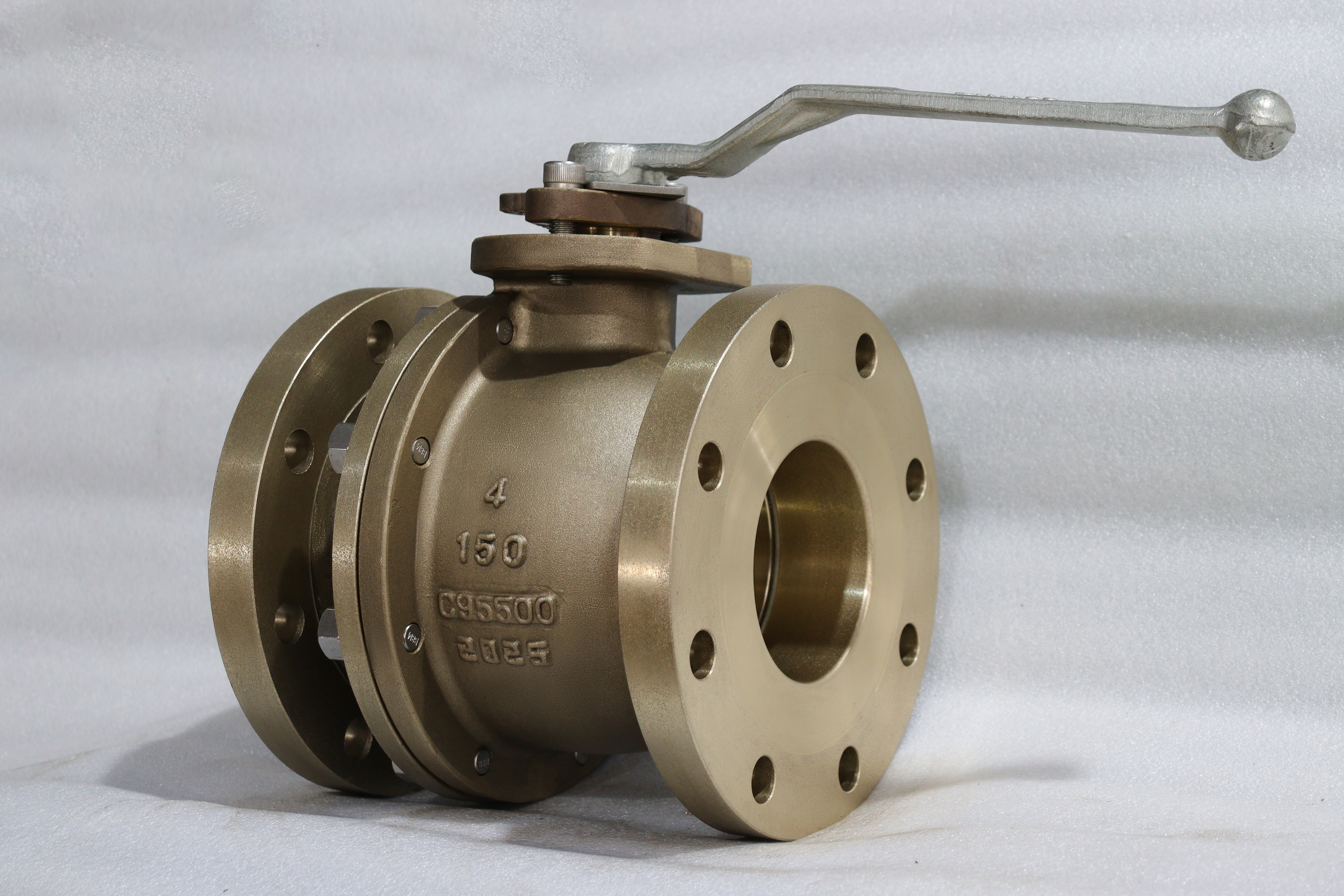
This is a four inch valve: DN100 bore, Class 150, which API 6D writes as PN20. The body is ASTM B148 C95500 cast nickel aluminium bronze, also written CuAl10Fe5Ni5, in two bolted pieces, with raised face flanges to the Class 150 pattern, a floating ball between two seat rings and a lever with a locking hole. It is supplied unpainted, because the alloy does not need a coating, and it is tested to API 598 before it leaves the works.
Bronze is chosen here for one reason: seawater. A carbon steel valve in seawater needs a coating that will be damaged during installation, and a stainless valve in seawater is exposed to chloride pitting and to crevice corrosion under gaskets and deposits. Nickel aluminium bronze resists both, and it does so as a solid cast body with no coating to repair and no corrosion allowance to add.
The trade is a low ceiling. Copper alloys lose strength as they get hot, and the standard that governs this valve stops well below the steel tables. So a bronze valve is a moderate pressure, moderate temperature product, and the engineering question is not whether it holds 150 psi but whether the line stays inside the temperature and velocity limits where the alloy works. Both limits are lower than most buyers expect.
Design and Construction
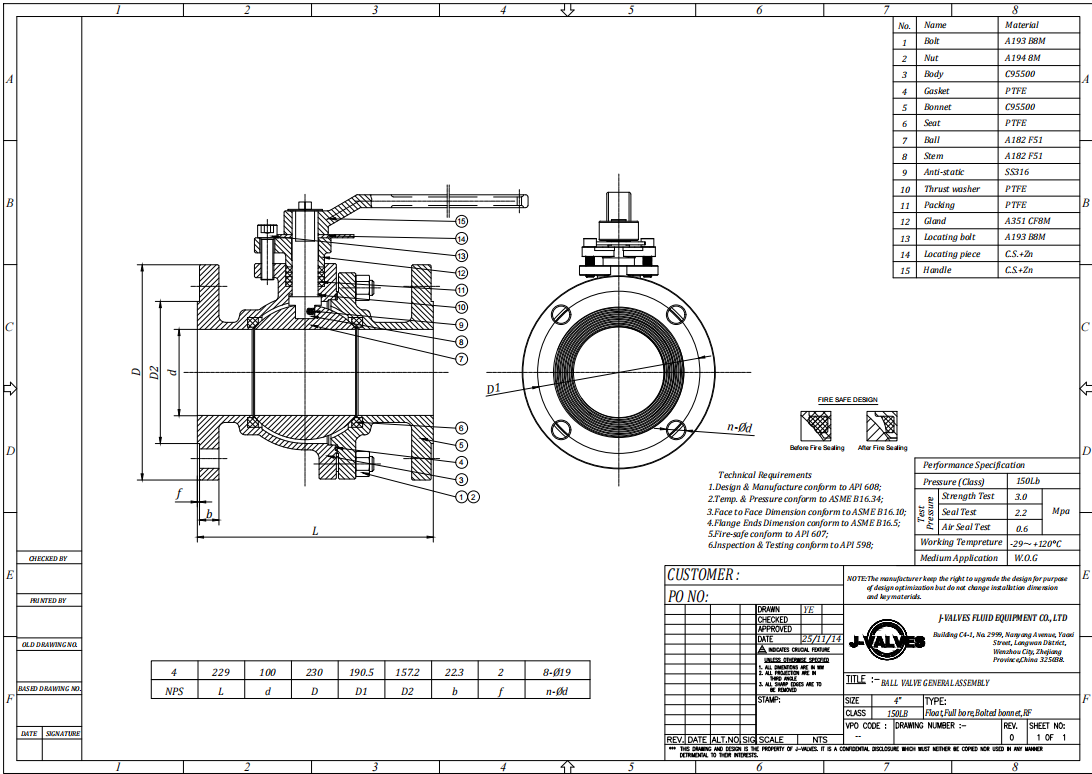
The ball floats. It sits between two seat rings with room to move, and the line pressure on the upstream half of the ball pushes the whole ball downstream until it presses on the outlet seat. At DN100 and Class 150 the pressure load is modest, so the seat load stays low and the lever swings easily by hand, which is the reason a four inch valve at this class is still a lever valve rather than a geared one.
The two piece body has a single bolted joint on one side of the ball. The end cap comes off, the seat and the ball come out, and the second seat is reached from inside the centre section. That is one joint fewer than a three piece body, which is one fewer pressure boundary to leak and one fewer gasket to stock; the price is that the ball cannot be lifted out from either end, so the trim is changed from one side only.
The stem passes through the bonnet, is retained so that it cannot be blown out, and drives the ball through a slot. An anti static spring keeps a conductive path from the ball through the stem to the body. The lever has a locking hole so the valve can be padlocked open or closed, which on a seawater line is often a safety requirement rather than a convenience.
The joint between the cast bronze parts is where a bronze valve earns or loses its reputation. Bronze is stiffer than steel and less forgiving of a joint face that is not flat, and the bolts are usually a different alloy from the body. That is why the bolt material is specified with the valve and not left to the installer: a 316 bolt in a bronze body in seawater is a galvanic couple waiting for a wet weekend.
Material Options
C95500 is the standard grade: a cast nickel aluminium bronze with about ten percent aluminium, five percent iron and five percent nickel, which gives it a yield strength closer to steel than to a tin bronze and a protective oxide film that re forms when it is scratched. C95800 carries more nickel and is chosen where velocity is higher; C95200 is the lower cost, lower strength alternative for quiet, clean seawater. The same alloy is sold as aluminum bronze in the United States and as nickel aluminium bronze in Europe, and now and then under the naval bronze label, which is a trade term for seawater duty rather than a specification.
The trim follows the body or improves on it. Ball in solid C95500, bare or hard chrome plated, with a nickel-copper alloy K500 or 316 ball where a harder or more noble surface is wanted. Stem in C95500, K500 or 17-4PH. Seat in PTFE or RPTFE as standard, PPL for warmer water, and a metal seat with flexible graphite where the temperature rules out polymers altogether.
| Component | Standard Material | Optional Upgrade | Service Notes |
|---|---|---|---|
| Body and end cap | ASTM B148 C95500 cast nickel aluminium bronze | C95800, C95200 | two pieces, one bolted joint |
| Ball | Solid C95500 | hard chrome, nickel-copper K500, 316 | one sealing face, lapped |
| Stem | C95500 | nickel-copper K500, 17-4PH | blowout proof, anti static |
| Seat ring | PTFE or RPTFE | PPL, metal with flexible graphite | the seat sets the temperature limit |
| Body gasket | Graphite spiral wound or PTFE envelope | Metal ring gasket | new gasket at every joint opening |
| Stem packing | PTFE V-ring | Flexible graphite | matched to the water temperature |
| Body bolts | Nickel-copper 400 or 500 | 316 stainless | specified with the valve, not by the installer |
| Operator | Lever with locking hole | Worm gear, pneumatic, electric | pad on the bonnet for actuation |
Technical Specifications
The envelope is DN100, Class 150, two piece body in cast C95500, raised face flanges to the Class 150 pattern, face to face to ASME B16.10, lever with locking hole, and pressure testing to API 598. The body is supplied unpainted and the bore is blended at the seat pocket so there is no step for the flow to work on. Threaded, socket weld or butt weld ends are available on request, and the length then follows the drawing rather than the flange table.
Two choices decide whether this valve survives its first year. The first is the body bolt material, because it is the part most often left unspecified and the first to corrode in a marine atmosphere. The second is the seat compound against the actual water temperature: a bronze body can take far more heat than a PTFE seat, so the seat, not the body, is what limits the service.
| Item | Value |
|---|---|
| Nominal size | 4 inch (DN100) |
| Pressure class | Class 150 (PN20) |
| Body construction | two piece, one bolted joint |
| Ball support | floating, no trunnion |
| Body material | ASTM B148 C95500 cast nickel aluminium bronze |
| Body options | C95800, C95200 |
| Alloy designation | CuAl10Fe5Ni5 |
| Rating standard | ASME B16.24 for cast copper alloy valves |
| Ball | solid C95500 |
| Ball options | hard chrome, nickel-copper K500, 316 |
| Stem | C95500 |
| Stem options | nickel-copper K500, 17-4PH |
| Seat | PTFE or RPTFE |
| Seat options | PPL, metal with flexible graphite |
| Temperature basis | copper alloy table in ASME B16.24, well below the steel tables |
| Packing | PTFE V-ring |
| Packing option | flexible graphite |
| Body gasket | graphite spiral wound or PTFE envelope |
| Body bolts | nickel-copper 400 or 500 |
| Bolt option | 316 stainless |
| Bore | full port, DN100 |
| End connection | raised face flange, Class 150 pattern |
| End options | NPT, socket weld, butt weld |
| Face to face | ASME B16.10 |
| Pressure testing | API 598 shell and seat, both directions |
| Fire safety | API 607 where ordered |
| Operator | lever with locking hole |
| Actuation options | worm gear, pneumatic, electric |
| Anti static | spring loaded path from ball to stem to body |
| Marking | size, class, C95500 and heat number on the body |
| Documentation | EN 10204 3.1, test record, general arrangement drawing |
Standards and Compliance
The standard for a cast copper alloy flanged valve is ASME B16.24, which covers copper alloy valves in Classes 150 through 2500 and carries its own pressure temperature tables. ASME B16.34, which the original page cites, is written for steel valves and does not govern a C95500 body. That is not a detail: the allowable stresses and the temperature limits are different, and quoting the steel standard on a bronze valve overstates what the valve can do.
The flange drilling follows the Class 150 pattern so the valve bolts to a standard Class 150 steel flange, which is what makes a bronze valve usable in a steel pipeline at all. Pressure testing is to API 598, with shell at one and a half times and seat at one point one times. Fire testing to API 607 is available where the project asks for it, although a bronze valve is rarely used where fire survival governs.
| Requirement | Standard | What J-VALVES Supplies |
|---|---|---|
| Copper alloy valve rating | ASME B16.24 | Classes 150 to 2500, copper alloy pressure temperature tables |
| Flange drilling | Class 150 pattern | bolts to a standard Class 150 steel flange |
| Face to face | ASME B16.10 | flanged valve length for the size and class |
| Pressure testing | API 598 | shell at 1.5 times, seat at 1.1 times, both directions |
| Fire safety where ordered | API 607 | fire test certificate |
| Material certificate | EN 10204 3.1 | certificate per heat with mechanical properties |
Manufacturing Process
The body and end cap are sand cast in C95500, then heat treated to develop the microstructure that gives the alloy its strength: the aluminium bronze family depends on a controlled quench and temper, and an untreated casting is noticeably softer. Weld repair of a casting is not a shop floor decision; where it is permitted at all it needs a qualified procedure and a re test, and on the sealing faces it is normally refused.
Machining is where the valve is made or lost. The seat pocket and the joint face are cut in one setting so the seat ring sits square to the ball axis, the flange facing is cut to the Class 150 finish, and the bore is blended so that there is no step for the flow to attack. Assembly is seats, ball, end cap, gasket, bolts in a cross pattern, then the packing and the lever.

Quality Control and Testing
Each heat is checked for chemical composition and mechanical properties, and the certificate travels with the valve. Castings are inspected for porosity on the sealing faces and around the joint, because a bronze casting that looks sound can still weep through a shrinkage cavity that only shows up under pressure. Hardness is checked on the body and on the ball where a hardness difference between ball and seat is part of the design.
Every valve is shell tested at one and a half times the rating and seat tested at one point one times, both to API 598, and the seat test is run in both directions because a floating valve only seals on the downstream seat. Dimensional checks cover flange drilling, face to face, bore and stem thread, and the operating torque is recorded for reference. The test record and the material certificate are issued with the valve.
| Step | What Is Checked | Standard or Acceptance |
|---|---|---|
| Incoming casting | chemical composition, mechanical properties, hardness | EN 10204 3.1 against B148 C95500 |
| Casting soundness | porosity on sealing faces and around the joint | visual and dye penetrant, no repair on seal faces |
| Machining | seat pocket squareness, joint face flatness, flange facing | drawing tolerance |
| Flange | drilling, bolt circle, facing finish | Class 150 pattern |
| Bore | bore against DN100, blend at the seat pocket | gauged through the assembled valve |
| Shell test | body and joint at 1.5 times | API 598, no leak |
| Seat test | each seat in both directions at 1.1 times | API 598, no visible leak |
| Hardness | body and ball, where a hardness difference is specified | drawing range |
| Torque | breakaway torque on the assembled valve | recorded for reference |

Applications and Industry Service
The duty is seawater and brackish water isolation: cooling water intake and return, fire main branches, desalination pre treatment, shipboard sea water systems, fish farm and aquaculture lines, and coastal industrial water where the chloride load would destroy a stainless valve. In those services the valve is often open for months and closed only for maintenance, which is exactly the duty a quarter turn valve suits.
It is not a steam valve, not a hot oil valve, and not a valve for service above the temperature limit of the alloy. It is also a poor choice for abrasive slurry, where the aluminium bronze will erode, and for very high flow velocities, where erosion corrosion rather than general corrosion is what eventually takes the body out. Where the water is chlorinated or treated, check the treatment against the alloy before ordering, because a bronze that is fine in raw seawater is not automatically fine in a chemical dosing line.

Installation, Operation and Maintenance
Support the pipe independently; a bronze valve is not a pipe support and the flange bolts are not designed to carry bending. Where the valve sits between steel flanges in a wet area, use the specified nickel-copper or 316 bolts and consider an insulating gasket set if the pipe is cathodically protected, because a protected steel line will happily sacrifice an unprotected bronze valve. Paint the steel side of the joint, not the bronze.
Exercise the valve a few times a year even if it is never needed. Seawater standing against a closed ball grows marine deposits on the seat face, and a valve that has not moved for two years may not move when it is wanted. If the lever stiffens, open the body and clean the seat rather than forcing it, because a scored seat in bronze does not lap back as easily as a stainless one.
How to Specify and Order
Write the size, the class, the body alloy, the trim, the end connection, the bolt material and the operator. A typical line reads: four inch, Class 150, body C95500, ball C95500 with hard chrome, RPTFE seat, raised face flanges, nickel-copper body bolts, lever with locking hole. Add the water temperature and the expected velocity, because those two numbers decide whether the alloy is right, and add the chloride level if the water is not clean seawater.
Say whether the valve will be actuated, and whether it will sit in a cathodically protected system. Both change what is supplied: the first adds a mounting pad and a machined stem top, the second may add isolating gaskets and a different bolt specification. A bronze valve ordered without them is difficult to correct after it is installed, because the pad is machined into the bonnet and the stem top is cut for the drive at the same setting.
FAQ
Q: Why bronze rather than 316 stainless for seawater?
A: Because 316 in seawater pits and suffers crevice corrosion under gaskets and deposits, and a stainless valve that looks perfect can be perforated at a gasket face. Nickel aluminium bronze forms a protective oxide film that re forms when damaged, has no coating to repair, and is tolerant of the deposits that seawater leaves behind. It is the reason bronze is still the default for seawater valves after a century.
Q: Is ASME B16.34 the right standard for this valve?
A: No. B16.34 is written for steel valves; a cast copper alloy body is governed by ASME B16.24, which has its own pressure temperature tables and its own allowable stresses. The original page cites B16.34, and that overstates the rating because the copper alloy tables stop far below the steel ones. This page cites B16.24 for the rating and B16.10 for the length.
Q: What temperature can a bronze ball valve take?
A: Well below a steel valve of the same class, and the limit is set by the alloy rather than by the seat. Copper alloys lose strength as temperature rises, and the ASME B16.24 tables reflect that. In practice the PTFE or RPTFE seat gives out first, so the honest answer is that this is a cold and warm water valve, not a hot water or steam valve.
Q: Two piece or three piece body?
A: Two piece is cheaper, has one pressure boundary instead of two, and is easier to stock. Three piece lets the ball and both seats come out from either end with the pipe untouched, which matters on a line that cannot be opened. For a seawater line that is opened for cleaning rather than for trim changes, the two piece body is usually enough.
Q: Will it corrode in seawater?
A: The alloy resists general corrosion well, but erosion corrosion is the real failure mode: at high flow velocity the protective film is stripped faster than it re forms, and the metal thins. Keep the velocity inside the range the alloy is specified for, avoid sudden reductions in bore, and do not use a bronze valve on a line that is throttled part open.
Q: Can it be actuated?
A: Yes, where the valve is ordered with a mounting pad and a machined stem top. A worm gear, a pneumatic actuator or an electric actuator then mounts directly. Because the body is bronze and the actuator is usually aluminium or steel, check the bracket material as well: a mixed assembly in a marine atmosphere corrodes at the fasteners first.


Hot Products


News
Ball Valves in Geothermal Brine: Silica Scale, Chloride Cracking And The Cooling Trap
Why geothermal brine destroys ball valves: retrograde silica scale, calcite at the flash point, chloride cracking above 60 C and the 250 C seat limit.
Read More
Ball Valve Face To Face Dimensions: Why A Correctly Ordered Replacement Still Does Not Fit
A 6 inch Class 150 ball valve can be 267 or 305 mm face to face and both are compliant. How B16.10, EN 558 and flange drilling decide whether it fits.
Read More
Ball Valve Stem Key And Keyway: What Gives Way First, And What The Handle Cannot Tell You
Between the handle and the ball there are four fits. Which one shears, which one cracks, and how a few degrees of lost motion hides a valve that never seated.
Read More
Ball Valve Datasheet: Six Blocks That Decide Whether Two Quotes Are Comparable
A ball valve datasheet only works when six blocks are fixed: pressure basis, bore, temperature ceiling, test, end connection, operator. How each is written.
Read More