


CHINA J-VALVES Offers Various High-quality I ndustrial Ball Valves
J-VALVES, a distinguished professional ball valve manufacturer rooted in China, takes pride in its extensive product portfolio. Our offerings span a wide range, including trunnion-mounted ball valves, floating ball valves, high-temperature ball valves, high-pressure ball valves, metal-sealed ball valves, ultra-low temperature ball valves, DBB ball valves, Three-way And Four-way Ball Valve, and fully welded ball valves. Each product is a testament to our commitment to precision engineering and reliable performance. Meticulously crafted, they are designed to not only meet but exceed the most stringent industrial demands, ensuring stable operation even under extreme conditions. This enables us to provide our clients with high-value services and makes our valves widely sought-after in industries.
Product Category
Contact Us


-
J-VALVES-Q41F
-
J-VALVES
Overview of the J-VALVES PN100 WCB Two-Piece Floating Ball Valve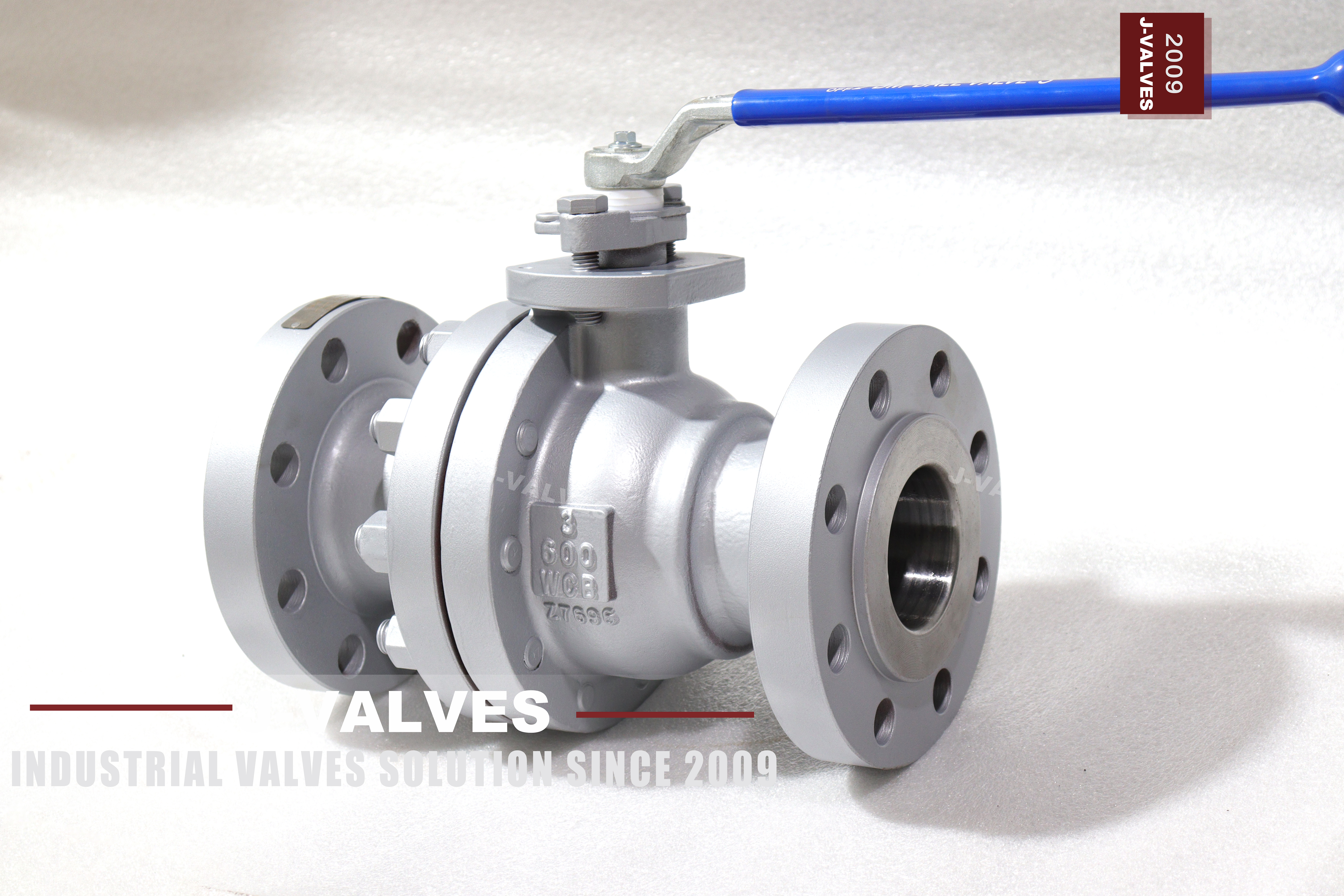
The J-VALVES PN100 WCB two-piece floating ball valve is a DN80 split-body isolation valve for Class 600 carbon steel piping. A single cast ASTM A216 WCB body machined on one centre line carries a polished ball free to shift downstream under line pressure, so the seat load rises with the pressure it is asked to hold and no external spring is needed for tight shutoff. The two-piece shell lets the insert be pulled to renew the seats without cutting the pipe.
The DN80 size sits on the boundary of the floating and trunnion families, and that boundary is decided by pressure class rather than by bore. At Class 600 the unbalanced thrust on an 80 mm bore approaches 51 kN, which a floating seat and a single stem can carry while the body stays compact. Above Class 600, or above DN200, the same duty moves to a trunnion design. Choosing floating here buys a shorter, lighter valve with fewer pressure joints, at a lower price than the equivalent trunnion product.
Typical duty includes gas gathering laterals, amine and glycol contactor outlet lines, produced water transfer, boiler feedwater isolation, terminal manifold branches and nitrogen blanketing headers. All of these need bubble-tight shutoff on clean or lightly contaminated fluid at 60 to 100 bar, and none need double block and bleed. Where positive isolation with a bleed port is written into the specification, this valve is the wrong selection and a double block and bleed assembly should be quoted.
Design and Construction
The shell is a two-piece split design: a main body holding the ball, seats and stem, closed by a bolted insert on the downstream flange side. One body-to-insert joint carries the entire pressure boundary, so there is one spiral wound gasket and one bolt circle to manage at every seat renewal. A three-piece version would open two joints for the same job and cost fifteen to twenty percent more to make; a top-entry version would need a much heavier bonnet forging. The two-piece compromise is right wherever the line is opened rarely and the budget is watched.
The ball floats, meaning it is not anchored by trunnions or bearings. Line pressure pushes it downstream into the seat ring, seal load is generated by the pressure itself, and the higher the pressure the tighter the contact. The stem turns the ball but carries no axial load from it. Because the ball can lift away from the upstream seat, any overpressure from thermal expansion of trapped liquid in the body cavity escapes back upstream, which is why this design needs no cavity relief valve.
Full bore is standard, with the ball passage matched to the ASME B16.34 and API 608 bore for the size and class, and reduced bore is available where weight and cost matter more than pressure drop. All wetted metal parts can be supplied with ENP, hard chrome or a stainless steel overlay when the medium is mildly corrosive. The stem is blowout proof: a shoulder under the gland retains it if the packing is removed. A graphite gasket backed by two O-rings forms the triple barrier at the stem, and an anti-static device bonds ball, stem and body so the valve cannot hold a static charge in hydrocarbon service.

Material Options
The table sets out what is supplied as standard and what an upgrade adds, so that a buyer can tell from the data sheet which parts are carbon steel and which are alloyed for a reason.
| Component | Standard Material | Optional Upgrade | Service Notes |
|---|---|---|---|
| Body and insert | ASTM A216 WCB cast carbon steel | ASTM A105 forging, ASTM A350 LF2 for low temperature | A105 and WCB share ASME B16.34 material group 1.1, so the pressure rating is identical |
| Ball | WCB with ENP, 250 to 300 HV | Hard chrome 700 to 900 HV, or 316 stainless overlay | Chrome for abrasive fines, overlay for chlorides and produced water |
| Stem | ASTM A105 with ENP | 17-4PH, or SUS420 stainless | 17-4PH for high cycle duty and higher torque margins |
| Seat seal | PTFE, minus 29 to 180 C | RPTFE, PPL to 280 C, PEEK to 260 C, metal seat with graphite to 425 C | Soft seats give bubble-tight shutoff; metal seats trade class VI for temperature |
| Body gasket | Flexible graphite spiral wound, 316 windings | Metal ring joint gasket | Spiral wound for RF flanges, ring joint for RTJ flanges |
| Packing | Flexible graphite with Inconel wire reinforcement | PTFE V-ring set | Graphite for fire safety, PTFE for low friction and clean gas |
| Bolting | A193 B7 studs with A194 2H nuts | B7M with 2HM for sour service, B8M with 8M for stainless | B7M is hardness controlled to NACE MR0175, not a higher strength grade |
| End connection | RF flange to ASME B16.5 | Butt weld ends to ASME B16.25 | RF is standard for Class 600 up to DN600 |
| Operator | Lockable lever | Worm gear, pneumatic, electric, gas over oil | Gear from DN150, actuator from DN100 upward |
Technical Specifications
The values below describe the standard DN80 Class 600 configuration. Anything outside this table is quoted against a signed drawing.
| Item | Value |
|---|---|
| Nominal size | DN80, NPS 3 |
| Pressure class | Class 600, PN 100 per API 6D clause 7.2 |
| Body material | ASTM A216 WCB |
| Design standard | API 608, ASME B16.34 |
| Pressure test | API 598 |
| Fire test | API 607 and ISO 10497 |
| Face to face | ASME B16.10, Class 600 long pattern, 356 mm |
| Flange drilling | ASME B16.5, 8 bolts, bolt circle 241.3 mm |
| Bore | Full bore, 76 mm nominal |
| Temperature, soft seated | Minus 29 to 180 C with PTFE, to 280 C with PPL |
| Temperature, metal seated | Minus 29 to 425 C |
| Working pressure at 38 C | 102.1 bar |
| Shell test pressure | 153.2 bar |
| Seat test pressure | 112.3 bar |
| Cv, full bore | 780 US gpm at 1 psi drop |
| Breakaway torque | 210 Nm clean service, 280 Nm after standing |
| Weight | 46 kg approximate |
Standards and Compliance
Pressure class is the first place buyers get into trouble with this valve. API 6D clause 7.2 lists PN 100 as the metric designation for Class 600, so printing PN 100 on a nameplate or a data sheet is correct and the two numbers describe one rating. What is not correct is treating PN 100 as an interchangeable flange standard. EN 1092-1 does carry a PN 100 step, but its flange dimensions differ from ASME B16.5: the EN PN 100 DN80 flange takes 8 bolts on a 200 mm bolt circle with M20 threads, while ASME Class 600 NPS 3 takes 8 bolts on a 241.3 mm circle with inch threads. A valve drilled to one pattern will not bolt to a flange drilled to the other, even though both are labelled the same pressure. Every J-VALVES PN 100 valve is drilled to ASME B16.5 unless an EN pattern is ordered in writing.
Pressure and temperature are not independent. Carbon steel in ASME B16.34 group 1.1 is rated 102.1 bar at 38 C, falls to 93.2 bar at 100 C, 79.6 bar at 200 C, 70.1 bar at 300 C and 61.8 bar at 400 C. The seat material caps the whole assembly well below the body limit: PTFE holds to about 180 C, PPL to 280 C, and only a metal seat reaches 425 C, and then with a leakage allowance instead of a bubble-tight claim. Quoting the valve as minus 29 to 425 C without naming the seat is the most common error on this page type.
| Requirement | Standard | What J-VALVES Supplies |
|---|---|---|
| Design and pressure temperature rating | ASME B16.34, API 608 | Rated body, wall thickness and bolting per group 1.1 |
| Fire safe qualification | API 607, ISO 10497 | Certificate per size and seat type, graphite secondary seal |
| Pressure testing | API 598 | Shell at 1.5 times rating, seat at 1.1 times rating, both recorded |
| Face to face | ASME B16.10 | Long pattern Class 600 dimensions |
| Flange dimensions | ASME B16.5 | RF raised face, 125 to 250 AARH finish |
| Marking | MSS SP-25, API 608 | Nameplate with class, size, material heat number and seat code |
| Material certificates | EN 10204 3.1 | Mill certificates traceable to heat number |
| Fugitive emissions | ISO 15848-1 | Graphite packing qualified where the project calls for it |
Manufacturing Process
Bodies are cast in the foundry attached to the Wenzhou plant, then normalised and shot blasted before machining. Each casting is checked for wall thickness at the flange hub and the body cavity, because shrinkage porosity in those two areas is what fails a hydro test at 153 bar. Flange faces are turned in a single set-up with the bore so that face runout stays inside 0.1 mm, and the bolt holes are drilled from a jig rather than by eye.
The ball is machined oversize, ground, then lapped against a master seat before plating. ENP is applied at 25 to 50 microns in a bath controlled for nickel concentration and temperature, and the plated ball is measured for roundness across four diameters. A ball that is out of round by more than 5 microns will leak at low pressure even though it passes a high pressure test, because the seat cannot follow an elliptical surface through the full 90 degree travel.
Seat rings are moulded or machined, then fitted with their O-ring and anti-extrusion ring and checked for free movement in the pocket. Assembly is done in a clean bay: the body cavity is wiped, the ball is set on the downstream seat, the insert is drawn up on a new spiral wound gasket, and the bolting is torqued in three passes on a diagonal sequence to the value stamped on the assembly card. Stem packing is compressed at the bench, and the torque trace of the first open and close is recorded and filed with the serial number.

Quality Control and Testing
Every valve passes the eight checks below before it is packed. Records travel with the valve as a test book, and any step can be witnessed by a third party inspector on request.
| Step | What Is Checked | Standard or Acceptance |
|---|---|---|
| 1 Chemical and PMI | Body, ball and stem alloy content against certificate | ASTM A216/A105, PMI on 100 percent of alloy trim |
| 2 Casting inspection | Surface and sub-surface defects, wall thickness | Visual plus PT on flange and body joint areas |
| 3 Dimensional | Face to face, flange drilling, bore, stem height | ASME B16.10 and B16.5, tolerance per drawing |
| 4 Shell test | Body and insert joint under water | 153.2 bar held 60 seconds, no leakage or sweating |
| 5 Seat test both directions | Bubble count at each seat with ball closed | 112.3 bar, zero bubbles for soft seat, API 598 rate for metal seat |
| 6 Torque and operation | Breakaway and running torque, 90 degree travel | Within the recorded limit, full travel with lever |
| 7 Anti-static | Resistance between ball, stem and body | Below 10 ohm |
| 8 Paint and marking | DFT, nameplate data, tag number | 120 to 180 micron epoxy, MSS SP-25 marking |

Applications and Industry Service
Natural gas gathering and metering laterals are the largest single use. Class 600 covers most field gathering pressures in the 60 to 90 bar band, and a two-piece flanged body can be pulled and reseated at a compressor station without cutting the header. Where the gas is sour, bolting changes to B7M and the trim to 316 overlay to meet NACE MR0175.
In amine and glycol systems the valve handles lean and rich solvent at up to 120 C. PTFE seats are adequate here but PPL is often specified because solvent carryover and heat together attack PTFE at the upper end of its range. Produced water and injection service calls for a chrome or overlay ball, since sand and scale abrade an ENP surface within a season on a throttling duty.
Steam and condensate headers use the same body with a metal seat and graphite packing, but only where a small leakage rate is acceptable. Boiler feedwater and chemical dosing skids use the full bore version for low pressure drop, and nitrogen blanketing headers on tank farms use it as the routine isolation point. In all of these the valve stays either fully open or fully closed; a soft-seated floating ball throttled at part travel will erode its seat, and a globe valve should be selected where control is required.
Installation, Operation and Maintenance
Install with the stem vertical or horizontal, never inverted, and check the flow arrow against the intended direction, though the valve seals in both. Flange bolts are tightened in a star pattern to the torque in the project specification, and the pipe is aligned so that the valve does not carry bending load from the line, which is the most common cause of a leaking body joint in the first year. Do not use the valve as a pipe support.
Operate with a quarter turn, and leave the lever in the fully open or fully closed position with the locking device engaged where the line has a lockout procedure. If the valve has sat closed for a long period on dirty service, open it slowly the first time, because sediment settles on the upstream seat face and a fast quarter turn will score the ball. Grease is not injected into this design, since a floating ball valve has no seat injection port and adding one would create a leak path.
Maintenance work is limited to four jobs: tightening or renewing stem packing, replacing the body gasket, renewing the seats, and replacing the ball. Packing can be adjusted by even turns on the gland nuts, a quarter turn at a time, until leakage stops; over-tightening accelerates stem wear and raises torque. Seat renewal means isolating the line, venting the cavity through the drain plug, releasing the insert bolting, and drawing the insert back. The valve is not repairable under pressure, and no part of this work should start before the line is isolated, drained and proven at zero pressure.
How to Specify and Order
A complete enquiry needs eight items: size and class, body and trim material, seat material with the design temperature, bore (full or reduced), end connection and facing, operator type, any fire safe or NACE requirement, and the inspection level. Sending the line medium and the design pressure alongside the temperature avoids the usual round of clarifications, because seat selection depends on all three at once.
Options that change the price most are the actuator, the trim upgrade and the inspection level. A pneumatic actuator with a solenoid and limit switch package can cost more than the valve, so specify whether the actuator is spring return or double acting at the outset. Third-party witnessed testing adds a day to the schedule and must be booked before the test date, not after. Standard sizes ship in two to four weeks from Wenzhou, and special trim or actuation takes four to eight weeks.
FAQ
Q: Is PN100 the same as Class 600?
A: Yes. API 6D clause 7.2 lists PN 100 as the metric designation for Class 600, so the two labels describe one pressure rating and PN 100 is correct on a nameplate. The number is not a flange standard: an EN 1092-1 PN 100 DN80 flange takes 8 bolts on a 200 mm circle with M20 threads, while an ASME B16.5 Class 600 NPS 3 flange takes 8 bolts on a 241.3 mm circle with inch threads. Confirm the drilling before ordering.
Q: Why choose a floating ball valve instead of a trunnion valve at DN80 Class 600?
A: Below about Class 600 and DN200 the thrust on the ball can still be held by a floating seat and a single stem, so a floating valve gives the same shutoff in a shorter, lighter body with one pressure joint instead of a trunnion set with bearings and injection ports. The trunnion design becomes necessary above Class 600, or where double block and bleed or very high cycle duty is specified.
Q: What temperature can a soft-seated PN100 valve take?
A: The body is rated from minus 29 C to 425 C, but the seat sets the real limit. PTFE holds to about 180 C, PPL to 280 C and PEEK to 260 C, and only a metal seat with graphite reaches 425 C, at the cost of a small allowable leakage instead of bubble-tight shutoff. Quote the seat with the design temperature, not the body rating alone.
Q: How is the valve tested before shipment?
A: Each valve goes through shell test at 153.2 bar for 60 seconds and a bidirectional seat test at 112.3 bar per API 598, plus anti-static resistance below 10 ohm, torque measurement and a dimensional check against ASME B16.10. Material certificates to EN 10204 3.1 and the test book travel with the serial number, and third-party witnessing can be booked.


Hot Products


News
Ball Valves in Geothermal Brine: Silica Scale, Chloride Cracking And The Cooling Trap
Why geothermal brine destroys ball valves: retrograde silica scale, calcite at the flash point, chloride cracking above 60 C and the 250 C seat limit.
Read More
Ball Valve Face To Face Dimensions: Why A Correctly Ordered Replacement Still Does Not Fit
A 6 inch Class 150 ball valve can be 267 or 305 mm face to face and both are compliant. How B16.10, EN 558 and flange drilling decide whether it fits.
Read More
Ball Valve Stem Key And Keyway: What Gives Way First, And What The Handle Cannot Tell You
Between the handle and the ball there are four fits. Which one shears, which one cracks, and how a few degrees of lost motion hides a valve that never seated.
Read More
Ball Valve Datasheet: Six Blocks That Decide Whether Two Quotes Are Comparable
A ball valve datasheet only works when six blocks are fixed: pressure basis, bore, temperature ceiling, test, end connection, operator. How each is written.
Read More