


CHINA J-VALVES Offers Various High-quality I ndustrial Ball Valves
J-VALVES, a distinguished professional ball valve manufacturer rooted in China, takes pride in its extensive product portfolio. Our offerings span a wide range, including trunnion-mounted ball valves, floating ball valves, high-temperature ball valves, high-pressure ball valves, metal-sealed ball valves, ultra-low temperature ball valves, DBB ball valves, Three-way And Four-way Ball Valve, and fully welded ball valves. Each product is a testament to our commitment to precision engineering and reliable performance. Meticulously crafted, they are designed to not only meet but exceed the most stringent industrial demands, ensuring stable operation even under extreme conditions. This enables us to provide our clients with high-value services and makes our valves widely sought-after in industries.
Product Category
Contact Us


-
J-VALVES-Q41Y
-
J-VALVES
Overview of the J-VALVES Stellite Seat High Pressure Floating Ball Valve, DN50 x 40 Class 1500
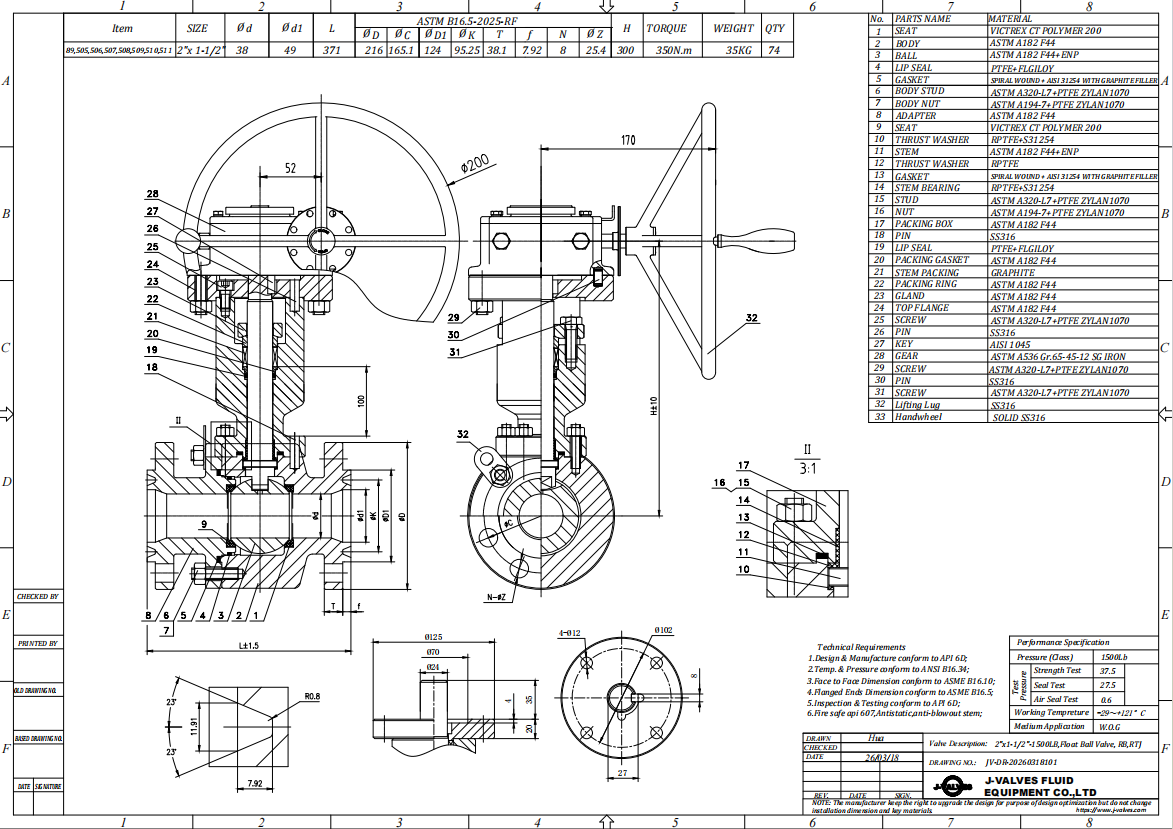
This is a two piece floating ball valve with a reduced bore, forged in ASTM A182 F44 and flanged to ASME B16.5 Class 1500 on ring type joints. Both ends are DN50, the bore is DN40, and the trim is metal seated, with the ball and both seat faces hardened and lapped to each other instead of lined with a polymer insert.

Two things usually go wrong when a soft seated valve is scaled up to Class 1500: the PTFE or PEEK insert cannot survive the load, and the metal trim chosen to
replace it belongs to a different valve, with different clearances, torque and leakage expectation. The second mistake is the expensive one.
The body is the super austenitic grade A182 F44, UNS S31254, known as 254SMO or 6Mo. It carries about 6 per cent molybdenum against the 2 per cent of 316L, putting its pitting resistance equivalent number near 43, which makes it defensible where pressure and chlorides arrive together.
A floating ball carries its ball on the two seat rings rather than on trunnions, so line pressure drives it onto the downstream seat and seat load rises with the pressure class. That is what makes a metal seat necessary here rather than optional, and why the torque is not that of a soft seated valve of the same size.
Design and Construction
The body is a single forged part, machined internally and closed on one bolted joint with a spiral wound stainless and graphite gasket, a joint that carries the full pressure and is therefore the first place an inspector should look on a Class 1500 valve.
The ball is a forged F44 sphere, ground round and then coated, and the seat is a separate F44 ring with a Stellite facing. Ball and seat are lapped together as a pair and stay together for the life of the valve, because a replacement ball against a worn seat will not seal. The seat is allowed a small axial float on disc springs, so a pressure surge is absorbed instead of pinching the ball, and the facing stops short of the ball bore, leaving a soft edge rather than one that chips.
The stem is 17-4PH or F44, passes through a graphite packing box and is retained by the body rather than the gland, so pressure cannot eject it. The extended stem is optional, because it serves one of three purposes that are not interchangeable.
Metal Seating and the Hard Face
A soft seat seals by deformation: the polymer insert conforms to the ball and fills the valleys of its surface, so a scratch of a few micrometres is bridged rather than followed. A metal seat seals on a contact band a tenth or two of a millimetre wide instead, and everything depends on that band being lapped true, kept clean and held at a stress high enough to flatten the high points.
Face finish is therefore the specification, not a detail. A typical requirement is a lapped face at Ra 0.05 to 0.1 micrometre with the contact band confirmed by blue check, and ball sphericity held to about 0.01 mm, because a ball out of round by a few hundredths carries its load on one high point and that point is where the coating spalls.
The ball should be harder than the seat by a few points on the Rockwell C scale, so the seat wears preferentially, since the seat is the renewable part and the ball is not. Two identical hard faces are the worst combination, because they gall instead of one bedding into the other, which is why the common build is a hard coated ball against a Stellite faced seat.
Stellite is the standard facing because it is welded as an overlay and then machined and lapped, so the finished face is part of the seat rather than a coating on it. Tungsten carbide is harder and resists fine particle erosion better, but it is a sprayed layer a few tenths of a millimetre thick, more brittle under impact, and cannot be relapped once spalled. The choice is a service decision, not a price one.
Material Options
| Component | Standard Material | Optional Upgrade | Service Notes |
|---|---|---|---|
| Body and end | ASTM A182 F44 forged super austenitic | None within this family | UNS S31254, 6Mo, PREN about 43 |
| Ball | Forged F44 with tungsten carbide coating | F44 with hard chrome | Sphericity 0.01 mm, coating stops at the bore edge |
| Seat ring | F44 forged ring with Stellite facing | Tungsten carbide faced seat | Lapped to the ball as a matched pair |
| Seat spring | Inconel 718 disc spring stack | None | Sets preload and absorbs thermal transient |
| Stem | 17-4PH or F44 | Inconel 718 for high temperature | Body retained, anti blow out |
| Stem packing | Flexible graphite with braided end rings | Graphite with wire reinforcement | Fire safe, tested to API 607 |
| Body gasket | Spiral wound 316L with graphite filler | F44 wound for chloride service | Renewed whenever the joint is opened |
| Bolting | A193 B8M with A194 8M nuts | B8M with anti galling coating | Galling control on stainless studs |
| Ring joint | Soft iron or SS316 oval ring, R24 | F44 ring for aggressive medium | Groove finish is part of the seal |
| Extended stem | F44 shaft and housing | None | Length and duty set by the application |
A carbon steel outer ring on a spiral wound gasket puts a dissimilar metal at the joint face, and in wet chloride service that ring corrodes first; windings and inner ring in 316L or F44 remove the couple at little cost. Bolting follows the same logic, so B8M replaces B8, and because B8M galls readily the assembly procedure has to name a compatible lubricant rather than leave it to the fitter.
Technical Specifications
| Item | Value |
|---|---|
| Nominal size | DN50 x DN40 (NPS 2 x 1 1/2), reduced bore |
| Body material | ASTM A182 F44, UNS S31254, solution annealed |
| Pressure class | Class 1500, catalogue label PN 260 |
| Ambient rating | 255.3 bar at 38 C to ASME B16.34 |
| Body temperature range | -29 C to 425 C |
| Seat type | Metal seated, ball lapped to seat, spring backed |
| Seat leakage acceptance | API 598 metal seat allowance, or zero visible leakage on request |
| End connection | ASME B16.5 Class 1500 ring type joint |
| Ring gasket | R24, 95.25 mm pitch diameter, 7.92 mm wide, 11.91 mm deep |
| Flange outside diameter | 215.9 mm, 38.1 mm thick, 8 x 7/8 inch on 165.1 mm circle |
| Face to face | 292 mm reference to ASME B16.10, confirm on the drawing |
| Stem extension | 300 mm to 1200 mm, set by the duty and by the drawing |
| Breakaway torque | 200 to 350 N m at the ambient rating, confirm by test |
| Actuator sizing | Output at least 1.5 times the measured breakaway torque |
| Design standard | API 608, ASME B16.34 |
| Material certificate | EN 10204 3.1, heat number traceable |
The torque figure is the one number here that should not be taken from a catalogue. A metal seated valve carries two components a soft seated valve does not hold in the same proportion: the seat preload, present before any pressure arrives, and the friction between two hard faces. Both depend on lapping quality and coating, so the figure is established on the bench for each build and the actuator sized from that measurement.
Standards and Compliance
This valve is designed to API 608, with ASME B16.34 setting wall thickness and rating. API 6D is often quoted at this class, but it is written around pipeline valves and a floating ball design is outside its scope; where a project requires API 6D, the answer is a trunnion valve, not a floating one carrying a different number.
Class 1500 in ASME B16.34 is 255.3 bar at 38 C, and a ring joint facing is standard at this class because a raised face joint is not considered reliable at this pressure. The dimensions that matter on site are the groove number and its finish: a 24 groove has a pitch diameter of 95.25 mm, a width of 7.92 mm and a depth of 11.91 mm, and a ring that does not seat fully in a damaged or remachined groove will leak whatever the bolt torque.
Seat leakage acceptance is where a metal seated valve is most often mis-specified. API 598 allows a metal seat a size dependent drip or bubble allowance, while a soft seat must show no visible leakage. Carrying the soft seat wording over to a metal seat asks for something the design cannot guarantee. State the acceptance explicitly.
The fire test is API 607, and it is a different claim here than on a soft seated valve. A metal seated valve is already fire safe at the seal, because nothing polymer sits in the seating pair, so the test exercises the body joint, the packing and the gasket, the parts that can still fail.
Manufacturing Process and Quality Control
The F44 body is forged, solution annealed and machined at the J-VALVES plants in Wenzhou and Lishui, a 15000 square metre base with 40 CNC lathes, 5 machining centres and 8 drilling machines. Super austenitic steel work hardens under a dull insert, so tool life and cutting data are controlled rather than left to the operator.
Seat and ball decide whether the valve seals, and they are made as a pair. The ball is ground, coated and ground again to final sphericity, the seat facing is welded, machined and lapped, and the two are then lapped against each other and checked by blue contact rather than by eye. Assembly sets the preload: the disc spring stack is measured, the height recorded, and the seat set so the faces touch without gripping the ball.
| Step | What Is Checked | Standard or Acceptance |
|---|---|---|
| Incoming material | Heat number, chemistry, PREN, mechanical certificate | EN 10204 3.1, A182 F44 limits |
| Coatings | Thickness, hardness, bond, porosity | Per qualified coating procedure |
| Lapping | Contact band, face finish, ball sphericity | Blue check, Ra 0.05 to 0.1 micrometre |
| Assembly | Spring stack height, seat float, breakaway torque | Torque recorded per valve |
| Shell test | 1.5 times the ambient rating | API 598, no leakage at the body |
| Seat test | 1.1 times the ambient rating, both seats | API 598 metal seat allowance |
| Low pressure seat test | Air at about 6 bar, both directions | Bubble count recorded |
| Final | Operation, marking, packing | Certificate of conformity |
The order matters. The shell test runs first with the ball open, so a body defect is found before the trim is loaded. The seat tests follow, one seat at a time and in both directions, because a floating ball seals downstream and a test from one side proves only half the valve.
Bench torque measured at assembly is a record, not a formality: it sizes the actuator and it is what the operator feels at the end of a long extension. Two checks are specific to this build: coating integrity at the edge of the ball bore, where a burr damages the seat on the first cycle, and groove condition on both flanges, since a ring joint groove cannot be repaired in the field.


Applications and Industry Service
The duty where this valve earns its place is high pressure water carrying solids. Produced and formation water injection, where pressure and chlorides are both high and sand is present, is the classic case: the solids erode a soft seat and the chlorides attack a carbon body, so trim and body are wrong at the same time.
Descaling and wash water in steel and power plants follows, where scale particles at pressure cut a soft seat within months, then chemical service at moderate temperature with a medium that attacks 316.
The limits are equally specific. It is not for service above about 425 C, where the body is the constraint, nor for a medium that solidifies in the seat band, because a metal seat has no resilience to push a solid aside on the next stroke. Nor is it a substitute for a trunnion valve above NPS 4, where a large bore at this class needs more seat load than one operator can apply.
Installation, Operation and Maintenance
The ring joint comes first. The groove must be clean, dry and free of the previous ring, the ring must be new and of the correct number, and the faces drawn up evenly, because a ring joint does not forgive an uneven pull. A used ring is never reinstalled.
The extension changes the installation. A high temperature extension lifts the packing off the hot line and the operator clear of the lagging; a low temperature one holds a gas column so the packing does not freeze; a buried one brings the operator up to a valve box at grade and is set by the burial depth. The three are not interchangeable, and a length on a drawing is only valid for the duty it was written for.
Operation should be a full quarter turn, because the seat band wipes the ball as it turns and a ball parked half open wears a groove into it. Breakaway torque exceeds running torque on a metal seat, and an extension multiplies both the torque applied and the twist reaching the seat, so a long extension on a large valve should be geared rather than levered.
Partial cycling is good practice on abrasive service even when the valve is not needed: one left closed for a year in a solids bearing line needs more torque to open than one exercised monthly, which is enough to stall a marginally sized actuator. Maintenance without opening the body covers the packing, the gland and the extension housing. Anything involving the seat is a body joint job, and because seat and ball are a matched pair they are replaced together with the gasket and ring joints.
How to Specify and Order
A complete enquiry states the size and bore, the class, the body and trim material by grade, whether the seat is metal and what the facing is, the end connection and ring number, the face to face standard, the extension length and its duty, and the leakage acceptance.
Three items are usually missing and each changes the price: the solids content of the medium, which decides whether the ball coating should be tungsten carbide or hard chrome; the cycle frequency, because a valve cycled daily and one cycled twice a year are maintained differently; and the leakage acceptance against a named standard, because the difference between the API 598 allowance and zero visible leakage is lapping time.
Standard builds are accepted from one piece, with 2 to 4 weeks for a standard configuration and 4 to 8 weeks for a custom build. Documentation is EN 10204 3.1 with heat number traceability, and a 3.2 certificate witnessed by a third party is available where the project calls for it. A torque test report and a lapping contact record should be requested on any metal seated valve: together they are the evidence that the trim was made as a pair.
FAQ
Q: Why Stellite on the seat rather than tungsten carbide on both faces?
A: Two identical hard faces gall against each other instead of one bedding into the other, and a tungsten carbide coating a few tenths of a millimetre thick cannot be relapped once it has spalled. Stellite is welded as an overlay and then machined and lapped, so the finished seat face is part of the seat body rather than a layer on it, and the seat can be reworked. The usual build is therefore a tungsten carbide coated ball, which is the harder of the two by a few points on the Rockwell C scale, against a Stellite faced seat, so the renewable part wears first.
Q: Will a metal seat hold class VI shut off?
A: Not reliably, and not after it has seen service. API 598 gives a metal seated valve a size dependent drip or bubble allowance, while a soft seated valve must show no visible leakage, and the two are different claims. A metal seat can be lapped to zero visible leakage on the bench, and this valve can be supplied that way on request, but the band that seals is a tenth or two of a millimetre wide and abrasive service opens it. Write the acceptance you need against a named standard rather than carrying the soft seat wording across.
Q: Why is the body F44 instead of 316?
A: Because pressure and chlorides arrive together in the duties this valve is built for. A182 F44 is UNS S31254 with about 6 per cent molybdenum against the 2 per cent of 316L, which puts its pitting resistance equivalent number near 43 against about 26. At the ambient rating of 255.3 bar there is no margin for a body that pits from the inside, and in water injection or formation water service that risk is continuous rather than incidental.
Q: Does the extended stem make this a buried valve?
A: No, and the three duties are not interchangeable. A high temperature extension lifts the packing off the hot line and the operator clear of the lagging. A low temperature extension holds a still gas column so the packing does not freeze. A buried extension brings the operator up to a valve box at grade and is set by the burial depth. This valve can be supplied with any of the three, but the length, the housing and sometimes the valve family change with the answer, so state the duty on the enquiry.


Hot Products


News
Ball Valves in Geothermal Brine: Silica Scale, Chloride Cracking And The Cooling Trap
Why geothermal brine destroys ball valves: retrograde silica scale, calcite at the flash point, chloride cracking above 60 C and the 250 C seat limit.
Read More
Ball Valve Face To Face Dimensions: Why A Correctly Ordered Replacement Still Does Not Fit
A 6 inch Class 150 ball valve can be 267 or 305 mm face to face and both are compliant. How B16.10, EN 558 and flange drilling decide whether it fits.
Read More
Ball Valve Stem Key And Keyway: What Gives Way First, And What The Handle Cannot Tell You
Between the handle and the ball there are four fits. Which one shears, which one cracks, and how a few degrees of lost motion hides a valve that never seated.
Read More
Ball Valve Datasheet: Six Blocks That Decide Whether Two Quotes Are Comparable
A ball valve datasheet only works when six blocks are fixed: pressure basis, bore, temperature ceiling, test, end connection, operator. How each is written.
Read More