


CHINA J-VALVES Offers Various High-quality I ndustrial Ball Valves
J-VALVES, a distinguished professional ball valve manufacturer rooted in China, takes pride in its extensive product portfolio. Our offerings span a wide range, including trunnion-mounted ball valves, floating ball valves, high-temperature ball valves, high-pressure ball valves, metal-sealed ball valves, ultra-low temperature ball valves, DBB ball valves, Three-way And Four-way Ball Valve, and fully welded ball valves. Each product is a testament to our commitment to precision engineering and reliable performance. Meticulously crafted, they are designed to not only meet but exceed the most stringent industrial demands, ensuring stable operation even under extreme conditions. This enables us to provide our clients with high-value services and makes our valves widely sought-after in industries.
Product Category
Contact Us


Pressure Class: Class 2500 (PN420), about 42 MPa at ambient
Body Material: ASTM A182 F316 forged, integral
Ball: F316 with HVOF tungsten carbide or Stellite, 68 HRC min
Seat: Devlon V, PEEK, or metal with Inconel / Stellite hardfacing
Bearing: Stellite or tungsten carbide, self-lubricating or forced lubrication
Stem: F316, 17-4PH, or Inconel 718
Bolting: B8M Cl.2 or Inconel 718, hydrogen embrittlement resistant
Seat Effect: Double piston effect (DPE) standard
End Connection: Flanged RTJ to ASME B16.5, ring joint mandatory
Temperature Range: -29°C to +425°C
Design Standard: API 6D, ASME B16.34, API 608; NACE MR0175 option
Test Standard: API 598; shell test 63.8 MPa, seat test 46.8 MPa
-
Q347Y
-
J-VALVES

A Class 2500 trunnion ball valve is built for the top of the ASME pressure range: about 425 bar at ambient temperature, which on an 8 inch bore means a seat load measured in tens of tonnes. At that load the valve stops behaving like a valve and starts behaving like a pressure vessel with a rotating closure, and every element — body wall, bolting, seat carrier, bearing, stem — is governed by stress rather than by flow.
J-VALVES builds this 8 inch Class 2500 pattern in forged ASTM A182 F316 with RTJ flanged ends, for ultra-high-pressure gas gathering, hydrogen and CO₂ injection, hydrocracking, and supercritical test loops. This page is about what changes at that pressure, and about the two specifications that decide whether the valve survives: sour service and hydrogen embrittlement.
Parameter | This valve |
|---|---|
Size | 8 inch (DN200); 2 to 12 inch in the family |
Pressure class | Class 2500 (PN420), about 42 MPa at ambient |
Body | ASTM A182 F316 forged, integral |
Ball | F316 with HVOF tungsten carbide or Stellite, 68 HRC minimum |
Seat | Devlon V, PEEK, or metal with Inconel or Stellite hardfacing |
Bearing | Stellite or tungsten carbide, self-lubricating or forced lubrication |
Stem | F316, 17-4PH, or Inconel 718 |
Bolting | B8M Cl.2 or Inconel 718, hydrogen embrittlement resistant |
Ends | Flanged RTJ to ASME B16.5, ring joint mandatory |
Seat effect | Double piston effect (DPE) standard |
Temperature | -29°C to +425°C |
Standard | API 6D, ASME B16.34, API 608; test API 598, NACE MR0175 option |
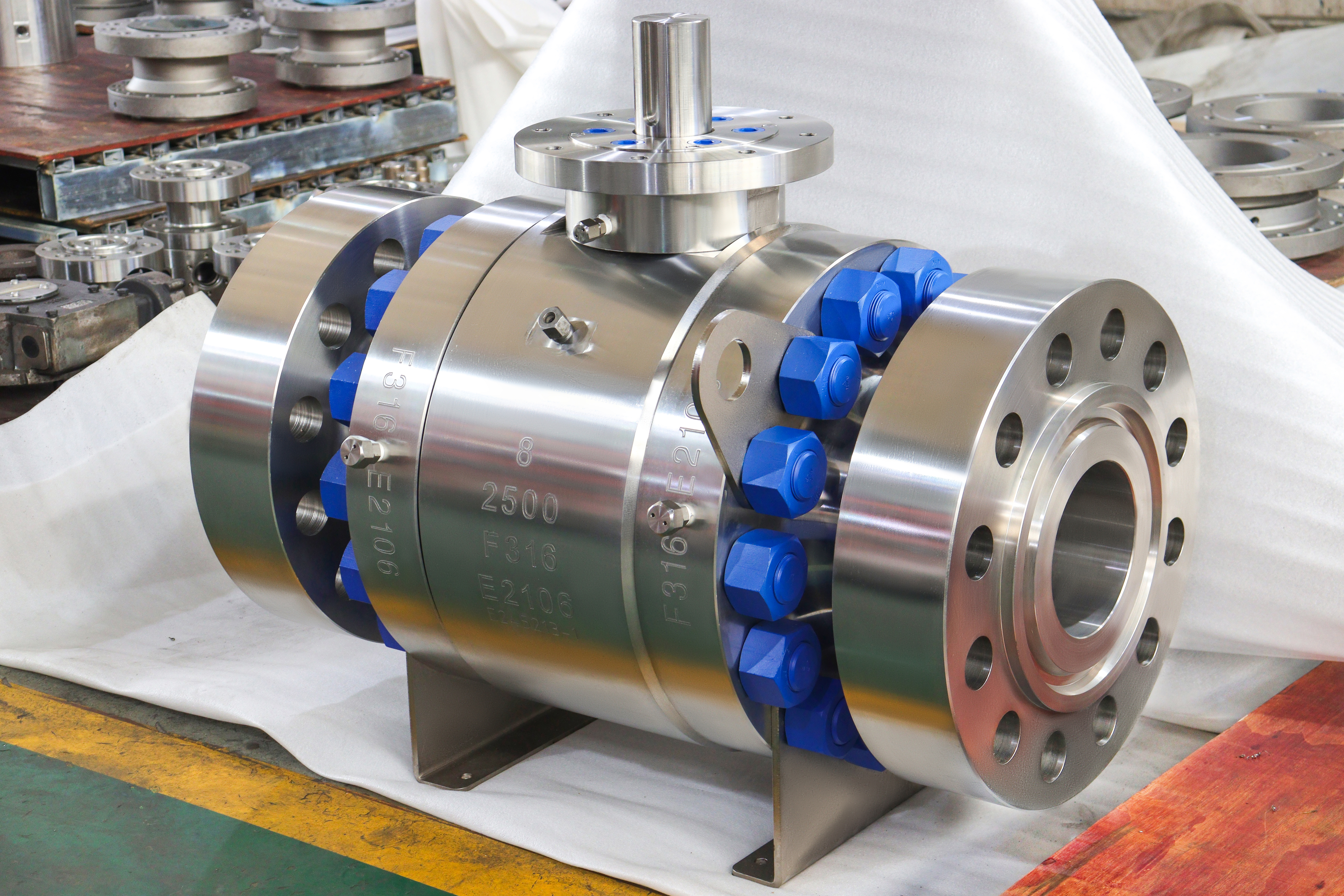
What 42 MPa Actually Means
Class 2500 is rated 425.5 bar at 38°C in both carbon steel and austenitic stainless, which is 42.5 MPa. The figure is not a limit to be approached casually: it is roughly the pressure at the bottom of a 4,300 m water column, and it is well above the critical pressure of CO₂, which is why CO₂ injection and sequestration projects land in this class.
Class | Rating at 38°C | Equivalent | Typical duty |
|---|---|---|---|
Class 900 | 153.2 bar | 15.3 MPa | High pressure gas gathering |
Class 1500 | 255.3 bar | 25.5 MPa | Wellhead, injection |
Class 2500 | 425.5 bar | 42.5 MPa | Ultra-high pressure gas, CO₂, hydrocracking |
Two consequences follow immediately. The hydrostatic shell test is at 1.5 times the rating, which is about 63.8 MPa, and a test at that pressure is a hazardous operation that needs a proper test cell, a written procedure and a safe distance. And the stored energy in a 8 inch bore at 42 MPa is enormous: a failure during test is not a leak, it is an event.

Why Forged F316, and Not Cast or Carbon
At this pressure the body is a thick-walled forging because a casting of that section cannot be guaranteed sound. The wall at the seat pocket on an 8 inch Class 2500 body is substantial, and shrinkage porosity in a thick casting is exactly the defect that opens under pressure cycling after a year in service.
F316 is chosen over carbon steel for three reasons. It has no ductile-to-brittle transition, so it is tolerant at low ambient and at depressurisation. It resists the CO₂ and chloride chemistry that usually accompanies high pressure service. And its thermal expansion matches the stainless trim, which keeps the seat clearances predictable across the temperature range. The cost penalty of a forged F316 body at this size is significant and it is usually accepted, because the alternative is a carbon steel body with an internal overlay, which introduces a weld at the worst possible place.
Forging also allows the body to be made as an integral piece with the flange necks, so the pressure boundary has fewer welds. Every weld in a 42 MPa body is a qualification, an NDT record and a residual stress, and a design that eliminates welds is worth its price.
The Ring Joint Is Not Optional
At Class 2500 a raised face gasket is not used. The joint is a ring type joint to ASME B16.5: a metal ring sits in matching grooves machined in both flanges and seals on line contact between the ring and the groove wall. The seal is metal-to-metal and it is maintained by bolt preload.
The reason is blowout resistance. A spiral wound or sheet gasket at 42 MPa is exposed to a pressure that will extrude it if the joint separates even slightly, and a gasket that extrudes is a gasket that has failed catastrophically. An RTJ ring is confined by the groove and cannot be extruded.
Two practical points. RTJ grooves are easily damaged by careless handling, and a damaged groove will leak regardless of a new ring; the groove should be inspected and the ring replaced at every break. And RTJ flanges are not interchangeable with RF flanges, so a replacement valve ordered as RF will not fit an existing RTJ spool.
Seats at 42 MPa
The seat is where the pressure becomes a mechanical problem. The seat ring is pushed against the ball by the line pressure plus the springs, and at 425 bar the resulting contact force on an 8 inch seat is large enough to extrude any conventional polymer. Devlon V and PEEK are used because they resist extrusion at high load, and a metal or Inconel hardfaced seat is used where the temperature or the fluid rules polymers out entirely.
Double piston effect is standard here, not because it is fashionable but because at this pressure a DPE seat gives two independent barriers and each seat alone can hold the full differential. On a line at 42 MPa the ability to prove each seat separately through a cavity bleed is a safety function, not a convenience.
The bearings carry the trunnion load and are Stellite or tungsten carbide faced, self-lubricating or force lubricated. A bearing that collapses under the trunnion load puts the ball out of alignment, and a misaligned ball in a metal seat at 42 MPa will not seal at any torque.
Bolting, Hydrogen and Sour Service
Two specifications dominate material selection at this pressure, and both are about cracking rather than corrosion.
Hydrogen embrittlement. High strength steels absorb hydrogen and crack under sustained load. B7 studs at 725 MPa tensile are not acceptable in hydrogen service at 42 MPa, and the answer is B8M Class 2 (strain hardened 316) or Inconel 718, both of which are far less susceptible. The same applies to the stem: 17-4PH in the H1150 condition is acceptable in some specifications and not in others, and Inconel 718 is the safer choice.
Sour service. NACE MR0175 / ISO 15156 applies where the H₂S partial pressure exceeds 0.3 kPa in the gas. The requirements are hardness limits — 22 HRC maximum for carbon and low alloy steels, with separate limits for austenitic stainless depending on cold work — plus qualification of the material for the specific H₂S partial pressure and pH. A 316 body is generally acceptable for sour service at moderate partial pressure, but the hardfacing, the stem and the bolting all have to be assessed, and a Stellite seat in a sour line needs the cobalt leaching question answered.
Neither specification can be satisfied by inspection after the fact. Both are material and process decisions made at purchase, and a supplier who asks "is it sour?" only after the order is a supplier who does not understand the class.
Torque and the Actuator at 2500
The breakaway torque on an 8 inch Class 2500 valve is high — several thousand newton-metres on a metal seated unit — and it is dominated by seat friction at full differential rather than by the packing. The gear ratio is chosen so that the rim pull stays within a two-handed limit, which for this size means a large ratio and a heavy gearbox, often with a motor or an actuator rather than a handwheel.
Actuator sizing follows the same logic as any trunnion valve, with a higher safety factor: 2.0 minimum, and 2.5 where the valve is an ESD device or operates infrequently. The actuator also has to be capable of the torque at the specified differential pressure, which for a DPE seat means the full 42 MPa across one seat.
Because the torque is high, the stem and the drive connection become fatigue components. A stem that is adequate in torsion but has a sharp keyway corner will crack at the keyway, and the failure appears as a stem break with no warning. The stem design should be checked for stress concentration, not only for shear.
Wall Thickness, Weight and Handling
ASME B16.34 sets the minimum wall for Class 2500, and at 8 inch the result is a body that weighs several hundred kilograms before the gearbox is fitted. That weight is a handling and installation issue: lifting points, slings, and the pipe support design all have to account for it, and a valve dropped during installation is a valve that should be reinspected rather than installed.
The wall is also why a Class 2500 valve is never a stock item in most sizes. The forging, the machining, the hardfacing and the testing are each on the critical path, and lead times of 10 to 14 weeks are normal.

Testing at 63 MPa
The shell test is at 1.5 times the rating, about 63.8 MPa, held for the duration required by API 598, with no leakage and no permanent deformation. The seat test is at 1.1 times, about 46.8 MPa.
Both tests should be run in a test cell with the valve restrained, the area cleared and the pressure applied and released under control. The test record should include the pressure trace, not only a pass stamp, because a pressure that was reached and held for the required time is a different claim from a pressure that peaked.
Additional examinations that a 42 MPa specification usually requires: 100 percent ultrasonic or radiographic examination of the forging, hardness survey across the body and the heat affected zones, a helium leak test on the seat where the duty is gas, and a functional test with the actuator at the specified supply pressure with the torque recorded.

Flange Make-up at 42 MPa
Bolting a Class 2500 RTJ joint is not the same operation as bolting a Class 150 raised face joint, and treating it as one is how joints leak at commissioning.
The ring must sit in a clean, undamaged groove, and the two flange faces must be parallel before any bolt is tightened. At this class a flange that is 0.2 mm out of parallel over its diameter will not seat the ring evenly, and the resulting gap is a leak path that no amount of torque will close. The joint is brought together with the bolts finger tight, checked for gap uniformity with a feeler gauge at four points, and only then torqued.
Torque is applied in a star pattern in at least three stages, to the value the gasket and stud specification requires — not to the highest value the wrench will produce. Lubricant matters: a dry B8M stud and a molybdenum-disulphide lubricated stud at the same wrench setting produce very different preloads, and the procedure should state which is assumed.
After the first pressure cycle the joint should be rechecked. At 42 MPa the flange rotates slightly as the load comes on, and the stud preload redistributes. A joint that was correct cold can be below specification hot, and a second torque pass after the first pressurisation is standard practice on high pressure joints.
When Class 2500 Is Over-specified
Class 2500 is sometimes chosen because the design pressure is high and nobody checked whether a lower class would do with a better material. That is worth challenging, because the cost curve between Class 900 and Class 2500 is steep.
Two alternatives are worth evaluating. A Class 1500 valve in a higher strength material may satisfy the design pressure at the design temperature, since the rating depends on both. And where the high pressure exists only in a small bore, a forged body with a clamped or cone-and-thread connector can replace a flanged joint entirely, removing the largest and most expensive component of the assembly.
What should not be done is to keep a Class 2500 body and substitute a lower class flange, or to use a Class 2500 valve with a gasket selected for Class 900. The class applies to the whole pressure boundary, and the weakest element sets the rating of the assembly.

Class 2500 Trunnion Ball Valve FAQ
What pressure does Class 2500 correspond to?
425.5 bar at 38°C, which is about 42.5 MPa, for both carbon steel and austenitic stainless in ASME B16.34. The rating falls with temperature, and the design temperature must be stated to read the correct figure.
Why is an RTJ flange used instead of raised face?
Because a gasket at 42 MPa can be extruded if the joint separates even slightly. A ring joint seals metal-to-metal with the ring confined in a groove, so it cannot be blown out. RF flanges are not used at this class.
Can this valve be supplied for sour service?
Yes, to NACE MR0175 / ISO 15156, with the H₂S partial pressure and pH stated so the material and hardness limits can be applied. The body, hardfacing, stem and bolting are each assessed, and the certificate names the applicable limits.
What changes for hydrogen service?
The bolting and the stem. High strength B7 studs are replaced with B8M Class 2 or Inconel 718 to resist hydrogen embrittlement, and the stem material is selected on the same basis. Hardness control and a documented material traceability package are required.
Why is double piston effect standard at this class?
Because it gives two independent seals, each able to hold the full differential, and it lets each seat be proved through a cavity bleed. At 42 MPa that is a safety function rather than a convenience, and the cavity is protected by an external relief device.
What is the lead time?
Typically 10 to 14 weeks for a forged F316 Class 2500 body with hardfaced trim and full NDT, because the forging, machining, hardfacing and 63 MPa testing are each sequential and cannot be compressed without risk.
Specifying This Valve
Provide size, class, design pressure and temperature, fluid composition including H₂S partial pressure, CO₂ and chloride content, whether hydrogen is present, bore, body and trim material, seat material and piston effect, flange facing (RTJ is assumed at this class), actuation with the torque basis, NDT and certification requirements, and whether a witnessed hydro test is required.
The approval drawing states the body wall at the seat pocket, the hardfacing alloy, the bolting grade and the test pressures. Those four items are the ones that decide whether the valve is fit for 42 MPa, and they should be checked before the forging is cut.
Hot Products


News
Ball Valves in Geothermal Brine: Silica Scale, Chloride Cracking And The Cooling Trap
Why geothermal brine destroys ball valves: retrograde silica scale, calcite at the flash point, chloride cracking above 60 C and the 250 C seat limit.
Read More
Ball Valve Face To Face Dimensions: Why A Correctly Ordered Replacement Still Does Not Fit
A 6 inch Class 150 ball valve can be 267 or 305 mm face to face and both are compliant. How B16.10, EN 558 and flange drilling decide whether it fits.
Read More
Ball Valve Stem Key And Keyway: What Gives Way First, And What The Handle Cannot Tell You
Between the handle and the ball there are four fits. Which one shears, which one cracks, and how a few degrees of lost motion hides a valve that never seated.
Read More
Ball Valve Datasheet: Six Blocks That Decide Whether Two Quotes Are Comparable
A ball valve datasheet only works when six blocks are fixed: pressure basis, bore, temperature ceiling, test, end connection, operator. How each is written.
Read More