

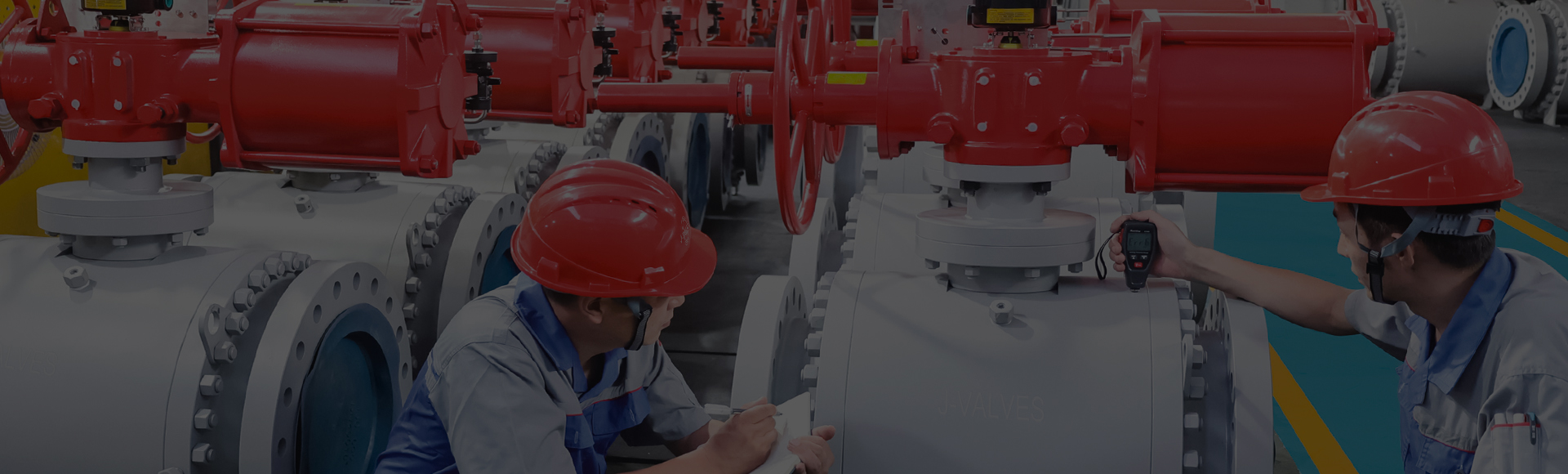
CHINA J-VALVES Offers Various High-quality I ndustrial Ball Valves
J-VALVES, a distinguished professional ball valve manufacturer rooted in China, takes pride in its extensive product portfolio. Our offerings span a wide range, including trunnion-mounted ball valves, floating ball valves, high-temperature ball valves, high-pressure ball valves, metal-sealed ball valves, ultra-low temperature ball valves, DBB ball valves, Three-way And Four-way Ball Valve, and fully welded ball valves. Each product is a testament to our commitment to precision engineering and reliable performance. Meticulously crafted, they are designed to not only meet but exceed the most stringent industrial demands, ensuring stable operation even under extreme conditions. This enables us to provide our clients with high-value services and makes our valves widely sought-after in industries.
Product Category
Contact Us


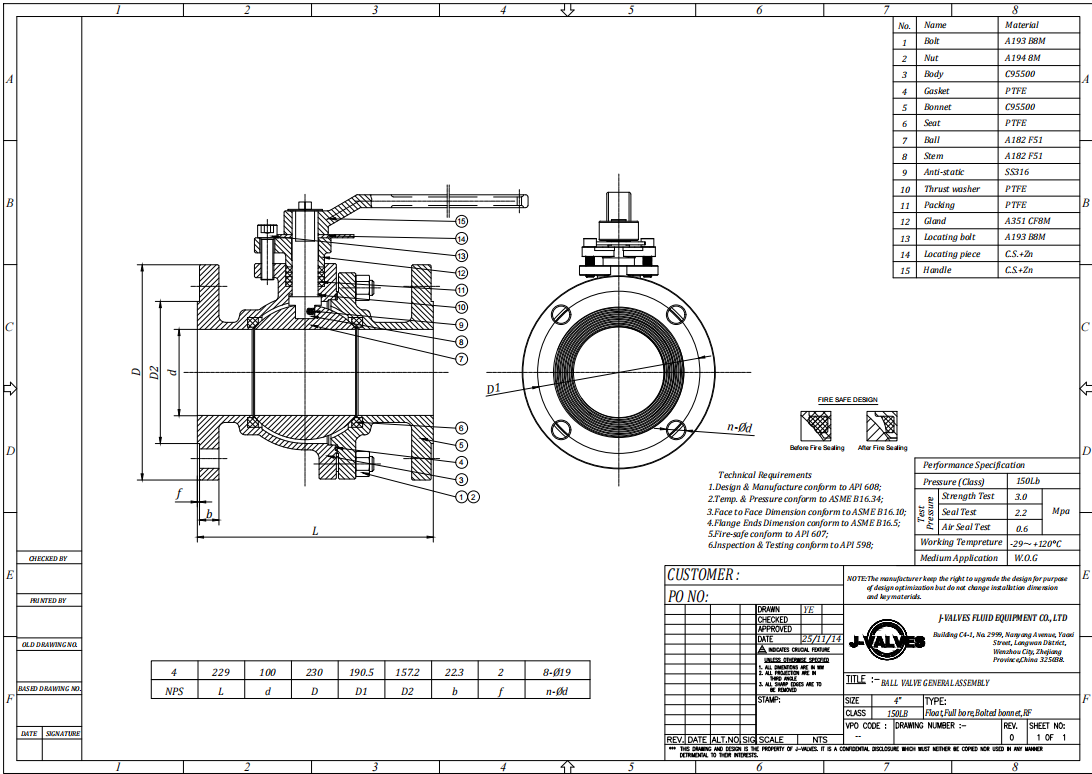
Pressure Class: Class 150 (PN20), 19.6 bar at 38°C
Body Material: ASTM B148 C95500 nickel aluminium bronze, impact tested
Ball: C95500, or 316L with hard alloy overlay
Stem:316L or C95500, extended
Seat: PCTFE, PTFE, or reinforced PTFE for low temperature
Packing: Low temperature graphite with PTFE V-ring combination
Ball Type: Floating ball, two piece body
End Connection: Flanged RF to ASME B16.5; butt weld optional
Temperature Range: -196°C to +120°C; -253°C option for liquid hydrogen
Design Standard: API 608, ASME B16.34, BS 6364
Test Standard: API 598, MSS SP-134, helium cold seat test
Leakage: Bubble tight to API 598
-
Q41F
-
J-VALVES
A C95500 nickel aluminium bronze ball valve is a cryogenic isolation valve whose body is cast from ASTM B148 C95500 rather than stainless steel, for LNG and liquid nitrogen service down to -196°C. The alloy is chosen for three properties that matter at that temperature: it keeps measurable toughness without a ductile-to-brittle transition, it has yield strength well above cast 316, and it resists both seawater and liquefied gas attack on the outside of the body as well as the inside.
J-VALVES casts and machines this valve for LNG receiving terminals, bunkering systems, marine loading arms, regasification trains and cold-box piping where the valve is exposed to weather, salt spray and spillage as well as to the cold. This page covers why aluminium bronze is used at -196°C, how the floating ball and extended stem are arranged, and one specification point that has to be settled before any order: what 2x5.5 actually denotes.
Parameter | This valve |
|---|---|
Size | 2 x 5.5 inch designation (see the section below) |
Pressure class | Class 150 (PN20), 19.6 bar at 38°C |
Body | ASTM B148 C95500 nickel aluminium bronze, impact tested |
Ball | C95500, or 316L with hard alloy overlay |
Stem | 316L or C95500, extended |
Seat | PCTFE, PTFE, or reinforced PTFE for low temperature |
Packing | Low temperature graphite and PTFE V-ring combination |
Ends | Flanged RF to ASME B16.5, butt weld optional |
Temperature | -196°C to +120°C; -253°C option for liquid hydrogen |
Leakage | Bubble tight to API 598 |
Standard | API 608, ASME B16.34, BS 6364; test API 598, MSS SP-134 |

Why Aluminium Bronze at -196°C
The default cryogenic body material is austenitic stainless, CF8M or CF3M, because it has no ductile-to-brittle transition and its impact energy at -196°C is well documented. Aluminium bronze is the alternative, and it earns its place in specific conditions.
Toughness without a transition. C95500 is a face-centred-cubic alloy and does not become brittle as it cools, so it retains impact energy at liquid nitrogen temperature. That is not an accident of this grade; it is a property of the copper-rich matrix, and it is why the alloy is impact tested at -196°C as a matter of routine rather than as a special request.
Strength. Sand cast C95500 runs around 620 MPa tensile and 275 MPa yield with about 15 percent elongation, against roughly 485 and 205 MPa for CF8M. On a small body that margin is useful, because the wall is thin and the flange has to carry the bolt load.
Corrosion on both sides. LNG terminals are coastal. The outside of the valve sees salt spray, and the inside may see seawater during hydrostatic testing or from a spill. Aluminium bronze resists both, and it does so without a coating that can be damaged during installation.
What it does not do: it is not cheaper than stainless in small sizes, it is harder to weld, and it cannot be used in every fluid. Ammonia and some amine systems attack copper alloys, so a C95500 body must not be offered where the process can contact ammonia. That check is a chemical question, not a mechanical one, and it belongs at enquiry.
What Happens to a Valve at -196°C
Liquid nitrogen boils at -196°C and LNG is about -162°C. At those temperatures four things change, and each one has a design consequence.
Effect | Magnitude | Design response |
|---|---|---|
Thermal contraction of the body | About 0.3 percent linear from 20°C to -196°C | Clearances set cold; extended bonnet so the gland stays warm |
Differential contraction of seat and body | PCTFE contracts several times more than bronze | Spring loaded seat to keep sealing stress positive |
Loss of polymer elasticity | PTFE unusable below about -29°C | PCTFE seat, or a metal seat below -196°C |
Moisture freezing on the stem | Ice collar at the gland | Extended stem, vapour barrier, gland above 0°C |
The seat is the component that decides whether the valve works. PCTFE keeps useful toughness at -196°C and has low permeability to methane and nitrogen, which is why it is the standard cryogenic seat. Its contraction relative to the bronze pocket is several times greater, so the seat cannot simply be pressed in and left; a spring or wave washer behind it maintains the sealing stress as everything shrinks.
Settling the 2x5.5 Designation
Size notation in small cryogenic valves is inconsistent across manufacturers, and this is the point at which a purchase order most often goes wrong. Two readings are in use, and they describe different hydraulic behaviour.
Reading one, flange size by bore size. This is the convention used on larger valves: the first figure is the flange size and the second is the bore. Under this reading a 2x5.5 valve would have a 2 inch flange and a 5.5 inch bore, which is impossible, so this reading cannot apply here.
Reading two, inlet by outlet. The first figure is the upstream connection and the second is the downstream connection, with the bore reduced relative to both. A 2 inch inlet with a 5.5 inch outlet is then a size transition combined with a restriction, which is a legitimate arrangement on a line that expands after a control point or a vaporiser, but it is not a "reduced bore" in the usual sense.
Because the two readings imply different flange sizes, different face-to-face dimensions and different pressure drop, the drawing has to be confirmed before manufacture. The points to confirm in writing are: the flange size and standard at each end, the actual bore diameter, the face-to-face dimension, and whether the valve is intended as an expansion or a restriction. A supplier who cannot state the bore diameter in millimetres is not ready to quote.
The Floating Ball in Cryogenic Service
This valve uses a floating ball, which is normal at small sizes. The ball is pushed into the downstream seat by line pressure, and at 19.6 bar in a 2 inch bore the force is modest, so the torque stays within a lever's capability and no trunnion is needed.
What is not normal is the stem. A cryogenic floating ball valve has an extended stem, and the length is a thermal device rather than a convenience. The stem has to be long enough that the packing sits above the insulation and above the frost line, so that the gland stays near ambient while the body is at -162°C. Bronze conducts heat less well than stainless, which helps, but a stem that is too short will still freeze the gland and tear the packing on the first operation.
The extension length is set by the insulation thickness and the ambient conditions, typically 250 to 400 mm on a cold box or an insulated LNG line. It is quoted as a dimension from body centre to gland face and should never be chosen from a table.
Orientation matters more here than on an ambient valve. A bonnet pointing down collects liquid and ice in the extension; a bonnet pointing sideways puts a bending load on the joint. Vertical up is the default, and the insulation and vapour barrier are arranged around it.
Seat, Packing and the Vapour Barrier
The seat is PCTFE in a metal carrier for most LNG duty. Below -196°C, or where the valve will see severe thermal cycling, a metal seat with a PCTFE insert is used so that a secondary seal survives after the polymer has been damaged.
Packing is a low temperature combination: graphite rings for the fire-safe and high temperature end, and PTFE V-rings where the gland stays warm. The combination is deliberate, because neither material covers the whole range on its own. A valve packed entirely in PTFE will seal at -196°C if the gland is warm and fail if it is not; a valve packed entirely in graphite will seal but requires higher gland load.
The vapour barrier is the detail that decides whether the insulation stays effective. It must be continuous around the stem and sealed to the insulation jacket, or moist air reaches the cold metal, condenses, and the ice that forms inside the insulation is invisible until the valve is operated and the packing is torn. A missing vapour barrier is the single most common installation defect on cryogenic valves, and it is not a valve defect.

Testing to BS 6364 and MSS SP-134
A cryogenic valve is proved by test, and the test is a sequence rather than a single event.
The shell test and the ambient seat test establish the baseline: 1.5 times the rating for the shell and 1.1 times for the seat, to API 598, at ambient temperature. These find ordinary manufacturing defects cheaply.
The valve is then chilled, by immersion in liquid nitrogen or by cold gas circulation, until thermocouples on the body near the seat reach the test temperature and stop changing. The seat test is repeated cold, usually with helium, because the molecule is small and stays mobile at cryogenic temperature, and the leak is measured on a mass spectrometer rather than counted as bubbles. The torque is measured on the same cold valve, because that figure sizes the actuator and a rising torque is the first sign that the seat is being crushed.
The final step is the one buyers forget: warm the valve back to ambient and repeat the seat test. If the seat does not recover its shape and hold the same leak rate, it has taken a permanent set and will fail on the second cool-down in the plant. A valve that passes cold and fails warm is a valve that has not been designed for cycling, and it will fail in service.

Where This Valve Is Used, and Where It Is Not
The natural home for a C95500 cryogenic valve is a coastal LNG facility where the valve is exposed to weather and to occasional spillage. Marine loading arms, jetty piping, bunkering skids and regasification units are all cases where the outside of the valve is as aggressive as the inside.
It is also used in liquid nitrogen and liquid argon distribution, where the duty is clean, the pressure is low and the valve is small.
It is not the right choice for ammonia, for amine systems, or for any process where copper contamination is unacceptable. It is not the right choice for large sizes, where stainless is more economical and better supported by the casting industry. And it is not a substitute for a properly extended and insulated installation: no body material compensates for a short stem and a missing vapour barrier.
C95500 LNG Ball Valve FAQ
Why use aluminium bronze instead of stainless for LNG?
Because C95500 keeps toughness at -196°C without a ductile-to-brittle transition, has higher yield strength than cast CF8M, and resists seawater on the outside as well as the process on the inside. It is not cheaper and it is not suitable where ammonia or amines are present.
What seat material is used at -196°C?
PCTFE, usually as an insert in a metal carrier, with a spring behind it to maintain sealing stress as the seat contracts. PTFE is limited to about -29°C and must not be used for LNG at -162°C. Metal seats are used below -196°C.
How long should the extended stem be?
Long enough that the packing stays above the insulation and above 0°C. In practice 250 to 400 mm from body centre to gland face on an insulated LNG line, set by the insulation thickness and the ambient conditions rather than chosen from a table.
Why does the valve leak after warming up if it passed the cold test?
Because the seat took a permanent compression set during the cold cycle. That is why BS 6364 and MSS SP-134 require the seat test to be repeated after warm-up. A valve that only passes cold is a valve that will fail on the second cool-down in the plant.
What does 2x5.5 mean?
The notation is not standard across manufacturers. It can denote flange size by bore size, or inlet by outlet size. For this valve the flange size at each end, the actual bore in millimetres and the face-to-face dimension must be confirmed on the drawing before manufacture.
Can it be used for liquid hydrogen?
A version is available to -253°C with a suitable seat and packing, but liquid hydrogen service is engineered case by case and tested to the project specification rather than supplied from a standard range.
Specifying This Valve
Provide both connection sizes and the flange standard at each end, the required bore in millimetres, class, design minimum temperature and fluid, whether the valve is inside a cold box or on an insulated line, the insulation thickness and required stem extension, seat and packing material, whether the body will be exposed to seawater, actuation, and the cryogenic test standard and certification required.
Delivery is typically 6 to 9 weeks, longer where a full BS 6364 test with a witnessed helium seat test and a warm-back cycle is required. The approval drawing states the bore, the extension length and the seat material, and those three figures are what determine whether the valve works in a cold box.
Hot Products


News
Ball Valves in Geothermal Brine: Silica Scale, Chloride Cracking And The Cooling Trap
Why geothermal brine destroys ball valves: retrograde silica scale, calcite at the flash point, chloride cracking above 60 C and the 250 C seat limit.
Read More
Ball Valve Face To Face Dimensions: Why A Correctly Ordered Replacement Still Does Not Fit
A 6 inch Class 150 ball valve can be 267 or 305 mm face to face and both are compliant. How B16.10, EN 558 and flange drilling decide whether it fits.
Read More
Ball Valve Stem Key And Keyway: What Gives Way First, And What The Handle Cannot Tell You
Between the handle and the ball there are four fits. Which one shears, which one cracks, and how a few degrees of lost motion hides a valve that never seated.
Read More
Ball Valve Datasheet: Six Blocks That Decide Whether Two Quotes Are Comparable
A ball valve datasheet only works when six blocks are fixed: pressure basis, bore, temperature ceiling, test, end connection, operator. How each is written.
Read More