

CHINA J-VALVES Offers Various High-quality I ndustrial Ball Valves
J-VALVES, a distinguished professional ball valve manufacturer rooted in China, takes pride in its extensive product portfolio. Our offerings span a wide range, including trunnion-mounted ball valves, floating ball valves, high-temperature ball valves, high-pressure ball valves, metal-sealed ball valves, ultra-low temperature ball valves, DBB ball valves, Three-way And Four-way Ball Valve, and fully welded ball valves. Each product is a testament to our commitment to precision engineering and reliable performance. Meticulously crafted, they are designed to not only meet but exceed the most stringent industrial demands, ensuring stable operation even under extreme conditions. This enables us to provide our clients with high-value services and makes our valves widely sought-after in industries.
Product Category
Contact Us


-
J-VALVES-Q41F
-
J-VALVES
Overview: A Four Inch Bronze Valve Built for Salt Water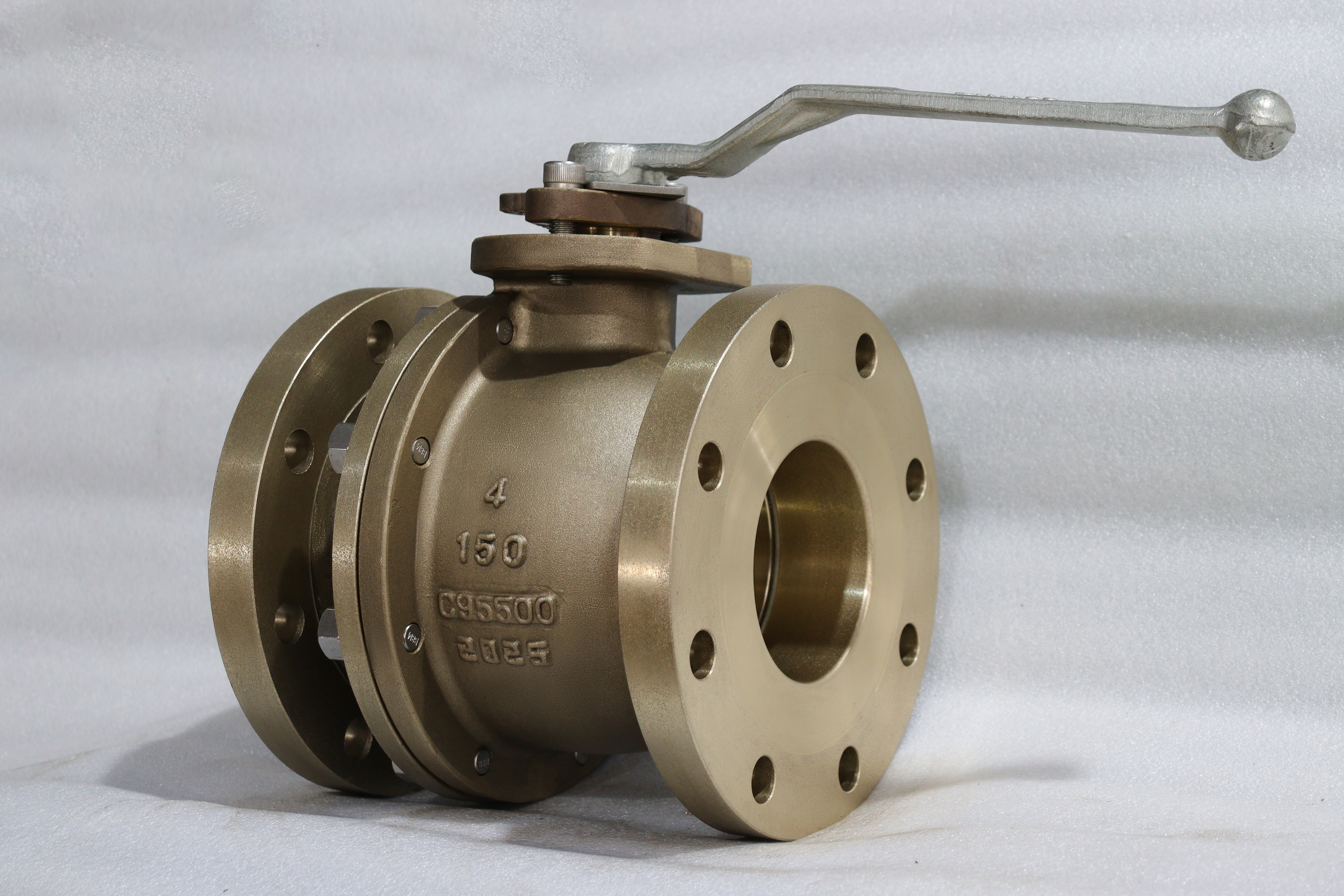
This is a four inch, DN100, Class 150 two piece flanged floating ball valve with a body cast in ASTM B148 C95500 nickel aluminum bronze. It is full bore, soft seated, lever operated, and rated PN20 in the ISO pressure designation that corresponds to Class 150. The ball floats between two seat rings and is pushed onto the downstream seat by line pressure, so there are no trunnion bearings, no bearing blocks and no cavity bleed connection in this design.
The combination is not accidental. C95500 is a nickel aluminum bronze, nominally Cu-10Al-4.5Ni-4Fe, and it is chosen where the medium is seawater, brackish water, brine, or a process stream that an ordinary bronze cannot hold. It is not chosen for steam, not chosen for high temperature, and not chosen for a line where the valve will be throttled hard against a large pressure drop. Those are different valves in different materials, and the sections below say where the boundary sits rather than pretending there is no boundary.
What follows is organised around the questions that come up in a technical review of this valve: what the alloy does that gunmetal does not, where the floating principle stops being the right answer, what a two piece body actually buys in maintenance, how the seat compound sets the temperature ceiling, why the flange drilling is a decision rather than a default, what fire safe means on a soft seated valve, what attacks a bronze valve in seawater, how it should be installed, and which six lines of an enquiry decide the valve. Each section answers one question. None of them repeats a marketing phrase in different words.
Why C95500 and Not Ordinary Bronze
The default bronze valve in most catalogues is a leaded red brass or a tin bronze such as C83600. It is inexpensive, it machines easily, and it is perfectly adequate for water at ambient temperature and modest pressure. Put it into seawater and the failure modes arrive quickly: dezincification wherever the alloy contains zinc, erosion corrosion at any point of local velocity, and a strength level that limits the pressure class the body can hold without excessive wall thickness.
Nickel aluminum bronze is a different family of alloy. The aluminium content forms a tough, self-repairing oxide film, and that film is what resists seawater rather than any inherent nobility of copper. The nickel and iron additions produce intermetallic phases that raise strength and hardness without making the casting brittle. In mechanical terms C95500 behaves closer to a carbon steel than to a tin bronze, while keeping the corrosion behaviour of a copper alloy. That combination is why the alloy appears on seawater intake lines, on desalination trains, on shipboard systems and on offshore utility piping, and why it does not appear in domestic plumbing.
Two consequences follow for a buyer. The first is that casting quality matters as much as the alloy designation. ASTM B148 governs chemical composition and mechanical properties, but a casting with porosity at a flange face will leak whatever the certificate says, so the foundry and the inspection regime are part of the specification. The second is that C95500 contains no deliberate lead addition, which matters on lines that touch potable or process water. Whether a particular valve is accepted for potable service is a certification question decided by the authority having jurisdiction, and it cannot be read off the alloy name.
C95800 is the other nickel aluminum bronze in common seawater service, with a higher nickel content and a different balance between strength and toughness. Where a project specification names C95800, the answer is a different casting and not a substitution. The two grades are not interchangeable on a datasheet and should never be offered as one, even though both are called nickel aluminum bronze and both are used in the same plants.
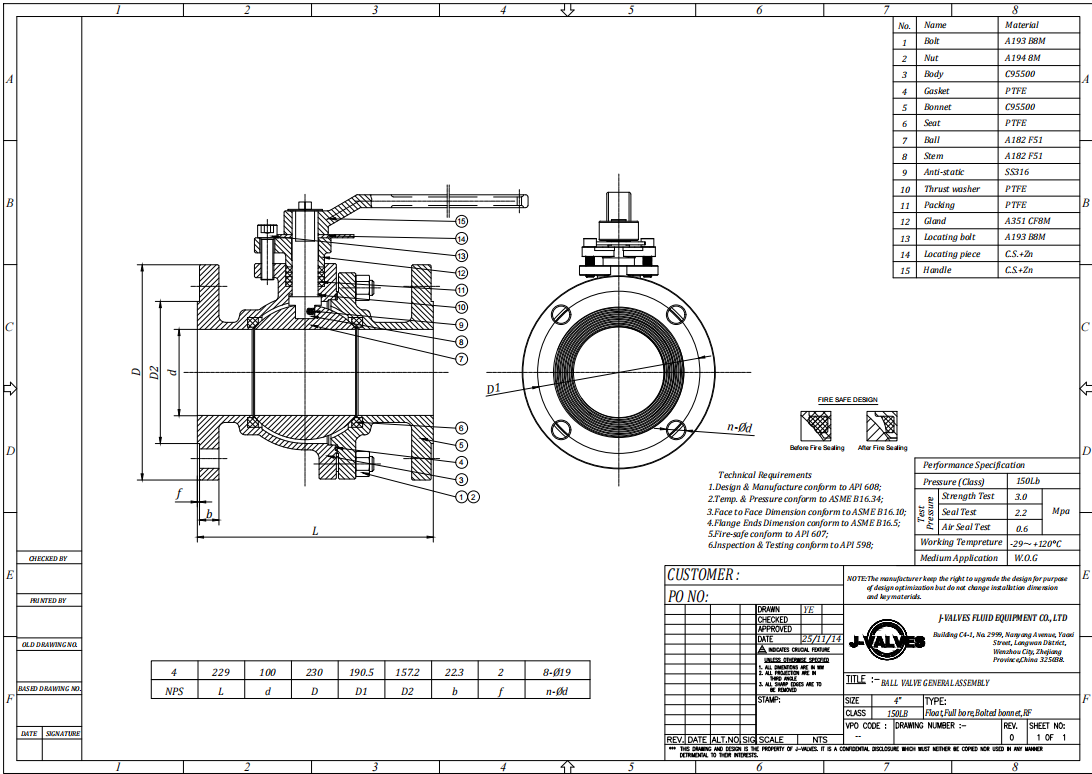
Where a Floating Ball Valve Is Right, and Where It Stops
A floating ball valve carries the ball on its seats. Line pressure pushes the ball downstream, the downstream seat takes the load, and the seal tightens as the pressure rises. The mechanism has almost no parts: one ball, two seat rings, springs behind the seats, a stem and a lever. There is nothing to adjust, and very little to wear apart from the seat faces.
At four inch Class 150 this is the normal construction, and the reason is load. The thrust the ball transmits to the seat grows with the bore area, so both the operating torque and the seat loading rise faster than the valve size does. At some combination of bore and pressure class the floating arrangement stops being efficient and a trunnion mounted ball is used instead: the ball is carried on bearings top and bottom, the seats only seal, and the operating torque falls away from the seat load. The crossover between the two constructions depends on size, class and the torque that the operator or actuator can deliver. It is not a single diameter, which is why two suppliers can legitimately quote different constructions for the same line.
Two consequences follow for this page. A four inch floating valve is a low torque, low part count device, and that is its value: inexpensive to own, predictable in service, easy to actuate. And it is not a throttling valve. A soft seated floating ball valve is an isolation device. Using it to control flow will destroy the seats long before the body gives any sign of trouble, and no amount of alloy selection will change that.
Two Piece Body: What It Actually Buys
The body is split into two halves, bolted at a single joint, with the ball, the seats and the stem assembled between them. Compared with a welded body the advantage is not in-line repair, because a two piece valve still comes out of the line for seat work. The advantage is that the valve can be opened on the bench and the seats, ball and stem seals replaced, which a welded body cannot do at all without cutting it out of the pipe. On a four inch line that difference in maintenance route is worth more than a small difference in purchase price.
The body joint brings its own discipline. The bolting has to be tightened evenly, in a crossing pattern, to the figure in the assembly record rather than by feel. A body joint loaded unevenly on a soft gasket will weep at the first thermal cycle, and a bronze body will not tolerate the bolt loads that a steel body shrugs off. Gasket material and bolting material are therefore part of the specification, not an afterthought left to the assembly shop.
Bolting material is also an electrochemical decision. A bronze body with stainless steel bolting is a galvanic couple, and in a wet marine atmosphere the less noble metal is the one that corrodes. That is why the valve is offered with 316 stainless or nickel-copper bolting, why the choice is written on the order, and why substituting whatever bolts are in the bin is a decision with a service life attached to it.
Seats: PTFE, RPTFE, PPL and the Temperature Line You Cannot Cross
The seat is the part that sets the temperature ceiling of a soft seated valve, and this is the single most misunderstood line on a bronze valve datasheet.
Three compounds are offered on this valve, and they sit on a rising ladder. PTFE is the baseline: chemically inert against almost everything, very low friction, excellent sealing at low differential pressure, but it creeps under sustained load and its useful range is the lowest of the three. RPTFE is PTFE with a filler, which reduces creep and cold flow and holds seat load better over time, at a small cost in chemical universality. PPL is a higher temperature thermoplastic that keeps its shape where the PTFE compounds have already softened, and it is the right answer when the stream is warm rather than when it is aggressive.
The selection rule is simple and often ignored: the ceiling of the valve is the ceiling of the compound ordered, not the ceiling printed on the family datasheet. A figure such as minus 29 to plus 425 degrees Celsius describes a family that includes metal seated and high temperature variants. A PTFE or RPTFE seat cannot operate at the top of that range, and a buyer who specifies from the headline number will receive a valve that fails in the first hot cycle and then argue about whose fault it was. The honest statement for this valve is that it runs from minus 29 degrees Celsius upwards to a ceiling set by the seat compound, and that the ceiling is confirmed against the compound and the actual service before the order is placed. Where a project genuinely needs the high temperature end, the answer is a metal seated valve, not a soft seated one with an optimistic datasheet.
The cold end needs the same discipline. When the valve cools, the seat contracts more than the body, so spring loaded seat rings are what maintain seal compression. A seat without preload that seals perfectly at shop temperature can lift off in cold service, and the leak then appears at the flange joint far away from the seat that caused it.
| Seat compound | What it is | Where it suits | What it does not like |
|---|---|---|---|
| PTFE | Unfilled polytetrafluoroethylene | Water, seawater and most chemicals at moderate temperature | Creep under sustained load; the lowest ceiling of the three |
| RPTFE | PTFE with a reinforcing filler | The general default for water and seawater duty | Strongly oxidising media that attack the filler |
| PPL | Higher temperature thermoplastic | Warm process streams above the PTFE range | The most aggressive solvents; check each stream |
Flange Drilling and the Standards Behind This Valve
The end connection is a raised face flange, and which dimensional standard governs it is a decision rather than a default. It is also the most common reason a bronze valve does not bolt up on site.
Two standards are in play. ASME B16.5 dimensions steel and alloy flanges and is what most piping specifications reference out of habit. ASME B16.24 dimensions cast copper alloy flanges and flanged fittings across the pressure classes. For the same nominal size and the same nominal class the two do not produce the same flange, so a valve built to one and a pipe flange built to the other will not mate, and no gasket will bridge the difference.
The practical rule is to write the standard and the drilling on the enquiry rather than the words "standard flange". Where the line specification is a steel piping class, the flange on the valve has to match that class and the valve is ordered to suit it. Where the specification is a copper alloy system, B16.24 is the reference. Either answer can be supplied. What cannot be supplied is a valve that is both, and the signed drawing is where the decision gets recorded so that nobody reopens it in the warehouse.
| Requirement | Standard | What it fixes |
|---|---|---|
| Body casting | ASTM B148 C95500 | Chemical composition and mechanical properties of the casting |
| Valve design | API 608, ASME B16.34 | Wall thickness, stem strength, pressure containing design |
| Flange dimensions | ASME B16.5 or ASME B16.24, as agreed | Bolt circle, facing and gasket envelope |
| Face to face | ASME B16.10 | Interchangeability with other flanged valves in the line |
| Pressure test | API 598 | Shell test at 1.5 times rating, seat test at 1.1 times rating |
| Fire test | API 607 | Behaviour with the soft seats destroyed |
Face to face follows ASME B16.10, which keeps the valve interchangeable with other flanged valves of the same size and class in the same line, and is the reason a replacement does not require the pipe to be re-cut.

Fire Safe Behaviour on a Soft Seated Valve
A soft seated valve has a problem that a metal seated valve does not: in a fire the seat compound burns away. The API 607 fire test exists to establish what happens next. The valve is burned, then cooled, then pressure tested, and it has to keep leakage inside the acceptance criteria with the soft parts gone.
Three design features make that possible here. The seat pocket is shaped so that, once the polymer is destroyed, the ball lands on a metal seat face and still forms a barrier. The stem sealing includes a graphite element that survives the burn and keeps the stem tight. And an anti-static device bridges ball, stem and body, so that static charge generated by flow cannot accumulate on a floating ball that is otherwise insulated from the body by its seats.
For a bronze valve the fire case is not theoretical. Fuel lines, lube oil systems, hydraulic power units and offshore utility piping all use soft seated valves, and the line specification that calls for API 607 is the one that decides whether the valve is acceptable at all. It is worth checking that the certificate on offer is a test report for the size and pressure class being purchased, not a family statement.
Seawater, Desalination and Marine Duty: What Actually Attacks the Valve
Nickel aluminum bronze resists seawater, but resistant is not immune, and the failures that do occur are specific enough to design against.
Velocity is the first. Copper alloys depend on a protective oxide film, and above a threshold local velocity the film is stripped faster than it can re-form, producing erosion corrosion. The threshold depends on alloy, geometry and sand content, which is why a seawater line specification states a velocity limit rather than leaving it to the valve supplier to guess.
Cavitation is the second. A valve throttled at a high pressure drop creates vapour cavities that collapse against the seat and body, and no copper alloy survives that for long. On a seawater intake the valve should be fully open or fully closed, with flow control done elsewhere in the system.
Galvanic coupling is the third. A bronze body bolted to a carbon steel flange, with a stainless stem inside it, is a small electrochemical cell. Bronze is usually the cathode and steel the anode, so the damage tends to appear on the pipe rather than on the valve, which makes it easy to miss until the spool is replaced. Isolation gaskets, insulating bolt sleeves or a transition spool are the usual answers, and the decision belongs to the piping design rather than to the valve.
Biological fouling is the fourth, and it is worse in warm seawater. Barnacle growth on a seat face is enough to stop a soft seated valve sealing, which is why intake systems are chlorinated or dosed, and why the valve is not expected to seal against a seat that has been fouled for a season.
Where the service is standby seawater, or a line that is hydrotested with seawater and then left wet for months, the nickel-copper alloy K500 option for ball and stem is worth pricing. It is a more expensive trim and it is not needed on every line. On a valve that sits closed in seawater for half a year it is the difference between a valve that opens on demand and one that has to be cut out.
Installation and Commissioning on a Bronze Body
Bronze is softer than steel, and that changes three things on site.
Flange bolts are tightened to the load the flange and gasket require, not to the torque used on the steel valve next door. Over-tightening a bronze flange distorts the facing and can crack the casting at the bolt holes, and the crack is usually found during commissioning rather than during installation. Where a torque figure is specified, it comes from the flange standard and the gasket type, and it is applied with a calibrated wrench in a crossing pattern.
The valve is supported. A four inch bronze valve fitted with a gearbox or an actuator is a lever arm hanging on the pipe. It should not carry the weight of the spool, and it should never be used to pull two flanges together; that is what pipe supports and a short spool are for.
Hydrotest water is drained and the valve left partly open afterwards. A soft seated valve left closed with dirty test water in the body cavity will have its seat damaged by the debris that settles on it, and the damage shows up as a seat leak at first operation rather than as a test failure.
Commissioning also fixes the operating convention. The lever has a locking hole, so a locked open or locked closed position can be set by written procedure and recorded, rather than by padlocking a valve that nobody has documented.
How to Specify: Six Lines That Decide the Valve
Most of the technical risk in a valve order sits in six lines, and none of them is the price.
State the body alloy and the casting standard together, because C95500 to ASTM B148 is a quality claim and C95500 from an unnamed foundry is not. State the seat compound and the service temperature in the same sentence, because the second is a consequence of the first. State the flange standard and the drilling, as set out above. State the trim and the bolting alloy, because the galvanic couple lives there. State whether the bore is full or reduced, because that decides pressure drop and whether the line can be pigged. And state the actuation and the mounting interface, because a valve retrofitted with an actuator later costs more than one ordered with the interface from the start.
| Item | What to write on the enquiry | Why it changes the valve |
|---|---|---|
| Body alloy | ASTM B148 C95500, casting certificates to EN 10204 3.1 | The alloy name alone does not fix casting quality |
| Seat compound | PTFE, RPTFE or PPL, with minimum and maximum service temperature | The compound sets the temperature ceiling |
| Flange | Standard and drilling, plus gasket type | B16.5 and B16.24 flanges do not interchange |
| Trim and bolting | Ball, stem and bolting alloys by UNS or ASTM designation | Determines galvanic behaviour in seawater |
| Bore | Full bore or reduced bore | Full bore for pigging and lowest pressure drop |
| Actuation | Lever, gear, pneumatic or electric, with mounting interface | Retrofit costs more than the original option |
A worked example shows the effect. A four inch Class 150 valve for a seawater intake at ambient temperature, operated fully open or fully closed, needs C95500 to B148, RPTFE seats, a flange standard agreed with the piping class, a 316 stem with 316 bolting, full bore, and a lever. The same valve on a standby line that sits wet for months adds the K500 trim. To an untrained eye both are the same model number. They are different orders, and the difference is decided at the enquiry stage, not on site.
Frequently Asked Questions
Is C95500 the same as gunmetal or leaded bronze?
No. Gunmetal and leaded red brass are tin and lead bearing copper alys used for general water service at ambient temperature. C9ss00 is a nickelaluminum bronze with nominlly 10 percent aluminium 4.5 percent nickel and 4 percentiron which gives it substantially higher strength and a seawatercorrosion resistance that the tn bronzes do nothave, The two are not interchangeable in seawater,and a C95500 requirement cannot be met by a gunmetal
valve with a different name on the certificate.
What is the actual temperature range of this valve?
The range is set by the seat compound ordered. The valve is offered from minus 29 degrees Celsius upwards and the upper limit depends on whether PTFE RPTFE or PPL is fitted. A figure of minus 29 to plus 425 degrees Celsius that circulates for this valve family describes a famiy that incudes meta seated andhigh temperature variants it does not describe a soft seated valve. On a project with a high temperature requirement the correct answeris a metal seated valve, not a soft seated one ordered against an optimistic headline number.
Can the ball and stem be supplied in nickel copper alloy?
Yes. The standard trim is a C95500 ball with hard chrome plating and 316 stainless steel stem Anickel -copper ally KS00, UNS N05500, is avalble for both ball and stem, and is the usual choice where the valve sits cdosed in seawater for long periods or where the line is hydrotested with seawater and left wet Bolting can be supplied in the same alloy family so that the body joint does not become a galvanic couple of its own.
What is the difference between this valve and a C95800 valve?
Both are nickel auminum bronzes used in seawater, but they are dfferent castings wth different nickel content and a differen balance of strength andtoughness. Where a specification names C9s800, a C9500 valve is not an equivalent and should not be ofered as one, even if the application looks identical.The selection is normaly fixed by the piping material specification or by the end user standard and the certificate has to match the grade named.
Can this valve be actuated?
Yes. The standard operator is a lever with a locking hole for a quarter tun Gear operation pneumatic and electric actuation are avalable and the mounting interface dimensions are confrmed on the order so that the actuator and the alve are matched before shipment rather than on site. On a fourinch floatingvalve the operating torque s low, which makes actuation straightorward. bu the torque stil has to be confrmed against the seat compound and the service rather than assumed from the size.
Is it acceptable for potable water?
The alloy contains no deliberate lead addition, which is why nickel aluminum bronze is used on water systems where leaded bronze would be refused. Aceptance for potable water serice is nevertheless a certifcation question decided by the authority having urisdiction in the destination market and itdepends on the ful wetted path induding seats gaskets and any coating. It is a question to settle with the certifcate in hand before the order, not a property of the alloy name.


Hot Products


News
Ball Valves in Geothermal Brine: Silica Scale, Chloride Cracking And The Cooling Trap
Why geothermal brine destroys ball valves: retrograde silica scale, calcite at the flash point, chloride cracking above 60 C and the 250 C seat limit.
Read More
Ball Valve Face To Face Dimensions: Why A Correctly Ordered Replacement Still Does Not Fit
A 6 inch Class 150 ball valve can be 267 or 305 mm face to face and both are compliant. How B16.10, EN 558 and flange drilling decide whether it fits.
Read More
Ball Valve Stem Key And Keyway: What Gives Way First, And What The Handle Cannot Tell You
Between the handle and the ball there are four fits. Which one shears, which one cracks, and how a few degrees of lost motion hides a valve that never seated.
Read More
Ball Valve Datasheet: Six Blocks That Decide Whether Two Quotes Are Comparable
A ball valve datasheet only works when six blocks are fixed: pressure basis, bore, temperature ceiling, test, end connection, operator. How each is written.
Read More