

CHINA J-VALVES Offers Various High-quality I ndustrial Ball Valves
J-VALVES, a distinguished professional ball valve manufacturer rooted in China, takes pride in its extensive product portfolio. Our offerings span a wide range, including trunnion-mounted ball valves, floating ball valves, high-temperature ball valves, high-pressure ball valves, metal-sealed ball valves, ultra-low temperature ball valves, DBB ball valves, Three-way And Four-way Ball Valve, and fully welded ball valves. Each product is a testament to our commitment to precision engineering and reliable performance. Meticulously crafted, they are designed to not only meet but exceed the most stringent industrial demands, ensuring stable operation even under extreme conditions. This enables us to provide our clients with high-value services and makes our valves widely sought-after in industries.
Product Category
Contact Us

Pressure Class: Class 150 to 2500 (PN20 to PN420)
Body Material: A105, A350 LF2, A694 F65, A182 F316
Ball: A105 with ENP 50 µm min, or stainless with STL / tungsten carbide
Seat: RPTFE, nylon, PEEK, or metal with Stellite hardfacing
Stem: A182 F6a, F316, or F51 duplex, surface hardened
End Connection: Butt weld to ASME B16.25
Wall Thickness: ASME B16.34 minimum, verified at seat pocket and bevel
NDT: 100% radiographic and 100% ultrasonic on body welds
Transition Pieces: Available to match pipe grade and wall thickness
Temperature Range: -46°C to +200°C; -196°C or +425°C option
Design Standard: API 6D, ASME B16.34, ISO 14313
Test Standard: API 598, ISO 5208; extended hydro option
-
Q467Y
-
J-VALVES
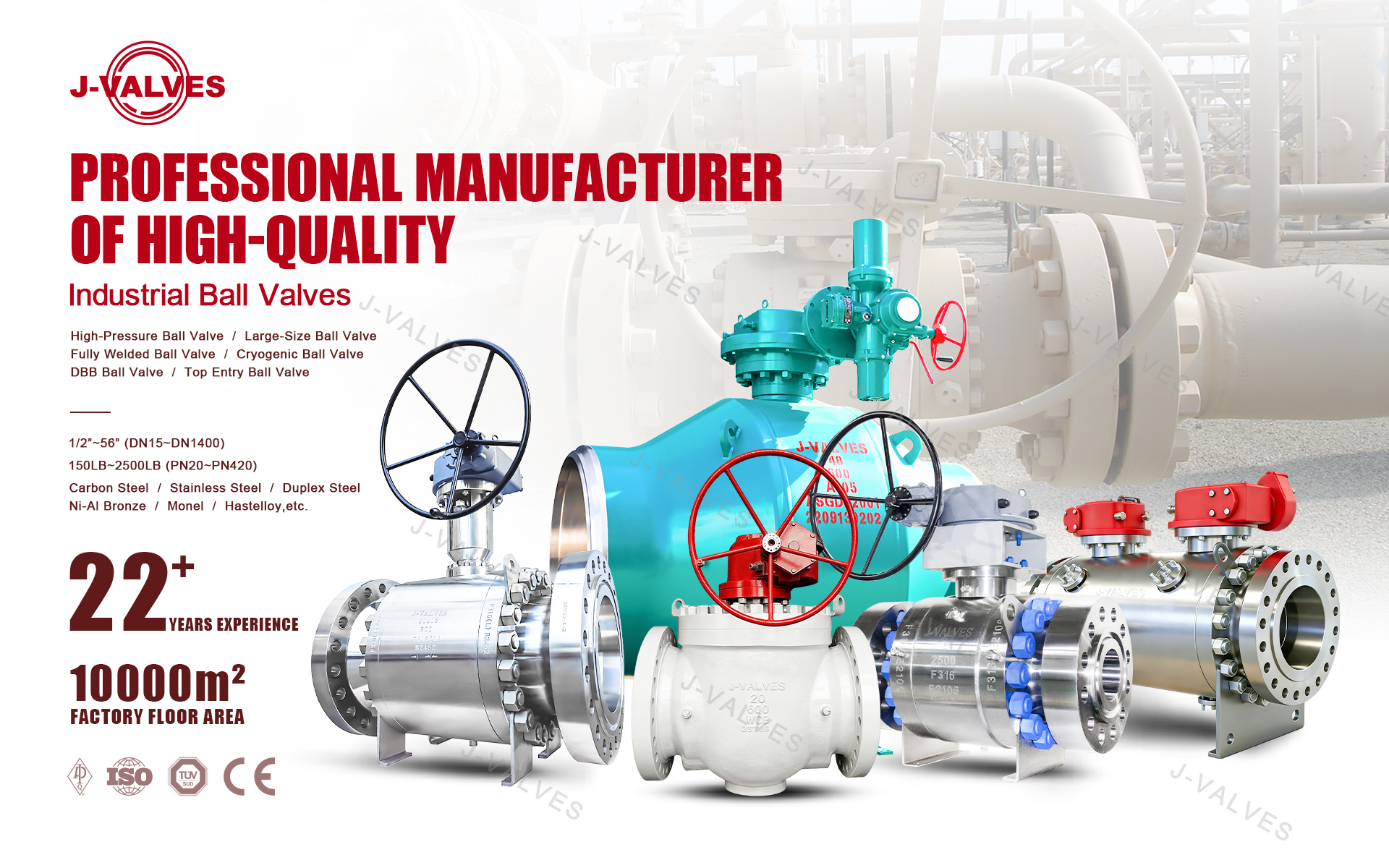
A butt weld trunnion ball valve has no flanges: the body ends are machined with a weld bevel to ASME B16.25 and the valve is joined to the pipeline by two girth welds. The trunnion carries the pressure thrust on bearings, which keeps the operating torque low on large and high pressure sizes, and the welded connection removes the flange pair, the gaskets and the bolt-up from the pressure boundary.
J-VALVES builds this valve from 2 inch to 56 inch in Class 150 to 2500 for gas transmission, high pressure gathering, injection and hydrotransport lines. The distinction that matters on this page is between welded ends and a welded body: this product is defined by its ends, and the body may be two piece, three piece or fully welded depending on the size and the specification. Buyers who need a body with no joint at all should say so separately, because "BW" in a datasheet only describes the connection.
Parameter | This valve |
|---|---|
Size | 2 to 56 inch (DN50 to DN1400) |
Pressure class | Class 150 to 2500 (PN20 to PN420) |
Body | A105, A350 LF2, A694 F65, A182 F316 |
Ball | A105 with ENP 50 µm minimum, or stainless with STL or tungsten carbide |
Seat | RPTFE, nylon, PEEK, or metal with Stellite or tungsten carbide |
Stem | A182 F6a, F316 or F51 duplex, surface hardened |
Ends | Butt weld to ASME B16.25 |
Wall thickness | ASME B16.34 minimum, verified at seat pocket and bevel |
NDT | 100% radiographic and 100% ultrasonic on body welds |
Temperature | -46°C to +200°C standard; -196°C or +425°C optional |
Standard | API 6D, ASME B16.34, ISO 14313; test API 598, ISO 5208 |

Why Remove the Flanges
A flange pair is convenient and it is also the least reliable part of a high pressure line. It has two gasket faces, a gasket, and eight to twenty bolts that have to be torqued correctly by someone working in a trench. It is also heavy and it is a point where the pipe has to be restrained.
Comparison | Flanged ends | Butt weld ends |
|---|---|---|
Joints to atmosphere per valve | 2 gasketed | 0 (the welds are the pipe) |
Weight, 20 inch Class 900 | Higher by the flange mass at both ends | Lower, often by 15 to 25 percent |
Leak paths at pressure | Gasket, bolt relaxation, facing damage | Weld defect only, found by NDT |
Installation | Bolt-up, alignment tolerance | Requires a qualified welder and NDT |
Removal | Unbolt | Cut and reweld |
Cost at large size, high class | Flange cost rises steeply with class | Cheaper above about 12 inch Class 600 |
The economic crossover is real. At 2 inch Class 300 a flanged valve is cheaper and more practical. At 24 inch Class 900 the flange pair is a significant part of the valve cost and of the installed weight, and the welded valve is both cheaper and better. Most transmission pipeline specifications resolve this by requiring welded ends above a stated size and class and permitting flanges below it.
What Changes at High Pressure
The same nominal valve at Class 900 is a different object from the Class 300 version, and the differences are not cosmetic.
The wall thickens to satisfy ASME B16.34, and on a large body that means a heavy casting or forging with a thick section at the seat pocket. The ball and stem grow, because the seat load and the stem torque scale with pressure and bore. The seat becomes a metal or PEEK insert in a carrier rather than a plain soft ring, because at 150 bar a soft seat extrudes. The stem seal gains an injection port and often a second barrier. The bolting, where there is bolting, moves from B7 to B7M or B8M depending on the fluid.
The most important change is not in the valve but in the specification: at Class 900 and above, nearly every project requires 100 percent radiographic or ultrasonic examination of the body castings or forgings, hardness testing of the welds and heat affected zones, and a documented impact test at the design temperature. A supplier who cannot produce those records cannot supply this class of valve to a transmission project, whatever the price.
The Bevel and the Field Weld
The bevel follows ASME B16.25. The wall thickness at the bevel has to match the pipe wall within the tolerance the welding procedure allows, and this is where a purchase order most often goes wrong: the valve is ordered to a class, and the pipe is ordered to a wall thickness, and nobody checks that the two meet.
When the mismatch is too great, or when the pipe grade is much stronger than the valve body, transition pieces are used. A pup is a short length of pipe welded to the valve at the works, with a wall and grade between the valve and the line, so that the field weld is made between similar materials. The pup also keeps welding heat away from the seat and gives the contractor a length to clamp. If the contractor supplies the pups, they must be strong enough to survive the 1.5 times shell test of the valve without yielding, which is a check that is regularly skipped.
The field weld itself is controlled by procedure: preheat for the wall thickness and grade, a qualified welding procedure and qualified welders, low hydrogen consumables, and hardness control where the line is in sour service. NACE MR0175 limits the weld and heat affected zone to 250 HV, and that limit is achieved by the procedure rather than by inspection, so it must be raised before welding starts.
Two site practices protect the valve. Weld with the valve fully open, so spatter cannot reach the seat and a closed ball cannot be distorted by the heat. And wrap or heat-sink the body during welding; on a 20 inch girth weld the heat input is large enough to damage a soft seat several hundred millimetres away, and the resulting leak appears at commissioning, months later, with no obvious cause.
What 100 Percent RT and UT Actually Find
Radiography finds volumetric defects: porosity, slag, incomplete penetration, gas holes in a casting. Ultrasonography finds planar defects and subsurface cracks, and it is better than radiography at detecting lack of fusion and laminations. Running both is not redundancy, because each is blind to what the other sees.
On the body, the examination covers the longitudinal and circumferential welds, the seat pocket region and the flange or bevel necks. On a casting, the critical zone is the seat pocket, because shrinkage porosity there produces a leak path that a hydro test at 1.5 times the rating may not open but service pressure cycling will.
The report should state the standard, the acceptance level, the technique and the operator certification. "NDT passed" is not a record; a report with the acceptance criteria and the indication locations is.
Body Construction: Three Options Behind the Same Ends
Because the ends are welded, the body joint is now the only remaining place where the pressure boundary can open, and its treatment defines three products.
A two piece welded-end valve has one bolted body joint and can be opened for seat replacement by cutting the line. A three piece version has two joints and is used where the centre section must be serviceable. A fully welded body has no joint at all and cannot be opened, and is chosen for buried and unmanned locations.
The seat logic follows. A body that can be opened can use single piston effect seats with automatic cavity relief. A body that cannot be opened generally uses double piston effect seats with an external vent, because a DPE seat blocks the cavity in both directions and either seat alone holds the full differential.
Seats at High Differential Pressure
At Class 900 and above the seat is the part that fails first, and the failure mode is extrusion rather than wear. A soft seat under 150 bar of differential pressure behaves like a viscous solid: it cold flows into the clearance between the seat ring and its pocket, and once it has flowed the seal is gone.
The standard answer is a seat insert in a metal carrier, with the insert in PCTFE, PEEK or a filled PTFE and the carrier taking the load. Above about 250 bar, or where the temperature is high, a metal seat with Stellite or tungsten carbide hardfacing is used, and the achievable leakage class drops from VI to V. That trade should be explicit in the specification, because a project that asks for Class VI and 400°C is asking for two things that are not available together.
Double block and bleed remains available through the body cavity vent, and it is the feature that lets an operator prove both seats are holding on a line that cannot be shut down for inspection.

Testing, and the Extended Hydro Question
The standard test is a shell test at 1.5 times the 38°C rating for the duration required by API 598, and a seat test at 1.1 times, with leakage compared against ISO 5208. On a welded-end valve the shell test is the only time the body is pressurised before the line is commissioned, so the test record matters more than on a flanged valve that can be re-gasketed on site.
Some pipeline specifications ask for an extended hydrostatic test, holding the shell pressure for a longer period or cycling it, to open defects that a short test would miss. That is a legitimate requirement and it should be quoted as an option, because it consumes test bay time.
The functional test includes stroking the valve with its operator, measuring and recording breakaway and running torque, and setting the limit switches. The torque record is the baseline for the whole service life: a rising torque trend is the earliest indication that the seat is loading up or the cavity is filling.

Coating, Storage and Site Handling
The external coating on a welded-end valve has to survive the field joint. The body is coated to the pipeline specification, the bevels are left bare and protected with a removable coating or a cap, and the field joint coating is applied after welding and testing. A valve delivered with paint on the bevel is a valve that will have to be cleaned on site, in the weather, by a contractor who did not plan for it.
The bore and the seat are protected with end caps and inhibited. On a large valve the caps should stay on until the spool is ready, because a 24 inch bore collects everything: rain, grit, tools, and small animals. A seat damaged by debris before first operation is not a manufacturing defect and will not be covered as one.
Store the valve closed, on a pallet, with the gear or actuator protected and the stem vertical where possible. A valve stored on its side for a year with the gear unsupported puts a bending load on the stem and the gland.
Butt Weld Trunnion Ball Valve FAQ
What is the difference between a butt weld valve and a fully welded valve?
A butt weld valve has welded ends and a body that may still have a bolted joint. A fully welded valve has both welded ends and a welded body, with no gasketed joint anywhere in the pressure boundary. The terms are often used interchangeably in the market and should be confirmed separately on any enquiry.
How is the valve welded to the pipeline?
With a girth weld to a procedure qualified for the pipe grade and wall thickness, using the bevel to ASME B16.25, with preheat as required and low hydrogen consumables. The valve is welded fully open, with the body protected from heat, and the joint is then examined and coated as part of the pipeline.
What are transition pieces and when are they needed?
Short pipe lengths welded to the valve at the works, used when the valve body and the line pipe differ too much in grade or wall thickness to be welded directly, or when welding heat must be kept away from the seat. They move the transition to a place where a like-to-like weld can be made.
Can a welded-end valve be removed for repair?
Only by cutting the pipe. That is the trade for the eliminated flanges, and it is why welded-end valves are specified with seat injection ports and a cavity vent so that a weep can be managed without excavation or cutting.
Is post-weld heat treatment required after the field weld?
For carbon steel pipe up to the thickness where the code requires it, no. Above that thickness, or for certain grades and for sour service, PWHT may be specified. The requirement comes from the pipeline specification, not from the valve, and it should be confirmed before the weld procedure is written.
What NDT is performed on the valve body?
100 percent radiographic and 100 percent ultrasonic examination of the body welds and critical sections, with the acceptance criteria and technique stated in the report. Cast bodies are examined at the seat pocket and flange or bevel necks, where shrinkage porosity creates leak paths.
Specifying This Valve
Provide size, class, design pressure and temperature, fluid and whether it is sour, bore, body and trim material, the pipe grade and wall thickness at the tie-in so the bevel and any pups can be assessed, whether the body must be fully welded or may be split, seat type and piston effect, actuation, coating specification, NDT and certification requirements, and whether an extended hydro test is required.
Delivery is typically 5 to 9 weeks depending on size and class, with Class 2500 and sizes above 24 inch at the longer end. Bevel dimensions, wall thickness at the bevel and the pups are shown on the approval drawing, and that drawing should be checked against the pipe book before the body is welded.
Hot Products


News
Ball Valves in Geothermal Brine: Silica Scale, Chloride Cracking And The Cooling Trap
Why geothermal brine destroys ball valves: retrograde silica scale, calcite at the flash point, chloride cracking above 60 C and the 250 C seat limit.
Read More
Ball Valve Face To Face Dimensions: Why A Correctly Ordered Replacement Still Does Not Fit
A 6 inch Class 150 ball valve can be 267 or 305 mm face to face and both are compliant. How B16.10, EN 558 and flange drilling decide whether it fits.
Read More
Ball Valve Stem Key And Keyway: What Gives Way First, And What The Handle Cannot Tell You
Between the handle and the ball there are four fits. Which one shears, which one cracks, and how a few degrees of lost motion hides a valve that never seated.
Read More
Ball Valve Datasheet: Six Blocks That Decide Whether Two Quotes Are Comparable
A ball valve datasheet only works when six blocks are fixed: pressure basis, bore, temperature ceiling, test, end connection, operator. How each is written.
Read More