

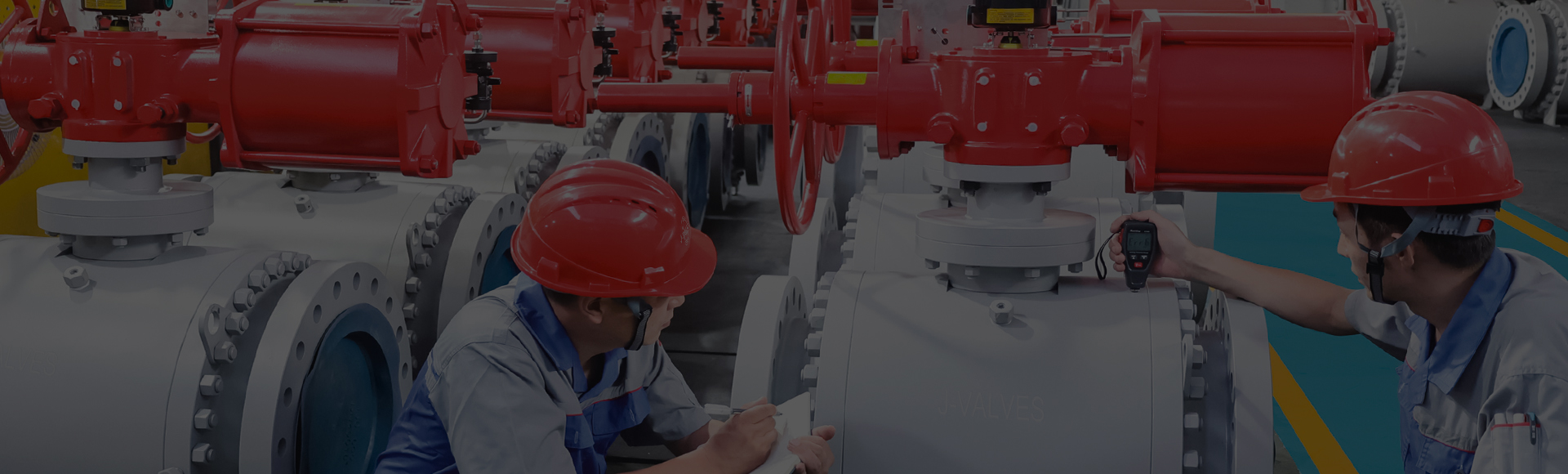
CHINA J-VALVES Offers Various High-quality I ndustrial Ball Valves
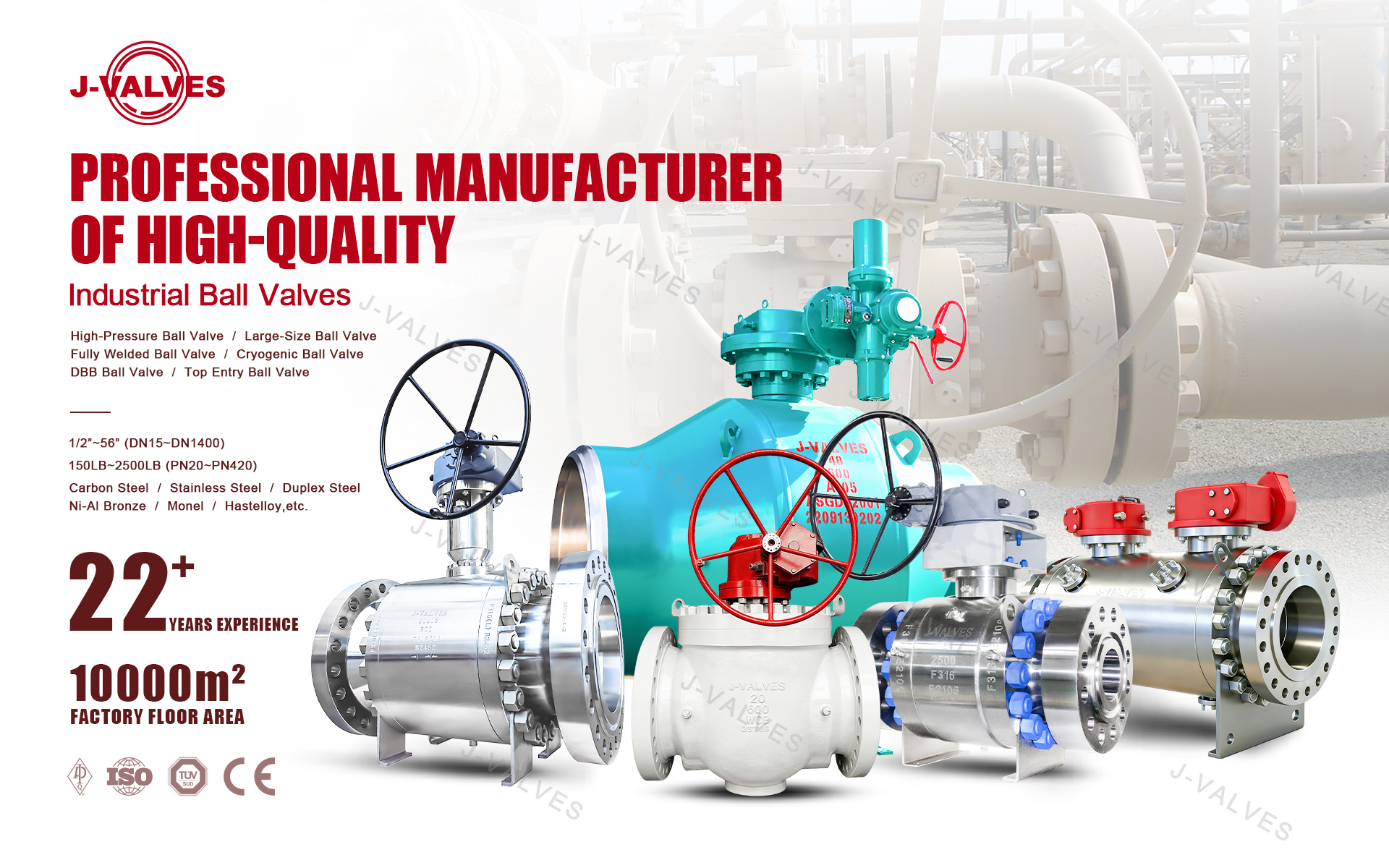
J-VALVES, a distinguished professional ball valve manufacturer rooted in China, takes pride in its extensive product portfolio. Our offerings span a wide range, including trunnion-mounted ball valves, floating ball valves, high-temperature ball valves, high-pressure ball valves, metal-sealed ball valves, ultra-low temperature ball valves, DBB ball valves, Three-way And Four-way Ball Valve, and fully welded ball valves. Each product is a testament to our commitment to precision engineering and reliable performance. Meticulously crafted, they are designed to not only meet but exceed the most stringent industrial demands, ensuring stable operation even under extreme conditions. This enables us to provide our clients with high-value services and makes our valves widely sought-after in industries.
Product Category
Contact Us


Pressure Class: Class 150 to 2500 (PN20 to PN420)
Body Material: ASTM A182 F304L forged, or A351 CF3 cast
Ball: F304L with ENP 25 µm min, or hard alloy coating
Seat: RPTFE, PCTFE, PEEK, or metal with Stellite hardfacing
Stem: F304L, surface hardened, anti-blowout
Seat Type: Floating ball with spring preloaded seat
Leakage Class: ANSI/FCI 70-2 Class VI soft seated, Class V metal seated
Fugitive Emission: ISO 15848-1 and TA-Luft, 50 ppm or better
End Connection: Flanged RF / RTJ, BW, SW, threaded NPT or BSP
Temperature Range: -196°C to +425°C, +538°C option
Design Standard: ASME B16.34, API 608, API 6D
Test Standard: API 598, ISO 5208, MSS SP-61
-
Q41F
-
J-VALVES
A bubble-tight ball valve is one whose seat leakage is measured in bubbles per minute or in millilitres per minute, rather than in a permitted drip rate. In practice the term means ANSI/FCI 70-2 Class VI, the tightest of the six seat leakage classes, and it is the class that chemical dosing, catalyst injection, sampling and analytical systems ask for because a Class IV valve that passes a hydro test will still bleed product into a sight glass.
J-VALVES builds this valve from 1/4 inch to 12 inch in Class 150 to 2500, in ASTM A182 F304L forged body or A351 CF3 cast body, with a floating ball and a spring-preloaded seat. This page explains what Class VI actually requires, why F304L is specified in the duties that ask for it, and why the hardest part of bubble-tight is not high pressure but low pressure.
Parameter | This valve |
|---|---|
Size | 1/4 to 12 inch (DN8 to DN300) |
Pressure class | Class 150 to 2500 (PN20 to PN420) |
Body | A182 F304L forged, or A351 CF3 cast |
Ball | F304L with ENP 25 µm minimum, or hard alloy coating |
Seat | RPTFE, PCTFE, PEEK, or metal with Stellite hardfacing |
Stem | F304L, surface hardened, anti-blowout |
Ends | Flanged RF / RTJ, butt weld, socket weld, threaded NPT or BSP |
Leakage | Class VI soft seated, Class V metal seated |
Fugitive emission | ISO 15848-1 and TA-Luft, 50 ppm stem leakage or better |
Temperature | -196°C to +425°C, seat dependent; +538°C option |
Standard | ASME B16.34, API 608, API 6D; test API 598, ISO 5208, MSS SP-61 |

What the Leakage Classes Actually Mean
The six classes come from ANSI/FCI 70-2, and the difference between them is large enough to decide whether a process works.
Class | Test medium | Allowable leakage | Typical application |
|---|---|---|---|
II | Air or water | 0.5% of rated capacity | General on/off, non-critical |
III | Air or water | 0.1% of rated capacity | Utility service |
IV | Air or water | 0.01% of rated capacity | Standard metal seated control valves |
V | Water at rated Δp | 0.0005 ml/min per inch of port per psi Δp | Metal seated, tighter duty |
VI | Air or nitrogen at 3.5 bar Δp | Bubble tight, allowance scales with port and Δp | Soft seated isolation, critical duty |
Class VI is expressed as a table of allowable leakage in millilitres per minute of air, indexed by port diameter and differential pressure. For a small port at low differential pressure the allowance is a fraction of a millilitre per minute, which for practical purposes is no visible bubble. That is why the class is described as bubble-tight and why the test has to be done with a bubble counter or a flow meter, not by eye at a flange.
Where Bubble-Tight Stops Being a Preference
Most isolation valves in a plant do not need Class VI, and paying for it everywhere is waste. It becomes necessary in a small number of situations, and they share a feature: the leak is not diluted.
Chemical and catalyst injection is the classic case. A few millilitres per minute of an additive into a main line is a dosing error, and a few millilitres per minute of process fluid back into the additive line is a contamination event that can gel a whole drum. Sampling systems have the same problem in reverse: a sample point that cannot be shut off completely is a continuous exposure to the operator. Analytical and chromatograph systems cannot tolerate a seat that passes carrier gas, because the baseline never stabilises. Hydrogen service adds a safety dimension, because a small leak of hydrogen at 200 bar is not small. And in nuclear and pharmaceutical service the requirement is usually written as a validated leak rate rather than as a class, but the number lands near Class VI.
The economic argument is that the incremental cost of a Class VI seat over a Class IV seat on a 2 inch valve is a small fraction of one batch of out-of-specification product.
Why F304L and Not F316
F304L is the low carbon grade of 18-8 stainless: 0.030 percent maximum carbon, 18 to 20 percent chromium, 8 to 12 percent nickel, 170 MPa minimum yield and 485 MPa minimum tensile to ASTM A182. F316 adds 2 to 3 percent molybdenum for chloride resistance and is the better general-purpose alloy, so specifying F304L is a deliberate choice and should have a reason.
The reason is welding. Carbon in the 0.04 to 0.08 range combines with chromium at the grain boundaries when the steel is heated into the sensitisation range, roughly 425°C to 850°C, and the chromium carbide that forms leaves the adjacent metal depleted in chromium. In a corrosive medium that depleted band is attacked first — intergranular corrosion. The low carbon grade does not have enough carbon to form those carbides, so it can be welded and left without a solution anneal. That is what makes F304L the right body for a valve that will be welded into a spool, welded to a socket, or welded and then not heat treated.
Where chlorides are present, F304L is the wrong answer regardless of carbon content, and F316L or a duplex grade is correct. The molybdenum is what resists pitting, and no amount of carbon control substitutes for it.
How Bubble-Tight Is Actually Achieved
Tight shutoff is not one feature. It is a stack of tolerances that all have to be inside their limits at the same time.
The ball comes first. A ball that is not round cannot seal against a seat that is round; the contact pressure varies around the circumference, and the low spots leak. The ball on this valve is machined and then lapped to a roundness within 0.005 mm and a surface finish of Ra 0.4 µm or better, and the ENP coating of 25 µm minimum is applied after machining so the coating does not change the geometry. A hard chrome coating applied thickly on a rough ball produces a valve that seals when new and leaks after a few hundred cycles.
The seat comes second. A soft seat conforms to the ball and tolerates small geometric error, which is why soft seated valves reach Class VI and metal seated valves generally do not. RPTFE is the standard choice for water, oil and chemical service; PCTFE is used where the temperature or the permeation requirement demands it; PEEK is used where the temperature is above what PTFE tolerates and a lower class is acceptable.
The preload comes third, and it is the part that is invisible in a datasheet. The seat has to be pushed against the ball with enough force to close the gap at the pressure being sealed, and that force has to remain positive when the valve is cold, hot, or at zero line pressure.
The Hard Case Is Low Pressure, Not High Pressure
Counter-intuitively, a ball valve that seals perfectly at 40 bar will often leak at 0.2 bar. The reason is that on a floating ball design the line pressure is what pushes the ball into the downstream seat. At high pressure that force is large and the seal is easy. At low pressure, or under vacuum, there is almost no force, and the seal depends entirely on the spring behind the seat and on the elasticity of the seat material.
This is why a spring-preloaded seat is not an optional refinement on a bubble-tight valve; it is the mechanism that makes the claim true across the whole pressure range. The spring is a wave washer or a ring of small coil springs behind the seat ring, and it holds the seat in contact with the ball when the line is empty, when the line is at 0.1 bar, and when the line is under vacuum.
Vacuum service adds a second problem: the seat is now pushed away from the ball by the pressure difference acting the other way, and any gas trapped in the seat pocket expands. A valve for vacuum duty should be specified as such, with a seat design that is retained rather than merely pressed in, and with a body that has been through a helium leak test rather than only a hydro test.
Fugitive Emission, Which Is a Different Leak
Seat leakage is product passing through a closed valve. Fugitive emission is product escaping past the stem packing to atmosphere. They are measured by different standards and fixed by different features, and a valve can be excellent at one and poor at the other.
ISO 15848-1 classifies stem sealing by the measured leak rate over a defined number of mechanical and thermal cycles, with tightness classes and endurance classes. TA-Luft is the German requirement and is frequently quoted in European specifications. The practical target is a stem leakage below about 50 ppm, measured by EPA Method 21 or by a vacuum method.
The design that achieves it is a combination of a live-loaded packing set, a polished stem in the packing region, and a packing material that does not relax. Graphite packing with disc springs holds its stress through thermal cycling; PTFE V-ring packing seals better cold but relaxes and has a temperature limit. Where the requirement is very tight or the fluid is hazardous, a bellows seal removes the dynamic seal altogether — the stem is enclosed in a welded bellows and the packing becomes a secondary barrier. A bellows adds height and cost and should be specified only where the emission limit or the fluid justifies it.
Floating Ball, and the Size Where It Stops
This valve uses a floating ball: the ball is not held by trunnions and is pushed downstream into the seat by the line pressure. The advantage is a simple, compact, inexpensive construction with very good sealing at moderate pressure. The limit is mechanical. As size and pressure rise, the force pushing the ball into the seat rises with the square of the bore, and the torque needed to turn the ball against that seat friction rises with it. Beyond roughly 6 to 8 inch at Class 300, or 4 inch at Class 900, the torque becomes impractical and the stem has to be enlarged to the point where a floating design no longer makes sense.
That is when the choice becomes a trunnion valve, in which bearings take the thrust and the seat load is set by springs rather than by line pressure. A trunnion valve holds Class VI equally well and can be built to 56 inch. What a trunnion valve does not do is seal as well at near-zero pressure without careful spring design, because the ball no longer benefits from being pushed into the seat. Both designs need the spring; the trunnion design needs it more.

Testing a Class VI Claim
The test is defined and it is not a hydro test. The valve is closed, air or nitrogen is applied to one side at 3.5 bar differential, and the leakage past the seat is measured with a flow meter or counted as bubbles through a water column for a defined time. The result is compared with the Class VI allowance for the port size and the differential pressure. The test is repeated on the other seat where the design allows it.
Three things invalidate the result and are worth checking in the report. The valve must be cycled before the test, because a seat that has never been moved is not representative. The test must be at the specified differential pressure, because a valve tested at 0.5 bar proves nothing about 3.5 bar. And the seat must be dry or wet as the standard requires — water on a seat changes the measured leak and makes the number incomparable.
For cryogenic or vacuum duty, a helium mass spectrometer test is added. Helium finds leaks that nitrogen misses because the molecule is smaller, and a leak rate in mbar·l/s is a far more informative number than a bubble count when the requirement is tight.

Handling and Installation
A Class VI seat is a soft component with a defined compression. Leaving the valve part open in storage, so that the ball presses on the edge of the seat for months, takes a set that shows up as a leak on commissioning. Store it closed, in its packing, with the end caps on.
Weld the valve with the ball fully open, so that spatter cannot reach the seat and the heat does not distort a closed bore. Do not use the valve as a pipe support or as a pulling point. And on a line that will be flushed, flush through an open valve or around it, not through a closed one, because grit trapped between the ball and the seat during flushing is the most common cause of a Class VI valve failing its first test on site.
Bubble-Tight Ball Valve FAQ
What does bubble-tight mean in a valve specification?
It means ANSI/FCI 70-2 Class VI, where the allowable seat leakage is expressed in millilitres per minute of air at a defined differential pressure and is small enough that no continuous bubble forms in a water column. It is a measured class, not a marketing phrase, and the test method and differential pressure should be stated.
Can a metal seated valve be bubble-tight?
Generally not to Class VI. Metal seats reach Class V at best in most designs, because metal-to-metal contact cannot conform to the same degree as a soft seat. Where both high temperature and tight shutoff are required, the usual answer is a soft seat with a metal backup, or a different valve type such as a double eccentric or triple eccentric butterfly.
Why does my Class VI valve leak at low pressure but seal at high pressure?
Because a floating ball relies on line pressure to push the ball into the seat. At low pressure there is almost no force, and the seal depends on the spring behind the seat. A valve without adequate spring preload, or with a seat that has taken a compression set, will leak at 0.2 bar and hold at 40 bar.
Is F304L better than F316?
Not in general. F304L is chosen for welded construction where no post-weld heat treatment is possible, because its low carbon content prevents sensitisation and intergranular corrosion. F316 is better wherever chlorides are present, because the molybdenum resists pitting. Choose on the chemistry of the fluid and the welding, not on the grade number.
What is the difference between seat leakage and fugitive emission?
Seat leakage is flow through a closed valve from upstream to downstream. Fugitive emission is flow from the process to atmosphere past the stem packing. They are covered by different standards — FCI 70-2 or ISO 5208 for seat leakage, ISO 15848-1 or TA-Luft for emission — and fixed by different design features.
How often should the seat be replaced?
On clean service with occasional cycling, a soft seat lasts many years. The trigger for replacement is a failed leak test, not a calendar interval. Frequent cycling with abrasive particles, thermal cycling that sets the seat, or running the valve part open will shorten life considerably.
Specifying This Valve
Provide size, class, design pressure and temperature, fluid with concentration and any chloride content, required leakage class, whether the line will be welded and whether post-weld heat treatment is possible, seat material, end connection, fugitive emission standard, and whether vacuum or low pressure sealing is part of the duty. If the valve is for a validated process, state the acceptance test and the records required at enquiry.
Delivery is typically 3 to 6 weeks. A Class VI certificate is issued with the valve by serial number, and where a customer requires it, the test is witnessed and the bubble count recorded per seat.
Hot Products


News
Ball Valves in Geothermal Brine: Silica Scale, Chloride Cracking And The Cooling Trap
Why geothermal brine destroys ball valves: retrograde silica scale, calcite at the flash point, chloride cracking above 60 C and the 250 C seat limit.
Read More
Ball Valve Face To Face Dimensions: Why A Correctly Ordered Replacement Still Does Not Fit
A 6 inch Class 150 ball valve can be 267 or 305 mm face to face and both are compliant. How B16.10, EN 558 and flange drilling decide whether it fits.
Read More
Ball Valve Stem Key And Keyway: What Gives Way First, And What The Handle Cannot Tell You
Between the handle and the ball there are four fits. Which one shears, which one cracks, and how a few degrees of lost motion hides a valve that never seated.
Read More
Ball Valve Datasheet: Six Blocks That Decide Whether Two Quotes Are Comparable
A ball valve datasheet only works when six blocks are fixed: pressure basis, bore, temperature ceiling, test, end connection, operator. How each is written.
Read More