


CHINA J-VALVES Offers Various High-quality I ndustrial Ball Valves
J-VALVES, a distinguished professional ball valve manufacturer rooted in China, takes pride in its extensive product portfolio. Our offerings span a wide range, including trunnion-mounted ball valves, floating ball valves, high-temperature ball valves, high-pressure ball valves, metal-sealed ball valves, ultra-low temperature ball valves, DBB ball valves, Three-way And Four-way Ball Valve, and fully welded ball valves. Each product is a testament to our commitment to precision engineering and reliable performance. Meticulously crafted, they are designed to not only meet but exceed the most stringent industrial demands, ensuring stable operation even under extreme conditions. This enables us to provide our clients with high-value services and makes our valves widely sought-after in industries.
Product Category
Contact Us


-
J-VALVES-Q347F
-
J-VALVES
Overview of the J-VALVES Three Piece Forged Steel Flange Trunnion Ball Valve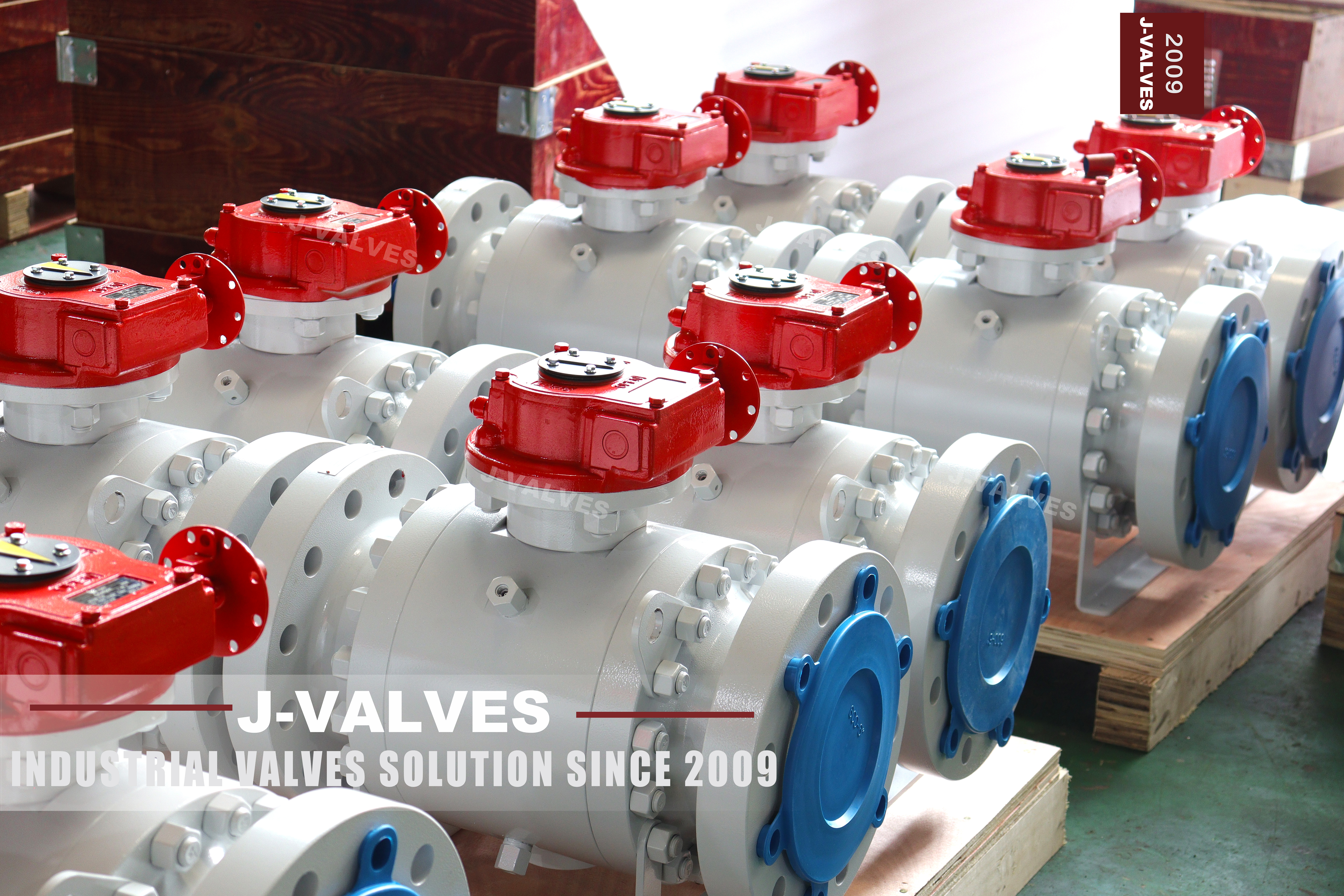
This page carries no size, and that is the first thing to understand about it. What it describes is a family: three piece body, forged, flanged ends, trunnion mounted ball, from half an inch to fifty six inch and from Class 150 to Class 2500, in carbon steel, low temperature carbon steel, austenitic stainless and duplex stainless forgings. No single valve has all of those properties at once, because several of them exclude each other.
That makes the page a filter rather than a specification. Used properly, it answers the question of whether this family is the right one for a service, and then four numbers turn it into an actual valve: size, class, facing and body grade. Used improperly, it becomes a specification that a buyer sends out with nothing filled in, and the quotation that comes back will be for whatever the supplier had in the works that week. The rest of this page is about those four numbers and the two ends of the range.
Design and Construction
Three pieces, two bolted joints, and a ball carried on trunnions. The centre section holds the ball, both seats and the trunnion bearings, and it comes out while the two end pieces stay bolted to the pipe. That is the reason for the third piece: on a large valve it converts a line shutdown into a maintenance job. The cost is two large pressure boundaries instead of one, and at high classes those joints are the parts that demand the most care in assembly.
The trunnion is what makes the design work above a certain size. Line pressure on the ball has to go somewhere; in a floating valve it goes into the downstream seat, and the seat load rises with the bore. Past a certain bore that load is more than a seat can carry, so the ball is pinned to upper and lower shafts and the thrust goes into bearings in the body. The changeover point depends on bore and class together, not on either one alone.

Material Options
The material line on this page is a comma string, and what a buyer actually needs from it is simpler than it looks. Carbon steel forging covers general service down to the low temperature floor of that grade. Low temperature carbon steel exists for service below that floor and is impact tested for it. The austenitic grades cover corrosive media, and the duplex grades cover chlorides where an austenitic grade would crack. Four questions, four answers, and the page prints all of them in one line.
The ball is described as matching the body, and mostly it does, but not always in the same condition. A metal seated valve needs a hardness difference between ball and seat to avoid galling, so the ball may be a different grade or a different heat treatment from the body even when the material family is the same. The stem is a separate choice again: a precipitation hardening grade, an austenitic grade or a duplex grade, depending on strength and on the medium.
| Component | Standard Material | Optional Upgrade | Service Notes |
|---|---|---|---|
| Body and end pieces | forged carbon, low temperature carbon, austenitic or duplex steel | grade named as stamped | three pieces, two bolted joints |
| Ball | matching the body family | hardness controlled for a metal seat | trunnion mounted above a size that depends on class |
| Stem | precipitation hardening, austenitic or duplex stainless | as the medium and torque require | anti static bonding to body |
| Seat | PTFE, reinforced PTFE, PEEK or nylon | metal seat with hard facing | DPE standard, SPE optional |
| Packing | flexible graphite | PTFE | gland adjustable |
| Ends | raised face or ring joint | ASME B16.5 | facing is a product choice, not an accessory |
| Operator | lever at small sizes | worm gear, pneumatic, electric or hydraulic | gear above a size that depends on class |
Technical Specifications
What a range page can tell you is the envelope: the sizes made, the classes made, the facings available and the material families. What it cannot tell you is any of the numbers that belong to a specific valve. Face to face, bore, overall height, weight and torque all change with size and class, and none of them can be read off a range table. They come from the drawing for the size ordered, and a quotation that quotes them from a range table is quoting an average.
The bottom of the printed range deserves a note. The page says trunnion mounted from half an inch, and at half an inch the trunnion has nothing to do: the ball is small, the seat load is small, and the design that is actually made at that size is a floating valve. The trunnion becomes necessary as the bore grows and the class rises. Reading the range from the top down is safer than reading it from the bottom up, because the top is where the design is under load.
| Item | Value |
|---|---|
| Size range | 1/2 inch to 56 inch (DN15 to DN1400) |
| Pressure range | Class 150 to Class 2500 |
| Body construction | three piece, forged, two bolted joints |
| Ball support | trunnion mounted above a size that depends on bore and class |
| Bore | full bore or reduced bore to the order |
| Body material | forged carbon, low temperature carbon, austenitic or duplex steel, grade as stamped |
| Ball material | matching the body family, hardness controlled for a metal seat |
| Stem | precipitation hardening, austenitic or duplex stainless |
| Seat | PTFE, reinforced PTFE, PEEK or nylon; metal seat optional |
| Seat arrangement | double piston effect standard, self relieving optional |
| Packing | flexible graphite |
| End connection | raised face or ring joint to ASME B16.5 |
| Face to face | per size and class, dimension on the signed GA drawing |
| Design standards | ASME B16.34 and API 6D |
| Test standard | API 598 and API 6D where ordered |
| Standard scope note | API 608 reaches twenty four inch nominal size |
| Non destructive examination | to the order, more likely at the higher classes |
| Operation | lever at small sizes, gear or actuator above that |
| Marking | size, class, body code, heat number |
| Documentation | EN 10204 3.1 on request |
| Weight | quoted with the drawing for the size and trim ordered |
| Country of manufacture | China |
Standards and Compliance
Three standards are listed and they do not cover the same ground, which matters more on a range page than on a single valve. ASME B16.34 is the pressure boundary document and it applies across the whole range. API 6D is the pipeline valve specification and it is the one that carries the functional and documentation requirements. API 608 is the general industrial ball valve standard, and it is written for ball valves up to twenty four inch nominal size, so it does not reach the top of this range at all.
That has a practical consequence for anyone specifying from this page. Below twenty four inch, all three can be named and the buyer has to say which one governs. Above twenty four inch, the pipeline specification is what covers the valve, and a tender that names only the general industrial standard is describing a document that was not written for the size being bought. The order should name the standard that actually reaches the size, not the one that sounds most familiar.
| Requirement | Standard | What J-VALVES Supplies |
|---|---|---|
| Pressure boundary | ASME B16.34 | applies across the whole printed range |
| Pipeline valve specification | API 6D | functional requirements, marking and documentation |
| Ball valve design | API 608 | written for ball valves up to twenty four inch nominal size |
| Shell and seat test | API 598 | multipliers set by the standard, not by the class |
| Non destructive examination | to the order | radiography or ultrasonic at the higher classes |
| Facing | ASME B16.5 raised face or ring joint | ring joint above the class where soft gaskets stop |
| Documentation | EN 10204 3.1 | chemistry and mechanical results per heat |
Manufacturing Process
Forging dominates the smaller and middle sizes, where a solid blank can be upset and punched and then machined into a body that has no seam in the pressure boundary. As the size grows, the blank grows faster than the valve does, because the forging has to carry the bore, the seat pockets and the trunnion bores without distortion, and the handling equipment grows with it. That is one reason large sizes are quoted with a lead time rather than from stock.
Machining is where the three piece design pays for itself. The centre section is machined as a separate part, so the seat pockets and the trunnion bores can be cut from a single reference without working around an end flange. The two end pieces are machined to the facing and drilling named on the order. Assembly follows, with the body joints tightened in a cross pattern in stages, and the ball cycled between passes so that nothing shifts as the studs come up to torque.

Quality Control and Testing
Shell and seat tests follow the test standard named on the order, with the multipliers that standard sets. On top of that, the class decides what non destructive examination is expected: the higher the class, the more likely the order will call for radiography or ultrasonic examination of the body and the body joints, and for a record of any weld repair. None of that is visible on a range page, and all of it changes the price of the valve.
Material verification is a separate question from pressure testing, and on a page that lists six grades it is the question that matters most. Positive material identification on the finished body confirms which of the six actually arrived. The mill certificate behind the 3.1 documentation carries the chemistry and the mechanical results for the heat. A hydrostatic test proves the valve holds; only these two prove what it is made of, and both belong on the order when the service is aggressive.
| Step | What Is Checked | Standard or Acceptance |
|---|---|---|
| Forging | grade, heat number, mechanical properties | 3.1 certificate against the stamped code |
| Machining | seat pocket coaxiality, trunnion bore alignment | in process gauging |
| Body joints | stud tension and cross pattern | controlled torque in stages |
| Shell test | no leakage through body or joints | to the test standard named on the order |
| Seat test | both directions, leakage rate for a metal seat | to the test standard named on the order |
| Non destructive examination | stated areas of body and joints | radiography or ultrasonic where ordered |
| Material identification | body and ball alloy | positive material identification where ordered |

Applications and Industry Service
A page like this is read by three kinds of buyer. An engineer writing a specification uses it to decide whether the family is right and then writes the size, class, facing and grade into the specification. A distributor uses it to check what can be supplied from one source across a project. A maintenance planner uses it to find a replacement for a valve already in service, which is the hardest of the three, because the replacement has to match a face to face and a flange pattern that were fixed years ago.
The family suits oil and gas gathering, process plants, power stations and large water systems, wherever a forged body and a trunnion ball are needed together. It is the wrong family for small bore isolation, where a floating valve is cheaper and just as good, and for services where the medium would destroy a forged carbon body, in which case one of the stainless or duplex grades has to be chosen rather than the base grade the page leads with.

Installation, Operation and Maintenance
Above a certain size these valves are gear operated, and above a certain size again they need lifting points and a support of their own. The size at which that happens depends on the class and the operator, so it belongs on the drawing rather than in a rule of thumb. What does not change with size is the assembly discipline: flanges made up parallel, studs brought down in a cross pattern in stages, and the body joints left alone unless the valve is out of service.
Maintenance is seat and ball replacement through the centre section, with both seats changed as a pair. On a large valve that is a lifting job, so the weight of the centre section and the height needed to clear it are part of the maintenance plan rather than an afterthought. Packing is adjusted at the gland and replaced when the gland runs out of travel. Cavity pressure has to be released before any joint is opened, through the drain or vent provided for it.
How to Specify and Order
Four numbers and a standard turn this page into an order: size, class, facing and body grade, plus the design standard that governs. Add the bore if reduced bore is acceptable or required, the seat material and whether it is metal seated, the operator, and the test and documentation requirements. Everything left unsaid will be supplied to the standard build, and the standard build is a decision made by somebody else about somebody else's service.
It is worth writing the enquiry so that it cannot be answered with a range. A request that says three piece forged steel trunnion ball valve, size to be advised, will produce a quotation that is equally vague. A request that says the four numbers, the facing, the grade and the standard produces a price for a valve. The difference is not paperwork; it is whether the valve that arrives can be installed without a second purchase order.
FAQ
Q: Why does this page not give a size?
A: Because it describes a family rather than one valve. The same three piece forged trunnion construction is made from half an inch to fifty six inch across six classes, and the individual valves differ in body pattern, ball support, operator and facing. A single size printed on the page would be right for one product and wrong for the rest. The size, class, facing and body grade have to be supplied before any of the numbers on a data sheet mean anything.
Q: Is a trunnion mounted valve made at half an inch?
A: Not in practice. The trunnion exists to take the thrust of a large ball off the seats, and at half an inch there is no thrust worth taking: the ball is small and the seat load is modest, so the design that is actually made at that size is a floating valve. The printed range starts at the smallest size the family is offered in, not at the smallest size where the trunnion is doing work. Reading the range from the top down avoids that confusion.
Q: Which standard governs at fifty six inch?
A: The pipeline specification, API 6D. API 608 is written for ball valves up to twenty four inch nominal size, so it does not reach the top of this range, and a tender at that size that names only the general industrial standard is naming a document that was not written for the valve being bought. Below twenty four inch all three standards can be quoted, and the buyer has to say which one governs the acceptance.
Q: What are the four numbers needed for a quotation?
A: Size, class, facing and body grade. Size fixes the flange pattern and the face to face; class fixes the wall, the flange and the test pressure; facing decides whether the valve is a raised face or a ring joint product, which are not interchangeable; and the grade fixes the temperature range, the medium it can handle and the certificate that has to come with it. Everything else can be discussed afterwards, but without those four there is no valve to discuss.
Q: Can the body material be changed after the order is placed?
A: Not without starting again. The grade determines the forging or casting that has to be made, the heat treatment, the impact testing if any, and the non destructive examination regime. Changing from carbon to stainless is a different body, not a different line on a form. That is why the grade belongs in the first enquiry rather than being settled at the drawing approval stage, when the forging has already been ordered.
Q: Does the range include metal seated valves?
A: Yes, as an option. The page lists soft seats in PTFE, reinforced PTFE, PEEK and nylon, and a metal seat as the alternative where temperature or abrasive service rules polymers out. A metal seated valve needs a hardness difference between ball and seat, and it is accepted on a leakage rate rather than on zero leakage. Whether it is available at a given size and class is a question for the quotation, not for the range table.


Hot Products


News
Ball Valves in A Kraft Pulp Mill: Black Liquor, Green Liquor And The Cost of Choosing The Alloy by Habit
White liquor at pH 14 cracks carbon steel welds, black liquor sets solid below 100 C, green liquor dregs grind seats: alloy choice and torque in a kraft mill.
Read More
Slug Flow And Ball Valves: What Actually Arrives At The Seat
A slug is liquid mass with momentum, not a pressure spike. What changes at the seat, in the cavity and at the actuator when liquid reaches a ball valve.
Read More
Ball Valves in Direct Lithium Extraction: PH 1 Eluate, Gypsum Scale And 438,000 Cycles in Twenty-Five Years
Direct lithium extraction swings valves from pH 1 eluate to pH 12 caustic, 48 column switches a day and gypsum scale. Materials, seats and torque.
Read More
Ball Valves in Geothermal Brine: Silica Scale, Chloride Cracking And The Cooling Trap
Why geothermal brine destroys ball valves: retrograde silica scale, calcite at the flash point, chloride cracking above 60 C and the 250 C seat limit.
Read More