


CHINA J-VALVES Offers Various High-quality I ndustrial Ball Valves
J-VALVES, a distinguished professional ball valve manufacturer rooted in China, takes pride in its extensive product portfolio. Our offerings span a wide range, including trunnion-mounted ball valves, floating ball valves, high-temperature ball valves, high-pressure ball valves, metal-sealed ball valves, ultra-low temperature ball valves, DBB ball valves, Three-way And Four-way Ball Valve, and fully welded ball valves. Each product is a testament to our commitment to precision engineering and reliable performance. Meticulously crafted, they are designed to not only meet but exceed the most stringent industrial demands, ensuring stable operation even under extreme conditions. This enables us to provide our clients with high-value services and makes our valves widely sought-after in industries.
Product Category
Contact Us


-
J-VALVES-Q41F
-
J-VALVES
Overview of the J-VALVES Carbon Steel Floating Ball Valve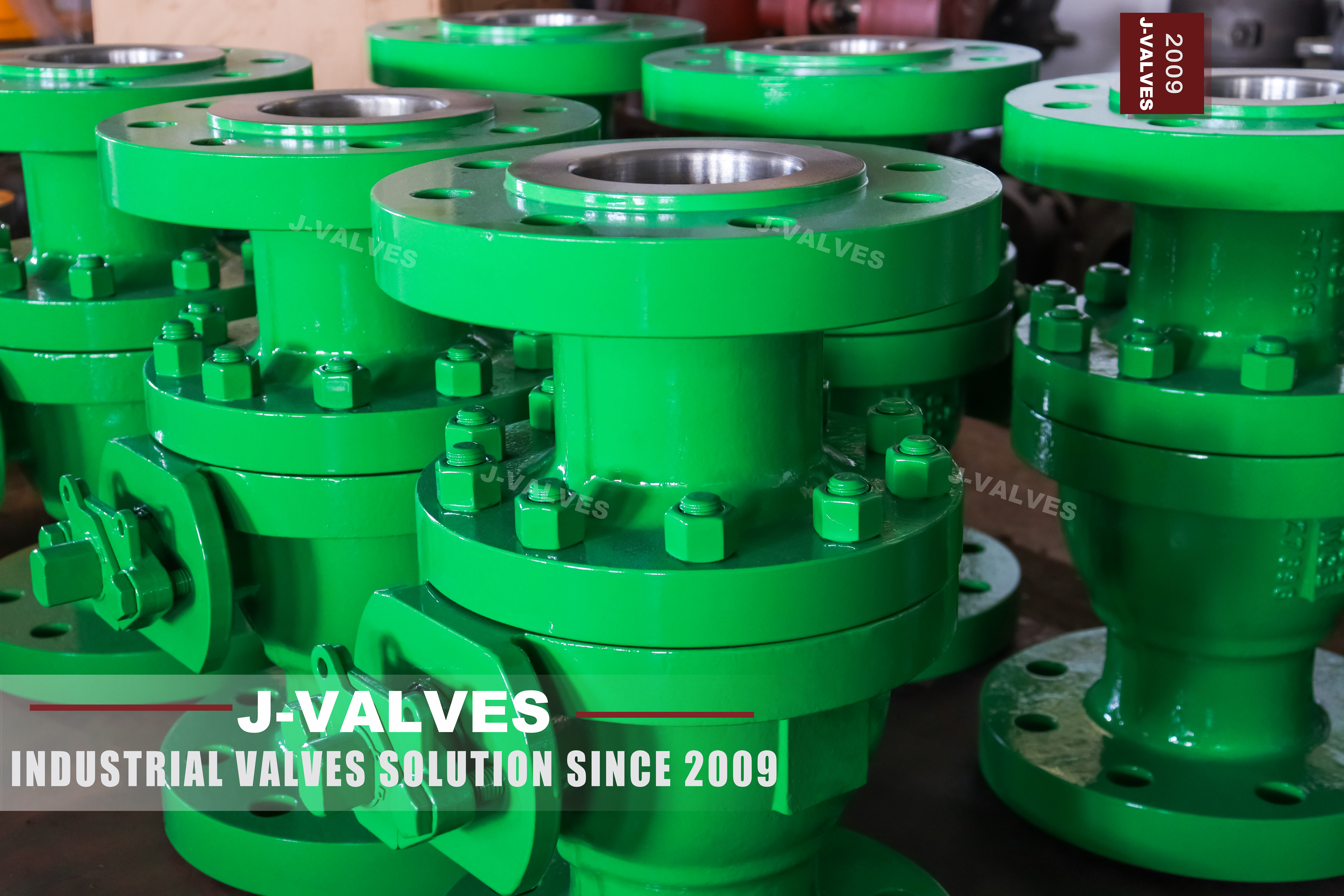
A carbon steel floating ball valve is the default isolation valve on water, oil and gas lines that have no reason to be stainless. The body is cast in ASTM A216 WCB, the ball is free to move a fraction of a millimetre downstream under line pressure, and the whole valve is a quarter turn. This page covers the WCB build from half an inch to eight inch at Class 150 to 600, and the valve in the photographs is a three inch Class 600 unit with flanged ends.
What separates one WCB ball valve from another is not the drawing, it is what the buyer believes carbon steel will survive. WCB is a carbon manganese casting with no chromium in it, so it has no passive film to lose and no chloride limit to argue about. It simply corrodes at a rate set by the medium, the temperature and the oxygen in it, which is why the grade decision on this valve is a water chemistry question rather than a pressure question.
Design and Construction
The body is split at one joint. The main body carries the stem, the packing and the upstream seat, and the end cap closes the downstream side. Because the two halves are machined from one setting, the seat pockets end up coaxial with the bore, and the ball seats on both rings without shimming. There is no second joint to leak and no top entry cover to remove, which is why a two piece carbon steel valve costs less than a three piece one at the same rating.
The ball is not carried on a trunnion. Line pressure pushes it downstream onto the seat ring and the seal is made by that contact, so the valve is self energising and needs no spring behind the seat. The same mechanism sets the size ceiling: as the bore grows, the force on the seat ring grows with the square of the diameter, and the torque needed to turn a floating ball at eight inch and Class 600 is already at the limit of what a hand lever can deliver. Above that size a trunnion mounted valve is the right product.

Material Options
WCB is chosen for strength and cost, not for corrosion resistance. It holds a thin wall at Class 600, it welds, and it takes a coating well, which matters on buried or coastal installations where the outside of the valve corrodes faster than the inside. Its weakness is equally simple: any medium with free chlorides, any dilute acid, and any wet line that stands still will attack it, and the attack shows up first at the body joint recess and at the bottom of the cavity where the water sits.
The ball, stem and seat are the parts that decide whether the valve still turns after a year. A hard chrome plated WCB ball against a PTFE seat is the standard build and it is a good one for clean water. In oil with sand in it, the chrome wears at the seat contact line and a stainless ball lasts longer; in steam above 200 C, PTFE creeps and the seat has to go to PPL or metal. None of these choices change the body, which is why the body grade and the trim grade are two separate decisions on the order.
| Component | Standard Material | Optional Upgrade | Service Notes |
|---|---|---|---|
| Body and end cap | ASTM A216 WCB cast carbon steel | Low temperature impact tested WCB | Wall thickness to ASME B16.34 |
| Ball | A105N or WCB, hard chrome plated | 304 or 316 stainless | Lapped against the seat after the joint closes |
| Stem | 410 or 420 stainless steel | 17-4PH | Shoulder above the packing prevents ejection |
| Seat | PTFE | RPTFE, PPL, metal seat | The seat sets the temperature ceiling of the valve |
| Packing | PTFE V rings | Flexible graphite | Adjustable at the gland nut |
| Body joint gasket | Spiral wound, graphite filler | PTFE envelope for clean service | Replaced every time the joint opens |
| Bolting | A193 B7 with A194 2H | B7M for sour service | Torqued in a cross pattern |
| End connection | ASME B16.5 raised face | RTJ, butt weld to B16.25 | Same size, different facing |
| Coating | Shop primer | ISO 12944 system, 240 to 320 micron | Blast profile recorded before coating |
| Operator | Lever with locking hole | Worm gear, pneumatic, electric | Mounting pad to ISO 5211 |
Technical Specifications
Three rows on this sheet carry the weight. The class row fixes the wall, the flange and the test pressure together, and Class 600 is PN100 in the API 6D designation, not a separate rating. The flange row decides whether the valve physically enters the pipe it was bought for, and at Class 600 the raised face and the ring joint are not interchangeable. The seat row sets the temperature ceiling of the whole valve, because the body will take 425 C long after a PTFE seat has stopped sealing.
The size range on this page runs from half an inch to eight inch, and the flange pattern changes inside that range: the small sizes are four bolt and the larger sizes are eight bolt at Class 600. That is the reason a buyer should order by size and class rather than by flange footprint, and the reason the bolt circle is checked against ASME B16.5 on the inspection record rather than against a catalogue page. Everything in the table below is what the valve is quoted against.
| Item | Value |
|---|---|
| Product type | Two piece flanged floating ball valve |
| Nominal size | 3 inch (DN80) as illustrated; 1/2 to 8 inch in the series |
| Pressure class | Class 600 (marked 600LB, PN100); Class 150 to 600 in the series |
| Body material | ASTM A216 WCB cast carbon steel |
| Body style | Two piece, one bolted body joint |
| Ball | A105N or WCB, hard chrome plated |
| Ball option | 304 or 316 stainless on request |
| Stem | 410 or 420 stainless steel |
| Stem option | 17-4PH precipitation hardening |
| Seat | PTFE, to 150 C on the data sheet |
| Seat option | RPTFE to 180 C, PPL to 280 C, metal seat on request |
| Packing | PTFE V rings |
| Packing option | Flexible graphite for higher temperature |
| Body joint gasket | Spiral wound with graphite filler |
| Bolting | ASTM A193 B7 studs with A194 2H nuts |
| End connection | Flanged raised face, ASME B16.5 |
| End option | RTJ ring type joint, or butt weld ends |
| Face to face | ASME B16.10 |
| Design standard | ASME B16.34, API 608 |
| Test standard | API 598 |
| Fire safe | API 607, certificate with the seat compound |
| Anti static | Ball to body continuity, API 608 requirement |
| Temperature range | -29 to 425 C, ceiling set by the seat compound |
| Media | Water, oil, gas, saturated steam to the seat ceiling |
| Operation | Lever as standard, quarter turn |
| Operation option | Worm gear, pneumatic or electric actuator |
| Bore | Full port and reduced port both built |
| Coating | ISO 12944 system on request, DFT recorded |
| Marking | Size, class and material cast or stamped on the body |
| Traceability | EN 10204 3.1 certificate with the heat number |
Standards and Compliance
ASME B16.34 sets the wall thickness and the pressure temperature ratings for the body, and API 608 sets the design and marking rules for a floating ball valve specifically: anti static path, blowout proof stem, and the data that has to appear on the nameplate. API 6D is the pipeline standard, and it applies to this valve only when the line is a pipeline rather than plant piping; the two standards overlap on testing and differ on documentation, so the order should say which one governs.
API 598 governs the pressure test, with a shell test at one and a half times the rating and a seat test at one and a time the rating in both directions. Fire safe performance is certified to API 607, and on a soft seated valve that certificate depends on the metal shoulder behind the seat and the graphite gasket in the joint rather than on the PTFE, which is gone in a fire. The face to face length follows ASME B16.10 and is held on the drawing, not inferred from the size.
| Requirement | Standard | What J-VALVES Supplies |
|---|---|---|
| Wall thickness and rating | ASME B16.34 | Cast wall tabulated for Class 600 in carbon steel |
| Flange drilling | ASME B16.5 Class 600 | Raised face or RTJ, four bolt and eight bolt patterns by size |
| Face to face | ASME B16.10 | Length held on the signed general arrangement drawing |
| Design and marking | API 608 | Anti static path, blowout proof stem, nameplate data |
| Pressure test | API 598 | Shell at 1.5 times and seat at 1.1 times the rating |
| Fire test | API 607, same method as ISO 10497 | Certificate against the seat compound supplied |
| Pipeline valve design | API 6D | Applied where the line is a pipeline rather than plant piping |
| Material certificate | EN 10204 3.1 | Heat number on the body traced to the certificate |
| Coating | ISO 12944 | System, DFT and surface preparation recorded |
Manufacturing Process
The body is sand cast in WCB, then normalised to bring the ferrite and pearlite into a uniform structure and to relieve the casting stress. That heat treatment is the step that decides whether the flange face stays flat after machining, and it is also the step a foundry shortens when a quotation has to come down. A body that was not properly normalised machines fine and then moves, and the symptom is a flange that will not hold a gasket at the first hydrostatic test in the plant.
Machining starts from the flange face and the body joint face, and the seat pockets are cut from the same setting so that the two halves line up when the joint is closed. The flange is drilled last, from the ASME B16.5 table for the size and class ordered, because that is the operation where a valve built to the wrong standard shows itself. The bore is then blasted, primed and coated, with the flange face masked so that the coating never sits under the gasket.

Quality Control and Testing
On a carbon steel body the chemistry check is the one that catches real problems, because WCB is a specification with a range rather than a single recipe, and a heat at the top of the carbon range machines differently from one at the bottom. Chemistry and tensile results come per heat on the mill certificate, and the heat number is what ties the finished body to that certificate. Where low temperature impact testing is ordered, the Charpy values are reported at the lowest stated service temperature, not at room temperature.
Pressure testing runs shell first on the assembled body, then seat in both directions. The shell test is where a casting defect at the joint face shows up, and it is also where an over-torqued joint gasket shows up as a leak that reappears after the valve is painted. Anti static continuity is measured from the ball to the body flange on every valve, because a dry PTFE seat insulates the ball and the path has to be built with a spring loaded contact rather than assumed.
| Step | What Is Checked | Standard or Acceptance |
|---|---|---|
| Heat chemistry | Carbon, manganese, silicon, sulphur, phosphorus | Spectrographic analysis per heat on the 3.1 certificate |
| Tensile properties | Yield and elongation of the WCB heat | Mill test report per heat |
| Impact test | Charpy at the lowest stated service temperature | Only where low temperature WCB is ordered |
| Casting soundness | Porosity at the joint face and seat pockets | Visual plus penetrant, radiography on request |
| Dimensional | Bolt circle, face to face, seat pocket | Gauged against ASME B16.5 and the drawing |
| Shell test | Body and joint under pressure | 1.5 times the rating at 38 C, held to API 598 |
| Seat test | Both directions on the seat supplied | 1.1 times the rating, no visible leakage |
| Anti static | Continuity from ball to body flange | Measured on every valve, recorded in ohms |
| Coating | DFT and holiday test | Gauge reading per area, holiday test on the wetted flange edge |

Applications and Industry Service
The duties this valve is built for are water distribution, fire protection lines, oil and fuel transfer, compressed air, and saturated steam up to the seat ceiling. In all of them the medium is neutral to mild, the temperature is inside the PTFE band, and the valve is operated occasionally rather than throttled. A carbon steel floating ball valve in a water line is a twenty year item; the same valve throttled at half open erodes the downstream seat edge in a season, and that is an application error rather than a product fault.
The duties it should not be sold into are the ones where the grade, not the class, is the answer. Sea water, brine, swimming pool water and any line dosed with hypochlorite will pit WCB at the joint recess within months. Dilute acids and any medium with a pH below about five attack the body directly. Wet carbon dioxide and wet hydrogen sulphide need a different material and often a different bolting grade. On all of those the answer is CF8 or CF8M, and the pressure class does not change the decision.

Installation, Operation and Maintenance
The valve goes in with the end cap facing downstream, which keeps the body joint on the low pressure side while the valve is closed. Flange bolts are drawn up in a cross pattern in two or three stages, because a carbon steel flange is stiffer than a stainless one and will pull a gasket out of position if one bolt is taken to full torque first. Pipe supports go on both sides of a valve above four inch, since the valve is not a pipe support and should not be asked to carry the line.
Maintenance on a two piece valve is a seat job rather than a valve replacement. The line is isolated, vented and drained, the joint studs come out, and the end cap lifts off to expose the downstream seat and the ball. The joint gasket is replaced every time the joint opens, because a spiral wound gasket that has been compressed once does not seal twice. The packing gland can be tightened in service, but the stem seal itself is a dismantling job and should be planned as one.
How to Specify and Order
An enquiry for this valve needs five facts before a price means anything: size, pressure class, body material and trim, flange facing, and the medium with its temperature. Everything else is a preference. The two that buyers most often leave out are the flange facing, where raised face and ring joint are different products at Class 600, and the operating temperature, which decides the seat compound and therefore the price more than the body grade does.
The paperwork that should come with the valve is a material certificate to EN 10204 3.1 with the heat number traced to the body, a pressure test record per valve, an anti static continuity reading, and the fire safe certificate for the seat compound supplied. Where the line is a pipeline rather than plant piping, API 6D documentation is added. A spare seat pair and a joint gasket cover the two items that fail first, and they are worth ordering with the valve rather than after the first shutdown.
FAQ
Q: What temperature can a WCB carbon steel floating ball valve take?
A: The body is rated from minus 29 to 425 C, but the valve as assembled is limited by the seat. PTFE stops at 150 C on the data sheet, RPTFE at 180 C, PPL at 280 C, and only a metal seated build reaches the 425 C body limit. Order by the operating temperature, not by the body rating.
Q: Is Class 600 the same as PN100?
A: Yes. API 6D clause 7.2 lists PN100 against Class 600, so the two are one rating written in two systems. The valve is marked with the class, and the flange is drilled to ASME B16.5 Class 600, which is not the same bolt pattern as a PN100 flange to EN 1092-1.
Q: Can this valve be used on sea water?
A: No. WCB has no chromium and no passive film, so chlorides pit it at the body joint recess and at the bottom of the cavity. Sea water, brine and hypochlorite dosed lines need CF8M or a super austenitic grade; the pressure class does not change that.
Q: Does a floating ball valve work in both flow directions?
A: Yes, and it seals better in one. Line pressure pushes the ball onto the downstream seat, so the valve is tight against the pressure side and the upstream seat is unloaded. It is a bidirectional valve but not a symmetric one, and the preferred direction should be marked on the line.
Q: What is the largest size for a floating ball valve?
A: About eight inch at Class 600. Above that the seat load and the operating torque grow faster than a lever can handle, and a trunnion mounted valve takes over. The series on this page stops at eight inch for that reason rather than for a manufacturing limit.
Q: Is the valve fire safe?
A: It can be certified to API 607 with the seat compound supplied. The certificate rests on the metal shoulder behind the seat and the graphite gasket in the body joint, because the PTFE seat itself is consumed in a fire. Ask for the certificate against the exact seat ordered.


Hot Products


News
Ball Valves in A Kraft Pulp Mill: Black Liquor, Green Liquor And The Cost of Choosing The Alloy by Habit
White liquor at pH 14 cracks carbon steel welds, black liquor sets solid below 100 C, green liquor dregs grind seats: alloy choice and torque in a kraft mill.
Read More
Slug Flow And Ball Valves: What Actually Arrives At The Seat
A slug is liquid mass with momentum, not a pressure spike. What changes at the seat, in the cavity and at the actuator when liquid reaches a ball valve.
Read More
Ball Valves in Direct Lithium Extraction: PH 1 Eluate, Gypsum Scale And 438,000 Cycles in Twenty-Five Years
Direct lithium extraction swings valves from pH 1 eluate to pH 12 caustic, 48 column switches a day and gypsum scale. Materials, seats and torque.
Read More
Ball Valves in Geothermal Brine: Silica Scale, Chloride Cracking And The Cooling Trap
Why geothermal brine destroys ball valves: retrograde silica scale, calcite at the flash point, chloride cracking above 60 C and the 250 C seat limit.
Read More