


CHINA J-VALVES Offers Various High-quality I ndustrial Ball Valves
J-VALVES, a distinguished professional ball valve manufacturer rooted in China, takes pride in its extensive product portfolio. Our offerings span a wide range, including trunnion-mounted ball valves, floating ball valves, high-temperature ball valves, high-pressure ball valves, metal-sealed ball valves, ultra-low temperature ball valves, DBB ball valves, Three-way And Four-way Ball Valve, and fully welded ball valves. Each product is a testament to our commitment to precision engineering and reliable performance. Meticulously crafted, they are designed to not only meet but exceed the most stringent industrial demands, ensuring stable operation even under extreme conditions. This enables us to provide our clients with high-value services and makes our valves widely sought-after in industries.
Product Category
Contact Us


Pressure Class:ASME Class 150 to 600 / PN16 to PN40
Body Construction:Two piece, one bolted body joint
Body Material:Stainless steel CF8M, CF8, CF3M; carbon steel WCB
Ball:CF8M or F316, mirror polished, ENP optional
Stem:F316, blowout proof, anti-static
Seat:PTFE, RPTFE, PPL, PEEK
Body Gasket:PTFE flat, spiral wound or flexible graphite
Bore:Full port standard
Mounting Pad:ISO 5211 high mounting pad, F03 to F10 on request
Design Standard:API 608, ASME B16.34, BS 5351
Face to Face:ASME B16.10
Flange Standard:ASME B16.5, EN 1092-1
Test Standard:API 598, shell 1.5x and seat 1.1x
-
Q41F-150LB P
-
J-VALVES
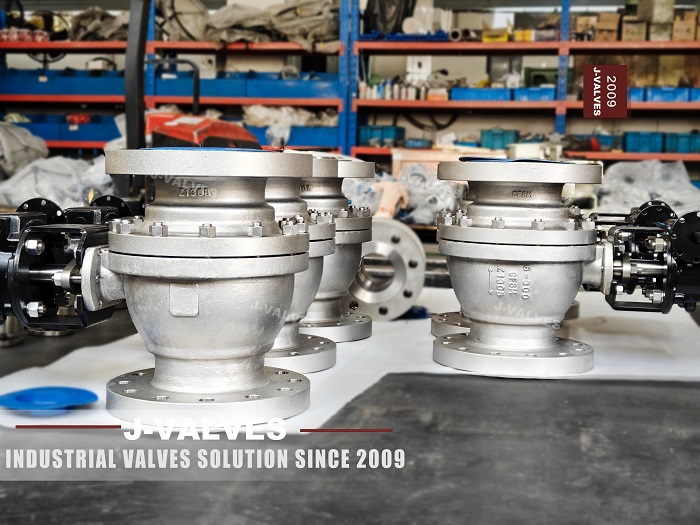
A 2 piece flange ball valve is a flanged quarter-turn valve whose body is split once, at one end, so that the end cap can be unbolted and the ball and seats lifted out. That single joint is the whole design argument. It makes the valve serviceable on a bench instead of replaceable, and it adds exactly one gasket and one set of bolts to a pressure boundary that would otherwise be a single casting.
J-VALVES builds them from 1/2 inch to 8 inch in Class 150 to 600, full port, in CF8M, CF8, CF3M and WCB, to API 608 and ASME B16.34. They are the workhorse of the range: the size band where a floating ball is still the right engineering answer, and the price band where a plant can afford one on every branch line. This page is about the joint, the seat pocket behind it, and the two standards that get confused on the enquiry.
Where the Body Actually Splits
In a two piece design the main body carries the ball, the seats and the stem, and a separate end cap closes one side. On most patterns the cap is bolted, on some it is threaded; the bolted version is what a process plant should specify, because a threaded cap on a 4 inch body is difficult to torque correctly and impossible to inspect.
Compare the three arrangements honestly:
| Body style | Joints in the pressure boundary | Trim access | Repairable | Sensible range |
|---|---|---|---|---|
| One piece | None in the shell, but a screwed seat retainer | None in line, none on the bench | Effectively no | 1/2 to 2 inch, utility |
| Two piece | One gasketed joint | Whole valve out of line | Yes, seats and ball | 1/2 to 8 inch |
| Three piece | Two gasketed joints | Centre section out, pipe untouched | Yes, in line | 1/4 to 4 inch |
Two piece wins on the balance of the three. It has half the joints of a three piece, it can still be rebuilt, and above 4 inch it is lighter and cheaper than the equivalent three piece because the pipe does not have to carry the extra flange pair.

The Joint Is a Preload Problem
A bolted body joint does not seal because it is tight. It seals because the gasket is compressed into a stress window and stays there: high enough that the fluid cannot pass, low enough that the gasket is not crushed or extruded into the clearance. Both limits move with temperature, and the bolt load moves with them.
Three things go wrong in the field, in this order of frequency.
The joint is torqued in a circle. Going around the bolts one after another pulls the cap to one side. The gasket is over-compressed near the first bolt and barely touched 180 degrees away, and the weep appears at the far side months later. Star pattern, two stages, final figure from the drawing.
The wrong gasket for the temperature. A PTFE gasket is the right answer for a cold chemical line and the wrong answer on a 200 °C steam header, where it creeps and does not recover. The joint then weeps on cool-down and nobody can find a leak on a cold, depressurised valve.
The gasket is reused. A compressed gasket has taken a set. Putting it back gives a joint that holds cold and fails hot, because the remaining compression range is now half of what it was.
A fourth, less obvious one: the bolts are stainless and the body is stainless, and stainless galling on a body joint is common enough that thread lubricant is not optional. A galled bolt cannot be brought to torque, and it cannot be removed without drilling.
The Seat Pocket Behind the Joint
Opening the joint is what lets you see the part that actually does the work. Each seat sits in a pocket machined into the body or the cap, and behind it there is normally a spring washer or a wave spring. That spring has two jobs: it holds the ball centred when the line is at atmospheric pressure, and it keeps a minimum contact stress so the valve seals on a few bar of air, not only when line pressure is high enough to push the ball into the seat.
This is the part of a cheap valve that fails first. A pocket machined with too much clearance lets the seat extrude under pressure, the contact band widens, the stress per unit area falls, and the leak starts as a weep. A pocket with too little clearance will not accept the seat without forcing it, which scratches the sealing face.
When you rebuild the valve, replace the seats and the spring washers together. A new seat on a flattened spring has no preload, and the valve will pass a bench test on high pressure and fail on the low pressure line where it is actually installed.
API 608 or API 6D, and What the Difference Costs
| Item | API 608 | API 6D |
|---|---|---|
| Scope | Metal ball valves, flanged, threaded and welding ends | Pipeline valves, including ball, gate and check |
| Typical duty | Process, utility, general isolation | Pipelines, manifolds, custody transfer |
| Fire test | API 607 by reference | API 6FA or API 607, stated in the specification |
| Documentation | Material and test certificates | Full quality plan, NDE records, traceability to heat number |
| Effect on price | Baseline | Higher, mainly in documentation and witness testing |
Both call up ASME B16.34 for the pressure boundary, both use API 598 for the shell and seat test, and both require an anti-static device. The practical difference is what paperwork arrives with the valve and how much of the manufacturing process is witnessed. On a plant utility line, 608 is enough. On a pipeline where the operator will audit the file, 6D is what the specification means even when it is not written.

Stem Sealing and the Three Barriers
The stem is the only part that moves, so it gets three separate barriers. The primary is the packing set, normally PTFE V-rings or graphite rings, compressed by a gland that can be adjusted without depressurising. The second is the thrust washer under the stem shoulder, which takes the upward load from line pressure. The third is the blowout-proof geometry: the stem has a shoulder larger than the bore it passes through, so if the gland is removed entirely the stem cannot be ejected by pressure.
The anti-static device is a small spring-loaded pin bridging stem to body. API 608 requires it and it is not optional on gas, because a ball rotating in a dry seat generates charge that has nowhere to go until it arcs across the seat. The acceptance figure is a resistance of not more than 10 ohms between ball, stem and body, measured before the valve is packed.

How to Specify It Without a Follow-Up Email
Size in inch with the DN in brackets, and the class in ASME, not "PN equivalent".
Flange standard and facing: B16.5 RF, EN 1092-1 RF, or RTJ.
Body material and seat material as separate lines. The seat decides the temperature, the body does not.
Port: full or reduced, and if reduced, the actual bore in mm so the Cv can be checked.
Whether a mounting pad is needed now, because it cannot be added later.
Test standard, certificate level, and whether a third party witness is required.
Add the fluid, the design temperature, and the number of cycles per year. A valve that moves twice a year and a valve that moves twice a shift are the same product on paper and different products in five years.

2 Piece Flange Ball Valve FAQ
Does a two piece body leak more than a one piece?
It has one more place to leak and it is a controlled joint, which is not the same thing. A one piece body has no gasket but it does have a screwed seat retainer, and that thread is a leak path that depends on thread quality and cannot be inspected. A two piece body has a machined groove, a gasket of known material and a defined bolt torque, so the joint can be checked, retorqued and, if needed, remade. In practice the two piece joint is the more predictable of the two.
Should the body gasket be PTFE, spiral wound or graphite?
PTFE to about 180 °C in clean service, because it is chemically inert and needs the least bolt load. Spiral wound with a graphite filler from 180 to 400 °C, where PTFE would creep and the joint would relax. Flexible graphite where the temperature cycles hard and the flange stack is thick, because it tolerates the differential contraction between bolt and body without losing preload. Above 400 °C the answer is a different valve, not a different gasket.
How is the body joint torqued?
In a star or criss-cross pattern, in at least two stages, ending at the value the drawing states for that gasket. The first stage is about half the final figure. Torquing around the circle in sequence pulls the end cap over to one side and leaves the gasket compressed unevenly, which shows up later as a weep at the point diametrically opposite where you started. On a used valve the gasket is replaced, not reused, and the groove is cleaned of every trace of the old one.
What is the difference between API 608 and API 6D for this valve?
API 608 covers flanged, threaded and welding-end metal ball valves and is the normal reference for general process and utility duty. API 6D is written for pipeline valves: it adds requirements on documentation, on the fire test, on the stem and seat design for pigging, and on the quality of the pressure-containing welds. A valve can be built to both, and many are, but a 6D certificate costs more and is only worth paying for on a pipeline or where the project specification names it.
Can I convert a lever valve to pneumatic later?
Only if the body was cast with a mounting pad and the stem has a square or keyed drive at the right height. A pad cannot be added to a finished body, and a valve supplied with a bare stem and no pad cannot take a bracket that meets ISO 5211 without machining. If there is any chance of actuation, specify the pad at the order stage; it is a small fraction of the valve price and it is the difference between a two hour conversion and a new valve.
Why does the joint weep only when the line is hot?
Because the bolt and the flange stack expand by different amounts, the gasket thins as it heats, and the preload that was correct cold is no longer enough. PTFE gaskets creep under that load and do not recover on cool-down, so the second cycle is worse than the first. A graphite gasket or a longer bolt with disc springs keeps the preload inside the window. Retightening a hot joint is not a fix: the torque will be wrong again when it cools.
Hot Products


News
Ball Valve Spare Parts for Overseas Projects: The Wear Part List, The Quantity Math, And Four Traps
Why isolation valves fail on calendar time, not cycles. Wear part lists, Poisson stock maths, seat kit traps and the clauses that decide year six.
Read More
Ball Valves On A Bottom Loading Gantry: Creep, Dry Break And The Test That Proves Neither
A loading gantry cycles a ball valve far more than it is designed for and still cannot prove shut-off. Where creep starts, and what to specify.
Read More
Lined Ball Valves in Acid Service: The Liner Does Not Fail, The Steel Behind It Does
The valve came out of the line looking better than most valves that come out of a hydrochloric acid line. Three inch, PFA lined, cast body, Class 150, fourteen months in service on a 32 percent acid transfer duty at 55 to 60 degrees C, about forty open and close cycles a week. The paint was intact.
Read More
Ball Valves in Amine CO2 Capture: Heat Stable Salts, Rich Amine, And The Three Places The Body Thins
Rich amine at 110 C with heat stable salts is where capture plant ball valves fail. Materials, velocity limits, cavity gas and seat choice, with numbers.
Read More