
CHINA J-VALVES Offers Various High-quality I ndustrial Ball Valves
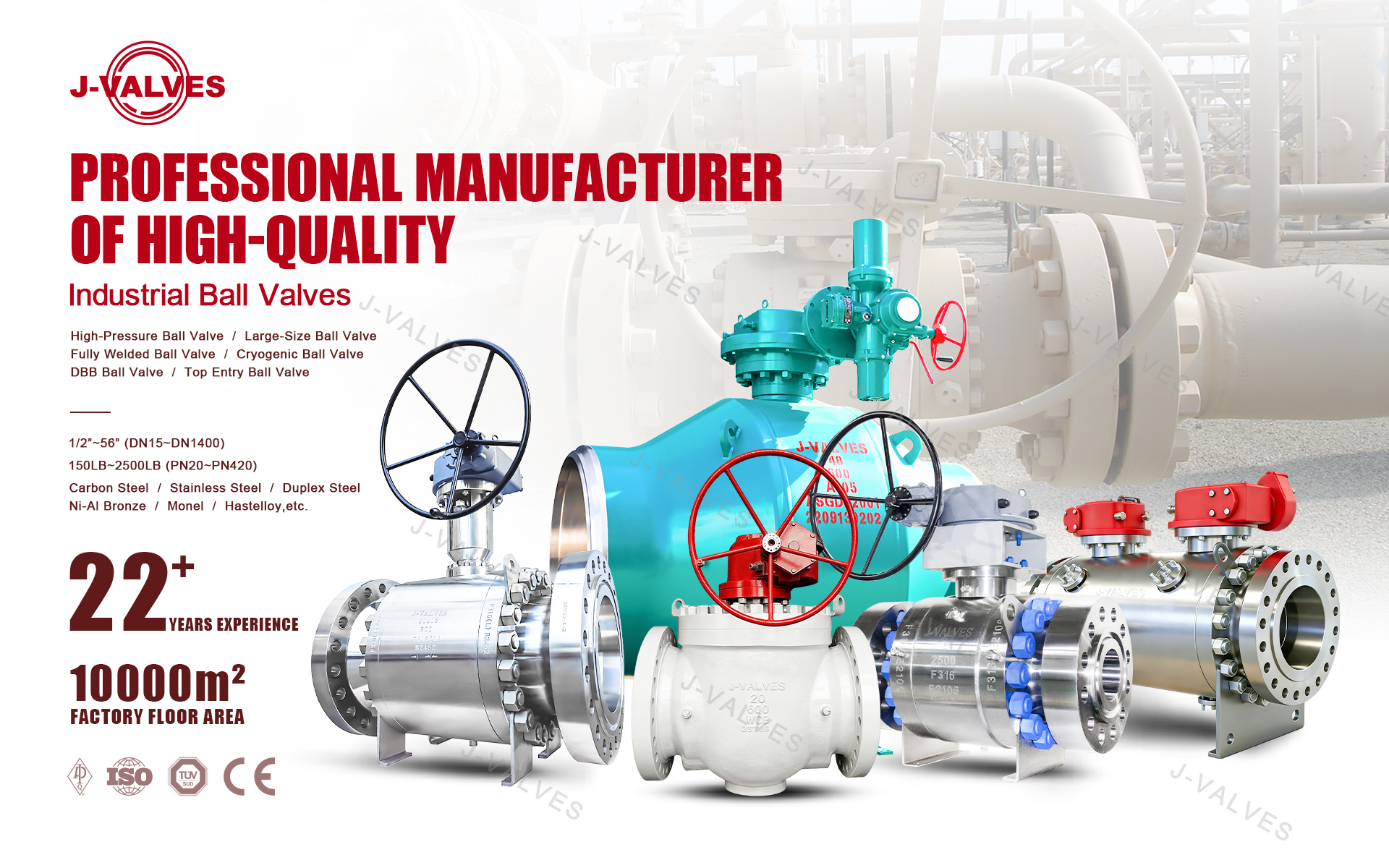
J-VALVES, a distinguished professional ball valve manufacturer rooted in China, takes pride in its extensive product portfolio. Our offerings span a wide range, including trunnion-mounted ball valves, floating ball valves, high-temperature ball valves, high-pressure ball valves, metal-sealed ball valves, ultra-low temperature ball valves, DBB ball valves, Three-way And Four-way Ball Valve, and fully welded ball valves. Each product is a testament to our commitment to precision engineering and reliable performance. Meticulously crafted, they are designed to not only meet but exceed the most stringent industrial demands, ensuring stable operation even under extreme conditions. This enables us to provide our clients with high-value services and makes our valves widely sought-after in industries.
Product Category
Contact Us


Pressure Class: ASME Class 300, 51.1 bar at 38 C
Body Material: ASTM A494 CU5MCuC, UNS N08825
Material Family: Nickel iron chromium cast alloy, cast form of Incoloy 825
Body Style: Two piece, side entry
Ball: Floating, full bore, 25 mm, CU5MCuC
Stem: CU5MCuC, blowout proof, anti-static
Seat: PTFE or RPTFE standard, PEEK or metal optional
End Connection: RF or RTJ flange, ASME B16.5 Class 300
Face to Face: 178 mm per ASME B16.10
Temperature Range: -29 C to 200 C with PTFE seat
Design Standard: API 608, ASME B16.34
Test Standard: API 598, ISO 5208 Rate A
Fire Safe: API 607 / ISO 10497
Sour Service: NACE MR0175 / ISO 15156-3, documentation on request
Top Flange: ISO 5211, actuator ready
Operation: Lever standard, gear, pneumatic or electric optional
Approximate Weight: 8 kg
-
Q41F CU5MCuC
-
J-VALVES
What a 1 Inch Class 300 CU5MCuC Floating Ball Valve Is
A 1 inch Class 300 CU5MCuC floating ball valve is a small bore, quarter turn isolation valve cast in ASTM A494 CU5MCuC, which is the cast form of UNS N08825, better known as Incoloy 825. It is a nickel iron chromium alloy, not a stainless steel and not a duplex steel. The valve is rated 51.1 bar at 38 C, flanged to ASME B16.5 Class 300, and designed to API 608.
The reason anyone specifies this material at this size is sour service with chlorides. Carbon steel needs inhibition and hardness control, 316 suffers chloride stress corrosion cracking above about 60 C, and duplex is resistant but not immune. CU5MCuC is austenitic with roughly 40 percent nickel, so it does not suffer chloride stress corrosion cracking at all, and its copper and molybdenum content lets it survive reducing acids such as sulphuric and phosphoric acid that destroy both stainless and duplex grades.
The valve is a two piece side entry floating design with a full bore ball, PTFE or RPTFE seats as standard, and a lever operator. It is not a control valve: a soft seated ball valve is an isolation device, and throttling it will destroy the seat. That distinction matters here because this page is often found by people searching for an oil and gas control valve, and the honest answer is that this is the wrong product for that duty.

What CU5MCuC Actually Is
Most catalogue pages get this wrong, and the error is worth correcting at the start because it is the whole reason the material costs what it costs.
CU5MCuC is an ASTM A494 cast nickel alloy. Its UNS number is N08825. It is the cast equivalent of wrought Incoloy 825, which is specified under ASTM B425 for bar and B564 for forgings. It is not UNS S32550, and it is not a super duplex stainless steel. S32550 is a duplex stainless with about 5 percent nickel; CU5MCuC has 38 to 46 percent nickel. They are different alloy families with different corrosion mechanisms and different welding procedures.
Element | Range, percent | What it does |
|---|---|---|
Nickel | 38.0 to 46.0 | Austenitic structure, immunity to chloride stress corrosion cracking |
Chromium | 19.5 to 23.5 | Passive film, resistance to oxidising media |
Iron | balance, about 22 | Cost control, keeps the alloy castable |
Molybdenum | 2.5 to 3.5 | Resistance to pitting and to reducing acids |
Copper | 1.5 to 3.0 | The reason it survives sulphuric acid |
Titanium | 0.6 to 1.2 | Stabilises carbon, prevents intergranular attack after welding |
Carbon | 0.05 max | Kept low for corrosion resistance at welds |
Manganese, silicon | 1.0 max each | Deoxidation and casting |
Sulphur, phosphorus | 0.03 max each | Impurity control |
Minimum mechanical properties are around 450 MPa tensile and 205 MPa yield with 25 percent elongation. That is lower than a duplex grade of the same cost, and it is the trade the alloy makes: strength is given up for corrosion resistance across a much wider range of chemistries.
The titanium addition is the detail that catches fabricators. It is there to tie up carbon as titanium carbide so that chromium carbides do not form at grain boundaries during welding, which would leave the weld heat affected zone open to intergranular corrosion. A casting that has been repaired by welding without a matching filler and a solution anneal can lose exactly the property the buyer paid for, and it will still pass a hydrostatic test.
Why Nickel Alloy Instead of 316 or Duplex
The choice between stainless, duplex and nickel alloy is not a ladder where more expensive is better. It is a question of which corrosion mechanism is actually present, and the three common ones point in different directions.
Chloride stress corrosion cracking is the mechanism that rules out 316. Above roughly 60 C, with chlorides present and tensile stress in the metal, austenitic stainless cracks. Duplex resists it far better because of its ferritic phase, but it is resistant rather than immune. CU5MCuC, with 40 percent nickel, is immune, and that is a categorical difference rather than a matter of degree.
Pitting and crevice corrosion is the mechanism that rules out 316 in seawater. It is ranked by the pitting resistance equivalent number, and here CU5MCuC is not the winner: its PREN is around 30, which is below super duplex at above 40. A buyer who selects on PREN alone will not choose this alloy, and will then be surprised when the super duplex valve fails in sulphuric acid.
Reducing acids are the mechanism that rules out both stainless and duplex. Sulphuric acid below about 60 percent concentration, and phosphoric acid, attack stainless steels because there is not enough oxygen to maintain the passive film. The copper in CU5MCuC changes the surface chemistry and lets the alloy passivate in those conditions, which is a mechanism no amount of chromium will reproduce.
Material | Nickel | PREN | Chloride SCC | Reducing acids | Practical cost index |
|---|---|---|---|---|---|
316 / CF8M | 10 to 14 | about 25 | Cracks above about 60 C | Poor | 1 |
Duplex 2205 / CD3MN | 4.5 to 6.5 | about 35 | Resistant, not immune | Poor | 1.6 |
Super duplex / CD3MWCuN | 6 to 8 | above 40 | Resistant, not immune | Poor to moderate | 2.5 |
CU5MCuC / N08825 | 38 to 46 | about 30 | Immune | Good | 4 to 6 |
WCB carbon steel | none | not applicable | Not applicable | Poor | 0.5 |
The pattern in that table is the point: the alloy with the highest PREN is not the alloy with the widest chemical range. CU5MCuC is chosen when the service has chlorides plus acid plus temperature, which is the normal condition in wet sour gas and in acid plants.
Where CU5MCuC Stops Working
A page that only lists advantages is not useful to an engineer, so the limits belong here too.
The alloy is not a high temperature material. It holds its corrosion resistance to about 540 C in air, but its creep strength is modest and it should not be used for sustained high temperature pressure service where an alloy steel such as WC9 or a stainless casting would be stronger and cheaper.
It is not resistant to hydrofluoric acid or to fluorine compounds, where Monel or a Hastelloy grade is required. It is not the right choice for strongly oxidising chloride conditions such as wet chlorine gas. And in concentrated nitric acid above about 65 percent, a low carbon stainless such as CF3 is both cheaper and better.
The practical limit that matters most on this valve is not the alloy at all, it is the seat. A PTFE seat caps the whole valve at 200 C regardless of what the body can survive, and buyers who read "CU5MCuC, 540 C" and order a soft seated valve have bought a 200 C valve.
Floating Ball Sealing in Sour Service
The sealing mechanism is the same as any floating ball valve: the ball is carried only by the two seat rings, line pressure pushes it downstream, and the downstream seat does the sealing while the upstream seat is pushed away. One seat seals at a time, and the body cavity stays connected to the upstream line.
In sour service that last detail is an advantage rather than a limitation. A valve whose cavity is isolated by two sealing seats traps a volume of wet H2S bearing fluid, and when that volume warms it has to go somewhere. A floating valve has no trapped volume, so it needs no cavity relief device and cannot overpressure its own body from thermal expansion. What it cannot do is double block and bleed, because there is no second barrier to test. A sour gas duty that requires DBB needs a trunnion mounted valve with double piston effect seats, and no amount of alloy substitution turns a floating valve into one.
The other sour service point is galvanic. When the body, ball and stem are all CU5MCuC, there is no couple between dissimilar metals inside the wetted cavity, and no preferential attack on the less noble part. A nickel alloy body fitted with a stainless ball is cheaper and is a common offer, but it creates exactly the couple that a wet sour environment will find.
Criterion | Floating ball, 1 inch | Trunnion mounted, 3 inch and above |
|---|---|---|
Ball support | Seat rings only | Top and bottom trunnions in bearings |
Seats sealing at a time | One, the downstream seat | One or both, per seat type |
Body cavity | Open to upstream line, self relieving | Can be isolated, needs relief with DPE |
Double block and bleed | Not possible | Standard |
Torque at this size | Low, lever operation | Higher, gear or actuator |
Best fit at 1 inch Class 300 | Yes, this is the normal design | Not economic below 2 inch |
Body, Trim and the 1 Inch Build
The body is a two piece side entry casting with a bolted end cap, which is the standard pattern at this size because a 1 inch Class 300 flange joint is small enough to break for seat access without disturbing the line. A three piece body is available where the valve sits in a skid that cannot be spread, and it costs more for two gaskets instead of one.
The ball is full bore at 25 mm, floating, and cast in the same CU5MCuC as the body unless a stainless ball is specified. The stem is CU5MCuC or a matching nickel alloy, sealed by two O-rings and a graphite packing set, retained against blowout by a shoulder below the gland plate. An anti-static spring bonds stem to body and body to ball. The top flange is to ISO 5211, so a pneumatic or electric actuator can be fitted without an adapter plate.
Cast nickel alloy is not a commodity. Foundries that pour A494 CU5MCuC are fewer than those that pour CF8M, the casting yield is lower, and weld repair has to be done under a qualified procedure with a solution anneal afterwards. That is why this valve is quoted at four to six times the price of the same size in WCB, and why the lead time is measured in weeks rather than days.
Seats and the Temperature Ceiling
Insert | Maximum temperature | Leakage | Use |
|---|---|---|---|
PTFE | 200 C | ISO 5208 Rate A | Standard, sour gas and liquids |
RPTFE | 200 to 220 C | Rate A | Better creep resistance at pressure |
PEEK | 250 C | Rate A | Higher temperature, lower differential |
Metal, Stellite faced | 425 C and above | Rate B to D, not bubble tight | Abrasive or high temperature |
At 1 inch Class 300 the seat load is small, so a soft seat holds a bubble tight shutoff easily and there is no reason to move to metal unless the temperature or the solids demand it. The seat material, not the body alloy, is what sets the temperature on the nameplate.

NACE MR0175 Compliance
A statement that a valve "meets NACE" is worth very little on its own, because NACE MR0175 / ISO 15156 is a set of requirements about the material in a specific environment, not a certificate that a product either has or does not have.
For CU5MCuC under ISO 15156-3, compliance means the chemistry is within the specified range for the alloy, the hardness is controlled and measured on the actual parts rather than on a generic heat, the heat treatment is documented, and the parts that see the sour fluid are traceable to those records. It also means the bolting and the soft goods are suitable, since a compliant body with a non compliant gasket is not a compliant valve.
What a buyer should ask for is the material certificate to EN 10204 3.1 with the heat number, the hardness results for body, ball and stem, the heat treatment record, and a statement of the environment the valve is qualified for in terms of partial pressure of H2S, pH and chloride content. A page that says only "NACE MR-01-75" is quoting a designation that was withdrawn more than twenty years ago and has told the buyer nothing.
Technical Specifications
Item | Value |
|---|---|
Nominal size | 1 inch, DN25 |
Pressure class | ASME Class 300, 51.1 bar at 38 C |
Body material | ASTM A494 CU5MCuC, UNS N08825 |
Body style | Two piece, side entry |
Ball | Floating, full bore, 25 mm, CU5MCuC |
Stem | CU5MCuC, blowout proof, anti-static |
Seat | PTFE or RPTFE standard, PEEK or metal optional |
End connection | RF or RTJ flange, ASME B16.5 Class 300 |
Face to face | 178 mm per ASME B16.10 |
Temperature range | -29 C to 200 C with PTFE seat |
Design standard | API 608, ASME B16.34 |
Test standard | API 598, ISO 5208 |
Fire safe | API 607 / ISO 10497 |
Sour service | NACE MR0175 / ISO 15156-3, documentation on request |
Top flange | ISO 5211, actuator ready |
Operation | Lever standard, gear, pneumatic or electric optional |
Approximate weight | 8 kg |
Standards and Compliance
API 608 is the correct design standard for this valve. It covers flanged and butt weld metal ball valves from Class 150 to 1500 with a floating or trunnion ball, and it sets the wall thickness, seat and test requirements for exactly this size and class. API 6D, API 6DSS and API 6A do not apply: they cover pipeline valves from DN50 upward, subsea valves, and wellhead equipment, and quoting them on a 1 inch Class 300 industrial valve signals that the specification was assembled from a template rather than from the product.
Requirement | Standard | Supplied |
|---|---|---|
Valve design | API 608 | Yes |
Pressure temperature rating | ASME B16.34 | Yes |
Flange dimensions | ASME B16.5 | Yes |
Face to face | ASME B16.10 | Yes |
Pressure and seat test | API 598 | Yes |
Leakage acceptance | ISO 5208 Rate A | Yes |
Fire safe | API 607, ISO 10497 | Yes |
Sour service | NACE MR0175 / ISO 15156-3 | Documentation on request |
Material certificate | EN 10204 3.1 with heat traceability | Yes |
Actuator interface | ISO 5211 | Yes |
Sizing and Selection
At 1 inch Class 300 the valve is almost always full bore, because the cost difference against a reduced bore is small and a full bore valve adds nothing measurable to the pressure drop of the line. Reduced bore is used where the valve is being matched to a smaller downstream line.
Torque is low at this size. A 1 inch Class 300 valve with a PTFE seat breaks away at roughly 15 to 30 Nm at full differential, which a lever delivers easily, and the figure is measured and recorded on every valve rather than taken from a table. An actuator, if one is fitted, is normally chosen for automation rather than for force, and the ISO 5211 pad makes that straightforward.
The selection question that actually matters at this size is not mechanical, it is the fluid. Confirm the chloride content, the H2S partial pressure, the pH, the temperature and whether any acid is present, because those five numbers decide whether the valve should be CF8M, super duplex or CU5MCuC, and the price difference between them is a factor of four.
Testing and Inspection
Test | Method | Acceptance |
|---|---|---|
Chemical analysis | Spectrometer on the cast heat | Within A494 CU5MCuC range |
Hardness | Portable or bench, body, ball, stem | Within the NACE limit |
Shell test | 1.5 times rated pressure, water | No leak, no deformation |
Seat test, each direction | 1.1 times rated pressure | ISO 5208 Rate A |
Torque | Breakaway and running | Recorded against the calculation |
Functional | Ten full cycles | Smooth, no binding |
Fire test | Type approval to API 607 | Certificate on file |
Dye penetrant | Weld repairs and critical sections | No relevant indication |
Final | Marking, nameplate, documentation | EN 10204 3.1 set complete |
The chemical analysis and hardness records are the two tests that matter more on this valve than on a carbon steel one, because they are what the buyer is actually paying for. A certificate that lists the alloy name without the heat analysis has not proved anything.

Installation and Operation
Install with the flanges parallel and concentric, use a spiral wound gasket in the correct material for the fluid, and tighten in a cross pattern to the specified torque. A nickel alloy flange is softer than a carbon steel one and will gall if the bolts are run down dry and unevenly, so lubricate the threads and take two passes.
Leave the valve fully open during line flushing. Debris passing a partly open ball scores the seat and the ball surface, and on a nickel alloy valve that damage costs far more to fix than on a carbon steel one, because the replacement trim is not a stock item.
Operate fully open or fully closed. A ball valve used as a throttle directs the flow at the seat edge and erodes it, and no seat material survives that for long. A soft seated valve that has been used to throttle will pass on test and leak in service, and the cause is usually not visible when the valve is opened.
Applications
Wet sour gas gathering and wellhead manifolds are the main duty, where chlorides and H2S appear together and 316 or duplex will not hold. Test separators, metering runs and sampling points use the small size because the flow is small and the fluid is the aggressive part.
Seawater injection and seawater cooling use CU5MCuC where the chloride level and the temperature rule out 316. Sulphuric and phosphoric acid service in fertiliser and chemical plants is the classic application for the copper bearing composition. LPG and condensate with mercaptans, flue gas desulphurisation slurry, and acid plant piping all appear on the reference list for this grade.
It is not the right answer for plain water, air, steam or non corrosive oil and gas, where WCB or CF8M does the same job for a fraction of the price.

How to Specify
State the size and class, the fluid with chloride content, H2S partial pressure, pH and temperature, the seat material and the temperature that seat will see, the end connection and facing, the operator and whether an actuator supply is available, and the NACE documentation required. Add the face to face dimension and the required leakage rate and most of the technical queries disappear before they are raised.
Lead time for a cast CU5MCuC valve is 6 to 8 weeks against 3 to 4 weeks for the same valve in CF8M, because the casting has to be scheduled at a nickel alloy foundry. The delivery package includes the EN 10204 3.1 certificate with heat analysis, hardness records, shell and seat test reports for both directions, the torque record, and the fire safe certificate. Third party inspection can be witnessed at casting review, at pressure test and at final assembly.
FAQ
Q: What is CU5MCuC, and is it a duplex stainless steel?
A: CU5MCuC is an ASTM A494 cast nickel iron chromium alloy with the UNS number N08825. It is the cast form of Incoloy 825, which is specified as wrought bar under ASTM B425 and as forgings under B564. It is not a duplex stainless steel and it is not UNS S32550. CU5MCuC contains 38 to 46 percent nickel, while S32550 contains about 5 percent, and the two rely on completely different corrosion mechanisms. Any page that describes CU5MCuC as super duplex has misidentified the material.
Q: Why choose CU5MCuC instead of 316 or super duplex?
A: Because the three alloys fail in different ways and only one of them matches the service. 316 cracks from chloride stress corrosion above about 60 C. Super duplex resists that far better and has a higher pitting resistance, but it is still attacked by reducing acids such as sulphuric and phosphoric acid. CU5MCuC is immune to chloride stress corrosion because of its nickel content and survives reducing acids because of its copper, so it covers the combination of chlorides, acid and temperature that wet sour gas presents. On pitting resistance alone it loses to super duplex, which is why selecting on PREN alone leads to the wrong valve.
Q: Is a ball valve a control valve? Can it be used for throttling?
A: No. A ball valve is an isolation valve and should be operated fully open or fully closed. Partly open, the ball directs the flow at the seat edge and erodes both the seat and the ball, and no seat material survives that for long. A soft seated valve that has been used to throttle typically passes a bench test and then leaks in service. If the duty requires flow regulation, the correct products are a globe valve, a segmented ball valve or a characterised butterfly valve, not this valve.
Q: Does this valve meet NACE MR0175 for sour service?
A: The material is suitable and the valve can be supplied with full documentation, but compliance is not a property of the product name. Under ISO 15156-3 it means the chemistry is within the specified range, the hardness is measured on the actual body, ball and stem, the heat treatment is documented, and the soft goods and bolting are suitable as well. Ask for the EN 10204 3.1 certificate with heat analysis, the hardness results, the heat treatment record, and a statement of the H2S partial pressure, pH and chloride level the valve is qualified for.
Q: What is the temperature limit, and what governs it?
A: The valve is limited to 200 C by its PTFE seat, not by the alloy. CU5MCuC itself holds its corrosion resistance to about 540 C in air, but a soft seat cannot go near that. With an RPTFE seat the limit is 200 to 220 C, with PEEK it is 250 C, and only with a metal seat does the valve reach 425 C, at the cost of a leakage rate that is no longer bubble tight. The nameplate temperature should always be read together with the seat material.
Q: What does CU5MCuC cost compared with WCB or 316, and what is the lead time?
A: Expect roughly four to six times the price of the same valve in WCB, and about two to three times the price of CF8M, driven by the alloy content and by the small number of foundries that pour A494 CU5MCuC. Lead time is 6 to 8 weeks against 3 to 4 weeks for CF8M, because the casting has to be scheduled at a nickel alloy foundry rather than picked from stock. Weld repair of a nickel alloy casting also needs a qualified procedure and a solution anneal, which is part of why the cost is where it is.
Q: Can it be used for seawater and acid service?
A: Seawater yes, where the chloride level and temperature rule out 316, although super duplex is often a better compromise on cost for plain seawater at moderate temperature. Sulphuric acid below about 60 percent and phosphoric acid are the classic duties for this grade, because the copper content lets the alloy passivate where stainless cannot. It is not suitable for hydrofluoric acid, for wet chlorine, or for concentrated nitric acid above about 65 percent, where other grades are both cheaper and better.
Hot Products


News
Ball Valves in Geothermal Brine: Silica Scale, Chloride Cracking And The Cooling Trap
Why geothermal brine destroys ball valves: retrograde silica scale, calcite at the flash point, chloride cracking above 60 C and the 250 C seat limit.
Read More
Ball Valve Face To Face Dimensions: Why A Correctly Ordered Replacement Still Does Not Fit
A 6 inch Class 150 ball valve can be 267 or 305 mm face to face and both are compliant. How B16.10, EN 558 and flange drilling decide whether it fits.
Read More
Ball Valve Stem Key And Keyway: What Gives Way First, And What The Handle Cannot Tell You
Between the handle and the ball there are four fits. Which one shears, which one cracks, and how a few degrees of lost motion hides a valve that never seated.
Read More
Ball Valve Datasheet: Six Blocks That Decide Whether Two Quotes Are Comparable
A ball valve datasheet only works when six blocks are fixed: pressure basis, bore, temperature ceiling, test, end connection, operator. How each is written.
Read More