CHINA J-VALVES Offers Various High-quality I ndustrial Ball Valves
J-VALVES, a distinguished professional ball valve manufacturer rooted in China, takes pride in its extensive product portfolio. Our offerings span a wide range, including trunnion-mounted ball valves, floating ball valves, high-temperature ball valves, high-pressure ball valves, metal-sealed ball valves, ultra-low temperature ball valves, DBB ball valves, Three-way And Four-way Ball Valve, and fully welded ball valves. Each product is a testament to our commitment to precision engineering and reliable performance. Meticulously crafted, they are designed to not only meet but exceed the most stringent industrial demands, ensuring stable operation even under extreme conditions. This enables us to provide our clients with high-value services and makes our valves widely sought-after in industries.
Product Category
Contact Us


Pressure Class: ASME Class 2500 / PN420
Cold Working Pressure: Approx. 42 MPa at 38 degrees Celsius
Shell Test Pressure: Approx. 63 MPa, 1.5 times rating
Seat Test Pressure: Approx. 46 MPa, 1.1 times rating
Body Material: Forged ASTM A182 F304, F316, F316L
Ball: F304, F316, HVOF tungsten carbide or Stellite hardfacing
Seat: PEEK or Devlon V-API with anti-extrusion ring; Stellite or Inconel metal
Seat Design: Double piston effect with external cavity relief
Stem: F316, 17-4PH, Inconel 718
Bolting: A193 B8M Class 2; Inconel 718 above 450 degrees Celsius
Gasket: RTJ ring to ASME B16.20, or spiral wound graphite
End Connection: Flanged RF or RTJ to ASME B16.5
Face to Face: ASME B16.10
Operation: Gearbox, pneumatic, electric, hydraulic, ESD
Gearbox Ratio: 250:1 to 400:1 for metal seated, 60 to 120 handwheel turns
Design Standard: API 6D, ASME B16.34, API 608
Test Standard: API 6D, API 598
Fire Safe: API 607 / ISO 10497
-
Q447F
-
J-VALVES

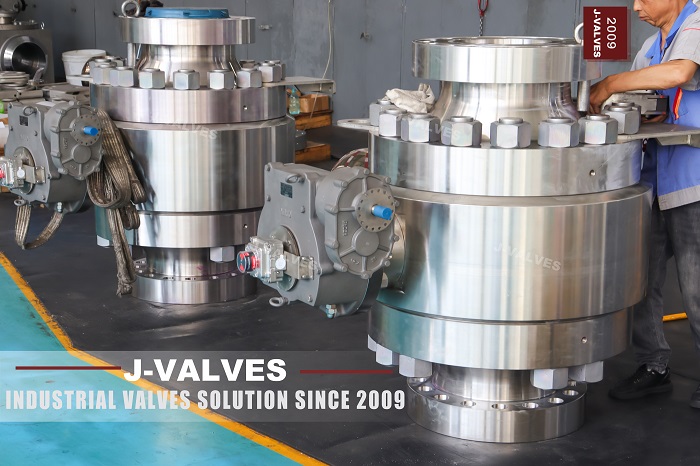
A Class 2500 stainless steel flanged trunnion mounted ball valve is a quarter turn isolation valve rated to about 42 MPa at ambient temperature, built from a forged austenitic body, bolted into the line through ASME B16.5 flanges, and supported on trunnion bearings so that the ball does not carry the seat load. Class 2500 is the top of the ASME B16.34 general service range: above it, the industry moves to API 6A wellhead ratings and the flange system changes entirely.
This page deals with the engineering that only appears at this pressure class. Bolting that relaxes, a ring joint that has to be perfect on first make-up, a seat that must be relieved or it will crack the body cavity, and a gearbox that a strong person cannot turn without a ratio of several hundred to one. J-VALVES manufactures this valve from 2 inch to 12 inch in F304, F316 and F316L forgings, with reduced or full bore, soft or metal seating, and manual, pneumatic, electric or hydraulic operation.

What Class 2500 Actually Means
The class number is not a pressure in pounds. It is a rating index, and the actual allowable pressure depends on the material group and the temperature. For the austenitic stainless group in ASME B16.34, Class 2500 corresponds to approximately 42 MPa at 38 degrees Celsius. That is the number the design is built around, and it appears in three places that each have a different meaning.
Figure | Value at Class 2500, austenitic group | Where it is used |
|---|---|---|
Cold working pressure, 38 degrees Celsius | Approximately 42 MPa | Design basis, datasheet rating, line class |
Shell test pressure, 1.5 times | Approximately 63 MPa | Hydrostatic test of the pressure boundary |
Seat test pressure, 1.1 times | Approximately 46 MPa | Seat leakage test, each seat, each direction |
The difference between the working pressure and the shell test is what drives the wall thickness, and at 6 inch Class 2500 the body wall before any corrosion allowance is in the region of 38 to 45 mm depending on the material group and the manufacturer's margin over the B16.34 minimum. That thickness is the reason a 6 by 4 inch valve in this class weighs several hundred kilograms and needs a lifting plan.
The rating also falls with temperature. Austenitic stainless holds its rating well to about 50 degrees Celsius, then declines; by 400 degrees Celsius the allowable is roughly three quarters of the cold figure, and by 500 degrees significantly less. A valve ordered as "Class 2500" for a 450 degree hydrogen service is not rated to 42 MPa at that temperature, and the datasheet has to state the design temperature alongside the class or the rating is meaningless.

Why Stainless, and When Stainless Is Wrong
Class 2500 is usually specified in carbon steel or low alloy steel for general service, because a forged carbon steel body is cheaper and easier to source. Stainless is chosen for one of four reasons, and only the first two are usually decisive.
Corrosion resistance. F316 contains 2 to 3 percent molybdenum, which gives it resistance to chloride pitting and to the chlorinated and marine atmospheres that destroy a carbon steel body from the outside as well as the inside. On a coastal installation or a sour gas gathering line, that alone justifies the premium.
Product contamination. In pharmaceutical, food, and high purity chemical service, a stainless wetted body removes the need for a coating or a lining and removes the risk of a coating failure at 42 MPa, where a pinhole in a lining becomes a corrosion cell.
Low temperature. Austenitic stainless has no ductile to brittle transition, so it holds impact toughness down to minus 196 degrees Celsius without a special grade. A carbon steel body at Class 2500 needs Charpy testing and a hard minimum temperature, and below about minus 46 degrees it is not available at all.
Hydrogen and ammonia service. Both need care rather than a simple material upgrade. Hydrogen at 42 MPa attacks the steel by embrittlement, and the answer is not "more stainless" but a controlled hardness, a specified grade and a qualified procedure under ASME B31.12. Urea synthesis at 25 to 32 MPa needs the urea grade of 316L with a controlled ferrite content, because the carbamate attacks the standard grade along the grain boundaries.
Where stainless is the wrong choice: a large Class 2500 valve in dry sweet gas at ambient temperature. There the carbon steel forging performs identically, costs less, and is easier to weld if a repair is needed. The stainless premium at 12 inch Class 2500 is substantial and buys nothing in that duty.
The Reduced Bore Argument at 6 by 4
A 6 by 4 inch valve has a 6 inch nominal size and a 4 inch bore. At Class 2500 this is not a cost saving trick; it is often the only practical configuration.
Consider what a full bore 6 inch Class 2500 body would be. The bore alone is 152 mm, the wall is around 40 mm, and the ball has to be larger than the bore to seal against the seats, so the body diameter passes 300 mm. The forging, the machining, the weight and the torque all follow. A reduced bore valve with a 100 mm passage cuts the ball diameter, the seat circumference, the bearing load and the operating torque, and it does so while the line's flow requirement is usually set by a 4 inch downstream system anyway.
Three numbers describe the trade. Weight falls by roughly 30 to 40 percent, operating torque falls by 25 to 35 percent, and cost falls with both. The cost is a permanent pressure loss at the reduction, a turbulent zone downstream of the step, and the loss of pigging capability. On a hydrocracker charge line or a wellhead flowline, none of those three matters. On a line that is pigged, or on a line where the pressure loss across the valve is a significant fraction of the available differential, full bore is mandatory and the weight and torque have to be accepted.
Bolting: the Failure Mode That Gets Forgotten
At 42 MPa the body joint is not held by the bolts alone; it is held by the bolt preload. The bolts are stretched to between 50 and 70 percent of yield at assembly, and the gasket is compressed by that stored energy. Anything that reduces the stretch reduces the joint integrity, and at this pressure there is very little margin.
A193 B8M Class 2 is the standard choice for a stainless body: 316 stainless, strain hardened, with good strength and no risk of galvanic couple with the body. Its weakness is relaxation at temperature. Above about 400 degrees Celsius, stainless bolts creep under the preload and the joint loses compression, which shows up as a weeping flange gasket on a hot hydrocracker unit after a few thermal cycles.
Three answers exist. Use Inconel 718 studs where the temperature exceeds about 450 degrees Celsius and the differential expansion is large; the cost is significant and the material is difficult to source in small quantities. Use a graphite or spiral wound gasket with enough resilience to follow the relaxation, rather than a flat metal or a PTFE gasket that has no recovery. Or design the joint with disc springs under the nuts, which maintain preload across a wider range of differential expansion.
Fastener | Temperature ceiling, practical | Strength | Issue |
|---|---|---|---|
A193 B8M Class 2 | About 400 to 450 degrees Celsius | Good, 725 MPa tensile class | Relaxation at temperature, galling on make-up |
A193 B7 with A194 2H | About 450 degrees Celsius | Higher than B8M | Not for stainless bodies in wet service, galvanic risk |
Inconel 718 | Above 600 degrees Celsius | Very high | Cost, availability, and a different torque procedure |
Whatever the fastener, the make-up torque has to be calculated for the specific joint and applied with a calibrated tool, not with an impact wrench and judgement. On a 6 inch Class 2500 body joint there are typically 8 to 12 studs of 1 inch or larger, and a 20 percent scatter in preload across the circle is enough to open the joint on the low side.
Ring Type Joint or Raised Face
At Class 2500, ring type joint is the normal choice and raised face is the exception. The reason is the sealing mechanism: a raised face gasket is held by bolt load alone and relies on the gasket staying compressed, while a ring joint seals by wedging a metal ring into a groove, so the sealing stress rises with internal pressure rather than falling.
The ring joint has its own disciplines. The groove is machined to ASME B16.20 with a specified surface finish, typically 1.6 micrometres Ra or better, and a groove that is rough, damaged or contaminated will leak no matter how much torque is applied. The ring must be new or proven, of the correct number, and of a material matched to the flange: soft iron for standard service, 316 for corrosive service, Inconel for high temperature. And the joint is a one-time assembly: a ring that has been crushed once should not be reused.
Raised face is used where the client's piping is already raised face, or where the valve has to mate with a cast iron or a non-metallic component. In those cases the gasket must be a spiral wound type with a graphite filler and an inner ring, because a plain sheet gasket will blow out at 42 MPa.
Double Piston Effect and Cavity Relief at 42 MPa
At this pressure, cavity management stops being a detail. A ball valve closed with liquid in the cavity and then warmed by the sun or by process heat will develop a cavity pressure far above line pressure, because liquid expands by a fraction of a percent per degree and the cavity volume cannot grow.
The DPE seat is chosen here for one reason: it holds from both directions, so a damaged upstream seat leaves the downstream seat still isolating the line. The cost of that behaviour is that the cavity loses its self-relieving path, and at 42 MPa a cavity with no relief is not a detail. The relief device therefore belongs to the pressure boundary in its own right, and its set pressure, orifice size and discharge route are drawing items rather than accessories chosen at the end.
A single piston effect seat relieves automatically into the low pressure side, which solves the cavity problem and gives up the double barrier. At 42 MPa in hydrogen or in dense phase CO2, most specifications choose double piston effect with a relief, and then specify that the relief discharges to a closed system rather than to atmosphere, because the fluid is either valuable or hazardous.
The relief sizing follows a simple rule: the device must pass the volumetric expansion of the trapped liquid over the expected temperature rise at the relief set pressure. For a 6 inch valve the cavity is small, and a relief of a few millimetres orifice is usually sufficient; the mistake is to fit a device that is too small because the calculation was never done.
Seat Material at Ultra-High Pressure
Soft seats work at 42 MPa only if the material resists extrusion, because the gap between the seat and the ball grows with pressure and a soft polymer will flow into it.
PEEK based materials, including the Devlon V-API grade, are the practical soft seat at this class. They have a high compressive strength, a high modulus, and enough creep resistance to hold seat load without extruding, and they work to around 200 to 250 degrees Celsius. What it costs is a higher seating torque and the need for an anti-extrusion backup ring on the low pressure side of the seat. Virgin PTFE is not used at Class 2500: it will extrude and it will take a permanent set on the first cycle.
Metal seating is used where the temperature exceeds what PEEK will take, where the fluid is abrasive, or where fire survival is the governing case. The seat and ball are hardfaced with Stellite or Inconel to above 60 HRC and ground to a matching spherical form. The result is a valve that survives almost anything and leaks a little: ISO 5208 rate D or E is the realistic expectation, while a demand for rate A on a metal seat at Class 2500 asks for a valve that the torque needed to achieve it would damage.
Seat | Pressure capability | Temperature | Leak rate | Torque |
|---|---|---|---|---|
PEEK / Devlon V-API with backup ring | Full Class 2500 | To about 250 degrees Celsius | ISO 5208 rate A | Moderate |
PEEK insert in metal carrier | Full Class 2500 | To about 250 degrees Celsius | Rate A, with a secondary metal seal | Higher |
Metal, Stellite faced | Full Class 2500 and above | To 600 degrees Celsius and beyond | Rate D or E | Two to three times soft seat |
Torque and the Gearbox
At Class 2500 the torque is large enough that the operating method becomes a design decision rather than an accessory.
A 6 inch Class 2500 trunnion valve with soft seats typically needs 4,000 to 8,000 Nm break-to-open at full differential; with metal seats the figure is nearer 10,000 to 16,000 Nm. A person at a 400 mm handwheel applies about 200 N, which is 80 Nm at the rim. Even with a 120:1 gearbox at 40 percent efficiency, that is around 3,800 Nm at the stem, which is not enough for the metal seated case.
So a metal seated 6 inch Class 2500 valve is normally supplied with a gearbox of 250:1 to 400:1, and the handwheel takes 60 to 120 turns for the quarter turn. That is acceptable as an emergency override and unacceptable as a routine operation, which is why most of these valves in real plants are actuated. A pneumatic double acting actuator with a spring return, or a hydraulic actuator, is the normal configuration, and the actuator has to be sized on the break torque with a factor of at least 1.5, because at 42 MPa there is no room for a valve that almost opens.
The gearbox specification matters as much as the ratio. It should be rated for the valve's break torque, not its running torque, sealed to IP68 if the valve is outdoors, fitted with a position indicator and a limit switch box, and provided with a manual override that disengages positively rather than by friction.

Testing at 63 MPa and the Actuator Loop
The hydrostatic test at 1.5 times the rating is the event that finds a bad casting, and at Class 2500 it is also a test of the test equipment. Three points are worth specifying.
Water quality. On a stainless body the test water must be controlled for chlorides, typically below 30 ppm, and drained and dried afterwards. Residual chloride in a seat pocket at 42 MPa is a stress corrosion crack waiting for service.
Hold time and measurement. The shell test is held for the duration API 6D requires with the pressure measured at the body, not at the pump, and any pressure drop is investigated rather than attributed to temperature equalisation.
Seat test after the shell test. The seat test at 1.1 times follows the shell test, on each seat, from each direction on a double piston effect design. A valve that passed the shell test and weeps at the seat is a valve with a damaged seat, often damaged by the shell test itself if the cavity was not vented.
The actuator loop test is then run at the site, at the lowest supply pressure expected, with the valve at the maximum differential. The closing time, the torque or pressure trace and the fail-safe stroke are recorded. On a Class 2500 valve the fail-safe stroke is the one that matters: a spring that closes the valve on the bench at 5 MPa differential may not close it at 42 MPa, and the only way to know is to test it.

Where Class 2500 Appears
The class is used where the process pressure is genuinely high, and the applications are consistent across industries.
High pressure gas gathering. Shale and tight gas wellhead flowlines run at 35 to 70 MPa, and the block valves at the wellsite and the gathering manifold are often Class 2500 with a stainless or duplex body for CO2 and H2S resistance.
Hydroprocessing. Hydrocrackers and hydrotreaters run at 15 to 25 MPa of hydrogen at 350 to 450 degrees Celsius. The valve here is usually 2 to 8 inch, forged F316 or F321, metal seated, with Inconel 718 bolting and a graphite gasket.
Supercritical CO2 and CCS. Dense phase CO2 above 7.4 MPa and 31 degrees Celsius behaves like a liquid with a gas's ability to expand, and the decompression cooling can take a seat below its ductile range. Double piston effect seats with a closed relief and a metal backup are usual.
Urea and ammonia synthesis. Synthesis loops run at 25 to 32 MPa, and the urea grade of 316L with controlled ferrite is specified because standard 316L suffers selective attack in carbamate service.
Waterjet and descaling. 40 to 60 MPa water with abrasive entrainment destroys soft seats in hours; metal seated valves with tungsten carbide trim are the standard answer.

Frequently Asked Questions
What pressure is a Class 2500 valve rated to?
About 42 MPa at 38 degrees Celsius for the austenitic stainless group in ASME B16.34, which corresponds to the PN420 designation. The rating falls as temperature rises, so a valve for 400 degrees Celsius service holds roughly three quarters of that figure. The datasheet must state the design temperature as well as the class, because the class alone does not define the allowable pressure.
Why is a 6 by 4 inch valve used instead of full bore 6 inch?
Because a full bore 6 inch Class 2500 body would have a ball larger than the bore, a body diameter over 300 mm, and a weight and torque that make it difficult to handle and to actuate. The reduced bore cuts weight by 30 to 40 percent and torque by 25 to 35 percent, and most systems downstream are 4 inch anyway. Full bore is used where the line is pigged or where the pressure loss matters more than the weight.
Should the connection be RTJ or raised face?
Ring type joint is normal at Class 2500, because the metal ring seals by wedging into a groove so the sealing stress rises with pressure, while a raised face gasket depends entirely on bolt load. Raised face is used where the piping is already raised face; in that case use a spiral wound gasket with a graphite filler and an inner ring, not a sheet gasket. The ring joint groove finish matters as much as the ring material.
Why do the body bolts loosen on a hot unit?
Because stainless bolts relax under preload at temperature, and the flange stack expands at a different rate from the bolts, so the joint loses compression after a few thermal cycles. The answers are Inconel 718 studs above about 450 degrees Celsius, a resilient spiral wound gasket that can follow the movement, or disc springs under the nuts. Retightening a hot joint is a temporary fix that usually makes the scatter worse.
Can a soft seat hold 42 MPa?
Yes, if it is PEEK based rather than PTFE. PEEK and the Devlon V-API grade have the compressive strength and creep resistance to hold seat load at full Class 2500 without extruding, provided an anti-extrusion backup ring is fitted. Virgin PTFE and RPTFE will extrude into the seat gap and take a permanent set, so they are not offered at this class.
What is the test pressure?
The shell test is 1.5 times the 38 degree Celsius rating, about 63 MPa, and the seat test is 1.1 times, about 46 MPa, on each seat and from each direction on a double piston effect design. On stainless bodies the test water must be controlled for chlorides and the body drained and dried afterwards, because residual chloride in a seat pocket at this pressure is a stress corrosion risk.
For a quotation, state the size and bore, class and design temperature, the fluid including H2S and chloride content, body and trim material, seat type, end connection and gasket type, actuation and fail position, and the test standard. On this class the design temperature and the fluid chemistry change the material selection more than the pressure does.
Hot Products


News
Ball Valve Condition Monitoring: Which Signals Actually Predict A Failure
Torque signatures, acoustic emission, differential pressure and digital twin residuals: which measurements find a failing ball valve early.
Read More
Ball Valves in SWRO Desalination: The High Pressure Section Where Ordinary Seawater Valves Fail
Why SWRO high pressure valves fail early: recovery arithmetic, crevice temperature, ERD ripple, scale, letdown cavitation and surge.
Read More
Air Test And Water Test For Ball Valves: What Each Medium Can Prove
A ball valve can pass a hydrostatic seat test and still leak gas. Why air and water prove different things, and how to read a bubble, decay or helium test.
Read More
Ball Valve Flange Bolting: Preload, Relaxation And The Fasteners That Decide Leakage
A weeping flange is rarely the gasket. Preload, torque scatter, hardness limits and thermal relaxation decide whether the joint holds at 100 bar and 400 C.
Read More