CHINA J-VALVES Offers Various High-quality I ndustrial Ball Valves
J-VALVES, a distinguished professional ball valve manufacturer rooted in China, takes pride in its extensive product portfolio. Our offerings span a wide range, including trunnion-mounted ball valves, floating ball valves, high-temperature ball valves, high-pressure ball valves, metal-sealed ball valves, ultra-low temperature ball valves, DBB ball valves, Three-way And Four-way Ball Valve, and fully welded ball valves. Each product is a testament to our commitment to precision engineering and reliable performance. Meticulously crafted, they are designed to not only meet but exceed the most stringent industrial demands, ensuring stable operation even under extreme conditions. This enables us to provide our clients with high-value services and makes our valves widely sought-after in industries.
Product Category
Contact Us


-
J-VALVES-Q41F
-
J-VALVES
Overview of the J-VALVES Half Inch Class 300 Cast Steel Floating Ball Valve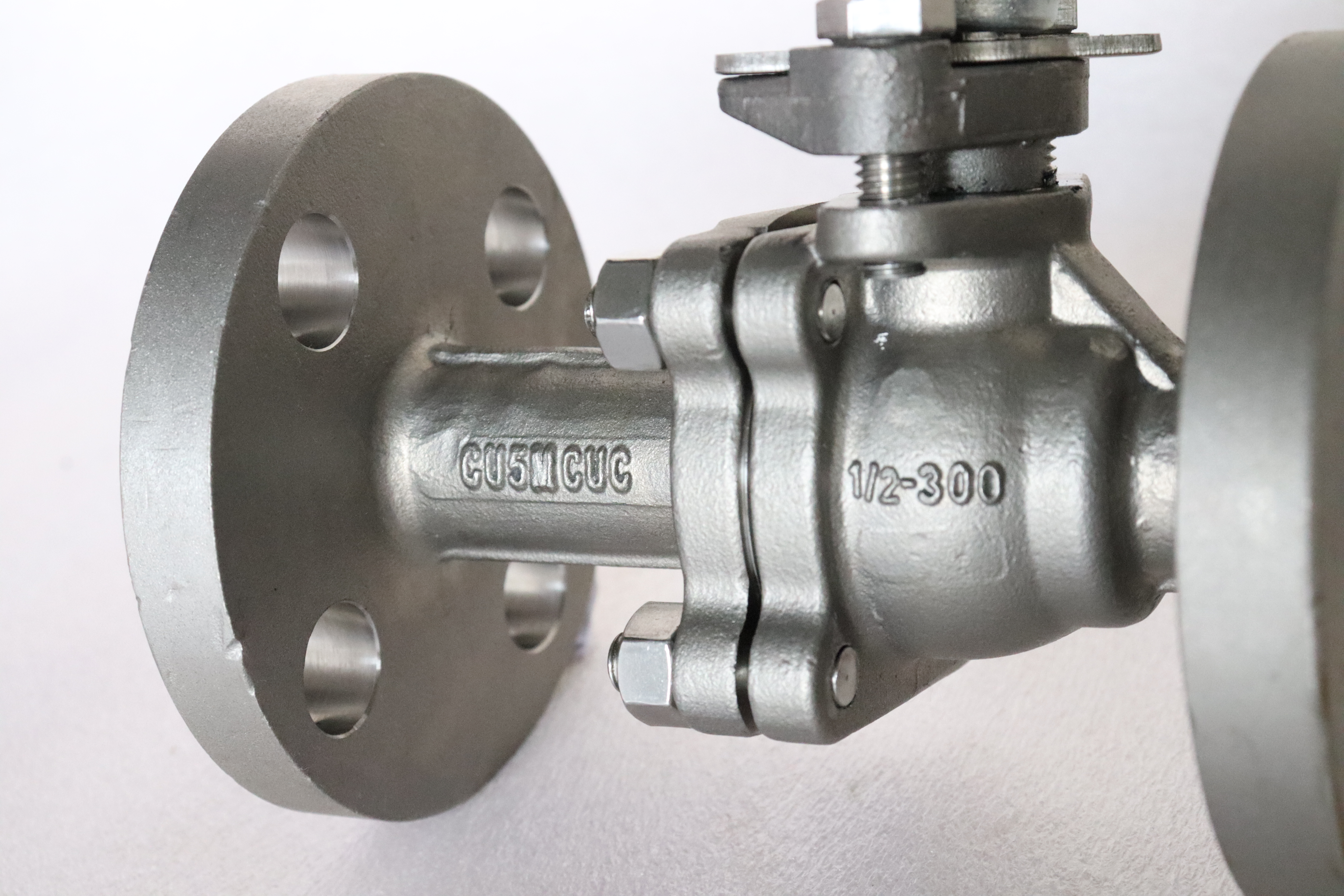
This is a half inch two piece floating ball valve in cast carbon steel, ASME Class 300, with raised face flanges to ASME B16.5 and a lever with a locking hole. The body is cast, not machined from bar, and the casting carries the size and class in raised figures: the photograph shows 1/2 and 300 cast into the side of the body alongside the works number. Four bolt holes in each flange, a two piece body with one bolted joint, and a lever that can be padlocked.
Two facts about this valve are worth knowing before the price is discussed, and neither of them is on the data sheet. The first is that at this bore the B16.5 flange for Class 300 and the flange for Class 600 share the same dimensions: same outside diameter, same bolt circle, same bolt size, same number of holes, same thickness. Buying Class 300 at half inch does not buy a smaller flange, it buys a lower rated body on an identical flange.
The second is that a cast body at half inch is a different proposition from a cast body at six inch. The wall is thin, the seat pocket sits close to the joint face, and the volume of metal around the seat is small, so the casting has to be made well rather than merely made. That does not make a cast half inch valve wrong; it makes the examination of the casting the item that decides whether the valve is worth its price.
Design and Construction of the Cast Two Piece Body
The body is split into a main body and one end cap with a single bolted joint, sealed by a flat gasket in a machined recess and located on a spigot so that the bore stays concentric when the joint is made up. At this size the joint carries two studs, which is enough for the load and few enough that the joint has to be tightened evenly rather than one fastener at a time. The end cap carries one seat ring and the main body the other, so opening the joint gives access to both seats and to the ball without disturbing the stem or the packing.
The ball is a half inch sphere lapped to a spherical form, sitting between two seat rings. The upstream pressure pushes it onto the downstream seat, and the upstream seat is left able to lift slightly when the cavity pressure rises, which is the self relieving behaviour of a soft seated floating valve. The stem passes through the neck, is sealed by packing under a gland, and is retained against blowout by a shoulder that cannot pass through the gland bore.
The lever is fitted on a square or flattened stem end and carries a locking hole through the handle, so that the valve can be locked in the open or the closed position. The travel stop limits rotation to a quarter turn. On this size the lever is short and the torque is low, which is one reason the locking hole matters more than the handle length: a valve that can be locked is a valve that will not be moved by the wrong person during a maintenance window. The hole is drilled through the handle rather than through a separate bracket, which keeps the lever from being swapped for a plain one during maintenance and quietly removing the lockout provision.
| Component | Standard Material | Optional Upgrade | Service Notes |
|---|---|---|---|
| Main body and end cap | ASTM A216 WCB cast carbon steel | A217 WC6 for higher temperature, A351 CF8 for corrosive service | Casting examined for porosity around the seat pocket |
| Ball | A105N or WCB with hard chrome | 304 or 316 stainless | Lapped, polished |
| Stem | A276 410 or 420 | 17-4PH | Blowout proof shoulder above the gland |
| Seat | PTFE | RPTFE, PPL | Seat compound sets the temperature ceiling |
| Packing | PTFE | Flexible graphite | Gland at the body neck, adjustable |
| Body gasket | Graphite or PTFE flat gasket | Spiral wound | Flat gasket in a machined recess |
| Bolting | A193 B7 with A194 2H nuts | B7M | Two studs at the body joint |
| End connection | Raised face flanged to ASME B16.5 Class 300 | RTJ facing, or threaded ends as a different body | Same flange dimensions as Class 600 at this bore |
| Operator | Lever with locking hole | Small gear, or a padlockable bracket | Quarter turn stops |

Material Options and What Cast Steel Means at This Size
WCB is the standard cast carbon steel for valve bodies and is right for water, oil, gas and steam inside the group 1.1 temperature range. At half inch the casting is small enough that the pour is the whole quality story: a small casting cools quickly, the metal can freeze before it fills a thin section, and a cold shut at the seat pocket will pass a visual inspection and fail a pressure test. That is why a small cast body is examined rather than assumed. The grade is specified by tensile and chemistry ranges rather than by a single number of properties, and two foundries pouring to the same specification can still differ in how well the thin sections fill, which is a reason to qualify the foundry rather than only the grade.
The ball and stem options are about wear rather than about corrosion. A hard chrome ball against a PTFE seat is the standard combination and is right for clean water and air. A stainless ball is specified where the medium would corrode a carbon steel ball, and on a valve this small the ball is usually the cheapest part to upgrade, so the choice is worth making deliberately rather than by default.
The seat compound is the temperature decision. PTFE is standard, RPTFE and PPL raise the ceiling, and none of them is a high temperature seat. Where the line runs hot, the answer is a different seat material and often a different body material, and the class does not change. On a half inch valve the seat is also the part that sets the operating torque, so a change of seat compound changes what the lever feels like. On a half inch valve the seat is also the part that wears first when the valve is used as a stop rather than an isolator, so the compound and the way the valve is operated are not independent choices.
Technical Specifications
The rows here are short because the valve is simple, and the two that carry the most weight are the flange note and the flange bolting row. Everything else, from the ball grade to the seat compound, is a choice the buyer makes and the works records; the flange note is a fact about the standard that the buyer needs before the order rather than after it. What the table cannot show is the reason the flange note exists: a fact about a standard that changes a purchasing decision is worth a row of its own even when it is not a property of the valve.
The flange note says that at this bore the B16.5 Class 300 and Class 600 flanges are dimensionally the same. That has two consequences worth stating. A valve ordered at Class 300 will bolt to a flange drilled for Class 600, which is convenient on a mixed plant and dangerous during an inspection, because the joint looks right whichever class was ordered. And a buyer who assumes a lower class means a smaller flange will find that at half inch it does not.
The temperature rows repeat the pattern used on every soft seated valve on this site: the body has a ceiling from the group 1.1 table and the valve has a lower ceiling set by the seat. On a cast carbon steel valve the gap between the two is wide enough that the seat is almost always the limiting item, which is why the seat compound appears in the specification rather than in a footnote.
| Item | Value |
|---|---|
| Product type | Two piece side entry floating ball valve, soft seated, lever operated |
| Nominal size | 0.5 inch, DN15 |
| Pressure class | ASME Class 300, PN 50 by its ISO designation |
| Rating basis | ASME B16.34, material group 1.1 |
| Body material | ASTM A216 WCB cast carbon steel |
| Body marking | 1/2 and 300 cast into the body with the works number |
| End connection | Raised face flanged to ASME B16.5 Class 300 |
| Flange bolting | Four holes per flange at NPS 0.5 Class 300 |
| Flange note | At this bore the Class 300 and Class 600 B16.5 flanges share the same dimensions |
| Face to face | ASME B16.10 for NPS 0.5 at Class 300 |
| Bore | Full bore to API 6D Table 1 for NPS 0.5 |
| Ball | A105N or WCB, hard chrome plated |
| Stem | A276 410 or 420, blowout proof shoulder |
| Seat | PTFE standard, RPTFE or PPL on request |
| Packing | PTFE, flexible graphite on request |
| Body joint | One bolted joint, two studs at this size |
| Operator | Lever with locking hole, quarter turn stops |
| Anti static | Ball to body through the stem, to API 608 |
| Fire safe | Metal shoulder behind the seat, API 607 and ISO 10497 |
| Product standard | API 608 |
| Test standard | API 598 |
| Certification | EN 10204 3.1 with heat number and part number |
| Temperature, body | Per ASME B16.34 group 1.1 at Class 300 |
| Temperature, valve | Set by the seat compound ordered, below the body ceiling |
Standards and Compliance
ASME B16.34 rates the body from the group 1.1 table, where the allowable pressure at each temperature is listed for the material group rather than for the individual grade. WCB sits in group 1.1 along with the other carbon steels, and the rating of this valve at its design temperature is a lookup in that table rather than a conversion from the class number. The rating is therefore a function of temperature as well as of class, and a valve that is correct for a cold water line at this class is not automatically correct for a hot one.
ASME B16.5 governs the flanges, and at NPS 0.5 it produces a result that surprises buyers. The Class 300 and Class 600 flange dimensions are identical at this bore: the same table row serves both classes up to NPS 1, and the classes separate only from NPS 1.5 upward. A half inch Class 300 valve therefore has the same flange as a half inch Class 600 valve, and the two are interchangeable on the pipe while being rated differently.
API 608 governs the product and applies here: the flanged scope runs from DN15 to DN600 at Class 150, 300 and 600, so a half inch Class 300 valve is inside it. The standard covers the body joint, the stem retention, the anti static path and the fire safe shoulder, and it is the document that a 608 compliance statement refers to, with API 598 for the pressure test. A 608 statement on this valve is therefore truthful, which is not the case at Class 900 or Class 1500 in the same catalogue, where the standard falls outside on class alone.
| Requirement | Standard | What J-VALVES Supplies |
|---|---|---|
| Pressure temperature rating | ASME B16.34, group 1.1, Class 300 | Rated pressure at the design temperature from the group 1.1 table |
| Flange drilling and facing | ASME B16.5, Class 300, NPS 0.5 | Four holes, facing and bolt circle to the B16.5 table, measured and recorded |
| Interchangeability note | ASME B16.5, NPS 0.5 | Flange dimensions identical to Class 600 at this bore, recorded on the drawing |
| Product design | API 608 | Body joint, stem retention, anti static path, fire safe shoulder |
| Casting quality | ASTM A216 with radiographic or penetrant examination as ordered | Casting examination record against the part number |
| Pressure testing | API 598 | Shell and seat test records, both seats, both directions |
| Material certification | EN 10204 3.1 | Heat number and part number on the certificate |
Manufacturing Process
The body and end cap are sand cast in the same heat, which is what lets one works number appear on both parts. At half inch the pattern work is the critical step: the seat pocket has to be cast close enough to size that machining removes a controlled amount of metal without cutting into a shrinkage void, and the wall around the flange has to be thick enough to hold the bolt holes without breaking through. Where the two parts are cast in different heats, two works numbers appear on the valve and the certificate has to name both, which is a detail worth checking on the marking rather than on the paperwork alone.
Machining is done in two stages with a pause between them for the casting to settle. The joint face and the flange faces are cut, the part is set aside, and the finishing cuts are taken afterwards, because a small casting moves after the first cuts and a joint face that is flat on the bench will not be flat when the studs are tightened. The seat pocket is then cut relative to the bore, and the flange facing is cut relative to the joint face.
The ball is turned, ground and lapped, then plated where hard chrome is specified. Assembly is done with the ball and seats fitted dry to check the float, then with the gasket and the two studs torqued evenly. The lever is fitted, the locking hole is checked against the handle, and the valve is marked, plugged and packed. The plating thickness is controlled on the sealing band rather than over the whole sphere, because a heavy plate on a half inch ball changes the ball diameter enough to alter the seat interference.

Quality Control and Testing
Every valve is shell tested at one and a half times the rated pressure and seat tested at one and one tenth, both to API 598, with each seat tested in each direction. On a cast body the shell test is also the examination that finds a cold shut or a through wall porosity, which is why the test is witnessed rather than simply recorded on a small casting. The test pressure is held for the duration API 598 sets for this size, and the valve is dried afterwards so that no test water sits against a carbon steel seat pocket during packing.
Casting examination follows what the order asks for. Radiographic examination of the body is the thorough option and is specified where the valve is going into a line that cannot be isolated easily; penetrant examination of the machined surfaces is the standard option and finds surface breaking defects around the seat pocket and the flange. Where neither is specified, the pressure test is the only examination, which is a decision worth making consciously.
Material identity is checked by spectrometry against the A216 ranges for WCB, and the result is recorded against the heat number. Dimensional inspection covers the bore, the face to face length, the flange bolt circle and facing, and the lever lock. Final marking records the size, class, grade and heat number, and the flange faces are protected before packing. The same test distinguishes WCB from a low alloy cast steel such as WC6, which matters where the valve has been ordered for a higher temperature duty and the marking alone would not prove it.
| Step | What Is Checked | Standard or Acceptance |
|---|---|---|
| Incoming casting | Visual and dimensional, wall thickness around the flange | Works procedure, pattern drawing |
| Casting examination | Penetrant, or radiographic where ordered | ASTM A216 and the order |
| Machining | Joint face, flange facing, seat pocket relative to the bore | Works drawing |
| Alloy identity | Spectrometry against A216 ranges for WCB | ASTM A216, all heats |
| Shell test | One and a half times rated pressure | API 598 |
| Seat test | One and one tenth rated pressure, both seats, both directions | API 598 |
| Dimensional | Bore, length, bolt circle, facing, lever lock | ASME B16.5, B16.10, API 608 |

Applications and Industry Service
Half inch Class 300 cast steel is a utility valve: plant air, instrument air, cooling water, low pressure steam, lube oil and small drains. It is chosen where a stainless valve would be unnecessary and a Class 150 valve would not match the line rating, which happens often on skids and packages where the piping class is 300 throughout. Package builders order it by the hundred for exactly that reason: the piping class on a skid is usually 300 throughout, and a valve that matches the class avoids a reducing spool at every take off.
It is also common as an isolation valve on gauges, sight glasses and small meters, where the lever with a locking hole is the reason for the selection: a valve that can be locked open prevents a gauge from being isolated by accident, and one that can be locked closed prevents a drain from being opened during a test. On a gauge root the valve is normally locked open so that the instrument stays live, and the locking hole in the lever is what makes that a procedure rather than a hope.
It is not the right valve for a line above the seat ceiling, for a medium that attacks carbon steel, or for a location where the valve will be operated constantly. Where the line is aggressive or the duty is frequent, the same size in a forged stainless body is the correct order, and the choice is about the body and not about the class. Where the medium is aggressive, the class is still correct and only the body material changes, which is why a forged stainless body at the same size and class exists in the same range.

Installation, Operation and Maintenance
The flange joint is made up with a new gasket and the four bolts tightened in a crossing pattern. Because the Class 300 and Class 600 flanges at this bore are dimensionally identical, a valve can be bolted to a flange drilled for either, and the only thing that changes is the rating of the joint; that is convenient, and it is also the reason a mismatch of class goes unnoticed until the line is pressurised. The bolts are tightened in stages rather than in one pass, because a flat gasket at this size takes its set during the first pass and the second pass is what actually loads the joint evenly.
The lever is operated a quarter turn and locked where the procedure requires it. The locking hole takes a padlock or a tag, and it is not a place to fit a bar for extra leverage. Where the valve is stiff, the cause is a dry packing or a damaged seat, and a longer lever converts that into a bent stem. The travel stop is inside the lever boss rather than in the body, so a lever removed and refitted in the wrong position will limit travel in the wrong place; the lever is marked for the open and closed positions for that reason.
Maintenance is limited to the packing, the seat and the ball, and on a two piece body the end cap has to come off to reach the seat and the ball. On a small valve in a utility line that is a short job with the line isolated, and the gasket is replaced at the same time because a compressed flat gasket is not reused. The body joint studs are the same grade as the flange bolting, so a joint opened in the field can be made up with fasteners from the same store as the flange bolts rather than with whatever is on the van.
How to Specify and Order
Six items make the order unambiguous: size and class, body material, end connection with its facing, seat compound, bolting grade and operator. At this bore the class is the item most often mis-specified, because the flange looks the same for Class 300 and Class 600 and the line rating is what decides which one to order. On a utility valve the operator is often the item that is left to the last minute, and a lever with a locking hole is not the same as a plain lever even though the price difference is small.
State whether the valve is to be locked open, locked closed, or both, since the locking arrangement is machined into the lever and cannot be added later by the site. State the gasket type as well, because a graphite gasket and a PTFE gasket are not interchangeable on a line that runs hot. Where the site intends to fit its own lock, the hole diameter matters as much as its presence, because a padlock shackle that does not pass through the hole turns a locked valve into an unlocked one.
Where the valve is replacing an existing one, order against the measured face to face length and the measured flange facing rather than against the class alone. J-VALVES quotes from the drawing for the size, the material and the trim ordered, and issues the certificate against the heat number that appears on the body. A replacement that is a few millimetres longer will not fit between two fixed flanges, and at this size the difference between two suppliers is easily that large.
FAQ
Q: Is a Class 300 flange at half inch smaller than a Class 600 flange?
A: No, and this is the one fact worth remembering about this size. In ASME B16.5 the Class 300 and Class 600 flange dimensions are identical up to NPS 1; the classes only separate from NPS 1.5 upward. So a half inch Class 300 valve carries the same flange as a half inch Class 600 valve, and the two will bolt to the same pipe flange.
Q: Then how can I tell a Class 300 valve from a Class 600 valve on site?
A: From the marking on the body, not from the flange. Since the flanges are dimensionally the same, the class is cast or stamped into the body and that is the only reliable indication. On a valve that has been repainted or where the marking is obscured, the certificate and the works number are the record rather than the flange measurement.
Q: Does a cast body at half inch have quality risks a machined one does not?
A: It has different ones. A small casting has thin sections that can cold shut, and a seat pocket close to the joint face where porosity would be a leak path. Those risks are managed by the foundry and by the examination: penetrant on the machined surfaces as a minimum, radiographic where the line cannot be isolated easily, and a shell test on every valve, which on a casting is also a soundness check.
Q: Is the lever lockable in both positions?
A: The hole is drilled through the handle so that the valve can be locked wherever the handle sits, which in practice means open or closed because the travel stops limit rotation to a quarter turn. The hole also takes a tag rather than a padlock, which is what most plants use for a valve that has to stay in one position during a maintenance window.
Q: Why does the page not give a pressure in bar?
A: Because the rated pressure of a WCB body at Class 300 depends on the design temperature and is read from the ASME B16.34 group 1.1 table rather than converted from the class number. A single figure printed on a data sheet would be right at one temperature and wrong at another, and the class marking on the body is what the site checks.
Q: Is this valve suitable for steam?
A: Inside the seat ceiling, yes, and PTFE is the limiting item rather than the body. Where the line runs hotter than the seat allows, the answer is a different seat compound and often a different body material, and the class stays the same. The valve is an isolator, so a line that needs regulation should have a separate valve for that duty.


Hot Products


News
Ball Valve Condition Monitoring: Which Signals Actually Predict A Failure
Torque signatures, acoustic emission, differential pressure and digital twin residuals: which measurements find a failing ball valve early.
Read More
Ball Valves in SWRO Desalination: The High Pressure Section Where Ordinary Seawater Valves Fail
Why SWRO high pressure valves fail early: recovery arithmetic, crevice temperature, ERD ripple, scale, letdown cavitation and surge.
Read More
Air Test And Water Test For Ball Valves: What Each Medium Can Prove
A ball valve can pass a hydrostatic seat test and still leak gas. Why air and water prove different things, and how to read a bubble, decay or helium test.
Read More
Ball Valve Flange Bolting: Preload, Relaxation And The Fasteners That Decide Leakage
A weeping flange is rarely the gasket. Preload, torque scatter, hardness limits and thermal relaxation decide whether the joint holds at 100 bar and 400 C.
Read More