CHINA J-VALVES Offers Various High-quality I ndustrial Ball Valves
J-VALVES, a distinguished professional ball valve manufacturer rooted in China, takes pride in its extensive product portfolio. Our offerings span a wide range, including trunnion-mounted ball valves, floating ball valves, high-temperature ball valves, high-pressure ball valves, metal-sealed ball valves, ultra-low temperature ball valves, DBB ball valves, Three-way And Four-way Ball Valve, and fully welded ball valves. Each product is a testament to our commitment to precision engineering and reliable performance. Meticulously crafted, they are designed to not only meet but exceed the most stringent industrial demands, ensuring stable operation even under extreme conditions. This enables us to provide our clients with high-value services and makes our valves widely sought-after in industries.
Product Category
Contact Us


-
J-VALVES-Q41F
-
J-VALVES
Overview of the J-VALVES WCB Two Piece Floating Ball Valve Without a Bleed Port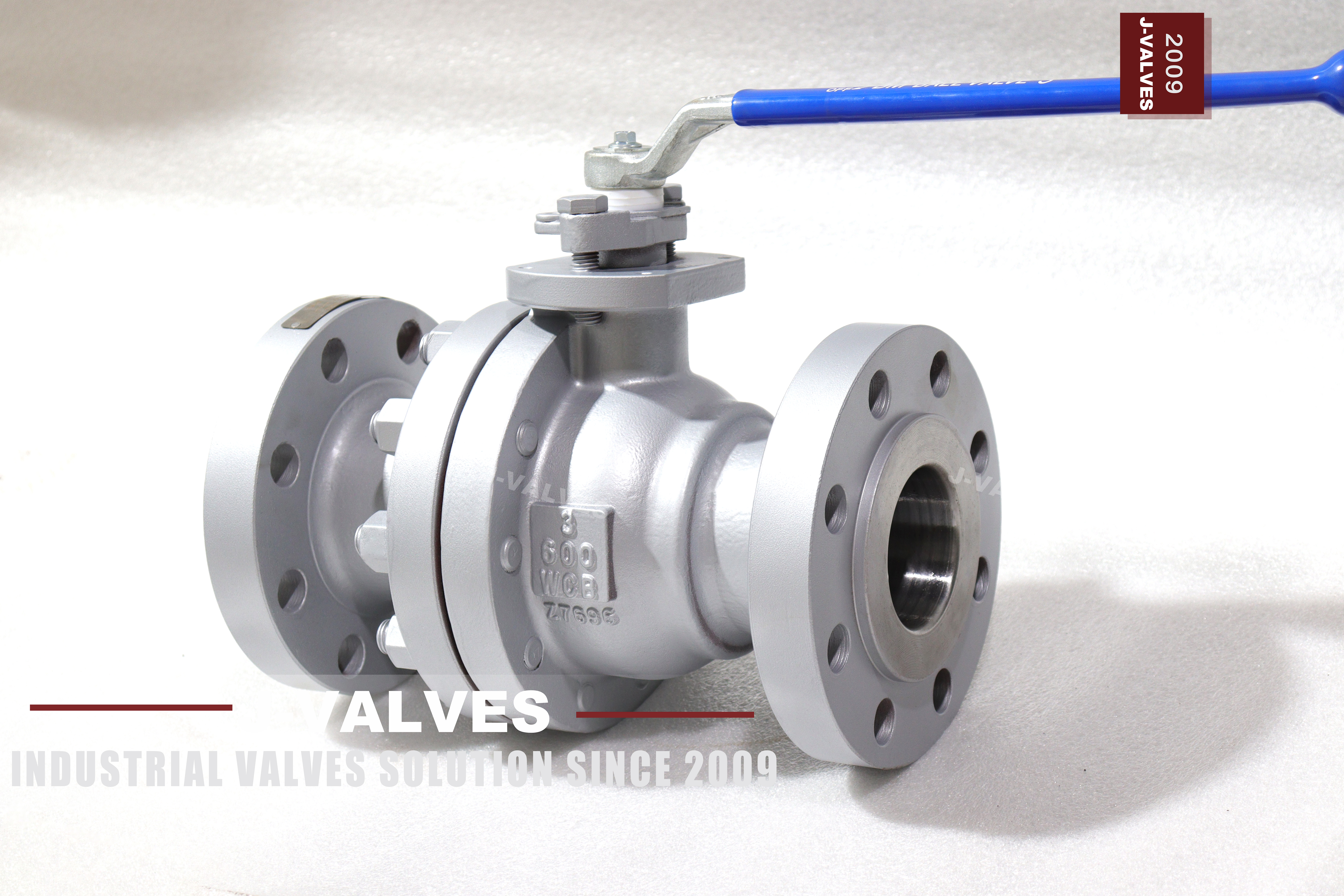
The enquiry for this valve usually arrives with a list copied from a trunnion page: double block and bleed, single or double piston effect, seat sealant injection. None of those three features exists on the valve in the photograph, and that is not a shortcoming of the valve. It is the arithmetic of what a two piece floating ball valve is: one ball, two seats, one bolted body joint, and no port into the body cavity. Everything else on this page follows from that one sentence. Everything that follows is about the version of this valve that exists, not the version the list describes.
What the valve does have is visible. There is a lever with a locking device, two raised face flanges, and a body joint running across the middle of the casting. What is missing is equally visible once you know to look for it: there is no boss on the body drilled for a drain, a vent or a grease fitting. A buyer checking whether a valve gives double block and bleed looks for that boss, and its absence answers the question before any drawing is opened.
The commercial point is worth stating plainly, because it decides quotations. A specification that asks for double block and bleed on a soft seated floating valve cannot be met by ticking an option box. It moves the product into a different structure, with two seats that seal in both directions, a trunnion to carry the ball, and an injection port. Knowing that at the enquiry stage saves the round trip; discovering it after the order is placed costs a schedule. A valve that is specified wrong is not corrected by a longer delivery date; it is corrected by a new enquiry.
Design and Construction
The body is split once. A main body carries the seat, the ball and the stem, and one end cap closes the assembly, so the ball and both seats load from the end cap side. That single joint is the whole pressure boundary of the shell, sealed by a gasket sitting in a machined recess and closed by a ring of studs. A three piece valve splits twice; this one splits once, which removes one joint and one set of bolting from the leak path. The joint sits mid body, which is also where the casting is thickest and where a leak is easiest to see.
The consequence for maintenance is not obvious from the drawing and deserves its own paragraph. On a three piece valve the four body bolts can be undone with the valve still in the pipe, and the ball and seats come out between the two end connections. On this valve, undoing the body bolts separates the valve into two halves, and the halves have to move apart. The valve comes out of the line, which means a spool piece, a pair of flange gaskets and a second shutdown.
The ball is not fixed. It sits between two seat rings and is free to move a short distance along the bore axis, so upstream pressure pushes it against the downstream seat and the sealing force rises with the pressure rather than staying constant. The stem only turns the ball and is not a shaft that carries the ball, so there are no trunnion bearings and no bearing blocks. The stem does carry a shoulder that prevents it from being blown out if the gland is dismantled under pressure. Because the stem carries no ball load, its diameter reflects packing friction and actuator torque, not structural demand.

Material Options
The body is ASTM A216 WCB, a cast carbon steel, and the two upgrades in the catalogue have narrow reasons rather than general ones. A350 LF2 exists on this list for low temperature service, where the carbon steel impact requirement changes. A105 exists for weld ends and for buyers who prefer a forging. For a raised face flanged valve at ambient utility duty, neither adds a rating, so the upgrade column should be read as a purchasing choice. What the buyer should ask for instead is the heat number, which travels with the 3.1 certificate.
The seat is the only non-metallic part in the sealing path, and it is doing three jobs at once. It seals, it insulates the ball from the body electrically, and it has to leave a metal shoulder behind it for the fire safe behaviour. That is why a seat in this valve is an assembly rather than a ring: polymer in front, metal behind. The certificate should name the compound, the supplier and the batch, because two compounds with the same trade description can differ in service.
There is exactly one gasket in this valve, and it sits in the body joint. It is also the part most likely to leak after the first seat change, because the joint is opened and closed again by hand in the field rather than in the workshop. A spiral wound graphite filled gasket suits the joint at this class. It is a one time part: it is replaced at every break, never re-used, and the stud torque is set by the manual rather than by feel on the wrench. A gasket that has been compressed once has already lost the resilience it needs for a second closure.
| Component | Standard Material | Optional Upgrade | Service Notes |
|---|---|---|---|
| Body and end cap | ASTM A216 WCB cast carbon steel | A105 forged, or A350 LF2 for low temperature | Upgrades answer temperature or weld ends, not pressure |
| Ball | Carbon steel with electroless nickel plating | Hard chrome, or a stainless overlay | The plating is the sealing surface and wears |
| Stem | A105 with ENP | 17-4PH, or 420 stainless | Carries torque only, with a blowout proof shoulder |
| Seat ring | PTFE or reinforced PTFE, with a metal shoulder behind | PPL to 280 °C, metal seat to 425 °C | Three functions: seal, insulate, back up the fire case |
| Body joint gasket | Spiral wound, graphite filled | — | One per break, never re-used |
| Packing | Graphite with wire reinforcement | PTFE V rings | V rings lower the ceiling to the PTFE figure |
| Bolting | A193 B7 studs with A194 2H nuts | B8M studs with A194 8M nuts | Lubrication changes the torque, not the grade |
| Operator | Lever with a locking device | Worm gear, pneumatic, electric | Sized from the measured torque, not a catalogue figure |
| Cavity port | None | None available | No drain, no vent, no injection point on this body |
Technical Specifications
A data sheet prints ranges and an order has to print a point, and three of the choices on this page change the valve rather than the paperwork. The bore decides the port and whether the pig passage claim holds. The seat compound decides the temperature ceiling. The end connection decides whether the valve bolts to a flange or is welded. The class and the size are fixed by the line, so they are the two items a buyer almost never gets to choose. Writing only the size and the class leaves three decisions to whoever fills in the order.
On bore, full bore is the standard build and it is what the pig passage sentence in the catalogue depends on. A reduced bore version is offered and it cuts weight and cost, but the port is smaller than the line and a pig sized for the pipe will not pass. It is also worth knowing that ASME B16.10 tabulates face to face by size and class rather than by bore, so the shorter overall length that a reduced bore suggests does not appear in the standard.
On rating, the class and the pressure designation are two names for one thing. The body is marked 600, and PN 100 is the designation that API 6D clause 7.2 writes against Class 600. The number that matters for a calculation is neither of those: it is the ASME B16.34 group 1.1 value at the design temperature, which is 1480 psi or 102.1 bar at 38 °C. Above that temperature the same table gives a lower figure, and no single number describes the whole range. The class on the body tells the site what the flange drilling is; it does not tell the engineer what the line may carry.
| Item | Value |
|---|---|
| Type | Two piece side entry floating ball valve, soft seated |
| Nominal size | DN80, NPS 3 |
| Pressure class | ASME Class 600, PN 100 by its ISO designation |
| Rating basis | ASME B16.34, material group 1.1, table value at design temperature |
| Body material | ASTM A216 WCB cast carbon steel |
| Body construction | Main body plus one end cap, one bolted joint, one gasket |
| Bore | Full bore as standard, reduced bore on request |
| Seat | PTFE or reinforced PTFE, with PPL and metal options |
| End connection | Raised face flanged to ASME B16.5, butt weld to B16.25 on request |
| Face to face | ASME B16.10, NPS 3 at Class 600 |
| Operator | Lever with locking device, quarter turn |
| Cavity port | None, so no drain, vent or sealant injection |
| Design standard | ASME B16.34 and API 608 |
| Test standard | API 598 |
| Fire test | API 607, and ISO 10497 as the equivalent document |
| Certification | EN 10204 3.1 with heat numbers and the seat batch |
Standards and Compliance
API 608 does apply to this valve, and it is worth saying why rather than leaving the claim to stand alone. The standard covers flanged ball valves from DN15 to DN600 in Classes 150, 300 and 600, and a DN80 Class 600 valve sits inside all three limits at once. There is no argument to make here. The same sentence explains the ceiling: at Class 900 the standard has nothing to offer, whatever the size, so a 900 pound valve cannot carry a 608 conformity statement at all.
What a standard does not do is make a claim about a factory. The old page carries a line headed API Licenses followed by 6DSS and 6A PSL4. Those are specifications for subsea pipeline valves and for wellhead equipment, and neither has any relationship to a DN80 utility isolation valve. Printing them on this page invites a question the valve cannot answer. A licence is an entry in a monogram programme for a specific product range, and it is either held for this range or not mentioned. A buyer comparing two quotations should read that line as a description of the factory's other products.
The fire sentence needs the same care. API 607 and ISO 10497 describe one test in two documents, and a valve qualified to one is qualified to the other. API 6FA is a different document with a different scope, and it asks for testing that includes metal seated variants, so citing it beside 607 for a soft seated valve is at best imprecise. The material note is dated rather than wrong: MR0175 has been superseded by MR0175/ISO 15156, and a current data sheet should write the pair. Both revisions are accepted where the older one appears, but only one of them is current.
| Requirement | Standard | What J-VALVES Supplies |
|---|---|---|
| Pressure and temperature rating | ASME B16.34, group 1.1 | Rating read from the table at the design temperature, stated on the data sheet |
| Product design and marking | API 608, flanged DN15 to DN600, Classes 150 to 600 | Conformity statement for DN80 Class 600, with the class cast on the body |
| Flange drilling | ASME B16.5, raised face | Flanges drilled to the class ordered, face finish stated on the drawing |
| Weld end geometry | ASME B16.25 | Weld end preparation to the standard when weld ends are ordered |
| Face to face | ASME B16.10 | Length per the table, verified on the first article |
| Pressure testing | API 598 | Shell and seat test on every valve, records with the certificate |
| Fire qualification | API 607, equivalent to ISO 10497 | Type test report for the size and seat combination supplied |
| Material certification | EN 10204 3.1 | Heat numbers for body, ball and stem, batch for the seat compound |
| Marking | API 608 and ASME B16.34 | Size, class, material, heat number and works number on the body |
Manufacturing Process
The two halves of the body are machined as a pair and stay a pair for the rest of their life. The joint face, the gasket recess and the bolt holes are cut with the two parts clamped together, so the recess depth and the hole positions agree by construction rather than by tolerance. A replacement end cap taken from another valve of the same size will bolt on and will leak, because the recess depth is a few hundredths out and the gasket cannot compensate. Both halves carry the same works number for that reason.
The seat pocket is cut after the joint face, because the joint face is what the pocket is measured from. Cutting them the other way round leaves the pocket dimension drifting with the face allowance, and on a soft seated valve the pocket depth sets how far the seat is compressed. The ball is ground and then plated, and the plating thickness and adhesion belong on the inspection record, since the plating is the surface that seals and the substrate behind it never touches the seat. A ball that is ground but not measured after plating is a ball whose sealing diameter is unknown.
Assembly is a sequence rather than a step. The gasket goes into the dry recess, the halves are closed, the studs are lubricated and run down in a cross pattern to the manual figure, and the valve is filled and shell tested. The joint is checked for weeping while the shell pressure is held, and the studs are re-torqued after the test, because a gasket that has taken a set under pressure is not at the same load it was when it was closed.

Quality Control and Testing
Every valve gets a shell test at 1.5 times the rated pressure and a seat test at 1.1 times, both at ambient temperature, both to API 598, with the hold time set by the size band in the standard. On a two piece valve the joint is the part that fails first, so the shell test is also the joint examination: the gauge proves the shell, and the eye on the joint line proves the assembly. A weeping joint is a re-work, not a re-test. The cost of the second test is a fraction of the cost of a joint that weeps on site.
The fire test is not performed on the valve being shipped. API 607 is a type test: a specimen of a given size and seat arrangement is burned and then pressure tested, and the report covers that combination. What the individual valve carries is the pressure test record and the material certificate. A buyer who needs to see fire documentation should ask for the type test report by size and seat compound, and should check that the size on the report is the size being bought. A report for a different size is not evidence for the valve in the crate.
Material traceability runs through the certificate. The body heat number is cast or stamped into the body and appears on the EN 10204 3.1 document together with the ball and stem heats and the seat batch. Castings are examined with penetrant on the machined surfaces as a standard step, and radiography is quoted when the line cannot be isolated for a repair. Nothing in this chain is inferred from a photograph, which is why the four parts inside the valve are documented rather than described.
| Step | What Is Checked | Standard or Acceptance |
|---|---|---|
| Incoming casting | Heat number, visual, wall thickness at the joint flange | Matches the certificate, no cold shuts on machined faces |
| Machining of the pair | Joint face flatness, gasket recess depth, bolt hole alignment | Both halves carry one works number, recess within drawing |
| Seat pocket | Depth and concentricity measured from the joint face | Depth sets seat compression, held to the drawing |
| Ball and plating | Diameter, roundness, plating thickness and adhesion | Plating is the sealing surface, thickness on the record |
| Assembly | Gasket fitted dry, studs lubricated, torque in a cross pattern | Manual figure, recorded per valve |
| Shell test | 1.5 times rated pressure, joint line watched | API 598, no weeping at the body joint |
| Seat test | 1.1 times rated pressure, both directions | API 598, leakage within the standard allowance |
| Re-torque | Stud load after the shell test | Gasket has taken a set, load restored to the manual figure |
| Final | Marking, lever travel, locking device, painting | Size, class, material, heat and works number legible |

Applications and Industry Service
This valve belongs on utility isolation: plant water, instrument air, oil headers, cooling circuits, and the isolation points on skids that are operated a few times a year rather than daily. That is the duty the structure suits, and it is why the two piece body is common in those positions. The valve is a soft seated isolator, so it shuts tight on clean service and it is not asked to regulate, to throttle, or to hold a differential open for long periods. The seat compound, not the body, is what limits the temperature on a clean utility line.
It does not belong where maintenance needs a positive double isolation. Double block and bleed means two seats that both seal and a port between them to prove it, and this body has neither. Where a line has to be opened with the upstream side still live, the answer is a trunnion valve with two pistons and a bleed valve, not a floating valve with an option added. The same applies to a line that needs the cavity vented for sampling or for draining. Both duties belong to a valve with a port into the cavity, and this body has none.
Frequent seat changes are the third reason to look elsewhere. Because the body has to come out of the line, a seat change on this valve is a planned shutdown item, and a plant that replaces seats every few months is paying for the body style twice. Outside the temperature range the seat offers, and below the impact temperature of the body, the constraint is material rather than structure, and it is answered by a different seat compound or a different body grade.

Installation, Operation and Maintenance
The valve is installed with the end cap on the downstream side. The reason is access rather than flow direction, since the valve seals in both directions: with the joint on the low pressure side, the body can be split later without breaking the upstream flange first. Flange faces are aligned before the studs are tightened, and the pipe is supported on both sides, because a two piece body is less tolerant of flange bending than a single casting with a heavy section. A joint that is pulled out of shape by unsupported pipe will weep long before the gasket is worn.
Operation is a quarter turn with stops at both ends, and the lever position is a direct indication of ball position because there is no gearbox between the two. The locking device takes a padlock or a tag through a hole in the handle, which matters where a valve has to stay in one position through a maintenance window. On a liquid line the valve is opened slowly, since a full bore floating valve opening quickly into a dead leg produces the surge the line was designed to avoid.
Maintenance on this valve is short and it is mostly about the joint. There is no grease port, so there is no routine injection task and no sealant to stock. When the seats are changed, the gasket is replaced at the same time and is never re-used, the studs are cleaned and lubricated, and the halves go back together as the pair they were machined as. A spare end cap kept in the warehouse is not a spare for this valve. The pair is the unit that was machined together, and only that pair can be closed again and hold.
How to Specify and Order
One sentence covers the order: a DN80 two piece floating ball valve, Class 600, full bore, soft seated, raised face flanged to ASME B16.5, lever operated with a locking device, designed to API 608, tested to API 598, with an EN 10204 3.1 certificate. Every word in that sentence closes an option that would otherwise be decided by the supplier. The two that are most often left out are the bore and the seat compound, and both change the valve. A quotation that omits them will be filled with the standard build, which may be the wrong one.
If the duty needs double block and bleed, the enquiry should say so at the top rather than in a note, because it changes the structure and the price together. A supplier who offers to add a bleed port to this body is describing a different valve, and the drawing should be asked for before the order. The same applies to sealant injection, which belongs on a valve with a metal seat and a trunnion, not on a soft seated floating body.
What J-VALVES needs from the buyer is the medium, the design temperature and pressure, the face to face constraint if the valve replaces an existing one, the actuator air supply and fail position if an actuator is ordered, the painting specification, and whether the certificate has to be 3.1. With those six items the quotation is a document rather than a price, and the drawing that comes back can be checked against the line it is going into. A drawing returned without those six items is a drawing that has not been checked against anything.
FAQ
Q: Does this valve have double block and bleed?
A: No, and it cannot be optioned in. Double block and bleed needs two seats that each seal in both directions plus a port into the cavity between them so the seal can be proved. A floating ball has one ball pushed against the downstream seat by line pressure, and the body in the photograph has no port into the cavity at all. Where that duty is required the answer is a trunnion mounted valve with two pistons and a bleed valve.
Q: Can a bleed port be added to the body when ordering?
A: Not to this casting. A port has to be designed into the body pattern with a boss, a thread and a path into the cavity, and it changes the pattern rather than the machining. A supplier offering to drill one afterwards is describing a modification that no standard covers on a soft seated body. If the duty needs a cavity vent, the enquiry should start from a different structure.
Q: Why does the catalogue list double block and bleed and piston effect then?
A: Because the feature block on the old page was written for a trunnion valve and carried across. Five of the six items in it describe a valve with a trunnion, two bidirectional seats and a cavity port, and none of those three things exists here. The items that do apply are the fire safe seat, the anti static path and the lever, and those are the ones this page documents.
Q: How long does a seat change take on a two piece valve?
A: It is a shutdown item rather than an in line job. Undoing the body bolts separates the valve into two halves, so the valve has to come out of the pipe, which means a spool piece, two flange gaskets and a second isolation. A three piece valve can be opened with the body still bolted in the line. The part to keep in stock is the body joint gasket as well as the seats.
Q: Is API 608 valid for this valve?
A: Yes. API 608 covers flanged ball valves from DN15 to DN600 in Classes 150, 300 and 600, and a DN80 Class 600 valve is inside all three limits. The same scope is why a Class 900 valve cannot claim it at any size. What the standard does not do is certify the factory, and the licence lines printed on some pages for subsea and wellhead specifications have no bearing on this valve.
Q: What temperature can this valve be used at?
A: The figure follows the seat, not the body. PTFE and reinforced PTFE are the standard build and set the ceiling well below the carbon steel limit, with PPL and a metal seat reaching higher. The range printed on the old data sheet is the envelope across all four options, so a single valve does not cover it. The rated pressure at any temperature is read from the ASME B16.34 group 1.1 table, not converted from the class number.


Hot Products


News
Ball Valve Condition Monitoring: Which Signals Actually Predict A Failure
Torque signatures, acoustic emission, differential pressure and digital twin residuals: which measurements find a failing ball valve early.
Read More
Ball Valves in SWRO Desalination: The High Pressure Section Where Ordinary Seawater Valves Fail
Why SWRO high pressure valves fail early: recovery arithmetic, crevice temperature, ERD ripple, scale, letdown cavitation and surge.
Read More
Air Test And Water Test For Ball Valves: What Each Medium Can Prove
A ball valve can pass a hydrostatic seat test and still leak gas. Why air and water prove different things, and how to read a bubble, decay or helium test.
Read More
Ball Valve Flange Bolting: Preload, Relaxation And The Fasteners That Decide Leakage
A weeping flange is rarely the gasket. Preload, torque scatter, hardness limits and thermal relaxation decide whether the joint holds at 100 bar and 400 C.
Read More