CHINA J-VALVES Offers Various High-quality I ndustrial Ball Valves
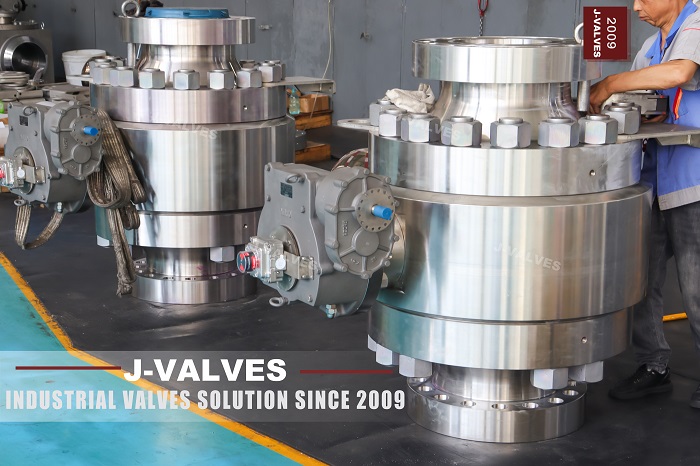
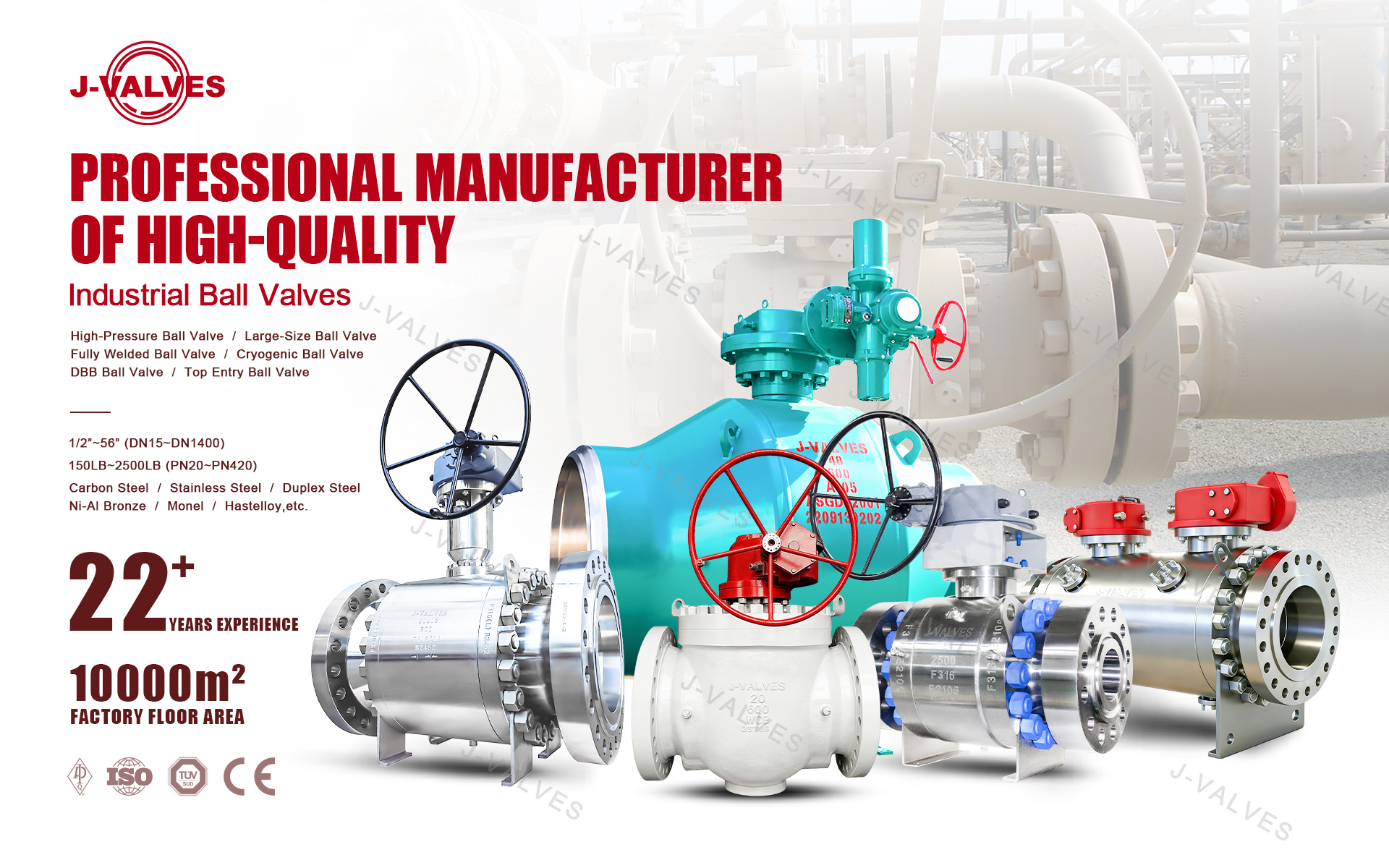
J-VALVES, a distinguished professional ball valve manufacturer rooted in China, takes pride in its extensive product portfolio. Our offerings span a wide range, including trunnion-mounted ball valves, floating ball valves, high-temperature ball valves, high-pressure ball valves, metal-sealed ball valves, ultra-low temperature ball valves, DBB ball valves, Three-way And Four-way Ball Valve, and fully welded ball valves. Each product is a testament to our commitment to precision engineering and reliable performance. Meticulously crafted, they are designed to not only meet but exceed the most stringent industrial demands, ensuring stable operation even under extreme conditions. This enables us to provide our clients with high-value services and makes our valves widely sought-after in industries.
Product Category
Contact Us

Pressure Class: ASME Class 150, 300, 600, 900, 1500
Valve Type: Floating or trunnion mounted ball valve
Actuator Type: Quarter-turn electric, on-off or modulating
Supply Voltage: 24 V DC, 24 V AC, 110-240 V AC, 380-415 V AC
Control Signal: Volt free contacts, 4-20 mA, 0-10 V, Modbus RTU
Duty Cycle: S2 15-30 min on-off, S4 30-75 percent modulating
Fail Action: Stay put, battery backup, or spring return motor
Enclosure: IP67 standard, IP68 on request, ATEX Ex d available
Body Material: WCB, CF8M, CF8, A105, F316
Seat: PTFE, RPTFE, PEEK, metal seated
Manual Override: Declutchable handwheel or hex drive
Design Standard: API 6D, API 608, ASME B16.34
-
Q961F
-
J-VALVES
An electric actuated ball valve is a quarter-turn ball valve driven by an electric motor and gearbox, with limit and torque switches that stop the motor at the end of travel and protect it if the valve jams. It needs no air, holds its position when power is removed, and gives position feedback as a standard feature. Those three properties are why it dominates where instrument air is unavailable, where the valve is far from a compressor, or where the control system wants a position signal rather than a limit contact.
J-VALVES supplies electric actuated ball valves from 1/2 to 24 inch, in floating and trunnion designs, with on-off and modulating actuators, supply voltages from 24 V DC to 380 V AC, IP67 or IP68 enclosures, explosion proof versions, and 4-20 mA or Modbus control. They are used on water and wastewater, HVAC, district heating, food and pharmaceutical skids, and remote pipeline locations. This page covers the on-off and modulating distinction, duty cycle, the three ways to handle power failure, and the enclosure choices that decide whether the actuator survives the site.

On-Off or Modulating
The two duties use different actuators, different control boards and different price brackets, and choosing the wrong one is expensive in both directions.
Property | On-off (open/close) | Modulating (regulating) |
|---|---|---|
Function | Drives to fully open or fully closed | Positions the ball at any angle in response to a signal |
Control signal | Volt free contacts, or two-wire control | 4-20 mA, 0-10 V, or a digital bus |
Positioning accuracy | Not applicable | Typically 1 to 2 percent of travel |
Duty cycle | S2, 15 to 30 minutes, a few cycles per hour | S4, 30 to 75 percent, continuous modulation |
Feedback | Open and closed limit switches | Continuous position, 4-20 mA |
Hunting | None | Must have a dead band, or the actuator will chase the signal and overheat |
Cost | Baseline | 40 to 120 percent more |
A modulating actuator on a ball valve is a poor control valve and a good shutoff valve. The ball's characteristic is roughly equal percentage in the first 60 degrees and then almost linear, and the seat is not designed for throttling: at small openings the flow is a high velocity jet across the seat, which erodes the seat and vibrates the ball. Where modulating control is genuinely needed, the usual answer is a segmented V-port ball or a proper control valve, with the electric actuator sized for the duty cycle rather than for a few cycles a day.
Duty Cycle: The Number That Burns Motors
Duty cycle describes how long the motor may run in a given period, and it is written on every actuator datasheet in a form that is easy to misread.
Rating | Meaning | Practical use | If exceeded |
|---|---|---|---|
S2, 15 min | Runs 15 minutes, then must cool to ambient | Small on-off valves, a few cycles per hour | Motor overheats, thermal protection trips, eventually winding fails |
S2, 30 min | Runs 30 minutes, then cools | Standard on-off duty, larger valves | Same, with a longer time to failure |
S4, 30% | 30 percent of each hour may be running | Light modulating duty | Gearbox and motor heat build up |
S4, 75% | 75 percent of each hour may be running | Continuous modulating, heating and cooling loops | Requires a larger motor; do not derate a 30 percent unit |
The trap is the "motorized ball valve" sold for general use with no duty cycle stated at all. On a building heating loop that modulates every few minutes, a 15 minute S2 actuator will fail within a season, and the failure is always described as a motor fault rather than a selection error.
Power Failure: Three Answers
An electric actuator holds position when power is lost, which is either exactly what is wanted or completely unacceptable depending on the line. There are three ways to provide a fail action, and each has a cost.
Method | How it works | Fail action | Limitation |
|---|---|---|---|
Stay put | No backup; the gear train holds the last position | Fail last | Only acceptable if the process can tolerate the valve staying open or closed |
Battery or capacitor backup | Stored energy drives one stroke on power loss | Fail closed or open, one stroke | Battery age and temperature; needs a health signal and a replacement schedule |
Spring return motor actuator | Springs close the valve when power is removed | Fail closed (some fail open) | Larger and more expensive; the spring must be reset by the motor each cycle |
On critical isolation, the honest engineering answer is often a spring return electric actuator or a pneumatic spring return unit, not a battery. Batteries are consumables, and a fail safe system that depends on a consumable needs a proof test schedule that most sites do not have.
Enclosure, Environment and Hazardous Area
The actuator is an electrical device in a wet, hot or explosive place, and its enclosure rating is the specification that is most often copied from a previous project without checking.
IP67 is the normal outdoor rating: dust tight and protected against temporary immersion. Adequate for most plant areas with a rain shield.
IP68 is required for buried, flooded or washdown locations, and the depth and duration must be stated, because IP68 without a depth is a marketing claim.
ATEX / IECEx Ex d for Zone 1 and 2 gas, with the certification covering the motor, the terminal enclosure and the cable entries. A general purpose actuator in a Zone 1 area is a finding at inspection and a real ignition risk.
Ambient temperature range must cover the site: a standard actuator rated to 55°C will derate or trip on a skid in direct sun in the Middle East, and a unit rated to -20°C will not start in a Siberian winter without a heater.
Enclosure heater is not optional in humid climates; without it, condensation inside the enclosure is a seasonal failure.

Commissioning Details That Get Missed
An electric actuator arrives with its limits set at the factory for a generic valve, and it must be set again on site.
Set the open and closed travel limits on the valve, not on the actuator's mid-travel. The closed limit is set with the ball on the seat, and the torque switch is set above the running torque but below the valve's damage torque.
Confirm the fail direction and the control mode: many actuators have a selector for open/close/stop and for local/remote, and a unit left in local will ignore the DCS.
Check the torque switch setting against the measured torque, not against the catalogue figure. A switch set too low trips on a cold morning; set too high, it does not protect the valve.
Record the position feedback at both ends: 4-20 mA span set at the actual travel, not at the nominal 0-100 percent.
Run three full cycles and check for overheating, unusual noise, and correct feedback at each limit.

Electric or Pneumatic
Factor | Electric | Pneumatic |
|---|---|---|
Stroke time | 10-60 seconds | 0.5-3 seconds |
Air supply | Not needed | Required, dry and at pressure |
Fail action | Battery, capacitor or spring return motor | Spring return, no external energy |
Cost at low torque | Lower | Higher |
Cost at high torque | Higher | Lower |
Modulating | Natural fit, 4-20 mA or bus | Needs a positioner, air hungry |
Remote location | Works anywhere with power | Needs an air line or a local compressor |
Sizing, Stroke Time and Torque Margin
Electric actuators are selected on three numbers, and a mistake in any one of them shows up as a motor that trips or a valve that stops half way.
Number | How it is established | Margin to apply | Consequence if wrong |
|---|---|---|---|
Break-to-open torque | Valve data, corrected for temperature and medium; ideally measured | 1.3-1.5 for electric, because the motor cannot absorb a stall | Torque switch trips on opening, or the motor stalls and overheats |
Running torque | Lower than break torque; sets the continuous load | Covered by the same margin | Overheating on long strokes and large valves |
Stroke time | Actuator output speed at the selected gear ratio; 10-60 s typical for quarter turn | Check against the process requirement, not the catalogue default | Too fast hammers the seat and the line; too slow misses an interlock |
Torque margin matters more on electric than on pneumatic, because a motor that is asked for more than its rated torque does not simply stall and wait: it draws locked-rotor current, heats up and relies on a thermal protector to trip. If the protector is set generously, or bypassed by someone in a hurry, the winding fails. That is why the torque switch on an electric actuator is a protection device and not a convenience, and why its setting has to be above the running torque and below the torque that would damage the valve.
Stroke time is a process number disguised as an actuator number. A 2 inch valve closing in 1.5 seconds on a water line will produce a pressure surge several times the working pressure, and the surge finds the weakest flange in the system. Where the process needs a fast closure on a large valve, the answer is a damped or two-stage closing arrangement, or a different valve type, rather than the fastest actuator available.
Electric Actuated Ball Valve FAQ
What is the difference between an electric and a pneumatic ball valve?
An electric actuator uses a motor and gearbox, needs no air, holds position on power loss and suits modulating duty. A pneumatic actuator uses air and a piston, strokes in under three seconds, and can fail safe with springs and no external energy. Electric wins where air is unavailable or position feedback is needed; pneumatic wins on speed, high torque cost and true fail safe.
What happens to an electric ball valve when the power fails?
By default it stays in its last position, because the gear train holds it. To move on power loss you need a battery or capacitor backup for one stroke, or a spring return electric actuator that closes when power is removed. Batteries are consumables and need a proof test schedule, so critical isolation often uses a spring return unit.
Can an electric ball valve be used for modulating control?
It can, with a modulating actuator rated S4 30 to 75 percent and a 4-20 mA or bus signal. But a standard ball valve is a poor throttling device: flow is nearly linear at small openings and the seat erodes in the high velocity jet. For real control duty, use a V-port or segmented ball, or a dedicated control valve.
What voltage options are available?
24 V DC and 24 V AC for small actuators and battery-friendly installations, 110 to 240 V AC single phase for general plant use, and 380 to 415 V three phase for large valves where torque is high. The voltage must match the site supply, and the control voltage is often separate from the motor voltage.
What does IP68 mean on an electric valve actuator?
It means the enclosure is protected against continuous immersion, but only at the depth and duration stated by the manufacturer. IP68 without a stated depth is a marketing claim. Buried or washdown locations need a stated depth, a stated duration and, usually, a breather or a sealed cable gland system.
What do you need to quote an electric actuated ball valve?
Valve size, class, body and seat material, design pressure and temperature, fluid, on-off or modulating, supply voltage and control signal, fail action, duty cycle, enclosure rating and hazardous area classification, ambient temperature, position feedback, manual override, and quantity.
Hot Products


News
Ball Valve Condition Monitoring: Which Signals Actually Predict A Failure
Torque signatures, acoustic emission, differential pressure and digital twin residuals: which measurements find a failing ball valve early.
Read More
Ball Valves in SWRO Desalination: The High Pressure Section Where Ordinary Seawater Valves Fail
Why SWRO high pressure valves fail early: recovery arithmetic, crevice temperature, ERD ripple, scale, letdown cavitation and surge.
Read More
Air Test And Water Test For Ball Valves: What Each Medium Can Prove
A ball valve can pass a hydrostatic seat test and still leak gas. Why air and water prove different things, and how to read a bubble, decay or helium test.
Read More
Ball Valve Flange Bolting: Preload, Relaxation And The Fasteners That Decide Leakage
A weeping flange is rarely the gasket. Preload, torque scatter, hardness limits and thermal relaxation decide whether the joint holds at 100 bar and 400 C.
Read More