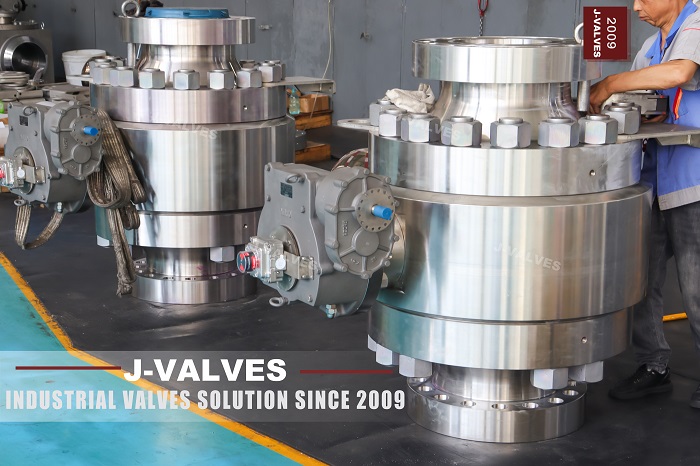
CHINA J-VALVES Offers Various High-quality I ndustrial Ball Valves
J-VALVES, a distinguished professional ball valve manufacturer rooted in China, takes pride in its extensive product portfolio. Our offerings span a wide range, including trunnion-mounted ball valves, floating ball valves, high-temperature ball valves, high-pressure ball valves, metal-sealed ball valves, ultra-low temperature ball valves, DBB ball valves, Three-way And Four-way Ball Valve, and fully welded ball valves. Each product is a testament to our commitment to precision engineering and reliable performance. Meticulously crafted, they are designed to not only meet but exceed the most stringent industrial demands, ensuring stable operation even under extreme conditions. This enables us to provide our clients with high-value services and makes our valves widely sought-after in industries.
Product Category
Contact Us


Pressure Class: ASME Class 150, 300, 600, 900, 1500, 2500
Isolation Grade: DBB, DIB-1 (two DPE seats), DIB-2 (one DPE, one SPE)
Body Style: Two piece, three piece, fully welded
Bleed Connection: 1/2 or 3/4 inch NPT with needle valve and pressure gauge
Cavity Relief: Thermal relief valve, drain port, or relieving seat carrier
Body Material: WCB, LCC, CF8M, A105, F316
Ball: A105 with ENP, or F316 hard chrome
Seat: RPTFE, PEEK, nylon; DPE or SPE; metal seated available
End Connection: Flanged RF / RTJ, butt weld
Design Standard: API 6D, ISO 14313, ASME B16.34
Fire Safe: API 607 / API 6FA available
Operation: Lever, gear, pneumatic, electric
-
Q347F / Q347Y
-
J-VALVES

A double block and bleed ball valve is a single ball valve whose two seats can isolate the upstream and downstream sides at the same time, with a bleed connection between them that vents or proves the space in between. It replaces two isolation valves and a spool with one body, and it is the standard answer wherever a line has to be positively isolated for maintenance, metering or custody transfer. The important word is positively: whether a given valve can actually do it depends on the seat design, not on the name on the drawing.
J-VALVES builds DBB ball valves as trunnion mounted, 2 to 24 inch, Class 150 to 2500, in two and three piece bodies, with double piston seats, a bleed port and, where specified, a cavity relief valve. This page defines the three isolation grades that get confused, shows what each seat type does under pressure, and sets out the test that decides whether a valve is a DBB valve or only looks like one.

The Three Grades: DBB, DIB-1 and DIB-2
API 6D and ISO 14313 describe three different things, and project specifications mix them up constantly. The difference is not marketing; it decides whether the isolation is valid in one direction or in both.
Grade | Seat requirement | Isolation achieved | Typical wording in a spec |
|---|---|---|---|
DBB | Two seats plus a bleed between them; the seats need not be bidirectional | Upstream and downstream isolated from the cavity at the same time, verified by bleeding the cavity | Double block and bleed, cavity vented to prove isolation |
DIB-1 | Two bidirectional seats, each proven to seal from both sides | Full double isolation in both directions, cavity independently relieved | Double isolation and bleed, DIB-1, two double piston seats |
DIB-2 | One bidirectional seat plus one unidirectional seat | Double isolation in one direction, single in the other | DIB-2, one DPE seat and one SPE seat |
In practice: every DIB-1 valve is a DBB valve, but not every DBB valve is DIB-1. A valve with two single piston effect seats can bleed its cavity and show zero pressure, and it still will not hold process pressure from the cavity side, because the seat relieves in that direction by design. That is why a DBB valve with SPE seats is correct for a liquid line that needs thermal relief and wrong for a metering run that needs two independent barriers.

What Each Seat Type Does Under Pressure
The seat is a piston. Its sealing behaviour depends on which side of that piston the pressure arrives from, and the two designs answer differently.
Situation | Single piston effect (SPE) | Double piston effect (DPE) |
|---|---|---|
Pressure from the bore, valve closed | Seals. Seat is pushed onto the ball | Seals. Seat is pushed onto the ball |
Pressure from the cavity | Lifts off and relieves into the bore | Seals tighter. Cavity pressure adds to seat load |
Cavity after bleeding | Stays at zero, any ingress relieves | Stays at zero only if both seats hold; any leak shows as pressure rise |
Trapped liquid warming up | Self-relieving, safe | No escape path; body or seat damage unless relief is fitted |
Isolation grade | DBB only | DBB and DIB-1 (both seats DPE) |
A DBB valve with DPE seats has a closed cavity between two seals. That is exactly what positive isolation needs, and it is also a pressure vessel that nobody designed. A slug of liquid trapped in the cavity when the valve closes will expand on warm-up or on a pressure drop, and because neither seat will relieve, the pressure goes into the body wall or pushes a seat carrier out. Every DPE valve therefore needs one of three provisions: a thermal relief valve on the body, a bleed port left connected to a closed drain, or a seat carrier with a controlled relief feature. A DBB valve delivered without any of them is a hazard with a nameplate.
Body Layout and the Bleed Connection
A DBB ball valve is a normal trunnion valve with one addition: a port drilled into the body cavity between the two seats, fitted with a small valve and usually a pressure gauge. The port is normally 1/2 inch or 3/4 inch NPT, and it is the part of the valve that gets specified last and matters most.
Three details decide whether the bleed works when someone needs it. The port must be full size to the cavity and not drilled through a seat carrier, or it will be blocked by the very seat it is meant to prove. The bleed valve must be rated for the class of the main valve, because it sees full cavity pressure, and a 1000 psi needle valve on a Class 1500 body is a common and dangerous substitution. And the outlet must be piped to a safe location, because bleeding a hydrocarbon cavity to atmosphere at a valve that may be hot is not a maintenance activity, it is an event.
Orientation matters too. The bleed port should be at the top of the cavity so gas collects at the port and can be vented, and so liquid can be drained through a second port at the bottom where the design provides one. A single port at the side will vent gas but will not drain liquid, which is the case that matters on a liquid line before maintenance.
Where DBB Valves Are Used
Application | Why DBB | Seat configuration |
|---|---|---|
Metering and custody transfer runs | Prove zero flow before proving or changing a meter | DPE both seats, DIB-1 |
Pig launcher and receiver isolation | Open the trap with a proven barrier between trap and line | DPE both seats, with cavity relief |
Wellhead and master valve | Two barriers in one body, compact, fewer flanges | DPE, often metal seated for sand |
Tank farm and loading lines | Isolate a tank or a loading arm for maintenance | SPE is acceptable where liquid relief is needed |
PSV and instrument isolation | Isolate a relief valve without shutting the system | DPE, small size, often 1-2 inch |
Compressor station and terminal | Maintenance isolation with a visible proof of zero pressure | DPE both seats |
The maintenance argument is what sells these valves. Two separate valves plus a spool gives the same isolation, but it takes three flanged joints, more space, more weight and three times the leak paths, and it still cannot prove that both valves hold without a bleed point in the spool. A single DBB body is smaller, cheaper to install and, critically, its isolation can be proven in one operation.

How a DBB Valve Is Tested
The test is the product. A valve that has not been through the sequence below cannot be called a DBB valve in a specification review, whatever the catalogue says.
Step | What is done | Pressure | Acceptance |
|---|---|---|---|
1 | Shell test, valve half open | 1.5 × the 38°C rating | No leak, no permanent deformation |
2 | Upstream seat test, downstream side open to atmosphere | 1.1 × rating | ISO 5208 rate A, no visible leakage |
3 | Downstream seat test, reversed | 1.1 × rating | Rate A, tested independently of step 2 |
4 | Cavity test, both seats closed, cavity pressurised | 1.1 × rating | Proves each seat holds from the cavity side; mandatory for DIB-1 |
5 | DBB proof, valve closed, cavity bled to zero | Rated pressure on both sides | No pressure rise in the cavity over the agreed hold period, normally 15 to 30 minutes |
6 | Bleed valve and gauge check | Cavity pressure | Bleed valve rated for full class, operates, no passing when closed |
7 | Torque and anti-static check | Rated differential | Torque recorded, 10 ohms or less ball to body |
8 | Cavity relief verification, when fitted | Set pressure | Relief opens at the set differential and reseats |
Step 5 is the one that separates a real DBB valve from a pair of seats in one body. With both seats closed and the cavity at zero, any leak past either seat shows up as a pressure rise in a closed cavity, and it shows up in minutes. The hold period and the acceptable rise should be written into the purchase order; a valve that passes at 5 minutes and fails at 30 has not passed.

Specification Mistakes That Cost Real Money
Six errors account for most DBB problems seen on site, and all six are visible on the datasheet before anything is manufactured.
Specifying DBB and receiving SPE seats. The valve bleeds to zero, passes its seat tests one at a time, and cannot hold a barrier from the cavity side. If the duty needs DIB-1, write DIB-1.
Specifying DIB-1 and receiving no cavity relief. Two DPE seats create a closed vessel. On a liquid line, the first warm day is the test.
Bleed valve under-rated. A 1/2 inch needle valve at 1000 psi on a Class 1500 valve is a fitting, not a barrier. Match the class.
Bleed port too small or blocked by the seat carrier. The proof of isolation cannot be performed, so the isolation is not proven.
No pressure gauge. The bleed tells you there is flow; the gauge tells you whether the cavity is at 2 bar or 20. Both are needed to sign a permit.
Full bore specified where reduced bore would do. On a DBB valve the body already carries two seats, and full bore adds size, weight and cost without adding isolation.
Selection Guide
Requirement | Configuration | Notes |
|---|---|---|
Positive isolation both directions, gas | DBB trunnion, DPE both seats, DIB-1, cavity relief | Test step 4 and 5 mandatory, records to be issued |
Isolation with liquid thermal relief | DBB trunnion, SPE both seats | Self-relieving; not DIB-1, do not claim it |
Isolation one direction, compact | DIB-2, one DPE and one SPE seat | State the flow direction on the body and the drawing |
Abrasive or high temperature | Metal seated DBB, DPE, Stellite faced | Leakage to rate D by agreement; torque up 1.5-2.5× |
Buried or inaccessible | Fully welded DBB with extended bleed line | Bleed line brought to a pit or above grade |

Double Block and Bleed Ball Valve FAQ
What is the difference between DBB and DIB-1?
DBB means two seats plus a bleed, so the upstream and downstream sides can be isolated from the cavity at the same time and the cavity vented to prove it. DIB-1 requires both seats to be bidirectional, each proven to seal from the bore side and from the cavity side, with the cavity independently relieved. Every DIB-1 valve is a DBB valve; a DBB valve with single piston seats is not DIB-1.
Can one DBB ball valve replace two isolation valves?
Yes, and that is its main commercial argument. One body replaces two valves and a spool, which removes flanged joints, weight, space and leak paths, and it allows the isolation to be proven by one bleed instead of by opening a spool. What it does not remove is the need to specify the seat type correctly, because a DBB valve with single piston seats will not give two independent barriers.
Why does a DBB valve with double piston seats need cavity relief?
Because two bidirectional seats turn the body cavity into a closed pressure vessel. Liquid trapped between them expands when it warms up or when line pressure drops, and there is no path out through either seat. Without a thermal relief valve, an open bleed to a closed drain, or a relieving seat carrier, the pressure finds the weakest part of the body or pushes a seat out.
How is double block and bleed proven on site?
Close the valve, open the bleed and let the cavity come to zero, then close the bleed and watch the pressure gauge. If either seat passes, cavity pressure rises, and the rate of rise tells you which seat is leaking if you test one side at a time. The hold period should be defined in the procedure, typically 15 to 30 minutes, with no measurable rise accepted.
What size bleed connection is normal?
1/2 inch NPT is the common default and 3/4 inch on larger valves or where a gauge and a drain are both needed. It must be full size into the cavity and rated for the full class of the main valve. A plugged port with no valve is not a bleed connection; it is a hole with a plug in it.
What do you need to quote a double block and bleed ball valve?
Size, class, isolation grade required (DBB, DIB-1 or DIB-2), seat type and piston effect, cavity relief method, bleed port size and outlet arrangement, body style, end connection, material, design temperature and fluid, fire safe and anti-static requirements, actuation, test standard with hold period, third party inspection, and quantity.
Hot Products


News
Ball Valve Condition Monitoring: Which Signals Actually Predict A Failure
Torque signatures, acoustic emission, differential pressure and digital twin residuals: which measurements find a failing ball valve early.
Read More
Ball Valves in SWRO Desalination: The High Pressure Section Where Ordinary Seawater Valves Fail
Why SWRO high pressure valves fail early: recovery arithmetic, crevice temperature, ERD ripple, scale, letdown cavitation and surge.
Read More
Air Test And Water Test For Ball Valves: What Each Medium Can Prove
A ball valve can pass a hydrostatic seat test and still leak gas. Why air and water prove different things, and how to read a bubble, decay or helium test.
Read More
Ball Valve Flange Bolting: Preload, Relaxation And The Fasteners That Decide Leakage
A weeping flange is rarely the gasket. Preload, torque scatter, hardness limits and thermal relaxation decide whether the joint holds at 100 bar and 400 C.
Read More