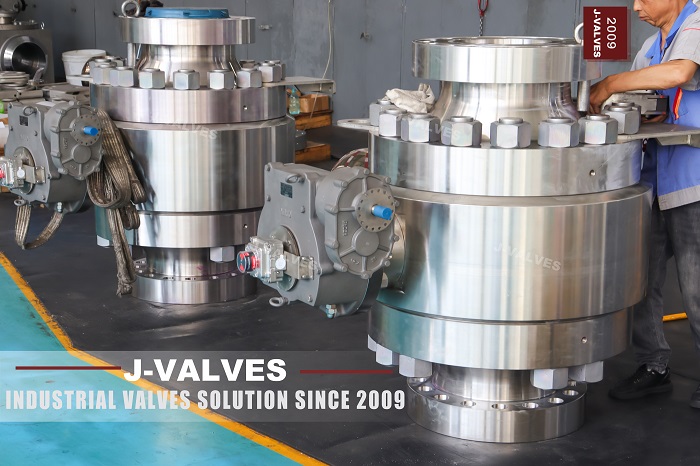
CHINA J-VALVES Offers Various High-quality I ndustrial Ball Valves
J-VALVES, a distinguished professional ball valve manufacturer rooted in China, takes pride in its extensive product portfolio. Our offerings span a wide range, including trunnion-mounted ball valves, floating ball valves, high-temperature ball valves, high-pressure ball valves, metal-sealed ball valves, ultra-low temperature ball valves, DBB ball valves, Three-way And Four-way Ball Valve, and fully welded ball valves. Each product is a testament to our commitment to precision engineering and reliable performance. Meticulously crafted, they are designed to not only meet but exceed the most stringent industrial demands, ensuring stable operation even under extreme conditions. This enables us to provide our clients with high-value services and makes our valves widely sought-after in industries.
Product Category
Contact Us

Pressure Class: ASME Class 150 to 900 / PN20 to PN150
Service Temperature: -50°C to -196°C
Bonnet:Extended, length sized to insulation and ambient
Body Material: CF8M, CF3M, F316
Seat: PCTFE, spring loaded
Stem: F316 extended stem, anti-blowout
Packing: Flexible graphite, gland above 0°C
End Connection: Flanged RF/RTJ, butt weld
Design Standard: API 6D, ASME B16.34, ISO 28921-1
Cryogenic Test: BS 6364
Orientation: Stem vertical to 45 degrees from vertical
Operation :Lever, gear, pneumatic or electric with bracket
-
Q347F
-
J-VALVES

A cryogenic extended stem ball valve is a quarter-turn isolation valve mounted on cold piping or inside a cold box whose packing gland is carried upward on a long bonnet to a point where the stem seal runs above 0°C, so the valve can be operated in liquid nitrogen, liquid argon, liquid oxygen or LNG service down to -196°C without the gland icing or the packing losing compression. J-VALVES builds this extended bonnet ball valve in CF8M and CF3M from 1/2 inch to 56 inch, ASME Class 150 to 2500, with the bonnet length set by the insulation thickness and the installation rather than by the valve size alone.
The question buyers actually ask about this family is how long the bonnet has to be. The honest answer is that the length is a thermal calculation with a mechanical consequence. A bonnet that is too short puts the gland in the frost zone; one that is too long adds heat leak, weight and a bending moment for the actuator bracket.
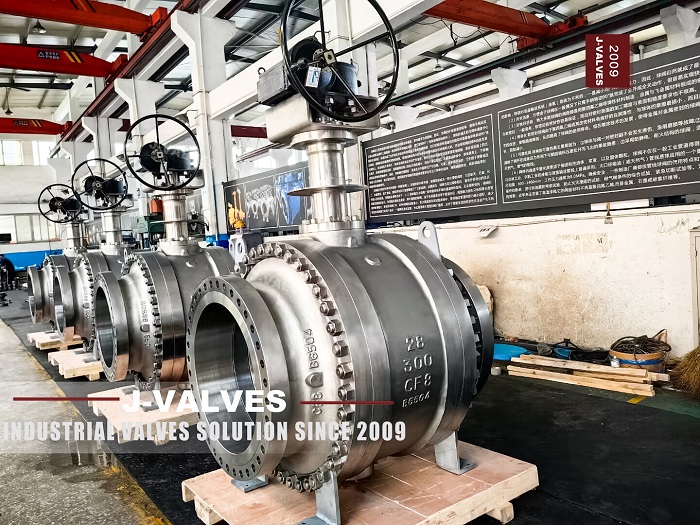
Why the Gland Has to Sit Above 0°C
A cryogenic extended stem ball valve lives or dies on the temperature of one small area: the packing box, roughly 60 mm of stem between the follower and the bottom of the stuffing box.
Packing is a compression seal, not a clearance seal. Flexible graphite needs a residual stress of several megapascals to stay in contact with the stem, and that stress is applied by the gland bolts at ambient temperature. When the box runs cold, three things happen at once. The stem contracts away from the packing, dropping the interface stress. Moisture condenses on the cold follower, freezes, and expands by about nine percent, jacking the follower up and releasing the bolts. And the ice ring around the stem is dragged into the box on each quarter turn, scoring the stem and breaking the graphite lamellae.
Below roughly -50°C the problem stops being academic. A gland at -100°C goes white with frost within minutes of commissioning, and the frost is not cosmetic: it is the 0°C isotherm sitting in the wrong place. BS 6364 treats this directly and requires the bonnet length to be sufficient for the insulation and the service temperature, which is why the extension is a design item and not an accessory.
There is also a practical reason. Someone has to adjust that gland during commissioning and again during maintenance, and a gland buried in a 150 mm insulation shell does not get adjusted.
The Heat Leak Path From Body to Packing
Heat reaches the cold body through three parallel routes, and the bonnet is the one that has to be tuned.
Conduction along the stem is the obvious path. A 316 stem of 25 mm diameter and 400 mm length carries heat from the warm end down to the ball, and a stainless thermal conductivity of roughly 16 W/m·K at room temperature falling to about 9 W/m·K near -196°C limits that flow. In a long bonnet the stem alone is not the largest term.
The larger term is the gas column in the bore. Cold vapour boils off the liquid at the bottom, runs up the wall, and gives up heat to the bore surface; warm gas returns down the centre. That circulation is efficient, and on a 500 mm bonnet it can carry several times the heat the stem conducts. Some designs break the loop with a baffle or a restrictor disc, and bore diameter becomes a design variable: a tight bore insulates better but makes the stem harder to guide.
That heat is not free. Every watt crossing the bonnet boils liquid inside the body or the line, and the boil-off is a continuous operating cost on an LNG plant. The order of magnitude runs from a few watts on a DN50 to several tens of watts on a DN300, which is why the bonnet is no longer than the thermal case requires.
Differential contraction ties the two sides together. The stem runs colder than the bonnet wall, so on a 500 mm bonnet it ends up roughly 1 mm shorter relative to the bonnet top than at assembly. The stem-to-ball engagement carries axial clearance for that offset, and the actuator coupling absorbs the remainder.
Bonnet Length Guide by Size and Insulation Thickness
An extended bonnet ball valve is normally specified from a table, and the table is driven by the insulation, not the pressure class. The values below are typical J-VALVES guide values for a vertical stem in still air at 20 to 35°C, with the gland at least 50 mm clear of the insulation. They are a starting point for the enquiry, not a standard, and are measured from the body centre line to the bonnet top.
Valve size | 50 mm insulation | 100 mm insulation | 150 mm insulation or cold box wall |
|---|---|---|---|
DN25 to DN50 | 250-280 mm | 300-330 mm | 340-350 mm |
DN80 to DN150 | 350-380 mm | 400-430 mm | 440-450 mm |
DN200 to DN300 | 450-500 mm | 520-560 mm | 580-600 mm |
DN350 to DN600 | 600-680 mm | 700-760 mm | 780-800 mm |
Two points matter here. Length grows with insulation thickness roughly one for one, because the 0°C point has to be pushed beyond the insulation surface. It also grows with size at constant insulation, because a larger stem conducts more heat and a larger bore circulates more gas, so the warm end has to be further away to reach the same temperature.
Above DN600, and on any valve that penetrates a cold box wall, the length is set per project from the insulation drawing and the calculated 0°C point. On a 56 inch valve the bonnet is a supported fabricated or forged structure, sized by thermal and stress analysis rather than by a band.
What Moves the Number Up or Down
Four site conditions can shift the bonnet length by 100 mm or more on the same valve, and all four belong in the enquiry.
Insulation thickness is the first and largest. The 0°C isotherm must land above the outside face of the insulation with a margin, typically 50 to 100 mm, so frost never forms on the insulated surface at the bonnet. Doubling the insulation from 50 mm to 100 mm adds about 50 to 80 mm of bonnet, not 50 mm, because the thicker shell also cuts the heat reaching the warm end.
Ambient temperature is the second. A valve at 50°C ambient has more heat at the top of the bonnet than the same valve at -20°C, so the 0°C point sits lower and a shorter extension holds the gland warm. Cold ambient cuts both ways: a valve standing in still air at -40°C may frost at the gland even with a long bonnet, and then the answer is a heated or purged gland, not more length.
Air movement is the third. Forced ventilation in a cold box, or wind on an open structure, removes heat from the bonnet far faster than still air, and a length that works indoors will ice up on an offshore module. The table assumes still air. For forced ventilation add 50 to 100 mm, or insulate the upper bonnet and accept a shorter gland life.
Cold box penetration is the fourth. When the bonnet passes through a box wall or roof, the length is set by the distance from the body to the wall plus the standoff for the penetration plate, the seal and the actuator. A valve mounted 300 mm inside the wall needs at least that distance plus the thermal margin, and the plate detail usually forces the next size up.
Extended Bonnet, Extended Stem and Bare Stem Compared
The long bonnet ball valve family covers three arrangements, and buyers use the names interchangeably when the hardware is not the same.
An extended bonnet carries the pressure boundary upward. The body neck is lengthened by casting, forging or welding, and the stem runs inside it with a guide near the top. The packing box sits at the far end, above the insulation, and the extension is a pressure part designed to the same class as the body and shell tested with it.
An extended stem keeps the standard bonnet and adds a sleeve or coupling that carries the shaft up through the insulation. The pressure boundary ends at the normal bonnet, so the packing box stays cold. This works for thin insulation on small valves, but it does not solve the icing problem.
A bare stem inside a cold box is the simplest case. The body sits on the cold line inside the box, the stem protrudes, and a long shaft or an actuator inside the box operates it. There is no thermal break, and maintenance means warming the box.
Feature | Extended bonnet | Extended stem, standard bonnet | Bare stem in cold box |
|---|---|---|---|
Packing box location | Above the insulation, above 0°C | At the body, at line temperature | At the body, inside the box |
Pressure boundary | Extended to the gland | Ends at the standard bonnet | Ends at the standard bonnet |
Gland icing risk | Low by design | High, the gland runs cold | Not applicable, no accessible gland |
Heat leak to cold body | Higher, by conduction and gas circulation | Lower | Lowest |
Actuator mounting | Bracket on the bonnet top, long moment arm | Bracket on the standard bonnet | Actuator inside the box or remote shaft |
Typical use | Cold box piping, LNG, air separation | Short insulation runs, small valves | Pump suction, box internals, short lines |
Maintenance access | From the operating floor | From the operating floor, cold gland | Requires box warm-up |
The insulation drawing usually makes the choice. Any valve whose gland would otherwise sit inside insulation needs an extended bonnet; the other two are compromises for mild thermal duty.
Installation Orientation: Vertical or Within 45 Degrees
A cold box ball valve is installed with the stem vertical, or within about 45 degrees of vertical. The limit is a constraint, not a preference.
The bore has to stay gas filled and thermally stratified. With the stem up, the cold end is at the bottom and the warm end at the top, and natural convection settles into a stable pattern: cold vapour forms at the bottom, rises, and cools the bore on its way up. Tip the bonnet towards horizontal and that pattern breaks down. Warm gas migrates down one side of the bore and the 0°C point wanders towards the gland, which is what the extension was built to prevent.
A horizontal bonnet also traps liquid. If the valve sits below the liquid line, or the line is filled for a cold start, liquid can flood the bore and sit against the packing. It boils there, drawing latent heat out of the gland, so the gland runs at product saturation temperature instead of ambient. On warm-up the trapped liquid expands and pushes out through the packing.
Mechanically, a long bonnet is a cantilever. A 600 mm bonnet with a 20 kg actuator on a horizontal axis puts a bending moment on the body-to-bonnet joint and deflects the stem guide. That closes the packing clearance on one side, raises torque, and on a large valve can bind the ball.
Stem down is never acceptable. The bore fills with liquid, the gland sits at the lowest point, and the ice has nowhere to drain.
Where the geometry forces the stem past 45 degrees, the fix is a change of design, not a longer bonnet: a supported extension, a remote actuator on a shaft, or a different valve location.
Insulation, Vapour Barrier and Penetration Plates on Site
Site insulation decides whether a correctly sized bonnet performs, and most first-winter failures come from this work rather than from the valve.
The body and lower bonnet are insulated with a cold-service material: cellular glass, PIR or PUR sections, or an aerogel blanket in tight spaces. Thickness follows the line specification, typically 50 mm on small bore and 100 to 150 mm on large cryogenic lines. The insulation stops at the calculated 0°C point and does not run up to the gland. Insulating the warm end cuts the heat reaching the packing and pulls the 0°C point down into the insulated zone, which produces exactly the iced gland the extension was meant to avoid.
The vapour barrier is the part that gets skipped. Cold insulation works only while it is dry; water vapour driven inward by the partial pressure difference condenses and freezes inside the material, and thermal conductivity climbs by a factor of two or three. The barrier has to be continuous from the pipe jacket, across the valve body, and up to where the insulation terminates, with no break at the flange or the bonnet transition. Use low-temperature mastic and a membrane rated for the service, and stagger the joints of pre-formed sections.
Penetration plates need their own detail. Where the bonnet passes through a cold box wall or roof, the plate carries the insulation and the vapour barrier across the gap, with a clearance hole around the bonnet and a flexible seal that follows the thermal movement of the box. The plate sits on the warm side of the barrier and is sized so the bonnet does not touch it in any operating case. A rigid welded plate around a bonnet that moves 3 mm on cool-down will crack the seal or load the bonnet.
Layer | Material | Typical thickness | Function |
|---|---|---|---|
Cold insulation on body and lower bonnet | Cellular glass or PIR sections | 50-150 mm | Limits heat leak into the cold body |
Vapour barrier | Membrane plus low-temperature mastic | 1-2 mm | Keeps water vapour out of the insulation |
Cladding or valve box | Stainless sheet or GRP | 0.5-1.0 mm | Mechanical protection and weather seal |
Penetration plate | Stainless or aluminium plate with flexible seal | Per box detail | Closes the box wall around the bonnet |
Gland zone | Left bare, no insulation | Not insulated | Keeps the packing above 0°C |
Actuator Mounting on an Extended Bonnet
An extended bonnet turns the actuator installation from a bracket on a valve into a bracket on a lever, and three things are checked before the valve leaves the factory.
Bracket stiffness comes first. The bracket sees actuator torque plus the weight of the actuator at the end of a long arm, and it has to hold deflection small enough that the coupling does not side load the stem. A fabricated bracket from 8 mm plate that is fine on a standard valve will flex visibly on a 600 mm bonnet; the answer is a machined or cast bracket with gussets, bolted to a flange on the bonnet top rather than clamped to the tube.
Stem alignment comes second. The bonnet top flange, the bracket and the actuator pilot have to be coaxial, because a long stem of small diameter has little tolerance for misalignment at the coupling. The adapter is machined to the stem key and the actuator bore as one item where possible, and the coupling is checked with the valve in both end positions.
Thermal offset comes third, and it is the one that catches people out. The stem moves axially by roughly 1 to 3 mm between ambient and -196°C, depending on bonnet length. If the actuator is rigidly coupled and the bracket references the body, that movement goes into the actuator thrust bearing or lifts the ball off its seat location. Bracketing to the bonnet top and leaving axial float in the coupling keeps the offset in the bracket instead of in the trim.
Two smaller points belong in the same check. A standard actuator is usually limited to -20°C or -40°C, so it must sit above the insulation and, outdoors in a cold climate, carry a heater. And the override and junction box have to be reachable from the operating floor, which on a 700 mm bonnet means a platform, not a stretch.
Check | Target | Why it matters |
|---|---|---|
Bracket deflection at full torque | Small enough to keep the coupling free of side load | Stem binding, torque rise, packing wear |
Coaxiality of bonnet top, bracket and actuator pilot | Machined as one assembly where possible | Coupling wear and stem side load |
Axial float in the coupling | Covers the thermal offset at -196°C | Thrust bearing damage, ball lift |
Actuator ambient limit | Above the local minimum, heater if needed | Torque loss and seal hardening |
Access to override and junction box | Reachable from the floor or a platform | Maintenance and emergency operation |

Where the Long Bonnet Valve Fits in the Plant
Cold box piping is the home application. Air separation units, nitrogen liquefiers and LNG pre-treatment modules run lines at -196°C inside an insulated box, and every isolation valve on those lines needs the gland brought out through the wall. The body sits on the cold line, the bonnet passes through the penetration plate, and the actuator stands on top of the box, which is also the only place a technician can reach it.
LNG terminals and send-out systems use the same arrangement at -162°C, on tank outlet lines, boil-off gas, send-out pumps and loading arms. Insulation there is thicker, 100 to 150 mm, and ambient can be 40°C or more, so the bonnet is typically 400 to 600 mm on DN80 to DN300. Seats are PCTFE, never PTFE.
Petrochemical and industrial gas plants use extended bonnets on ethylene and carbon dioxide lines, and on liquid oxygen and liquid argon service at -183°C and -186°C. The same valve, with a different seat and a different bonnet length, covers all of them, which is why the length belongs on the order as a number rather than being left to the standard.
Specification Data to Send With the Enquiry
A cryogenic extended stem ball valve cannot be quoted from size and class alone. The bonnet length is a project dimension, and the factory needs the thermal case to fix it.
Field | What to state | Example |
|---|---|---|
Size and class | DN and ASME class, with flange standard | DN100, Class 300, ASME B16.5 RF |
Service and minimum temperature | Product and design minimum | LNG, -196°C design, -162°C operating |
Body and bonnet material | Cast or forged grade | CF8M body, CF8M extended bonnet |
Seat and packing | Material and temperature basis | PCTFE seat, flexible graphite packing |
Bonnet length basis | Insulation thickness, ambient, air movement, penetration depth | 100 mm PIR, 35°C ambient, still air, 250 mm to box wall |
Orientation | Angle from vertical | Vertical, stem up |
Actuator interface | Standard, size, torque, weight | ISO 5211 F10, 200 Nm, 18 kg |
Testing and documents | Test standard, certificates | API 598 shell and seat, EN 10204 3.1, BS 6364 impact records |
The factory machines the bonnet to the stated length, tests shell and seat against the serial number, and issues the dimensional report with the bonnet length marked. Where site data is incomplete, the guide table above is used as a provisional value and flagged for confirmation, because a bonnet cut 100 mm short cannot be fixed on site.

Cryogenic Extended Stem Ball Valve FAQ
How long should the extended bonnet be on a cryogenic ball valve?
Long enough that the packing sits above 0°C with a margin, past the outside face of the insulation. As a J-VALVES guide for a vertical stem in still air, DN25 to DN50 runs 250 to 350 mm, DN80 to DN150 runs 350 to 450 mm, DN200 to DN300 runs 450 to 600 mm, and DN350 and above runs 600 to 800 mm. Thicker insulation, forced ventilation and cold box penetration each add length. These are guide values, not a standard.
Why must the stem packing stay above 0°C?
Because moisture in the air around the gland condenses on any surface below freezing, freezes, and expands by about nine percent. That ice jacks the gland follower up and releases the bolt load, so the packing loses compression and starts to leak. Ice also gets dragged into the stuffing box on each stroke and scores the stem. Keeping the packing warm keeps the seal stress where it was set at assembly, and keeps the gland adjustable during commissioning.
Does an extended stem change the pressure rating of the valve?
No. The rating belongs to the body, the closure and the pressure boundary, and an extended bonnet is designed as part of that boundary to the same ASME class, with the same wall thickness rules and the same shell test at 1.5 times the 38°C rating. What the extension does change is the mechanical duty: a longer bonnet adds bending moment at the body joint and at the bracket, so the extension is checked for that load case. Class 300 stays Class 300.
Can an extended stem ball valve be installed in any orientation?
No. Install with the stem vertical, or within about 45 degrees of vertical, and never stem down. A vertical bonnet keeps the bore gas filled and thermally stratified, so the 0°C point stays near the top, above the insulation. Tilt it towards horizontal and warm gas migrates down one side, the cold zone reaches the gland, and liquid can flood the bore. A horizontal long bonnet also puts the actuator weight on a cantilever.
How is the extended bonnet insulated on site?
Insulate the body and the lower bonnet with cellular glass, PIR or aerogel to the line thickness, and stop at the calculated 0°C point, leaving the gland bare. Carry the vapour barrier continuously from the pipe jacket across the valve to the insulation termination, with low-temperature mastic and staggered joints. At a cold box wall, fit a penetration plate with a clearance hole and a flexible seal, sized so the bonnet does not touch the plate as it moves on cool-down.
What is the lead time for an extended stem cryogenic ball valve?
Typically 4 to 8 weeks depending on configuration and material availability. A cryogenic valve is not a stock item: the bonnet is machined to the project length, the seats are PCTFE, the body and stem are impact tested and the certificate is issued against the serial number. Long bonnets above DN300, special flange drilling, NACE MR0175 bolting and actuator mounting all add time, so confirm the bonnet length and the actuator interface before the order is released.
Hot Products


News
Ball Valve Condition Monitoring: Which Signals Actually Predict A Failure
Torque signatures, acoustic emission, differential pressure and digital twin residuals: which measurements find a failing ball valve early.
Read More
Ball Valves in SWRO Desalination: The High Pressure Section Where Ordinary Seawater Valves Fail
Why SWRO high pressure valves fail early: recovery arithmetic, crevice temperature, ERD ripple, scale, letdown cavitation and surge.
Read More
Air Test And Water Test For Ball Valves: What Each Medium Can Prove
A ball valve can pass a hydrostatic seat test and still leak gas. Why air and water prove different things, and how to read a bubble, decay or helium test.
Read More
Ball Valve Flange Bolting: Preload, Relaxation And The Fasteners That Decide Leakage
A weeping flange is rarely the gasket. Preload, torque scatter, hardness limits and thermal relaxation decide whether the joint holds at 100 bar and 400 C.
Read More