CHINA J-VALVES Offers Various High-quality I ndustrial Ball Valves
J-VALVES, a distinguished professional ball valve manufacturer rooted in China, takes pride in its extensive product portfolio. Our offerings span a wide range, including trunnion-mounted ball valves, floating ball valves, high-temperature ball valves, high-pressure ball valves, metal-sealed ball valves, ultra-low temperature ball valves, DBB ball valves, Three-way And Four-way Ball Valve, and fully welded ball valves. Each product is a testament to our commitment to precision engineering and reliable performance. Meticulously crafted, they are designed to not only meet but exceed the most stringent industrial demands, ensuring stable operation even under extreme conditions. This enables us to provide our clients with high-value services and makes our valves widely sought-after in industries.
Product Category
Contact Us


-
J-VALVES-Q41F
-
J-VALVES
Overview of the J-VALVES Four Inch Nickel Aluminum Bronze Floating Ball Valve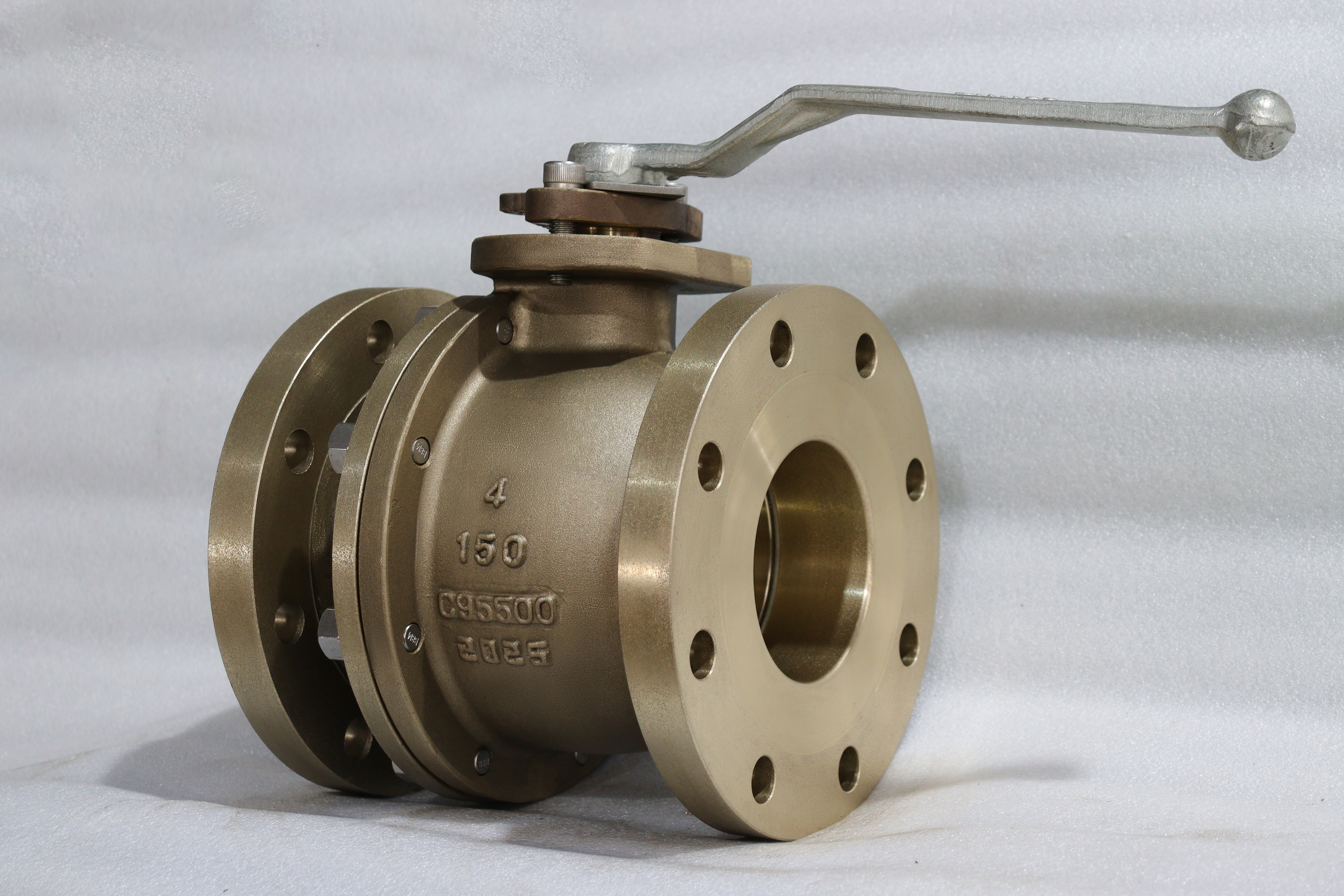
This is a four inch two piece floating ball valve with a body cast in ASTM B148 nickel aluminum bronze, rated ASME Class 150, which is PN 20 in the metric designation, and flanged to ASME B16.5 with eight bolt holes per flange. The ball floats between two seat rings and line pressure pushes it onto the downstream seat. The lever turns a quarter turn. None of that is unusual, and it is exactly why the page is worth reading: on a bronze valve the decisions that change the outcome are not in the size, the class or the bore.
The first decision is the flange facing. This valve can be supplied with a raised face or with a ring joint groove, and on a steel valve that is a note about gaskets. On a bronze valve it becomes a decision about which part is allowed to corrode, because a ring joint closes on a metal ring instead of a soft gasket, and a metal ring held against a bronze flange in seawater is a dissimilar metal pair with a predictable loser. The second decision is the alloy, C95800 or C95500, and neither can be read from the outside of the valve.
What follows is written for the buyer holding a piping class sheet that says bronze, Class 150, four inch, who has to turn that into an order that arrives correct. It gives no pressure in bar, no weight and no torque, because those three follow from temperature, from the pattern and from the seat compound rather than from the size, and a single figure printed here would be right on one line and wrong on the next. The class, the facing and the alloy are what this page can settle.
Design and Construction of the Ring Joint Flange Option
The body is split into a main body and one end closure with a single bolted joint. The joint is located on a spigot so the bore stays concentric when the studs are tightened, and it is sealed by a gasket sitting in a machined recess rather than on a flat face, which keeps the gasket from being extruded when the joint is made up hard. The end closure carries one seat ring and the main body the other, so opening the joint exposes both seats and the ball without disturbing the stem or the packing.
On the raised face version the sealing face stands proud of the bolt circle and the joint is closed by a gasket that is not metal: a spiral wound gasket with a graphite or PTFE filler, or a PTFE envelope gasket at the lower temperatures. The property that matters here is electrical rather than mechanical. A non-metallic gasket separates the bronze flange from the steel pipe flange, the dissimilar metal circuit is broken at the joint, and the current that would otherwise drive galvanic attack has nowhere to run.
On the ring joint version the face carries a machined groove and the joint closes on a metal ring softer than both flanges, so the ring deforms into the groove and the seal is metal to metal. ASME B16.5 defines the groove by ring number, and at NPS 4 Class 150 the groove takes an R series ring. The ring is sacrificial by design, which is sensible on a steel valve and awkward on a bronze one, because ring and flange are then two different alloys sitting in the same seawater, and the softer of the two is not the one that was specified for corrosion resistance.
| Component | Standard Material | Optional Upgrade | Service Notes |
|---|---|---|---|
| Main body and end closure | ASTM B148 C95800 nickel aluminum bronze | C95500, declared on the certificate | Grade is proven by heat number, not by appearance |
| Ball | Nickel aluminum bronze, polished | Hard chrome or ENP on the same alloy | Lapped against the seat after assembly |
| Stem | UNS N05500 nickel copper alloy | 316 stainless, 17-4PH | Dissimilar pair sits at the packing |
| Seat | RPTFE | PEEK, or a metal seat with hardfacing | Compound sets the temperature ceiling |
| Packing | PTFE V rings | Flexible graphite | Gland adjustable at the body neck |
| Body gasket | Graphite flat gasket in a machined recess | Spiral wound | Replaced every time the joint is opened |
| Bolting | Stainless steel studs with nuts | B7 studs with insulating washers | Bronze threads gall, so studs rather than bolts |
| End connection | Raised face to ASME B16.5 Class 150 | Ring joint groove for an R series ring | Facing decides which gasket list applies |
| Operator | Lever, quarter turn | Gear operator, or a padlock bracket | Lever is still practical at this size |
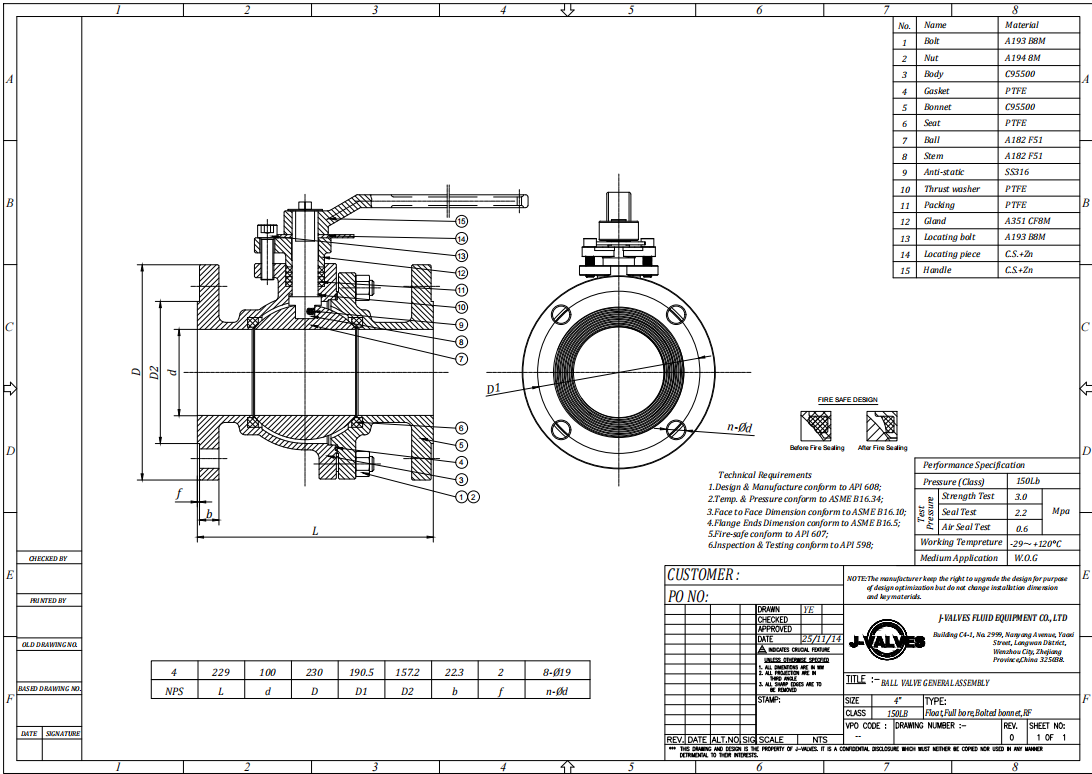
Material Options and the Two Bronze Grades on the Certificate
Nickel aluminum bronze is a copper alloy in which aluminium supplies the strength through a hard phase dispersed in the copper, while nickel and iron refine that phase and hold it stable. The metal resists seawater by forming a thin aluminium oxide film that repairs itself rather than by being noble, which is the reason it is used for bodies on desalination plants, seawater cooling systems and FPSO seawater duties where carbon steel would need a coating and stainless steel would pit under deposit. That film also means the alloy does not need a lining to survive, only a flow regime that does not tear the film off.
Two grades of ASTM B148 appear on the data sheet for this valve, C95800 and C95500, and this page does not choose between them because the sheet does not. Both are nickel aluminum bronze and both are acceptable in seawater, but they are separate grades with separate chemistry windows, and a certificate naming one of them is not a certificate for the other. The grade is declared on the EN 10204 3.1 certificate by heat number, so the first check on arrival is that the certificate and the marking on the body describe the same heat.
The trim is where the galvanic argument becomes practical. A 316 stem in a bronze body is a dissimilar pair sitting in an electrolyte, and the place where that pair matters most is where the electrolyte stands still, which is the packing region under the gland. The practical answers are either a stem in a nickel copper alloy that sits close to the bronze on the galvanic series, or the stainless stem with the packing area inspected at every service. What is not a good answer is to leave the choice to the workshop and find out from the certificate afterwards.
Technical Specifications
The rows below are short because the valve is simple, and the two that carry the most weight are the facing row and the certificate row. Everything else, from the ball finish to the seat compound, is a choice the buyer makes and the works records. The facing row is different in kind: it changes what has to be ordered alongside the valve, and a buyer who reads it after placing the order has usually already bought the wrong gaskets.
At NPS 4 in Class 150 the B16.5 flange carries eight bolt holes, and the facing is a separate decision from the drilling. That matters because two valves can be identical in drilling and still not be interchangeable, since a raised face closes on a soft gasket and a ring joint closes on a metal ring. The two facings also use different bolt lengths, because the ring sits in a groove rather than standing between the faces, and a stud cut for one will be wrong for the other.
The temperature rows follow the pattern used on every soft seated valve on this site. The body has a ceiling that comes from the rating table for the alloy, and the valve has a lower ceiling set by the seat compound. On a bronze valve the gap between the two is wide, so the seat is almost always the limiting item, which is why the compound appears in the specification rather than in a footnote at the bottom of the sheet.
| Item | Value |
|---|---|
| Product type | Two piece side entry floating ball valve, soft seated, lever operated |
| Nominal size | 4 inch, DN100 |
| Pressure class | ASME Class 150, PN 20 in the metric designation |
| Rating basis | Cast copper alloy class rating for the body, with the flange to ASME B16.5 |
| Body material | ASTM B148 nickel aluminum bronze, C95800 or C95500 as ordered |
| Body marking | Size and class cast into the body beside the heat number |
| End connection | Raised face or ring joint groove, ASME B16.5 Class 150 |
| Flange bolting | Eight holes per flange at NPS 4 Class 150 |
| Ring joint groove | R series groove to ASME B16.5, ring ordered separately |
| Face to face | ASME B16.10 for NPS 4 at Class 150 |
| Bore | Full bore, or reduced bore as a separate product |
| Ball | Nickel aluminum bronze, polished or hard chrome plated |
| Stem | UNS N05500 nickel copper alloy, 316 stainless or 17-4PH |
| Seat | RPTFE standard, PEEK or metal seat on request |
| Packing | PTFE V rings, flexible graphite on request |
| Body joint | One bolted joint with a gasket in a machined recess |
| Operator | Lever, quarter turn, gear operator on request |
| Anti static | Ball to body through the stem |
| Fire safe | Metal shoulder behind the seat, tested to API 607 |
| Product standard | API 608 for the flanged scope at Class 150 |
| Test standard | API 598 |
| Certification | EN 10204 3.1 with heat number and part number |
| Temperature, body | From the rating table for the alloy at Class 150 |
| Temperature, valve | Set by the seat compound ordered, below the body ceiling |
Standards and Compliance
A bronze valve is not rated by ASME B16.34. That standard is written for steel and alloy steel bodies and rates them from material group tables, and a C95800 casting does not appear in those tables. The document that rates a cast copper alloy flanged valve is the copper alloy class standard, which covers flanged valves from Class 150 upward and gives the allowable pressure at temperature for the alloys it lists. A data sheet citing B16.34 for a bronze body is citing the wrong document even when the class number comes out the same.
API 608 governs the product rather than the rating. Its flanged scope runs from DN15 to DN600 at Class 150, 300 and 600, so a four inch Class 150 valve is inside it, and the standard covers the body joint, the stem retention, the anti static path and the fire safe shoulder. What it does not do is give the body its pressure at temperature. That separation is worth keeping in the paperwork: a 608 compliance statement on this valve is true, and it says nothing about what the body will hold at a hundred and fifty degrees.
The third document is ASME B16.5, which governs the flanges and the ring joint groove. The facing has to be named on the order, because the groove and the raised face are not interchangeable and the ring is not in the valve box. Where the fire test is required, the test is run to API 607 with the seat in the compound that will ship, since a fire test on a different seat proves something about a different valve. The groove and the raised face also draw their gaskets from different lists, and the two lists do not overlap, which is why the facing has to be settled before the gasket schedule is issued rather than after.
| Requirement | Standard | What J-VALVES Supplies |
|---|---|---|
| Body rating | Cast copper alloy class rating | Class 150 body rated at the design temperature |
| Flange drilling | ASME B16.5 Class 150, NPS 4 | Eight holes per flange, raised face or ring joint |
| Ring joint groove | ASME B16.5 R series | Groove machined and gauged, ring quoted as a line item |
| Face to face | ASME B16.10, NPS 4 Class 150 | Dimension held on the signed general arrangement drawing |
| Product design | API 608, flanged scope | Body joint, stem retention, anti static path |
| Pressure test | API 598 | Shell and seat test with a record per valve |
| Fire test | API 607 | Certificate on the seat compound supplied |
| Material certificate | EN 10204 3.1 | Heat number traced to the casting and the test record |
Manufacturing Process
The body is cast rather than machined from bar, and at four inch that is a sand casting with a pattern that carries the flange, the neck and the seat pockets in one piece. The pour is the event that decides the valve. Aluminium in the melt oxidises quickly, so the gating has to fill the mould without turbulence that folds the oxide film into the metal, and the risers have to feed the thick flange section while the thin wall between the seat pockets is still liquid. A foundry that pours bronze every week does this by habit and one that pours it occasionally does not.
Machining starts at the flange face and works inward. The face is turned first and the seat pocket is cut from the same setting, because the concentricity between the flange and the seat is what keeps the ball centred in the bore and what keeps the joint from fighting the pipe. Where a ring joint groove is ordered, the groove is cut in the same operation as the face, since a groove recut after the face has been refinished moves the sealing plane and the ring no longer sits where the drawing says.
Assembly is the part that cannot be inspected afterwards. The ball is lapped and then checked against the seat with marking compound before the joint is closed, the stem is fitted with its shoulder above the gland so it cannot blow out, and the packing is set with the gland just tight enough to seal without loading the stem. The shell test then proves the casting, and the seat test proves the lapping. Both are recorded against the serial number, which is what makes the certificate worth reading.

Quality Control and Testing
Chemistry is checked per heat before the castings are released to machining, and the heat number is the thread that ties the whole valve together. It appears on the certificate, on the test record and on the body. A buyer who wants to know whether the alloy is C95800 or C95500 does not look at the colour, which is the same for both; the answer is in that chain. Spectro analysis on the finished casting is the check that catches a mixed charge at the foundry, and it is cheap next to the cost of a wrong certificate.
Surface examination is by penetrant on the machined flange face and around the seat pockets, which is where a bronze casting leaks if it is going to. Porosity in a bronze casting is not automatically a defect, since some is normal in sand castings, and the acceptance question is whether the indication is isolated or connected. Radiography is available on request for valves going into a line that cannot be isolated for a repair, and the report is more useful than the film for most buyers.
Pressure testing follows API 598, with a shell test on the assembled body and a seat test in both directions. On this valve the seat test is also the check on the lapping, so a seat that weeps tells the works that the ball and the seat have to come out before the valve ships rather than after it is installed. Where a ring joint groove is supplied, the groove is gauged against the ring number before dispatch, because a groove that is out of tolerance is not something a site can correct.
| Step | What Is Checked | Standard or Acceptance |
|---|---|---|
| Heat chemistry | Alloy identity against the grade ordered | Spectro per heat, recorded on the 3.1 certificate |
| Casting examination | Surface indications on machined faces and seat pockets | Penetrant as standard, radiography on request |
| Flange machining | Face square to the bore, groove to ring number | Gauged against ASME B16.5 for the size and class |
| Ball and seat | Sphericity and contact pattern | Lapping checked with marking compound |
| Shell test | Body and joint under pressure | API 598 shell test, no leakage or sweating |
| Seat test | Both directions, seat compound as shipped | API 598 seat test at the rated pressure |
| Stem and packing | Blowout retention, gland setting | Stem shoulder above the gland, packing leak free |
| Marking | Size, class, heat number, works number | Compared against the certificate before packing |

Applications and Industry Service
The obvious duty is seawater, and within seawater the most common single application is desalination. A reverse osmosis train has seawater on the feed side, brine on the reject side and permeate in between, and the valves that fail first are the ones in the brine line where chlorides are highest and the flow is turbulent. A nickel aluminum bronze body with a soft seat is a reasonable answer there, and the facing question comes up immediately, because plant piping classes in that industry are often written to a European flange standard while the valve is ordered to B16.5.
The second duty is seawater cooling on ships and onshore plants, where the valve sits in a line that runs intermittently and stands full between runs. Standing seawater is harder on a valve than flowing seawater, because the oxide film does not repair without flow and biofouling starts on any surface that stays wet and still. That is the argument for keeping the seat and the ball accessible, and for choosing a facing that lets the joint be broken without destroying the gasket, which is a point in favour of the raised face on lines that are opened for cleaning.
What the valve is not for is worth stating as plainly. It is not a control valve and should not be used to throttle, because a partly open soft seat erodes on the downstream edge and a floating ball in a half open position is unstable in a way that a trunnion ball is not. It is not a high temperature valve: the body alloy will take more heat than the seat will, and the seat is what ships. It is also not a substitute for a lined valve in a chemical service where the medium attacks copper, where the answer is a different body material rather than a thicker one.

Installation, Operation and Maintenance
Installation is a flange make up and the details are where these valves get damaged. The studs go in with the threads clean and lightly lubricated, and they are tightened in a cross pattern in stages rather than one at a time, because a bronze flange is softer than a steel one and an uneven pull will distort the face before the joint is even closed. On a ring joint the ring goes in dry and centred, and the joint is closed until the faces meet the ring, not until the studs feel tight.
A ring that has been compressed once should be replaced when the joint is opened, and that is a running cost worth knowing before the facing is chosen. The groove is also the part that cannot be repaired on site: a raised face that is scratched can be dressed with a stone, while a grooved face that is damaged needs the valve out of the line. Where a plant expects to break a joint for cleaning every season, the raised face is the facing that survives maintenance.
Operation is a quarter turn and nothing more. The lever stops are set at the works and the valve is not designed to be held part open, so a valve found in a half position has usually been used as a throttle and should be examined. Maintenance is limited to the packing gland and, at longer intervals, to the seats, which are reached by splitting the body joint. Because the ball is not carried on trunnions, the seats take the whole load and are the wear item on a valve that is cycled often.
How to Specify and Order
An order for this valve needs the size and the class first, and both should be written in the form the flange standard uses: NPS 4, ASME Class 150, with the metric designation noted rather than substituted. Then the facing, named as raised face or ring joint, with the groove ring number where a ring joint is ordered and the ring itself listed as a separate line, because it does not come in the valve box and a site that discovers this at installation loses a day.
The third line is the alloy. C95800 and C95500 both appear on the data sheet and the order must name one, since the certificate will name one and the two are not the same grade. Then the trim: ball finish, stem alloy and seat compound, each written out rather than offered as a slash list. Then the operator, with the lever as standard and a gear operator named where the valve will be operated against a differential that a lever cannot hold.
The last lines are the paperwork. API 598 test record, EN 10204 3.1 certificate with the heat number traced, API 607 fire certificate where the line requires it, and a note of the flange standard and gasket list the joint is being made to. That last note is the one that gets left off and the one that causes the most rework, because the valve will arrive correct for the standard that was ordered and the pipe will be drilled to another.
FAQ
Q: Why does the facing matter more on a bronze valve than on a steel one?
A: Because the ring joint closes on a metal ring rather than on a soft gasket. On a steel valve both the flange and the ring are steel alloys with a small potential difference. On a bronze valve the flange is a copper alloy and the ring is a soft iron or low alloy steel, so the joint contains a dissimilar pair sitting in the line medium, and the ring, being the softer and less noble of the two, is the part that goes first.
Q: Can I use a raised face gasket on a ring joint flange?
A: No. The groove removes the flat annulus the gasket needs, so the two facings take different gaskets from different lists and they are not interchangeable. A ring joint also needs a ring that is bought separately, and a site that finds this out at installation loses a day, which is the practical reason to settle the facing before the gasket schedule is issued.
Q: Is the ring reused when the joint is opened?
A: It should not be. The ring seals by being compressed into the groove, so a ring that has already deformed has done its work and a second make up relies on a shape that is no longer the one the groove was machined for. That is a running cost of the ring joint facing and it is worth knowing before the facing is chosen for a line that is opened every season.
Q: Which grade is the body, C95800 or C95500?
A: The source data sheet names both, and this page does not choose between them on the customer behalf. Both are ASTM B148 nickel aluminum bronze and both are used in seawater, but they are separate grades with separate chemistry windows, so the order has to name one and the certificate has to name the same one. The check on arrival is the heat number, not the colour of the casting.
Q: Does the page give a pressure rating in bar?
A: No. A bronze body is rated from a table that gives allowable pressure against temperature for the alloy and the class, so a single figure would be correct at one temperature and wrong at the next. The class and the design temperature are what belong on the order; the number that follows from them belongs on the rating sheet, and it is read rather than converted.
Q: What is this valve not suitable for?
A: Throttling, high temperature steam, and any medium that attacks copper. A partly open soft seat erodes on the downstream edge and a floating ball held off its seat is unstable in a way a trunnion ball is not. Above the seat compound ceiling the limiting item is the seat rather than the body, and the answer there is a different seat or a different valve rather than a higher class.


Hot Products


News
Ball Valve Condition Monitoring: Which Signals Actually Predict A Failure
Torque signatures, acoustic emission, differential pressure and digital twin residuals: which measurements find a failing ball valve early.
Read More
Ball Valves in SWRO Desalination: The High Pressure Section Where Ordinary Seawater Valves Fail
Why SWRO high pressure valves fail early: recovery arithmetic, crevice temperature, ERD ripple, scale, letdown cavitation and surge.
Read More
Air Test And Water Test For Ball Valves: What Each Medium Can Prove
A ball valve can pass a hydrostatic seat test and still leak gas. Why air and water prove different things, and how to read a bubble, decay or helium test.
Read More
Ball Valve Flange Bolting: Preload, Relaxation And The Fasteners That Decide Leakage
A weeping flange is rarely the gasket. Preload, torque scatter, hardness limits and thermal relaxation decide whether the joint holds at 100 bar and 400 C.
Read More