CHINA J-VALVES Offers Various High-quality I ndustrial Ball Valves
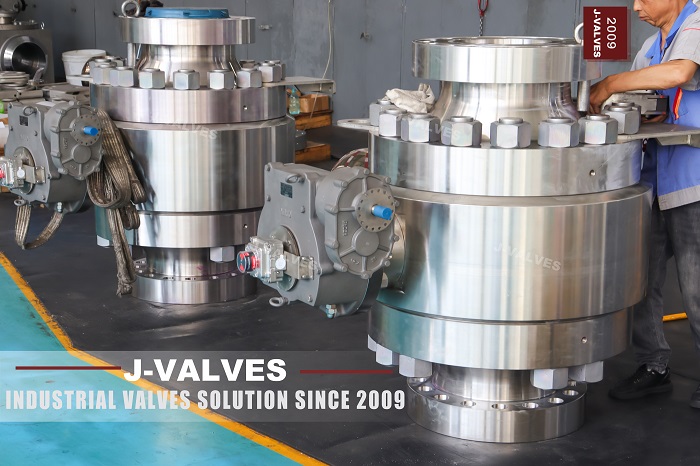
J-VALVES, a distinguished professional ball valve manufacturer rooted in China, takes pride in its extensive product portfolio. Our offerings span a wide range, including trunnion-mounted ball valves, floating ball valves, high-temperature ball valves, high-pressure ball valves, metal-sealed ball valves, ultra-low temperature ball valves, DBB ball valves, Three-way And Four-way Ball Valve, and fully welded ball valves. Each product is a testament to our commitment to precision engineering and reliable performance. Meticulously crafted, they are designed to not only meet but exceed the most stringent industrial demands, ensuring stable operation even under extreme conditions. This enables us to provide our clients with high-value services and makes our valves widely sought-after in industries.
Product Category
Contact Us

Pressure Class: ASME Class 150 to 600 / PN20 to PN100
Port Configuration: 3 port with L or T port ball, 4 port with X port ball
Seat Count: 2 seats or 4 seats
Body Material: WCB, CF8M, CF3M, A105
Ball: CF8M / F316, hard chrome or ENP plated
Seat Material: RPTFE, PTFE, PEEK, or metal seated
Stem: F316 or 17-4PH, blow-out proof, anti-static
End Connection: Flanged RF/RTJ to B16.5, butt weld to B16.25, socket weld
Design Standard: API 6D, API 608, ASME B16.34
Pressure Test: Shell 1.5x, seat 1.1x, API 598
Cavity Relief: Drilled relief hole in ball or self-relieving seat
Operation: Lever, gear, pneumatic or electric, 90 or 180 degree
-
Q44F / Q45F
-
J-VALVES
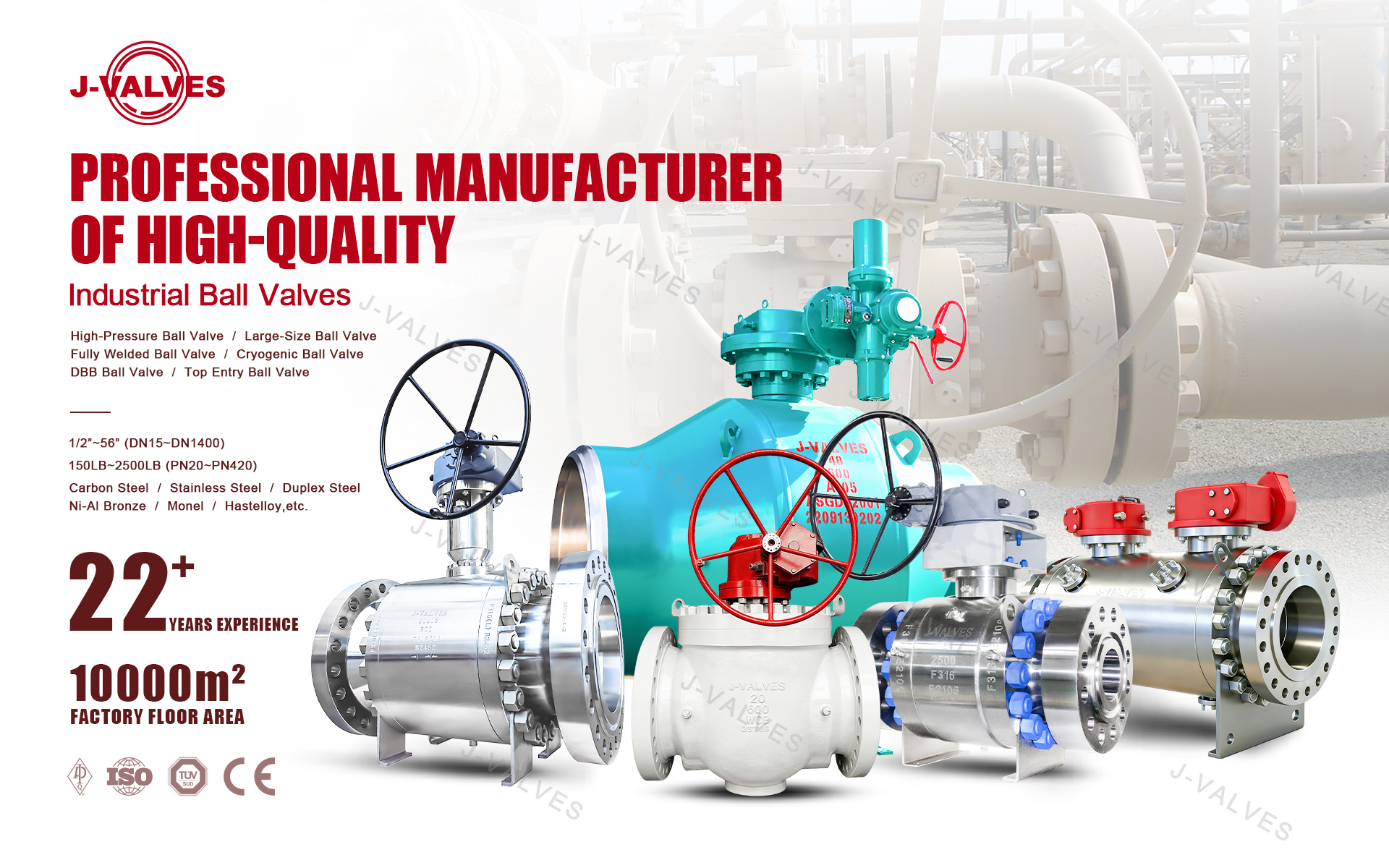
A 3 way ball valve is a quarter-turn valve whose ball carries an L-shaped or T-shaped port, so three connections can be switched, combined or split without a second valve. J-VALVES builds three way and four way versions from DN15 to DN200 in ASME Class 150 to 600, in WCB and CF8M, with PTFE, PEEK or metal seats.
Most 3 way ball valve enquiries arrive with a P&ID symbol, a line class and no more. What decides the valve is the port shape, the seat count and the number of positions, and those three are separate answers. This page takes them in that order and keeps the four way ball valve, the smaller family, in its own section.

Three Ports, Four Positions
All three ports sit in one plane at 90° spacing and the ball turns in 90° steps, so a full turn gives four index positions. Which of the four do useful work depends on the shape machined into the ball. Body, stem and actuator pad stay the same for both shapes, so a port form can change late in a project without redrawing the piping.
An L port has two bores meeting at the centre and opening 90° apart. Turning the ball connects one pair of adjacent ports, then the next pair, and the other two positions put a bore against a blank body wall so both lines are shut. Two flow paths and two dead positions in one turn: an L port is a selector, not a blender.
A T port has a straight bore plus a branch at 90°. At one position all three openings line up and the valve becomes a junction; at two others it connects a pair and blanks the third; at the fourth everything is shut. That through bore is what makes a 3 way ball valve useful for mixing and diverting, and it is also why its torque is less even.
Position count sets the actuator. A standard quarter-turn pneumatic head has two positions, 0° and 90°, and cannot reach the third and fourth. Three or four positions need an electric actuator with 90° stepping and feedback, a 180° or 270° rotary pneumatic, or a lever with a quadrant and lock. State the positions, not only the port shape.
L Port, T Port and What Each Can Do
Port form | Bore geometry | Flow combinations | Typical duty | Fits badly when |
|---|---|---|---|---|
L port | Two bores 90° apart | Two adjacent pairs, two all-closed | Source selection, pump changeover, tank selection | Two inlets must blend into one outlet |
T port | Straight bore plus 90° branch | All three joined, two of three, all closed | Mixing, diverting | All three lines must be positively isolated |
Straight port, two way | One bore | Open or shut on one line | Isolation, on/off control | The duty has to divert or combine |
X port, four way | Two crossing bores | 1-3 with 2-4, then 1-2 with 3-4 | Exchanger reversal, hot and cold changeover | Three-port duty; one port is wasted |
The table hides one detail that appears at commissioning: an L port has no position in which two inlets mix. Asked to blend hot and cold water, it can only alternate, and the outlet temperature swings between the two sources. A T port blends because all three ports open at once and the streams meet inside the ball. Buyers who order an L port for mixing find this out on the first test run.
Port area is not line area. The ball carries two intersecting bores, so the wall between them limits the bore: a DN50 three way valve has 38 to 42 mm ports against a 50 mm full bore. That is why the Cv figures later are half those of a two way valve, and why a 3 way ball valve is a poor like-for-like substitute in a gravity line.
Mixing or Diverting: The Same Valve, Two Duties
A 3 way ball valve with a T port does both jobs and the difference is flow direction. In mixing duty two lines enter and one leaves, and the sources meet inside the ball before the common port. In diverting duty one line enters and two leave, and the flow splits inside the ball. The valve is the same part number; the piping and the seat loading are not.
Mixing loads the ball unevenly. When the inlets sit at different pressures, the higher one pushes the ball towards the lower-pressure seat, so one seat carries the full differential and the other carries almost nothing. On a district heating substation with 6 to 10 bar between primary and secondary that is the normal condition, and the actuator breaks the ball away from a seat pressed by the whole differential. Diverting is closer to balanced.
Direction also decides which seat seals and which relieves. In mixing duty the common port is the outlet and the closed branch must hold the higher inlet pressure. In diverting duty the common port is the inlet and both branches must hold line pressure. Same casting, different seat arrangement, different test.
The enquiry therefore needs the one sentence most datasheets omit: does the valve mix or divert, and which port is common. Without it, seat orientation, relief direction and actuator sizing are guesses, and a valve built the wrong way round passes a bench test and leaks in the plant.
Two Seats or Four Seats
A two-seat 3 way ball valve has seat rings at two ports; the third opens straight into the body bore. A four-seat valve has a ring at every port, and the four way version at all four. The difference is what the valve isolates when closed, and how the cavity behaves.
Item | Two seats | Four seats |
|---|---|---|
Sealing direction | Only the two seated ports | Every port, both directions |
Idle port | Open to the cavity, cannot isolate that line | Bubble tight to ISO 5208 rate A |
Cavity | Follows the unseated line, cannot be trapped | Can be closed on all sides, needs relief |
Break torque | Reference | 30 to 50 percent higher |
Cost | Reference | 25 to 40 percent higher |
Fits | Changeover between lines at similar pressure | Sampling, tank selection, every four way valve |
The unseated port is the point buyers miss. In a two-seat valve that port is open to the cavity at all times, so the valve cannot isolate the line, only connect it. For changeover between two tanks at similar pressure that is acceptable and it is why the valve is cheaper. For a sample point that must be shut while the main line runs, it is not.
A four way ball valve has to be four seated. Each crossing bore opens on the ball surface and each opening needs a seat if the idle pair is to be isolated. Four seats also mean four pockets machined in one plane, four springs and a longer build, which is where the 25 to 40 percent price and 30 to 50 percent torque come from on a DN80 Class 300 valve.
Four Way Valves and Flow Reversal
A four way ball valve has four ports in one plane and two bores that cross at 90° without meeting, an X port. At one position it connects 1-3 and 2-4; at 90° it connects 1-2 and 3-4. Two lines swap over in a single quarter turn and both flows reverse together, which is what a heat exchanger changeover needs.
The classic duty is a shell and tube exchanger with cooling water on the tube side: reversal backwashes the tubes without stopping the process. On a chiller the same valve swaps condenser and evaporator circuits in a reversing machine. Other uses are hot and cold medium changeover on a test rig, regeneration of a softener, and reverse flushing of a transfer line. One valve instead of four cannot leave the plant in the wrong combination.
Rotation angle is the specification that gets argued about. Most four way valves index at 90°, but reversing machines ask for 180° so the actuator can be a plain double-acting cylinder with one solenoid. A 180° valve has a different ball and stop arrangement from a 90° valve and cannot be converted on site. State the angle and the fail position.
Leakage across the idle pair matters more here than in a three way. In the 1-3 / 2-4 position ports 2 and 4 are dead-ended, and seat leakage puts process fluid into the wrong circuit. Four seats and ISO 5208 rate A are normal for exchanger service; a two-seat four way valve is not worth specifying.
Torque and Port Imbalance
Torque in a 3 way ball valve is not one number. The ball area exposed to pressure changes with position, because the bores present different openings to the pressure on each side. At the all-open position of a T port the pressure acts on the largest remaining area and the seat contact is widest; at a two-port position part of that area vents through the open bore. On one valve, break torque varies by a factor of 1.6 to 2.2.
Position, DN50 Class 300 | Relative loaded area | Break torque, RPTFE, 20 bar | Comment |
|---|---|---|---|
L port, two ports connected | 1.0 | 70 Nm | One side loaded |
L port, dead position | 0.6 | 45 Nm | Bores face a blank wall |
T port, all three open | 1.9 | 130 Nm | Largest unbalanced area |
T port, two ports connected | 1.2 | 82 Nm | Branch vented, load falls away |
T port, all closed | 1.5 | 100 Nm | Cavity may be pressurised |
Those are clean, ambient, new-valve figures at 20 bar differential. Temperature moves the seat: PEEK at 200°C adds 25 to 35 percent over RPTFE at ambient, and metal more again. The fluid moves friction: dry gas and LPG raise break torque 15 to 25 percent against water. Time moves both: an elastomer seat closed for a year needs 20 to 40 percent more to break away.
Actuator sizing is a multiple, not a match: multiply the highest position torque by 1.5 for clean service and 2.0 for slurry, polymer or a valve that cycles less than monthly, then add the spring margin for a single-acting head. Use pressure at the cylinder, not at the filter regulator; undersized actuators stall at one end of the stroke only.

Cv, Pressure Drop and Sizing
A 3 way ball valve passes flow through two bores, so capacity is lower than a two way valve of the same nominal size. The table gives approximate Cv for water at 20°C with the flowing pair fully open, at the port diameters listed; the last column is a full bore two way ball valve for comparison.
Size | Port | Cv, L port | Cv, T branch | Cv, two way full bore |
|---|---|---|---|---|
DN15 (1/2") | 10 mm | 6.5 | 5.2 | 12 |
DN25 (1") | 17 mm | 24 | 19 | 45 |
DN40 (1-1/2") | 28 mm | 58 | 46 | 105 |
DN50 (2") | 38 mm | 110 | 88 | 215 |
DN65 (2-1/2") | 48 mm | 180 | 145 | 350 |
DN80 (3") | 60 mm | 260 | 205 | 480 |
DN100 (4") | 72 mm | 430 | 340 | 850 |
The T port figure is the branch path, where flow turns 90° inside the ball; the straight path through a T port is within about 5 percent of the L port figure. Where full line capacity is needed the size goes up a step rather than the bore: a DN80 three way L port matches roughly a DN65 two way valve.
Sizing uses Q = Cv × √(dP / G), with Q in US gpm, dP in psi and G the specific gravity; in metric units, Q = 0.865 × Cv × √(dP / G) with Q in m³/h and dP in bar. Take dP from the allowable drop, 0.1 to 0.3 bar for a selection valve and up to 0.5 bar for control duty, then pick a Cv at least 1.3 times the calculated figure. Above 100 cSt add a viscosity correction and usually one size; flashing duty does not belong in a straight-bore valve.
Cavity Relief and Thermal Blockage
A 3 way ball valve body holds less volume than a two way body of the same size, which sounds like good news for trapped liquid. It is not. In the all-closed position of a T port, or a dead position of an L port, a segment of bore is sealed between two seats and a short body passage, holding roughly 30 to 120 ml. Fill it with water, warm it 25 K, and it tries to expand by about 1 percent inside a rigid container.
Liquid is close to incompressible, so pressure climbs until something yields: 20 to 40 bar for that 25 K rise, above the rating of a Class 150 body at 60°C. The seat usually lifts first, which is why cavity relief works quietly on most soft-seated valves and why nobody notices until a seat is scored or a bonnet gasket weeps.
Three methods are used. A 1.0 to 1.5 mm hole drilled through the upstream side of the ball vents the pocket to the high-pressure line; it is cheapest and directional, so the ball is marked. A self-relieving seat with a lip that lifts at 3 to 5 bar above line pressure works both ways and is usual on a four way valve. A plugged cavity connection is used where the medium must not reach the bore.
Water and aqueous solutions, ammonia, LPG, refrigerated liquids, heat transfer oils and anything traced or jacketed need a relief path. Dry gas does not, because a gas pocket compresses and equalises past the seat. The rule at order entry: if the line can be isolated full of liquid and then warmed, specify the relief and say which side.
Where Three and Four Way Valves Are Used
Duty | Typical size | Class | Port | Note |
|---|---|---|---|---|
Heat exchanger changeover | DN50 to DN300 | 150 to 300 | Four way X | Four seats, 90° index, fail-hold actuator |
Sample point with bypass | DN15 to DN25 | 300 to 600 | T port | Dead volume under 10 ml, relief hole on liquid |
Tank selection, tanker unloading | DN80 to DN200 | 150 | L port | Two seats acceptable at equal tank pressure |
Hot and cold medium changeover | DN50 to DN250 | PN16 | T port | Mixing duty, check the inlet differential |
Softener service and backwash | DN50 to DN150 | PN10 | T port | Low torque, EPDM seat, frequent cycling |
Marine ballast and bilge transfer | DN80 to DN300 | 150 | L or T | CF8M or CuNi body, class survey |
The exchanger case sets the pattern: the valve is chosen for a combination, not a size, and the combination is written on the P&ID as two states. An enquiry that lists only a size, a class and the words "three way" comes back with questions.
Sizes stay modest. Above DN200 the ball is large, four-seat torque needs a gear or an actuator, and a machined three way body costs more than two two way valves plus a tee. That crossover is the honest limit of the product: a 3 way ball valve earns its place where space, leak points or interlock logic matter more than price.

What to Send with an Enquiry
Ten items decide the price and the drawing, and eight are usually missing from the first email. The list works as a request for quotation, and it is the same list used to build the test programme.
Line size, ASME class or PN, and end standard: B16.5, B16.47 or B16.25 weld ends.
Port shape: L, T, or X for the four way.
The flow combination at each position, written as port pairs.
Which port is common, and whether the valve mixes or diverts.
Seat count, two or four, or the isolation requirement that decides it.
Body and trim material, seat material, design and operating temperature.
Medium, specific gravity, and differential pressure across the valve.
Actuation: manual, pneumatic or electric, positions, rotation angle, fail position.
Cavity relief: drilled hole, self-relieving seat or vent, and which side.
Standard and test: API 6D or API 608, API 598, API 607, NACE MR0175, certificates.
With those, a quotation and a general arrangement drawing come back within a few days, and the drawing shows the ports as machined rather than symbolised. Delivery is 4 to 8 weeks; any non-standard face-to-face or stem length is drawn and approved before machining. Test records and an EN 10204 3.1 certificate travel with the valve.
3 Way Ball Valve FAQ
How do I choose between an L port and a T port three way valve?
Decide from the flow combinations, not the size. If the valve only changes a line from one source to another and never joins two inlets, an L port does the job with lower torque and lower cost. If it must blend two streams into one outlet, or split one stream into two, it has to be a T port, because only the T port has a position with all three ports open.
Can a three way ball valve be used as a two way shutoff valve?
It can, by blanking one port, but it is a compromise. A two-seat valve leaves the blanked port open to the body cavity, so isolation depends on which port was blanked. Capacity drops because the bore is reduced, torque is higher than a two way valve of the same size, and a dead cavity appears. For pure isolation a two way valve costs less and seals better.
What is the difference between a three way and a four way ball valve?
A three way valve has three ports and one L or T port ball, and it switches, mixes or diverts a single stream. A four way ball valve has four ports and two crossing bores, so two separate lines swap over together, which is used for exchanger reversal. The four way always needs four seats and is normally smaller, up to about DN100.
Why does a three way ball valve need more torque than a two way valve?
Two or four seats press on the ball instead of two, and pressure acts on a larger unbalanced area when the bores face each other at an angle. On the same DN50 Class 300 size, a T port at the all-open position needs about 130 Nm against roughly 70 Nm for an L port in a two-port position. Actuators are sized on the highest position, not the easiest.
Can a three way ball valve be supplied with a steam jacket?
Yes. A full or partial jacket can be cast or welded onto the body from DN15 to DN150, rated 6 to 10 bar, with the jacket ports on the branch side. It adds 30 to 50 mm to the face-to-face dimension and the drawing is approved before casting. It is used for sulphur, pitch, resins, chocolate and other media that set when cold.
What is the largest three way ball valve you make?
DN200, which is 8 inch, in ASME Class 150 to 300, and DN100 in Class 600. Above DN200 a machined three way body becomes heavier and dearer than two two way valves with a tee, and four-seat torque needs a gear or an actuator. Larger sizes are quoted as a fabrication or a manifold arrangement, case by case, not as a standard casting.
Hot Products


News
Ball Valve Condition Monitoring: Which Signals Actually Predict A Failure
Torque signatures, acoustic emission, differential pressure and digital twin residuals: which measurements find a failing ball valve early.
Read More
Ball Valves in SWRO Desalination: The High Pressure Section Where Ordinary Seawater Valves Fail
Why SWRO high pressure valves fail early: recovery arithmetic, crevice temperature, ERD ripple, scale, letdown cavitation and surge.
Read More
Air Test And Water Test For Ball Valves: What Each Medium Can Prove
A ball valve can pass a hydrostatic seat test and still leak gas. Why air and water prove different things, and how to read a bubble, decay or helium test.
Read More
Ball Valve Flange Bolting: Preload, Relaxation And The Fasteners That Decide Leakage
A weeping flange is rarely the gasket. Preload, torque scatter, hardness limits and thermal relaxation decide whether the joint holds at 100 bar and 400 C.
Read More