


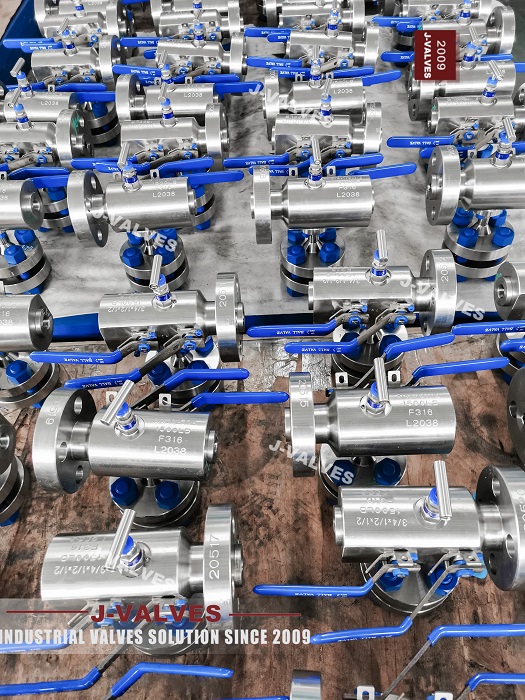
In oil transportation systems, a valve is not just a component for opening and closing flow. It is a critical part that directly affects safety, reliability, and maintenance efficiency across the entire pipeline. As project requirements for safety, automation, and maintenance convenience continue to rise, more and more oil transportation projects are adopting J-VALVES double block and bleed ball valves.
Why is this type of valve becoming so popular? The answer is simple: higher safety, compact design, easier maintenance, and better suitability for demanding service conditions. In oil transportation applications, where sealing and isolation are extremely important, this valve design is gaining wider recognition.
I. What Is a Double Block and Bleed Ball Valve?
In simple terms, a double block and bleed ball valve is designed to isolate pressure from both the upstream and downstream sides while allowing the cavity between the seals to be vented or drained. Its main functions are:
Isolate both sides of the pipeline
Release pressure from the valve cavity
Support safe maintenance procedures
Reduce leakage and operational risk
This design is especially suitable for oil, gas, and chemical pipeline systems that require high reliability.
II. Why Are More Oil Transportation Projects Choosing It?
1. Higher Safety
Safety is always the top concern in oil transportation. Leakage and live-line maintenance risks can cause serious problems. A DBB ball valve allows operators to isolate both ends first and then bleed the cavity pressure, making it easier to confirm a safe working condition.
This means:
Safer maintenance
Lower shutdown risk
More reliable pipeline switching
2. Fewer Components, Less Space
Traditional solutions often need multiple valves to achieve isolation, bleeding, and inspection functions. A double block and bleed ball valve integrates these functions into one unit, which helps reduce piping complexity and installation space.
This is especially valuable in projects with limited space, such as pipeline corridors and industrial platforms.
3. Easier Maintenance
Shutdown and maintenance in oil transportation systems are expensive. A DBB valve helps maintenance teams verify valve conditions faster and shorten service time, reducing unnecessary disassembly and downtime.
This improves maintenance efficiency and helps lower the total lifecycle cost.
4. More Stable Sealing Performance
Oil transportation often involves pressure changes, temperature variation, and corrosive media. J-VALVES double block and bleed ball valves are designed for industrial service conditions, helping improve long-term sealing stability and reduce internal and external leakage.
5. Better Fit for Modern Pipeline Management
More oil projects now focus on automation, monitoring, and standardized management. DBB valves are easier to integrate with instrumentation, bleed systems, and maintenance procedures, making them a strong fit for modern pipeline management.
III. Comparison with Traditional Solutions
Item | Traditional Valve Solution | J-VALVES DBB Ball Valve |
Isolation performance | Requires multiple valves | Integrates dual isolation in one valve |
Bleed function | Usually needs extra equipment | Built-in cavity bleed design |
Safety | More complicated procedures | More direct and safer operation |
Space usage | Larger footprint | More compact |
Maintenance efficiency | More steps required | Easier condition check and service |
System cost | Higher installation complexity | Better overall cost efficiency |
As the table shows, the advantage of a DBB ball valve is not just one strong point. It performs better across safety, efficiency, space saving, and maintenance convenience.
IV. Which Projects Are Best Suited?
J-VALVES double block and bleed ball valves are especially suitable for:
Crude oil transmission pipelines
Refined product pipeline systems
Storage and transfer stations
Pipeline corridor distribution systems
Projects requiring frequent maintenance
Industrial pipelines with strict leakage control requirements
If a project values safe isolation, maintenance efficiency, and clean system layout, this type of valve is often a preferred choice.
V. What Should Be Considered During Selection?
When selecting the valve, it is important to consider more than just the DBB function itself. The following factors should be reviewed:
Size and pressure class
Media type and corrosion level
Operating temperature range
Sealing material
End connection type
Manual, pneumatic, or electric actuation
Compliance with project standards and acceptance requirements
A proper selection ensures the valve can deliver real performance benefits in the field.
VI. Why J-VALVES?
The value of J-VALVES double block and bleed ball valves lies in the fact that they are designed around real oil transportation needs rather than simply adding functions. They help users achieve a better balance among safety, efficiency, and maintenance convenience.
For projects that want higher pipeline reliability, lower maintenance risk, and a more optimized layout, this type of product is becoming increasingly attractiv.
Conclusion
As oil transportation projects place more emphasis on safety management, maintenance efficiency, and space utilization, the demand for double block and bleed ball valves will continue to grow. With stronger isolation capability, safer operation, and easier maintenance, J-VALVES double block and bleed ball valves are becoming a preferred solution for many projects.
If your project is looking for a more stable and reliable pipeline valve solution, J-VALVES is worth close attention.


