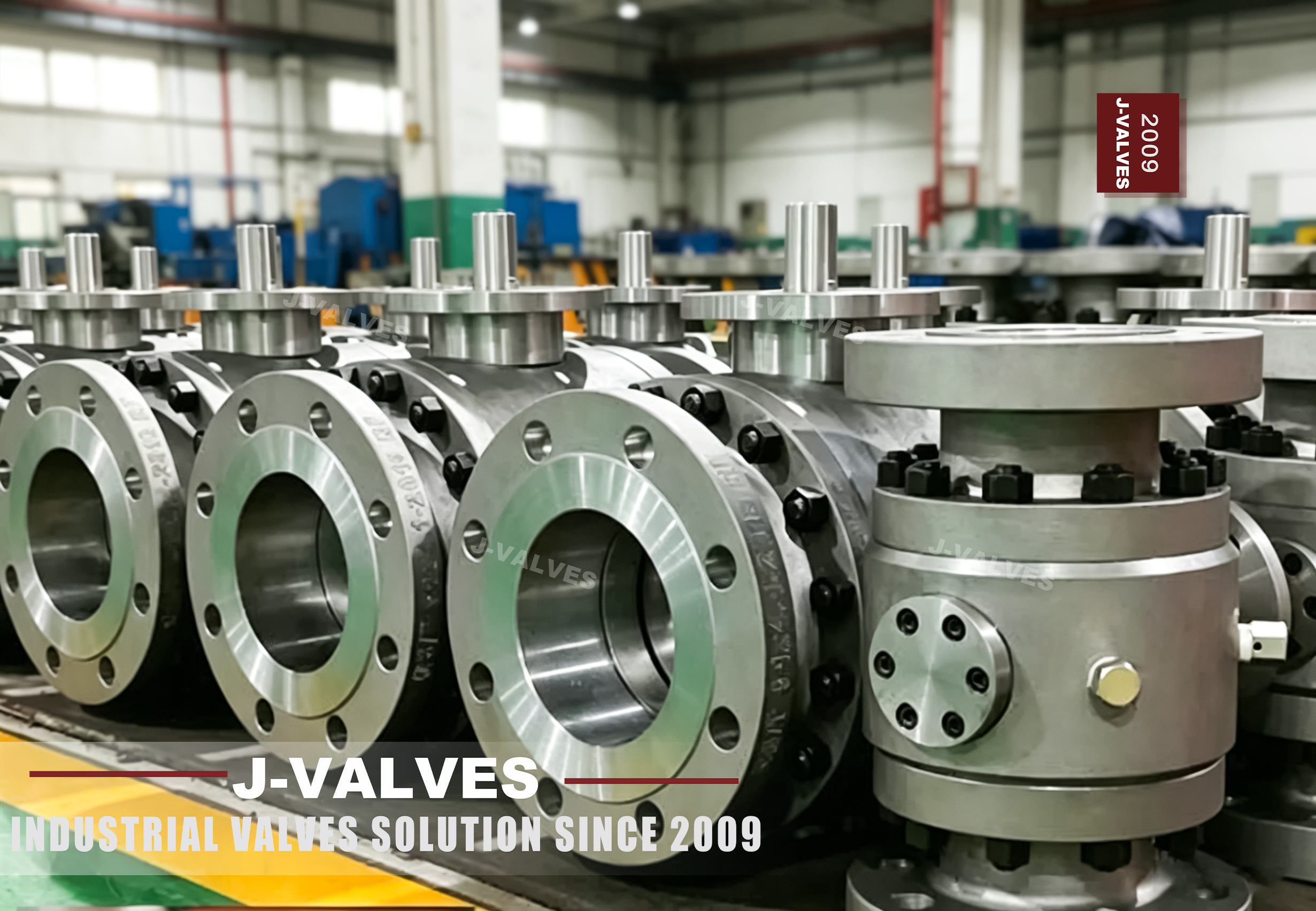
In the complex pipeline systems of modern industry, valves, as crucial control components, directly affect the safety and efficiency of the systems. The J-VALVES trunnion mounted ball valve stands out among numerous valve products with a series of outstanding features and has become an ideal choice in the industrial field.
I. Main Features of the J-VALVES trunnion mounted ball valve
(I) High Reliability: Dual Guarantees of Sealing and Materials
The J-VALVES trunnion mounted ball valve adopts advanced sealing technology to ensure zero leakage under various harsh working conditions. Its sealing system has undergone strict testing and can maintain stable operation for a long time in high-pressure, high-temperature, and highly corrosive environments. This sealing technology not only employs a multi-layer sealing structure but also combines new sealing materials, making the sealing performance more reliable. Moreover, the main materials of the ball valve have undergone special treatment, possessing excellent corrosion resistance and wear resistance, which significantly extends its service life. This material treatment process is unique to J-VALVES. It enhances the valve's adaptability in extreme environments through a special surface coating technology.
(II) High-Precision Control: The Key to Precise Adjustment
The J-VALVES trunnion mounted ball valve is equipped with high-precision actuators that can achieve accurate flow control. Its actuators utilize advanced sensor technology to provide real-time feedback on the opening and closing status of the valves, ensuring that the control precision reaches the industry-leading level. This high-precision control not only improves the operating efficiency of the system but also reduces potential risks caused by flow fluctuations. Whether it is manual operation or automated control, precise adjustment can be easily achieved. This design gives the J-VALVES trunnion mounted ball valve an incomparable advantage in industrial scenarios that require precise control, such as chemical reaction processes and fine chemical production.
(III) Low Torque Design: Dual Optimization of Operation and Maintenance
The J-VALVES trunnion mounted ball valve features a unique low-torque design, making the operation of the valve easier and more convenient. The friction coefficient between the ball and the seat is extremely low, enabling easy opening and closing even under high pressure. This design not only reduces the operation difficulty but also minimizes wear caused by frequent operations, further enhancing the valve's reliability. The core of the low-torque design lies in its unique mechanical structure and material selection. By optimizing the contact area and shape of the ball and the seat, the required operating torque is reduced. This design not only improves the user experience but also cuts down the maintenance costs during long-term operation.
(IV) Multiple Connection Methods: Flexible Adaptation to Different Needs
The J-VALVES trunnion mounted ball valve offers multiple connection methods, including flange connection, threaded connection, and welded connection, etc., to meet the diverse needs of users. Whether in new projects or the renovation of existing pipeline systems, it can be easily installed and used. In addition, the design of the connection methods also takes full account of sealing and safety to ensure reliable connections under various working conditions. This diverse range of connection methods enables the J-VALVES trunnion mounted ball valve to find suitable application scenarios in industrial projects of different scales and types, from large oil and gas pipelines to small chemical equipment, fitting perfectly.
(V) Environmental Protection and Energy Saving: The Embodiment of Sustainable Development
The J-VALVES trunnion mounted ball valve fully considers the requirements of environmental protection and energy saving during the design process. Its sealing system can effectively prevent medium leakage, reducing resource waste and environmental pollution. Meanwhile, the low-torque design reduces operating energy consumption and further improves energy utilization efficiency, conforming to the sustainable development concept of modern industry. This environmentally friendly and energy-saving design not only helps enterprises reduce operating costs but also complies with the global environmental protection trend, enhancing the enterprises' sense of social responsibility.
II. Comparison between the J-VALVES trunnion mounted ball valve and Other Types of Valves
The following table shows the comparison between the J-VALVES TRUNNION MOUNTED BALL VALVE and other common valve types:
Characteristics / Valve Types | J-VALVES trunnion mounted ball valve | Traditional Ball Valve | Gate Valve |
Operating Torque | Low | Medium | High |
Sealing Performance | Bidirectional sealing, high reliability | Unidirectional sealing, lower reliability | Unidirectional sealing, lower reliability |
Durability | High | Medium | Low |
Fire Safety | Complies with API607 standard | Not necessarily compliant | Not necessarily compliant |
Antistatic | Yes | No | No |
Operation Modes | Manual, worm gear, pneumatic, electric | Manual, electric | Manual, electric |
Applicable Media | Water, natural gas, petroleum, corrosive liquids | Water, natural gas, petroleum | Water, natural gas, petroleum |
Working Temperature Range | -196℃ ~ 600℃ | -20℃ ~ 200℃ | -20℃ ~ 200℃ |
Applicable Pressure Range | 150LB ~ 2500LB | 150LB ~ 2500LB | 150LB ~ 2500LB |
From the above comparison, it can be seen that the J-VALVES trunnion mounted ball valve has significant advantages in terms of operating torque, sealing performance, durability, fire safety, and antistatic properties, making it an ideal choice for industrial pipeline systems.
III. Application Scenarios: An All-round Player Applicable in Multiple Industries
The J-VALVES trunnion mounted ball valve is widely used in industries such as petroleum, natural gas, chemical, and power. Whether under extreme conditions like high pressure, high temperature, and corrosiveness or in situations requiring frequent operations, it can maintain stable performance to ensure the safe and efficient operation of the systems. For example, in oil and gas pipelines, it can effectively control the flow of media, prevent leakage, and ensure the stable transmission of energy. In the chemical industry, its excellent corrosion resistance enables it to handle various chemical media and ensure the safety and stability of the production process. Moreover, the J-VALVES trunnion mounted ball valve is also widely used in water treatment, food processing, and pharmaceutical industries. Its high-precision control and environmental protection and energy-saving characteristics make it the preferred valve in these industries.
IV. Conclusion: The Perfect Combination of Outstanding Performance and Reliable Guarantee
The J-VALVES trunnion mounted ball valve stands out among numerous ball valve brands with its advantages such as high reliability, high-precision control, low-torque design, multiple connection methods, and environmental protection and energy saving. Whether in the chemical, petroleum, natural gas, or water treatment industries, the J-VALVES trunnion mounted ball valve can provide outstanding performance and reliable guarantees. Choosing the J-VALVES trunnion mounted ball valve means choosing an efficient, energy-saving, and environmentally friendly industrial solution, and it also means choosing a reliable partner that can operate stably in complex industrial environments.