

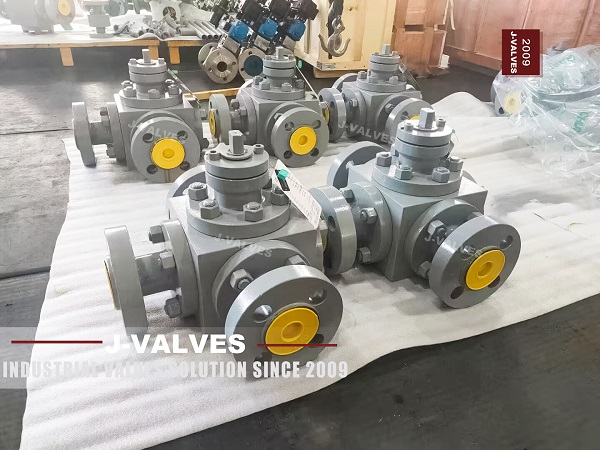
Three-way ball valves are essential components in fluid control systems, providing flexibility in diverting, mixing, and isolating flows. Among these, L-port and T-port configurations are the most commonly used, each offering distinct advantages depending on the application. Understanding their flow characteristics is critical for system efficiency, reliability, and safety.
1. Overview of Three-Way Ball Valves
A three-way ball valve features a ball with a hole through its center, allowing fluid to flow through multiple ports. Unlike two-way valves, which simply open or close a single flow path, three-way valves can:
Divert flow from one inlet to multiple outlets.
Mix flows from two inlets into a single outlet.
Change flow direction without requiring multiple valves.
The port configuration—L or T—determines the valve's functionality and suitability for a given system.
2. L-Port Ball Valves: Flow Diversion Made Simple
Design and Operation
The L-shaped port allows the valve to connect two of the three ports at a time.
By rotating the valve 90 degrees, the flow can switch between the connected paths.
Commonly used for diverting flow from a single inlet to one of two outlets.
Advantages
Simple flow control: Easy to divert fluids between pipelines.
Lower leakage risk: Fewer flow intersections reduce potential leak paths.
Compact and cost-effective: Suitable for systems where only one flow path is required at a time.
Typical Applications
Diverting process fluids in chemical plants.
Switching cooling water between heat exchangers.
Agricultural irrigation systems requiring sequential flow.
3. T-Port Ball Valves: Flexible Mixing and Flow Management
Design and Operation
The T-shaped port can connect all three ports simultaneously or connect any two ports at a time.
Provides more flexibility for mixing or splitting flow without additional valves.
Advantages
Mixing capability: Allows two streams to combine into one output line.
Flow splitting: Can simultaneously feed two downstream systems from a single source.
Versatile flow paths: Ideal for complex process systems requiring frequent flow redirection.
Typical Applications
Blending chemicals in a single output stream.
Multi-channel cooling or heating systems.
Pharmaceutical or food processing where precise mixing is required.
4. Flow Direction Comparison
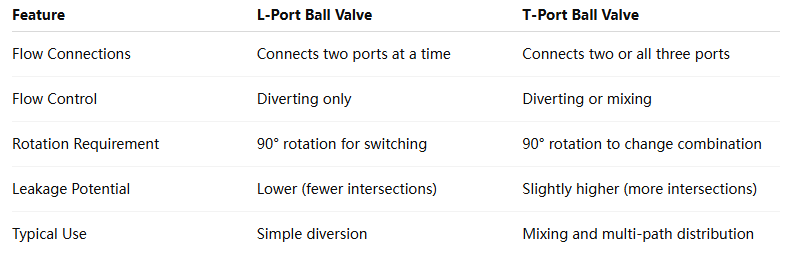
The choice between L-port and T-port valves is primarily determined by system complexity, flow requirements, and control strategy.
5. Material and Construction Considerations
For both L-port and T-port ball valves, material selection is critical for durability and corrosion resistance:
Stainless steel (304/316): Ideal for chemical and high-pressure applications.
Carbon steel: Suitable for industrial water or steam systems.
PTFE or PEEK seats: Ensure tight sealing and chemical compatibility.
6. Installation and Maintenance Tips
Ensure proper orientation during installation to achieve intended flow paths.
Periodically inspect seals and seats to prevent leaks.
Avoid over-torquing actuators or manual handles to prolong valve life.
For T-port valves, ensure flow patterns are compatible with mixing requirements to prevent turbulence or backflow.
7. Conclusion
Selecting between L-port and T-port three-way ball valves requires careful consideration of flow direction, application type, and system complexity. While L-port valves excel in simple diversion scenarios, T-port valves offer superior flexibility for mixing and multi-path distribution. Proper valve selection ensures efficient fluid control, reduces system downtime, and optimizes operational costs.