



Floating ball valves are widely used in oil and gas, petrochemical, water treatment, LNG, and industrial pipeline systems due to their reliable sealing performance and compact design. One of the most important design considerations in floating ball valve manufacturing is the valve body structure, particularly whether the body is cast or forged.
Both cast and forged floating ball valve bodies offer unique advantages depending on operating pressure, temperature, corrosion conditions, and project requirements. Understanding their structural differences helps engineers select the most suitable valve type for industrial applications.
What Is a Cast Floating Ball Valve Body?
A cast valve body is produced by pouring molten metal into a mold cavity and allowing it to solidify into the desired shape.
Common casting materials include:
1.WCB carbon steel
2.Stainless steel
3.Duplex stainless steel
4.Bronze alloys
Cast floating ball valves are widely used because they allow complex body designs and cost-effective mass production.
What Is a Forged Floating Ball Valve Body?
A forged valve body is manufactured by applying high pressure to heated metal billets, shaping the material through mechanical deformation.
Common forging materials include:
1.A105 forged steel
2.F316 stainless steel
3.F51 duplex stainless steel
Forged floating ball valves are known for their high mechanical strength and structural integrity.
Key Structural Differences
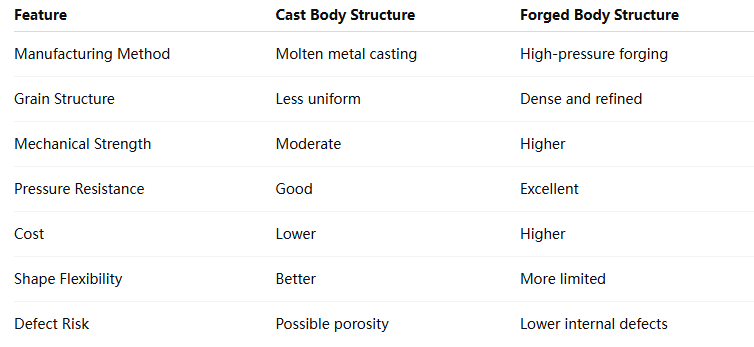
Mechanical Strength Comparison
Forged Valve Bodies
Forged floating ball valves have tighter grain structures and fewer internal voids, improving:
1.Tensile strength
2.Impact resistance
3.Fatigue resistance
4.High-pressure performance
This makes forged valves ideal for critical industrial services.
Cast Valve Bodies
Modern casting technology provides excellent structural quality for most standard industrial applications. Cast valves offer sufficient strength for medium-pressure systems while reducing manufacturing costs.
Pressure and Temperature Performance
Forged floating ball valves generally perform better under:
1.High pressure
2.High temperature
3.Thermal cycling conditions
Cast floating ball valves are commonly used in:
1.Utility pipelines
2.Water treatment systems
3.General industrial processes
where operating conditions are less extreme.
Corrosion Resistance
Corrosion resistance mainly depends on material grade rather than manufacturing process. Both cast and forged valve bodies can use:
1.Stainless steel
2.Duplex stainless steel
3.Alloy steel
4.Nickel aluminum bronze
However, forged structures may provide slightly better resistance to stress-related cracking due to improved material density.
Manufacturing Flexibility
Advantages of Cast Structures
Casting allows manufacturers to produce:
1.Complex body geometries
2.Large valve sizes
3.Customized flow passages
This makes casting highly suitable for large-diameter floating ball valves.
Advantages of Forged Structures
Forging produces more uniform internal structures and higher dimensional stability, especially for compact high-pressure valves.
Common Industrial Applications
Cast Floating Ball Valves
Widely used in:
1.Water systems
2.Chemical processing
3.HVAC systems
4.General industrial pipelines
Forged Floating Ball Valves
Commonly selected for:
1.Oil and gas production
2.High-pressure pipelines
3.LNG systems
4.Offshore platforms
5.Refinery operations
Cost Comparison
Cast floating ball valves are generally more economical due to simpler manufacturing and reduced material waste.
Forged valves require more machining and processing, resulting in higher production costs but improved long-term reliability in severe service conditions.
Which Valve Body Structure Is Better?
The best option depends on operating requirements.
Choose Cast Floating Ball Valves When:
1.Cost efficiency is important
2.Pressure conditions are moderate
3.Large valve sizes are required
4.Complex body shapes are needed
Choose Forged Floating Ball Valves When:
1.High pressure is involved
2.Maximum structural integrity is required
3.Severe operating conditions exist
4.Long-term reliability is critical
Conclusion
Cast and forged floating ball valve body structures each provide valuable advantages for industrial applications. Cast valves offer flexibility, cost efficiency, and suitability for standard industrial systems, while forged valves deliver superior strength, pressure resistance, and structural reliability for demanding operating environments.
Selecting the correct valve body structure requires careful evaluation of pressure ratings, operating conditions, corrosion exposure, and project budgets to ensure long-term system performance and operational safety.


