


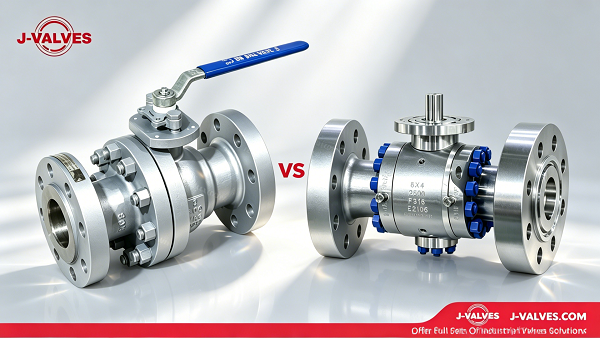
Ball valves are widely used in industrial pipelines for on/off flow control, providing reliable sealing and low-pressure drop. Among ball valves, the two main structural types are floating ball valves and trunnion-mounted ball valves. While both serve the same function of fluid isolation, their pressure and temperature ratings differ significantly due to their design principles, making it essential for engineers to understand these differences when selecting valves for critical systems.
1. Structural Differences Affecting Ratings
1.1 Floating Ball Valves
Design: The ball is suspended between two elastomeric seats and allowed to move slightly along the flow axis.
Sealing Mechanism: Relies on line pressure to push the ball against the downstream seat for tight sealing.
Stem Loading: The stem transmits torque but is not mechanically supported by trunnions.
Implications for Ratings:
Pressure Limitations: Floating valves are typically suitable for small to medium pipeline diameters (up to 12 inches) and moderate pressures (generally up to 1000 psi).
Temperature Limitations: Seal material limits the temperature range; elastomeric seals may soften at high temperatures, reducing reliability.
1.2 Trunnion-Mounted Ball Valves
Design: The ball is fixed at the top and bottom by trunnions, absorbing axial forces and preventing displacement.
Sealing Mechanism: Seat-to-ball contact is partially mechanically assisted by springs or hydraulic pressure, reducing reliance on line pressure.
Stem Loading: Stem torque is significantly reduced due to trunnion support.
Implications for Ratings:
Pressure Capability: Can handle very high pressures (up to 5000 psi or more), even in large-diameter pipelines.
Temperature Range: Can operate at higher temperatures, as mechanical sealing reduces dependence on elastomeric compression alone.
2. Comparison of Pressure Ratings
| Valve Type | Typical Max Pressure | Diameter Suitability | Torque Requirement |
Floating Ball Valve | ~1000 psi | Small to medium (≤12 inches) | Higher in large diameters due to line pressure |
Trunnion-Mounted Ball Valve | 3000–5000+ psi | Medium to very large | Low due to trunnion support |
Analysis:
Floating valves rely on line pressure to enhance sealing, which increases torque and limits the maximum allowable pressure in large sizes. Trunnion-mounted designs mechanically stabilize the ball, allowing operation at higher pressures with manageable torque.
3. Comparison of Temperature Ratings
| Valve Type | Typical Temperature Range | Limiting Factors |
Floating Ball Valve | -29°C to 200°C (depends on seal material) | Elastomeric seal degradation at high temperature |
Trunnion-Mounted Ball Valve | -46°C to 260°C (depends on seat and body materials) | Mechanical seat design reduces seal stress |
Analysis:
Trunnion-mounted valves are more suitable for high-temperature applications, as the mechanical support prevents seat extrusion and reduces thermal stress on seals.
4. Operational Implications
Best for low to medium-pressure pipelines where compact size and cost-effectiveness are priorities.
Increased torque in large diameters can impact automation and actuation requirements.
Less suitable for high-pressure or high-temperature pipelines.
Ideal for high-pressure, high-temperature, and large-diameter pipelines.
Reduced operating torque allows easier manual operation and automated actuation.
Suitable for oil & gas, chemical, and power generation applications where reliability under extreme conditions is critical.
5. Conclusion
The pressure and temperature ratings of floating and trunnion-mounted ball valves are fundamentally determined by their structural design:
Floating ball valves rely on line pressure for sealing, limiting their pressure and temperature capability in large systems.
Trunnion-mounted valves mechanically support the ball, allowing higher pressures, larger diameters, and extended temperature ranges.
Choosing the right valve type ensures system safety, operational efficiency, and long-term reliability, particularly in demanding industrial environments.


